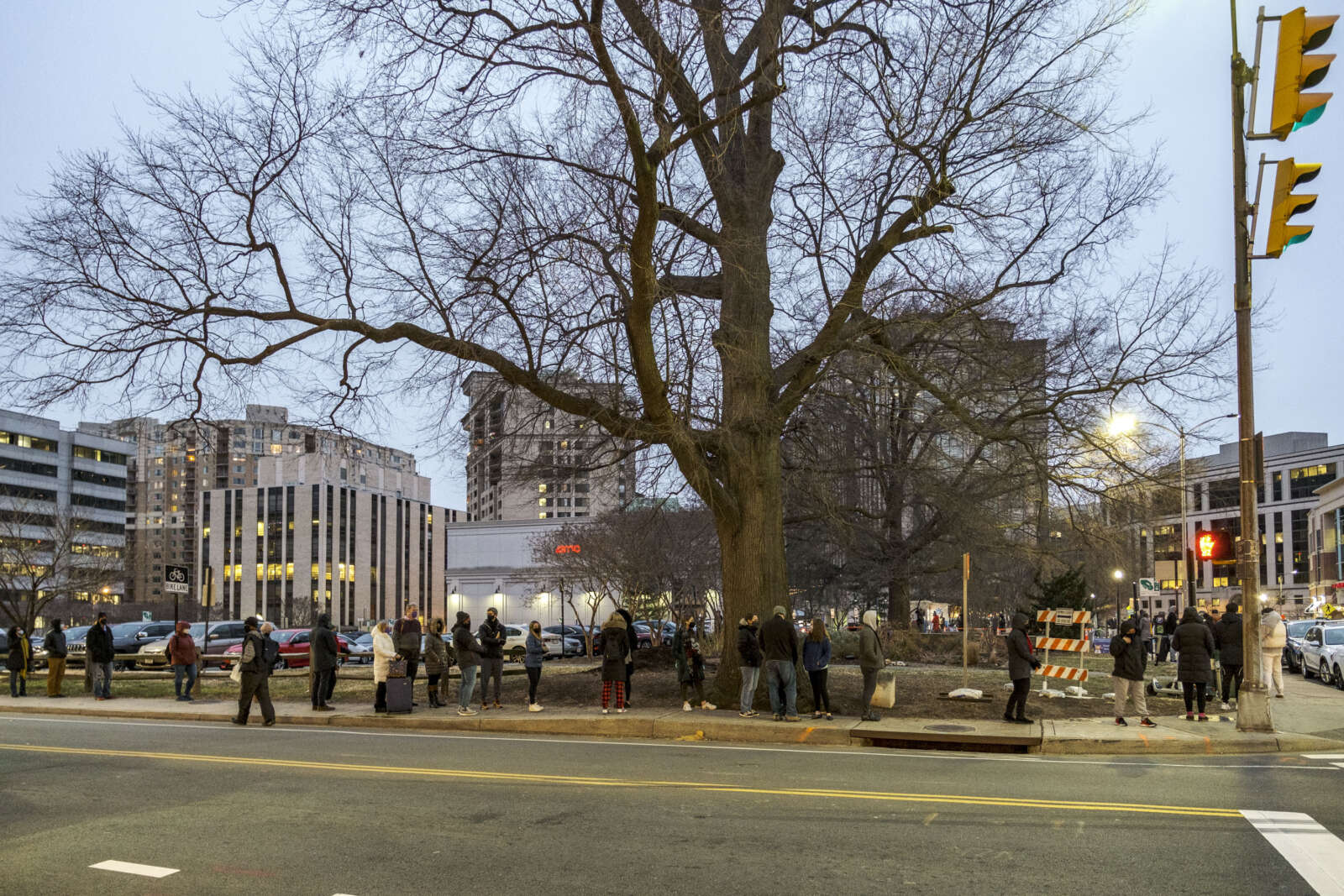
People in line for Covid testing in Courthouse, where the line wrapped around the block (staff photo by Jay Westcott)

On Tuesday Arlington’s seven-day moving average of Covid cases set another record.

Just shy of 200 people are testing positive for the virus in Arlington each day, on average, according to Virginia Dept. of Health data. Lines for local Covid testing sites stretch around multiple blocks. And yet, people are (mostly) still traveling for the holidays, dining at restaurants and generally living their lives.

Also, while local cases are skyrocketing — amid the Omicron variant wave that’s sweeping across the country — Covid-related hospitalizations remain at modest levels: just over one per day, on average, in Arlington. Hospitalizations are a lagging indicator, but the lack of a big spike is an encouraging sign that the vaccines are working and, perhaps, Omicron is not as deadly as past variants.

Meanwhile, there’s another worry on the minds of people this holiday season: inflation. Rising prices in the grocery store, at the gas pump and even the pizzeria elsewhere have put a squeeze on many people’s finances.

“U.S. inflation is at its highest rate in nearly four decades this fall, reaching 6.8% in November from a year ago,” the Wall Street Journal recently reported. “Consumers are seeing prices rise sharply for a variety of goods and services because of persistent supply and labor shortages and strong demand.”

Some of the price increases are being partially offset by rising wages, but there are still worries that inflation could continue and, together with rising real estate prices, make it tough for some households to make ends meet.

Given all of that, we’re wondering this morning — while acknowledging the incredible human toll of the pandemic overall — whether Arlington residents are currently more worried about the rises in Covid or inflation.


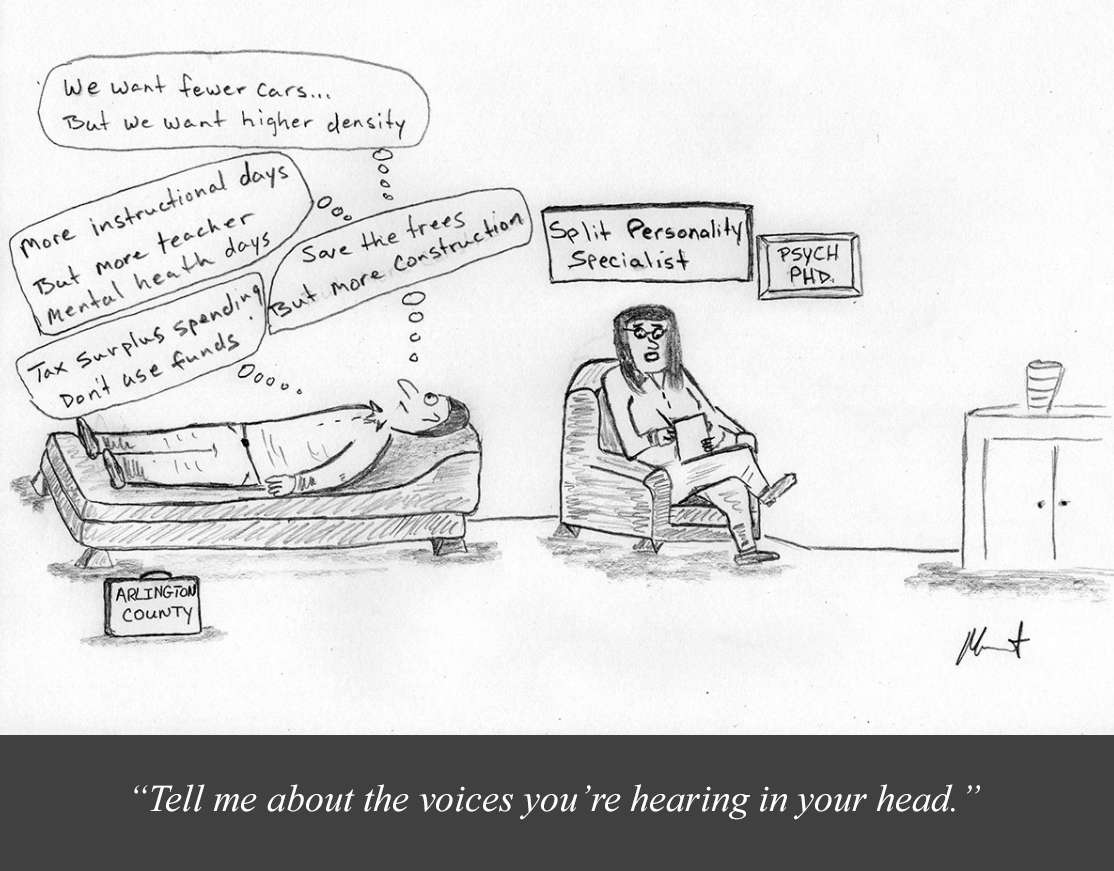
Cartoon by Mike Mount

Arlington is, in some ways at least, a place of contradictions. That’s the subject of this month’s local editorial cartoon.

Want to see all of Mike Mount’s weekly cartoons? Join the ARLnow Press Club.

Note that the cartoons will be taking a brief hiatus over the holidays. As with all opinion content published on ARLnow, the views expressed are are solely the author’s.


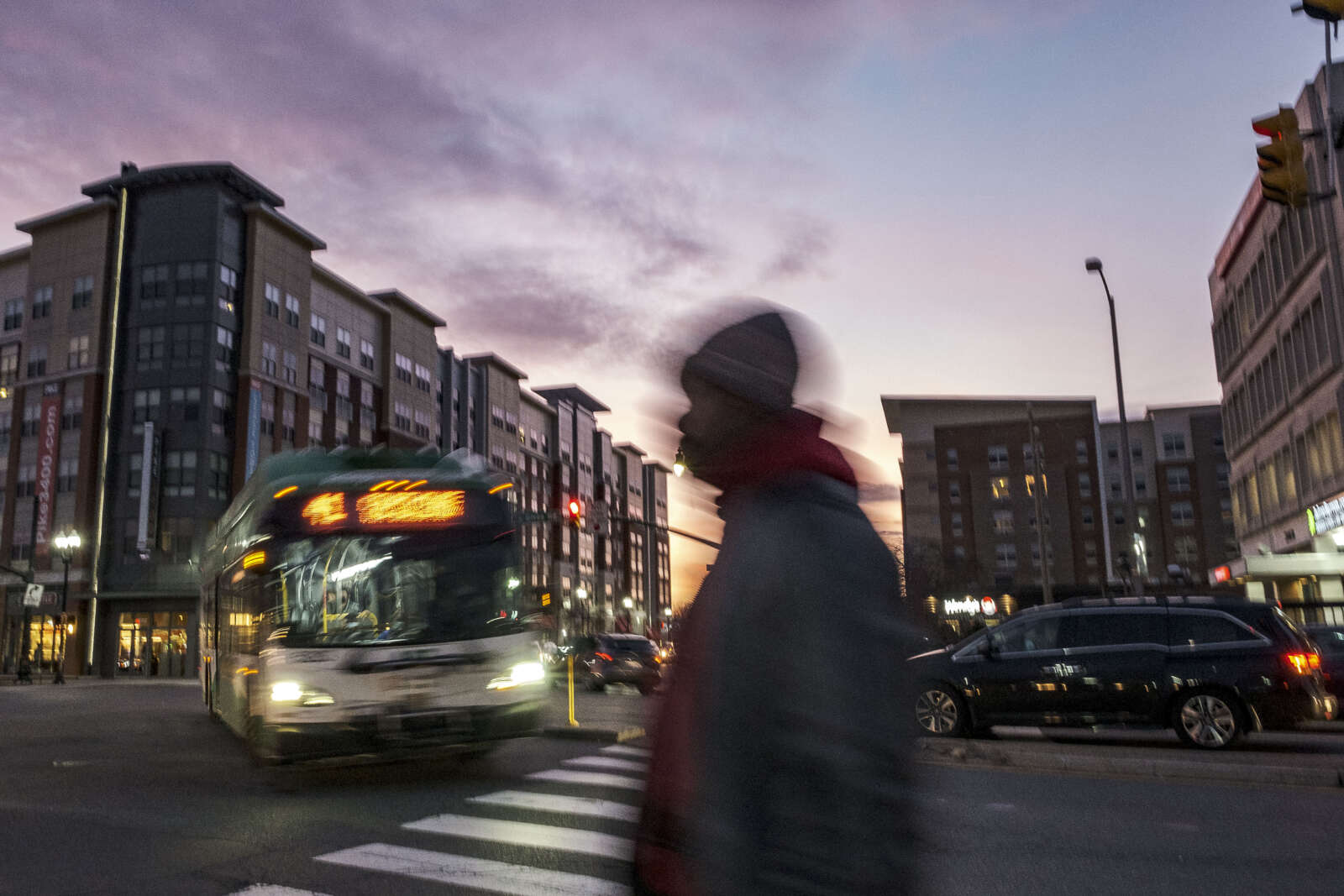
Along Columbia Pike at sunset (staff photo by Jay Westcott)

You would be forgiven for feeling that the end of this week has March 2020 vibes.

It’s of course different, given that most people are vaccinated and the health implications are not as nearly dire as the outset of the pandemic. But the continued drip of news about rapidly rising rates of new Covid cases and well-known people contracting the virus — whether the CEO of Southwest Airlines or any number of NFL players and coaches — definitely stirs up memories of the NBA, Tom Hanks and that fateful day.

Beyond significantly lower rates of serious illness, hopefully this time around there’s no shortage of toilet paper.

Now, here are the most-read articles of the past week:

  1. EXCLUSIVE: Investigation underway after State Dept. contractor died at Arlington facility
  2. Amazon and Arlington County to finance purchase of Columbia Pike apartment complex
  3. NEW: ‘B Live’ coming to former Whitlow’s space in Clarendon
  4. D.C. taqueria El Rey to open new Ballston location next week
  5. How Arlington’s Richmond representation could change under proposed redistricting maps
  6. Two men arrested after assaults on police in Clarendon
  7. Police nab four after spotting stolen car near Courthouse
  8. BREAKING: Covid case count in Arlington spikes amid Omicron worries
  9. JUST IN: Large gas leak shuts down Columbia Pike
  10. First responders facing possible job loss petition county to reverse vaccine mandate
  11. Rooster on loose near Lubber Run Park, running afoul of the law
  12. Locals push for dog park in Virginia Square

Feel free to discuss those stories or anything else of local interest in the comments. Have a great weekend!


What’s Next with Nicole is a biweekly opinion column. The views expressed are solely the author’s.

One of Arlington’s greatest assets is our highly educated population and range of knowledge in various policy topics. With my last column on ARLnow, I want to encourage you to pick something that you are passionate about in our community, and participate in our local government process. As a society, we would be better off with fewer keyboard warriors and more doers.

Commissions & Advisory Groups

Arlington has 50 commissions and advisory groups that are tasked with advising the County Board in their areas of interest. These groups also contribute to planning documents that shape how we operate. When people say things about how “the decision was already made” before it gets to the County Board for a vote, it is because dozens of commission and advisory group members have already given extensive public feedback prior to getting to the County Board for a vote. Meetings are typically once a month for 1-2 hours and you will have staff support for the logistics of getting things done.

Examples of commissions at work in the community: Phase 1 of the Draft Missing Middle Housing Study involved feedback from the Long Range Planning Committee, Commission on Aging, Climate Change, Energy and Environment Commission, Joint Facilities Advisory Commission, Forestry and Natural Resources Commission, Housing Commission and Transportation Commission.

Civic associations

Every neighborhood of Arlington is broken down into geographic areas that are represented by a civic association. Civic associations are your neighborhood advocates and organizers for everything from future development to dog parks to social gatherings. 

Examples of civic associations at work in the community: A group of civic associations around National Landing created a coalition called “Livability 22202” to proactively propose land use ideas. This has been used as the foundational ethos for Pentagon City Planning.

Public comment on planning documents

Engage Arlington is a site with ongoing planning documents that are open for public comment. Check this website regularly to ensure you don’t miss an opportunity to have your voice heard in the future of Arlington County. Currently, comment is open for the Fiscal Year 2023 Operating Budget.

Additionally, sign up for Arlington’s newsletter that will regularly deliver updates about ongoing projects.

Volunteer with your local political party

To get policy done, you need to have elected officials that believe in your values. Local political parties make targeted investments in local, statewide and federal elections to enhance political candidates’ ability to win. After Trump’s 2016 win, I got extremely involved in Arlington Democrats, where I was sent to knock doors as conveniently as my neighborhood for local elections, and as far as Georgia to support Sen. Raphael Warnock or Norfolk, Virginia to support Rep. Elaine Luria in order to flip key districts blue as part of the Beyond Arlington program.

If there is a local candidate that you like, reach out to them on their website and sign up to volunteer, donate, or host a meet and greet. Local politics is a small world and the more you help candidates with the groundwork of getting elected, the more influence you are likely to have in the future.

Conclusion

Get involved early and often. Make your voice heard. With so many forums for involvement now being virtual, it is easier than ever to make a difference. If not you, then who? If not now, then when?

Nicole Merlene is an Arlington native and former candidate for Virginia State Senate. She has served as a leader in the community on the boards of the Arlington County Civic Federation and North Rosslyn Civic Association, as an Arlington Economic Development commissioner, in neighborhood transportation planning groups, and as a civic liaison to the Rosslyn Business Improvement District.


Peter’s Take is a biweekly opinion column. The views expressed are solely the author’s.

This is my final ARLnow Peter’s Take column.

As announced earlier this month, ARLnow.com will be adopting a new approach to presenting opinions. I look forward to their new approach.

In January 2013, ARLnow published my first Peter’s Take column. Never in my wildest imagination did I foresee that it would publish over 360 more of my columns over a 9-year period. Thanks, ARLnow!

In my first column, I explained that “my take on the subjects I’ll be writing about will depart sometimes from the party line.” I’ve tried to follow this approach.

In this column, I’ll provide my perspective on some continuing issues.

Arlington Public Schools

I wrote dozens of columns about APS. I continue to be highly critical of APS’s excessive reliance on devices and virtual learning. APS staff is in thrall to Big Ed Tech. The Ed Tech empire continues to reap millions of our tax dollars from APS’s inappropriate uses of technology to supplant in-person, human interactions between students and teachers. Arlington’s elected School Board should vote to roll back APS staff’s excessive reliance on devices and virtual learning, and direct APS staff to strike a reasonable balance in device use.

In addition, the School Board should vote to adopt a formal policy that in-person instruction should drive APS facilities planning–not the other way around. After adoption by the School Board, the County Board also should vote to adopt this policy regarding APS facilities. And, APS’s facilities should prioritize instructional functionality, not dazzling architectural design headlines.

Arlington County Government

I wrote scores of columns about the Arlington County government. The specific subjects varied, but certain themes continue severely to hamper our local government’s effectiveness.

One theme is the unfortunate refusal of current County Board members to oversee more aggressively the policies and practices of the County Manager and staff, claiming that doing so would impinge on the Manager’s legal prerogatives. Often with respect to the same issue, the Manager claims that his hands are tied because he is only executing County Board policy.

Contrary to what current County Board members assert, this excessive deference to Manager and staff is not required by our form of government. The change that’s needed is a change in the attitudes of County Board members regarding how they interpret their own roles. (For different reasons, some changes in our current form of government also are desirable.)

Then there’s the so-called “Arlington Way”. In the vast majority of cases, what the Arlington Way means in practice is the deployment of County government’s massive public engagement organization to reach County government’s predetermined outcomes by seeking resident input on issues that are defined in a way deliberately designed to reach those outcomes. Beware the words “no decisions have been made.” The County Board should vote to direct the Manager to use his staff and his massive public engagement organization in only objective, un-biased, community-sensitive ways.

(more…)


The Right Note is a biweekly opinion column. The views expressed are solely the author’s.

As the readers of ARLnow know, this is the final week for regular opinion columns. First, let me say thank you to Scott Brodbeck for asking me to do this nine years ago.

Drafting the last one is a bitter-sweet moment for me. Along with Peter Rousselot, I have been writing faithfully since January of 2013 when his first column was published just hours before mine.

By my rough count, I have written 374 columns, and they averaged around 400 words each. So, I have typed enough words to fill a 500 page book. I have written on vacation, in the middle of the night, and occasionally an hour before one was due.

While I will not miss writing the columns on the weeks I have trouble locating time in the schedule or finding a topic I really want to talk about, I will miss running into random people across the county who tell me they read what I write. Some thank me. Some tell me they agree sometimes and disagree other times. To those who had nothing for me but a glare, thanks for letting me know I struck a nerve. And thanks for reading, even if it was just to see what “stupid” thing I would say next.

For the record, I never got paid a dime for any of it. I did it to insert a more conservative point of view in the public dialogue in a county where Democrats reign the political world. This became even more important as Republicans stopped regularly fielding candidates for the County Board. I tried to run myself twice, coming close once – close for a Republican in Arlington anyway.

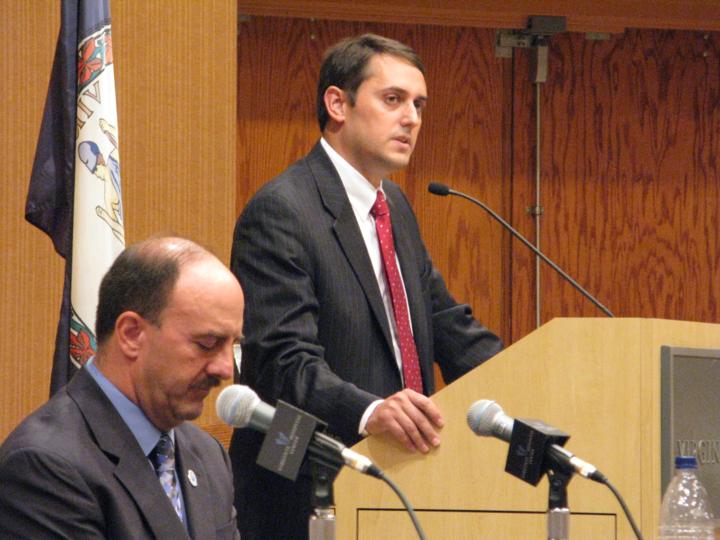
Republican Mark Kelly speaks at the Civic Federation County Board candidates debate in 2010 (staff photo)

I generally didn’t read many of the comments, though I checked in from time to time. Once there was a less than favorable haiku left in the comments after I discussed Arlington’s decision to hire a county poet. I responded with one of my own in the next column:

Trolley has been nixed.
Taxpayers are rejoicing
gondolas are next.

Thinking of back to the comments section and the trolley leads me to one of the best moments of writing this column – getting the email that the Columbia Pike streetcar project was being cancelled in the wake of John Vihstadt’s election to a full term. Having written a lot about that project, one week some of the commenters expressed a great deal disgust at the frequency of my criticism along with the fact I called the project a “trolley” at all. The next week as I wrote a column on another subject, I used the first letter of each paragraph to spell T-R-O-L-L-E-Y. I am sure no one noticed, but I knew it was there. I also once paid tribute to my dad on his birthday with a similar first letter of the paragraph approach.

One of my biggest disappointments is that the budget process, including the closeout spending, and all of the “woe is me,” fake “budget shortfall,” “we had to make tough decisions” rhetoric has remained unchanged. Sadly, a majority of Arlingtonians do not find the spending habits of their elected officials objectionable enough to vote in a majority of Independents or Republicans or even Democrats who would do things differently.

(more…)


Progressive Voice is a biweekly opinion column. The views expressed are solely the authors’.

By Progressive Voice Editors

Local news matters, and so do local opinions. Participating in local decision-making is a driver of democracy, to just stay aware, to advocate for or against a proposal.

Many of us might never know what the debate was about unless reputable, objective news outlets clued us in. Or unless a solid opinion columnist analyzed the issue, albeit briefly, to make readers aware.

This is the final Progressive Voice column, due to ARLnow’s decision to discontinue all current columns. Today, the editors of Progressive Voice reflect on some of our most well-received columns of the past four years, and offer a glimpse of issues and insights that still need to be heard.

Readers told us that they value seeing opinions on issues that directly affect them, such as tear-downs of single-family homes that are replaced by huge McMansions, being asked for input from the County when “the decision has already been made,” growth being “not an unbridled good,” and living in Arlington’s “blue bubble.” We know these issues struck a chord in part because of readership data (not “comments”), and from listening to a wide swath of Arlington citizens day after day.

Before the pandemic, our interactions at the coffee shop and gym let us hear people’s thoughts on what we’d just covered, or might be interested in covering. Because we consistently reached out, people never shied away from giving us feedback — good, bad or ugly.

Readers told us they liked hearing from different authors and points of view along the progressive spectrum. Over the past four years, Progressive Voice featured more than 70 different columnists, explaining why an issue mattered to Arlington or perhaps why they railed against a County decision. The need for quality childcare, the stormwater bond, what to do about the social isolation of senior adults, and much more.

Such issues are still out there, with earnest neighbors still caring about them. Given ARLnow’s decision to discontinue its current opinion columns, here are just three of the Progressive Voice columns that were in the works — yet now won’t be published:

  • Falls Church — the New Arlington? Ouch! Some of this might just be “grass is greener” syndrome, but Arlingtonians who have moved to Falls Church keep telling us how much they love it — “more livable than Arlington,” they say. Or, “Quieter, calmer” or “You can still hear the birds sing here” or “I prefer the Northside Social in Falls Church… it’s just nicer.” And, important to many, “civic processes” just seem to move more quickly in Falls Church than in Arlington. True? It’s a local view that no news outlet or opinion columnist has dared touch, but gets quietly worried about in certain circles.
  • Neighborhood and housing changes along Langston Blvd The old “Lee Highway” name has been replaced with Langston, and soon much of the 1960s-era commercial building or housing might be revamped as well, depending on what the Arlington County Board decides about land use and increasing density. Changes in the 4.6-mile Langston Blvd corridor will affect thousands of people who live, work and shop here. Implications for our schools, environmental and stormwater management issues, single-family neighborhoods? That’s why many people keep worrying as the saga winds along.
  • Local News — Linchpin of Democracy Every day, decisions get made that affect the lives, finances, happiness and health of Arlingtonians. Yet coverage of such decision-making remains skimpy and erratic, especially during the early stages before decisions get baked. The Washington Post deigns to cover Arlington a few times a year, the Sun Gazette understands the behind-the-scenes but is short-staffed, and ARLnow has expanded but splits a lot of its time among restaurant openings, rehashing press releases and getting new reporters onboard.

Progressive Voice always started with the desire to air well-informed views on local issues that mattered. We thought it important to present a variety of voices — so we worked with dozens of writers instead of relying on just one person’s view, time and again. Young, old, newcomer, long-timer, Black, Brown, White or Asian, well-off or not so much, they chose topics that mattered to them and cared enough to put their thoughts out there for the community. Progressive Voice closes its chapter with the hope that these voices will persevere, and not grow weary.

Progressive Voice is edited by Elaine Furlow and Laura Saul Edwards. 


Ed Talk is a biweekly opinion column. The views expressed are solely the author’s.

The school-to-prison is the most misunderstood phenomenon in Arlington, even amongst the highest levels of leadership. School board and county officials, including law enforcement and the former Commonwealth Attorney, have vehemently denied that the school-to-prison pipeline exists in Arlington.

They acknowledge the phenomenon but contend that it exists elsewhere, but “not here.” Such narrow-mindedness is troubling. Perhaps it is cognitive dissonance that causes them to recoil at the mere suggestion that our affluent county with its highly educated residents and top-ranked schools is complicit in the school-to-prison pipeline. It is.

The naysayers misunderstand the pipeline to prison as a linear path on a monopoly board: Go directly to jail; do not pass go, do not collect $200. In fact, the School-to-Prison Pipeline is a tapestry of school policies and procedures that drive many of our children into a pathway that begins in school, and after many bumps, twists, turns and detours, ends in the criminal justice system. Simply put, the pathway from school to prison is multifaceted and often indirect. While there are many pathways, I discuss the three that most frequently intersect and overlap. Each is broken in APS.

Illiteracy

There is enough research to show a direct correlation between a person’s future success rates and the likelihood of them becoming involved in the criminal justice system, due to their literacy levels. Research shows that children who struggle to read in first grade are 88% more likely to struggle in grade four; and those who struggle in fourth grade are four times more likely to drop out of school. Data reveals that 85% of juveniles who interact with the court system are functionally illiterate, and 60% of the nation’s inmates are illiterate. While it is an urban myth that prisons base some of their future planning on third and fourth-grade literacy rates, the data is compelling that there is a strong connection between early low literacy skills and incarceration rates.

In our own yard, the pandemic has exacerbated the declines in reading proficiency. APS spent decades attempting to teach students to read using balanced literacy instead of structured literacy, which has not worked well. As a result, we have students who are graduating functionally illiterate, if at all. This is known as failing up. The recent planned scale-up to structured literacy is slow and focused primarily on K-3, leaving students in the upper grades and secondary schools without a clear and solid path for evidence-based reading intervention.

Special Education

Students with disabilities who qualify for special education too often receive inferior services, and often in segregated settings, if they receive any services at all. The proverbial wait-to-fail practice of delaying evaluations precludes early identification of learning disabilities and compound intervention.

The APS 2019 Special Education Evaluation indicates that more than one-third of students with Individual Education Plans reported that only some or none of their teachers have high expectations for them, and that they do not feel understood or supported by their teachers. One-third reported not being able to participate in after-school activities, not being treated fairly, and not feeling welcomed in school.

Disparate discipline and disproportionate referrals to law enforcement

The discipline disparities we see in APS are reflective of the national data that Black students are suspended, expelled and reported to law enforcement three times more than White students. Many of them have learning disabilities and/or trauma, and would benefit from additional educational and counseling services. Instead, they are isolated, punished and pushed out. Students who have difficulty learning to read will often act out in school. Additionally, Black students tend to receive harsher punishment for less serious behavior, and are more often punished for subjective offenses, such as “loitering” or “disrespect.”

The U.S. Department of Education, reports that students with disabilities incur repeated disciplinary actions and are more than twice as likely to receive an out-of-school suspension than students without disabilities. Students with disabilities represent 12% of the overall student population, yet make up 25% of all students involved in a school-related arrest. (Similarly, LGBTQ youth are much more likely than their heterosexual peers to be suspended or expelled.) Because disparate discipline impacts students of color with disabilities, dismantling the Pipeline requires an intersectional approach to disability and racial discrimination.

Notwithstanding the School Board’s removal of School Resource Officers (SROs) from APS pursuant to recommendations from the SRO Work Group and Superintendent Francisco Durán, Governor-elect Glenn Younkin has threatened to withhold funding from school districts that don’t have SROs, which he’s said he will require. Regardless of whether SROs actually return to APS, discipline disparities and referrals to law enforcement will continue unabated unless school administrators, who overwhelmingly favor having SROs in their schools, evolve to embrace restorative practices. That would require a seismic shift in mindset and culture.

In a regressive legislative move, a Republican-sponsored bill (SB2) has already been pre-filed for the 2022 General Assembly session to revive a mandate that school administrators report misdemeanors to law enforcement. Less than a year ago, SB 3/HB 256 was enacted as a specific antidote to the school-to-prison pipeline, for which Virginia ranks as one of the worst states.

Given the trauma experienced by children during the pandemic, experts anticipated unprecedented behavioral difficulties and pervasive attendance problems in the reopening of schools. Phyllis Jordan of Georgetown University’s FutureEd opined that:

“[T]here are going to be kids who have behavioral outbursts, and you’re just going to have kids who are out of practice at being in school who are just not behaving properly. And the worst thing a school can do is flush them all out with suspensions or harsh discipline. There is going to have to be some attention and training on issues like restorative practices and ways of coping with these issues that kids are going to have.”

Conclusion

Illiteracy, special education and discipline are major pathways in the school pipeline to prison, but racial bias is the express route. Confronting racial bias is where the hard work is, and where I find that some Arlington leaders are unwilling to toil. If they would stop gaslighting us by denying the school-to-prison pipeline exists here, that would be a start. Stop. Listen. Learn. We can’t change what we won’t acknowledge.

Symone Walker is a federal attorney and an APS parent. She serves as Vice Chair of the Arlington Special Education Advisory Committee (ASEAC), and is an Executive Committee Member of the Arlington NAACP and Co-Chair of the NAACP Education Committee. Symone is a former candidate for the Arlington school board.


Before checking out for the holidays this month, check out the winners of the Winter 2022 Arlies!

You voted, we counted and the results are in. Below are the listed winners in each of the 17 categories, which included favorite coffee shop, title company, brunch spot, spa, ARLnow commenter and more.

Congrats to all of the winners and thank you to everyone who voted!

Favorite electrician/electrical contractor
1. Michael & Son

Favorite bakery
1. Bakeshop
2. Heidelberg Pastry Shoppe
3. Best Buns Bread Company

Favorite spa
1. Origins Thai Spa
2. Massage Envy
3. Azure Dream Spa

Favorite family dinner spot
1. Silver Diner
2. Ruthie’s All-Day
3. Pupatella

Favorite orthodontist
1. Hani Thariani Orthodontics
2. Iverson Orthodontics
3. VCO Orthodontics

Favorite pet boarding
1. Fur-Get-Me Not

Favorite chiropractor
1. Capitol Rehab of Arlington

Favorite ARLnow commenter
1. Flood Czar Mayor of Arlington
2. Dave Schutz
3. Metal Ox

Favorite personal trainer
1. Monica Amaya

Favorite coffee shop
1. Northside Social Coffee & Wine
2. Kino Coffee
3. Idido’s Coffee and Social House

Favorite mental health professional
1. Michelle M. May LPC, LLC

Favorite hill to go sledding
1. Bluemont Park

Favorite private elementary school
1. Saint Agnes Catholic School, Our Savior Lutheran School (tie)

Favorite brunch spot
1. Ted’s Bulletin
2. Ambar
3. Ruthie’s All-Day

Favorite beer/wine shop
1. Arrowine & Cheese
2. The Brew Shop
3. Total Wine & More

Favorite real estate agent for first-time buyers
1. Natalie Roy, Eli Tucker, Kristin Francis Team (tie)

Favorite title company
1. Universal Title, Allied Title & Escrow LLC, KVS Title LLC (tie)


Modern Mobility is a biweekly opinion column. The views expressed are solely the author’s.

With my final Modern Mobility column I’d like to look back at the last few years and look ahead to the next few.

I’ll talk about what it’s been like writing Modern Mobility and how it will continue in 2022. I’ll highlight some developments in local transportation over the last few years that I think are very good or very bad, and I’ll look at the top 5 things I’m looking forward to in the future.

Looking Back — Modern Mobility

First off — it’s been a pleasure writing this column and I’d like to thank everyone who took the time to read it. Your time and attention are scarce and valuable, and I greatly appreciate you spending some of it reading my column. To those who have engaged in good faith with me in the comments, thank you — even if we have continued to disagree, I have enjoyed the dialogue. To those who have gone to the comments to complain about what you thought I said, without actually reading the column and learning otherwise, I invite you to find a more useful hobby.

Looking Ahead — Modern Mobility

While I’m losing my place here at ARLnow, I will be continuing to write on transportation while sprinkling in some general Arlington government content. Future Modern Mobility posts will be hosted as a blog here on my personal website. You can sign-up to be notified by email when new articles are posted or add the blog to your favorite feed reader (Feedly is great). I hope to continue writing about two articles per month.

Looking Back — Transportation

  1. Thumbs up to Vision Zero: with Arlington’s Vision Zero action plan, the County is finally working to make fundamental changes to how they operate, putting safety at the center. It’s not going to be quick and I expect there will be stumbling blocks and growing pains, but Arlington managed to adopt a plan focused on improving processes (including across departments) rather than creating a performative checklist so the opportunity is there if we can do the work.
  2. Thumbs down to the Fire Clearance Quagmire: Neighborhood Complete Streets sidewalk projects are stalled, protected bike lanes are being axed and entire blocks of street parking are getting ripped out, all behind closed doors with no record of when exceptions to the clear width rule are being granted, when they’re denied, and how these decisions are being made. The Virginia Fire Code grants us the flexibility to modify this clear width to meet our street safety goals, and we need to do so much more often than we are. We need transparent leadership on this from the County Manager.
  3. Thumbs up to kicking-off feasibility studies for upgrading the Arlington Blvd Trail around Glebe Road and extending the Four Mile Run Trail underpass beneath Shirlington Road. While only studies, and not design or construction funding, these are important first steps to solve long-standing safety issues on our trail network.
  4. Thumbs up to School Slow Zones and moving forward on Automated Enforcement. While designing streets that “self-enforce” safety through their design and construction is the best way to improve street safety, lower speed limits and automated enforcement have an important supporting role while we work toward that goal.
  5. Thumbs down to Scooters blocking sidewalks. E-Scooters have great potential to provide a much more sustainable transportation option for short trips than cars, and many folks seem willing to ride them who aren’t interested in riding a bike. Unfortunately, the public’s main exposure to these vehicles is via micromobility providers like Bird and Spin whose “dockless” model continues to fail at demonstrating it can be compatible with our street infrastructure and respectful of other users. Despite having years to train their employees to properly stage their fleets each morning and over two years of the County having the ability fine and revoke the license for these providers, scooters inhibiting pedestrian movement continues to be a frequent issue and many of our neighbors in wheelchairs do not have the ability to simply move the scooter out of their way. If Arlington can’t bring the existing providers into compliance, the only reasonable futures for e-scooters in Arlington increasingly looks to be private ownership or a “docked” rental model like Capital Bikeshare.

Looking Ahead — Transportation

Transportation developments I’m looking forward to over the next few years:

(more…)


Community Matters is a biweekly opinion column. The views expressed are solely the author’s.

My father and I recently visited Bridgeport, Alabama, a small town located in Northeast Alabama near the state’s border with Tennessee. My father recounted many memories of his time in Bridgeport in the mid-1960s, largely impacted by segregation and poverty. He noted that of the 11 members of his 6th grade class, only two eventually went to college.

I started to imagine the mindsets of the majority of the people who grew up in that environment, how they live today, as well as how they think about their future. How much do our memories and perceptions of the past affect how we can plan for a better future for our communities?

Arlington prides itself on progressive attitudes and values. We must continually ask ourselves who is at the table thinking about Arlington’s future, from the government to the civic community, and how their lived experiences and memories impact our outcomes. Also, what are we doing today which will influence the experiences and the memories of those in the future who will be leading?

When I think about a future Arlington, among other things, I want an educational system that provides a quality and equitable education to all students, an abundance of safe transportation methods including well-lit trails and sidewalks, plenty of open space, and community engagement processes which are equitable and ensure that all voices are heard. My perspective on those issues and the impact I am able to make in the future, could be a function of my  memories and my perspectives today.

In an August 2011 issue of Memory and Cognition, “a study demonstrated that it is possible to make more specific predictions for the future by imagining that future in a familiar place rather than an unfamiliar place. For example, college students asked to envision an event happening five years from now in their current dorm room were able to make much more specific predictions about that event than those asked to envision an event happening at the Egyptian pyramids.”

As we conduct our work today and rely on past memories, we can frame programs and paint a picture in a context that people find familiar. While providing analyses of the 2021 election results one might capitalize on the common perspectives that existed in the 2016 election by drawing on those feelings while creating a strategy moving forward.

Many of our organizations are doing excellent work in key areas, but no one knows about them. Our future progress as a community could be predicated on how their work is remembered. Our local government, civic and community organizations should use all available resources to amplify their work, and shape Arlingtonians’ perceptions and memories today, to achieve our desired impact tomorrow.

Krysta Jones has lived in Arlington since 2004 and is active in local politics and civic life. This column is in no way associated with or represents any person, government, organization or body — except Krysta herself.


View More Stories