Modern Mobility is a biweekly opinion column. The views expressed are solely the author’s.

Most of Arlington’s current Protected Bike Lanes have a weak point: bus stops.

While riders have a largely low-stress, comfortable ride separated from moving cars by parked cars, that protection falls away at the bus stop where they need to mix with large vehicles that have somewhat limited rear and side visibility.

Floating bus islands to the rescue!
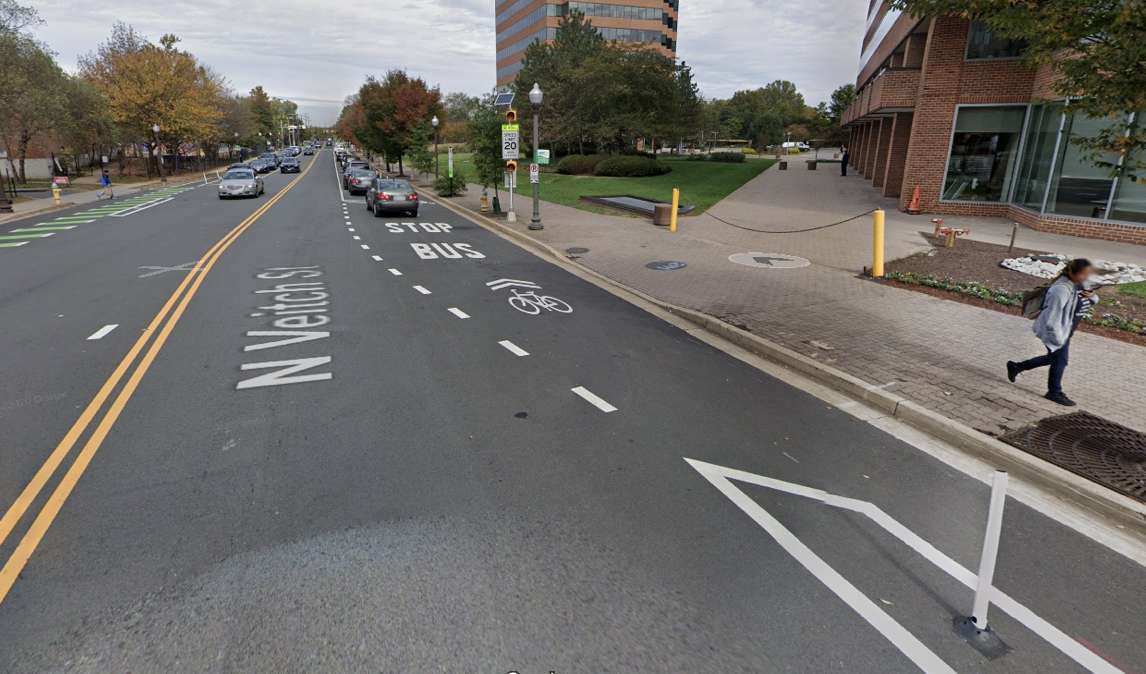
An example of how Arlington currently handles bus stops in a protected bike lane created by repaving (via Google Street View)

What is a Floating Bus Island?

With a floating bus island, the bus stop moves out to a sidewalk-level island that lines up with the protection for the bike lane. So with a parking-protected bike lane, the bus island aligns with where the cars park. From the sidewalk, bus users cross the bike lane and then wait on the island for the bus to arrive. The bus pulls up, stops in the travel lane, picks up and drops off passengers, and then continues on its way.

Having trouble picturing what this looks like? No worries, Arlington has one on Wilson Blvd near the new HB Woodlawn building so you can check it out for yourself (or just check out these photos).
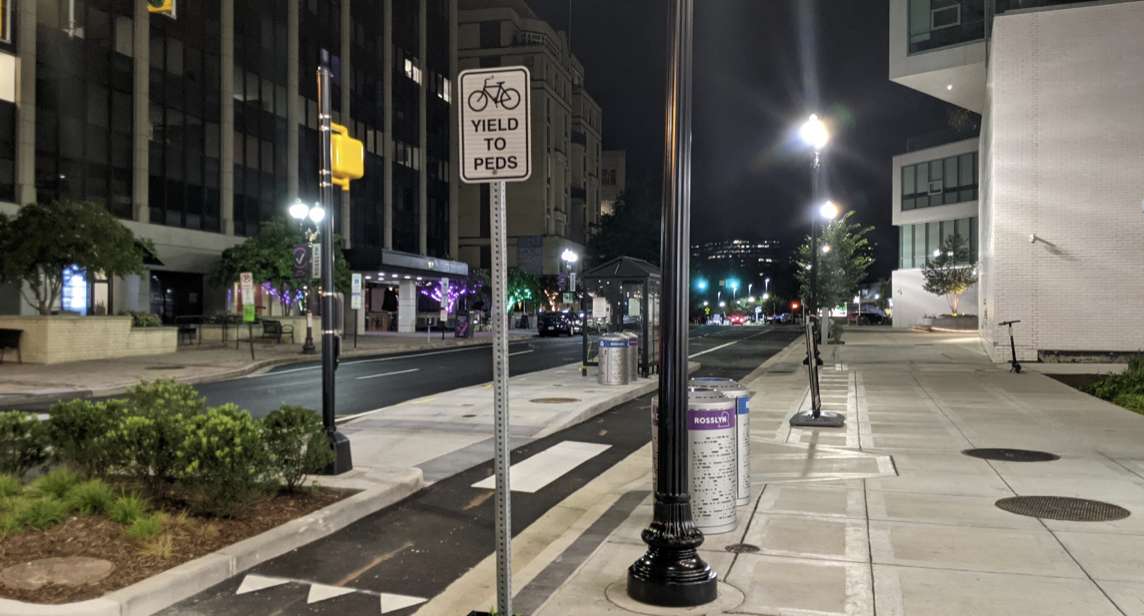
A floating bus island on Wilson Blvd. near Pierce Street in Arlington, VA (courtesy Chris Slatt)

This setup is both great for people on bikes — no more mixing with big scary vehicles — but also great for transit. Since the bus doesn’t have to pull to the curb, it also doesn’t have to pull back into the travel lane. This saves the bus (and the many folks on the bus) all of the time it would normally spend waiting for a break in traffic to pull back into the travel lane. Added together over the course of many stops, this can have a noticeable impact on how long the bus takes to get you to your destination.
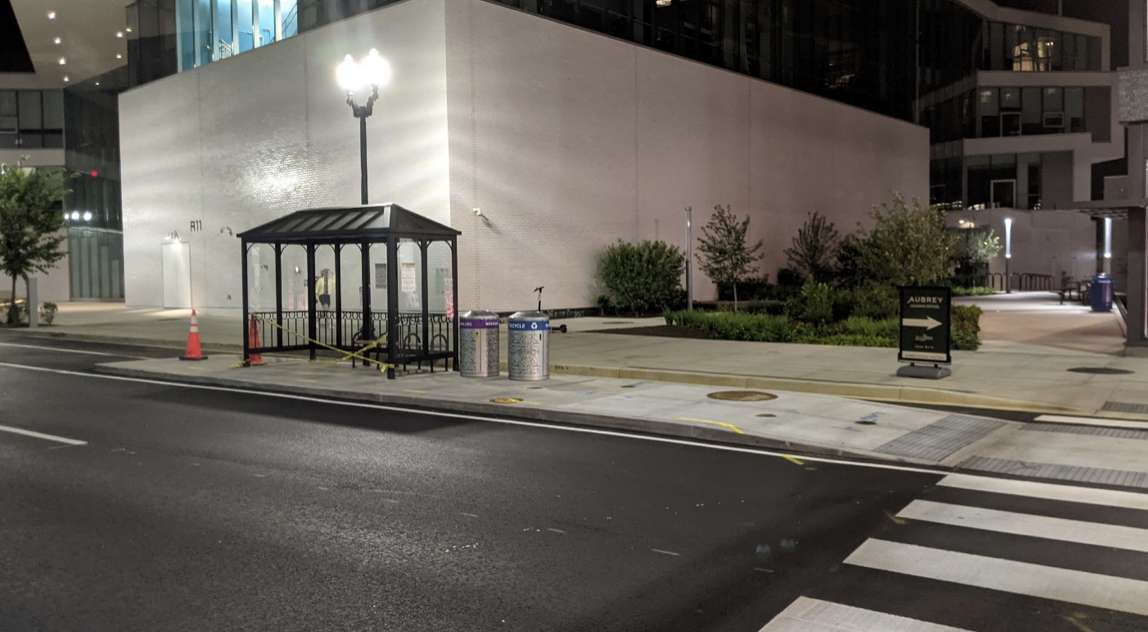
A floating bus island on Wilson Blvd. near Pierce Street in Arlington (courtesy Chris Slatt)

Why don’t we have more of them?

Arlington now has several protected bike lanes, why do we only have one floating bus island? Generally, because Arlington has achieved most of their protected bike lanes as opportunistically as part of repaving, rather than as part of a capital project. During a repaving project, options are much more limited which is why they are generally made with paint and plastic bollards.

The floating bus island on Wilson Blvd. was built as part of a redevelopment project, where curbs were already being changed and concrete was already being poured. More floating bus islands are coming as part of future capital projects; several will be built as part of the Army Navy Drive Complete Streets project, for example.
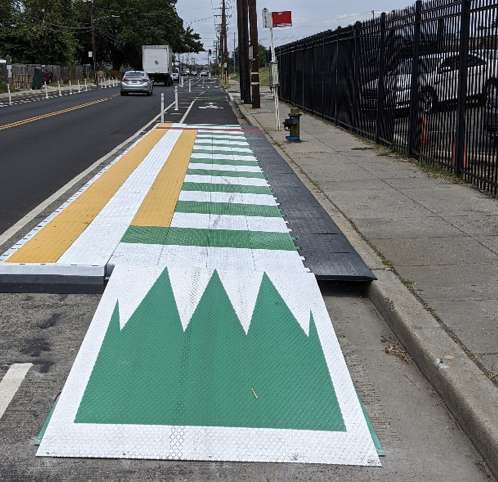
A modular floating bus island installed on West Virginia Avenue in D.C. (via @MarkSussman_ on Twitter)

It doesn’t have to be this way, however — we don’t have to wait for a capital project. Cities like D.C. and Portland have started creating floating bus islands with a modular product that can be dropped into place, enabling them to be installed as part of simple repaving and restriping projects, rather than requiring a costly capital project that pours new curbs.
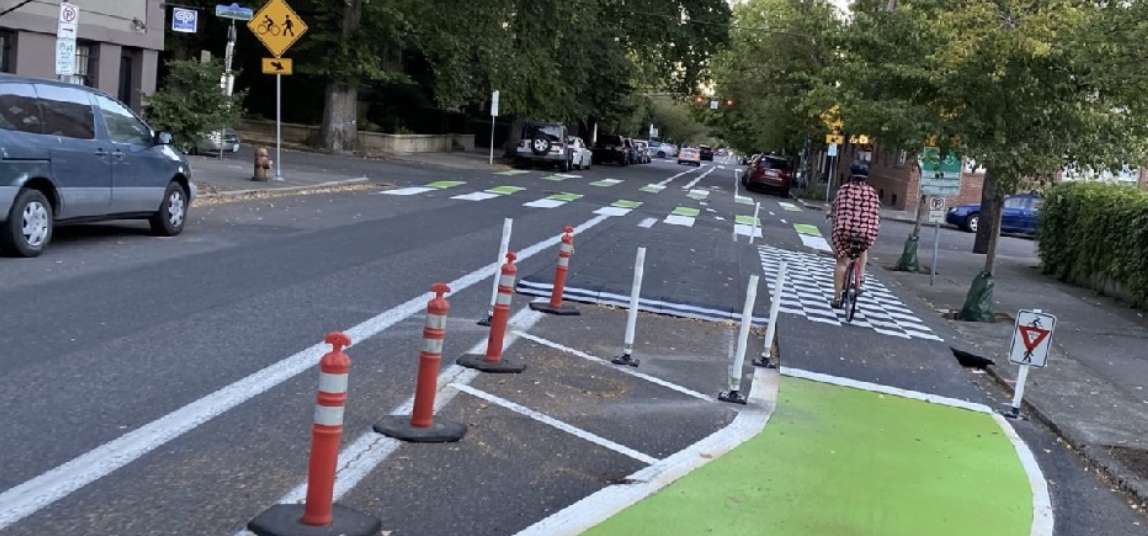
A modular floating bus island installed on Rose Lane in Portland (courtesy Zicla)

Arlington should add this or a similar product to its repaving project toolbox. It would drastically improve the quality of protected bike lane infrastructure that can be installed as part of repaving or other quick-build projects as well as speeding up transit operations, reinforcing our investment in bus service in Arlington.

Chris Slatt is the current Chair of the Arlington County Transportation Commission, founder of Sustainable Mobility for Arlington County and a former civic association president. He is a software developer, co-owner of Perfect Pointe Dance Studio, and a father of two.


Community Matters is a biweekly opinion column. The views expressed are solely the author’s.

As the U.S. withdraws troops from Afghanistan, there are discussions around the world about whether it’s the right course of action. It is a complicated decision, and it’s natural to think about the factors that went into the decision and what could have been done to produce a different outcome.

Recently, I have thought a lot about that moment in time when you decide to do the easier process instead of using all of the training you have received, all of the articles you have read and conversations you have taken part in, and go with the decision that is out of your comfort zone. When we think about what will make Arlington stronger, in all spaces, we have to be ready to push through the gray area of discomfort and come out stronger on the other side.

For example, I have observed teams thinking through the process of choosing a path related to diversity issues. Sometimes one person will bring up what they have heard or learned and apply that to the situation and another will bring up the traditional wisdom or the current process. Others may chime in to say that they see both points of view. Then the group has to make a decision.

Let’s say, for example, your team or organization has little diversity of any type, but someone suggests that there is a need to diversify. You may have a conversation about the true reason that you want to diversify, i.e. is it for appearances, is it because you want to change the quality of your product or service, is it because you want to do your part in ending structural racism or simply doing your part to create a more inclusive society?

Next you decide what you will do — will you essentially continue on the same course (which may be easier, less work, less expensive and less vulnerable) or take a step in the other direction. These are a few proactive steps which may make the decision easier:

Ensure diverse voices around the table. So many of our organizations struggle with not only recruiting diverse people in the organization but finding ways to retain them and make them feel like they belong and have a voice at the table. When you are at critical decision making points, your discussions will be richer if you have the right people at the table. Until then, start from a place of wanting to grow and do the best for your organization and society based on your organizational values.

Test people’s true intentions. This may be a little more controversial, but whether it’s through your recruitment or one-on-one conversations, I believe you need to know where people stand before it gets to a vote and discussion and you realize that their values are not aligned with the direction of the organization.

Make sure your training and conversations (diversity or in general) address potential challenges to different ideologies. A lot of groups are taking the right step by training and having important discussions on different topics. During the training, make sure you discuss potential challenges and be prepared to address the more difficult parts of organizational growth.

As we all make progress in growing as individuals and organizations, let’s be prepared to make the small and large decisions that will truly make Arlington a world-class community.

Krysta Jones has lived in Arlington since 2004 and is active in local politics and civic life. This column is in no way associated with or represents any person, government, organization or body — except Krysta herself.


A new week, a new category to vote on in the summer Arlies but first, the results from last week’s voting.

Your favorite sports bar is Crystal City Sports Pub, followed by First Down Sports Bar & Grill and Ireland’s Four Courts.

Now, let’s vote on this week’s category. Do you have a favorite lawn care service that keeps your yard weed free and pristine? A mower maestro that also keeps your grass green? Let us know below or by clicking this link.

Voting is open until next Tuesday, when we announce the winners and vote on a new category.

Photo by Daniel Watson on Unsplash


Making Room is a biweekly opinion column. The views expressed are solely the author’s. 

I am becoming a kindergarten parent this year and so I’m officially joining the Arlington Public Schools community. During the past 18 months, I’ve watched with sympathy as kids were kept out of school.

Arlington’s public schools were closed, or in a hybrid model, because elected leaders didn’t prioritize the mitigation strategies in our community that would have allowed safe in-classroom instruction. I was lucky to have my kids in full-time daycare for most of the pandemic. We were never exposed to Covid-19 from the center, despite limited mitigation practices.

I watched the Aug. 11 Return to School Town Hall with apprehension. For a school system that seemed incapable of prioritizing in-person learning or delivering on the obvious mitigation strategies to allow that to happen for over a year, I had lost a lot of hope. But my son is turning six soon and I have a philosophical and practical commitment to public education. I was prepared to trust the system and hope for the best. This town hall laid out a comprehensive plan to provide multiple layers of protection for students and staff at APS.

From the outset, Superintendent Duran unequivocally stated that APS will remain with five days of in-person instruction “unless the governor orders the schools to close.” To limit the disruption of quarantine, if a classmate tests positive close contacts will only be defined as anyone within 3 feet, or within 6 feet if both students aren’t wearing masks.

And APS is backing up this commitment with concrete mitigation strategies that address the Covid risk on multiple fronts:

  • Weekly testing of asymptomatic students through an opt-in program. This will take place at each school through a rapid antigen test, to detect asymptomatic cases before they spread
  • Mandatory vaccination or weekly testing of all APS employees (announced in conjunction with Arlington County’s policy after the Town Hall)
  • APS announced a universal mask mandate even before Governor Northam issues this for the entire state. Masks are readily available at each school for anyone to use
  • Certified air cleaning devices have been installed in every classroom, with the goal of delivering four to six air changes per hour. Opening windows is encouraged if the weather allows

Arlington staff should build on these plans to do even more to protect kids and maintain in-person learning:

  • Vaccines should be required for all eligible students
  • Outdoor lunch should be the norm, not just an option when it is most convenient. If staffing is a problem, call on parents to help
  • APS should distribute high quality masks for all children, staff and visitors
  • The facilities’ teams should continue to improve the ventilation and filtration of classrooms, especially for unvaccinated elementary students
  • APS should expand the definition of close contacts while the virus is spreading faster in the community and notify the entire class of a positive Covid test so families can opt to test and/or voluntarily quarantine

These steps would make in-person school safer and more sustainable as we wait for the delta variant to peak (which could occur as early as mid-September, according to some experts).

Every family will evaluate the risk and reward of in-person instruction in their own way. I was committed to sending my child to kindergarten even without these mitigation strategies. But knowing they are in place makes me confident that he is protected in the coming year.

If you haven’t yet registered your child for public school, there is still time. APS also has open slots in the Virginia Preschool Initiative, a state-funded program to offer free early learning for children in low-income families.

For everyone who doesn’t have children, you can help make the school year successful by getting vaccinated and taking precautions to mitigate community spread. As we’ve said since the beginning of the pandemic, we are all in this together.

Jane Fiegen Green, an Arlington resident since 2015, proudly rents an apartment in Pentagon City with her family. By day, she is the Membership Director for Food and Water Watch, and by night she tries to navigate the Arlington Way. Opinions here are her own.


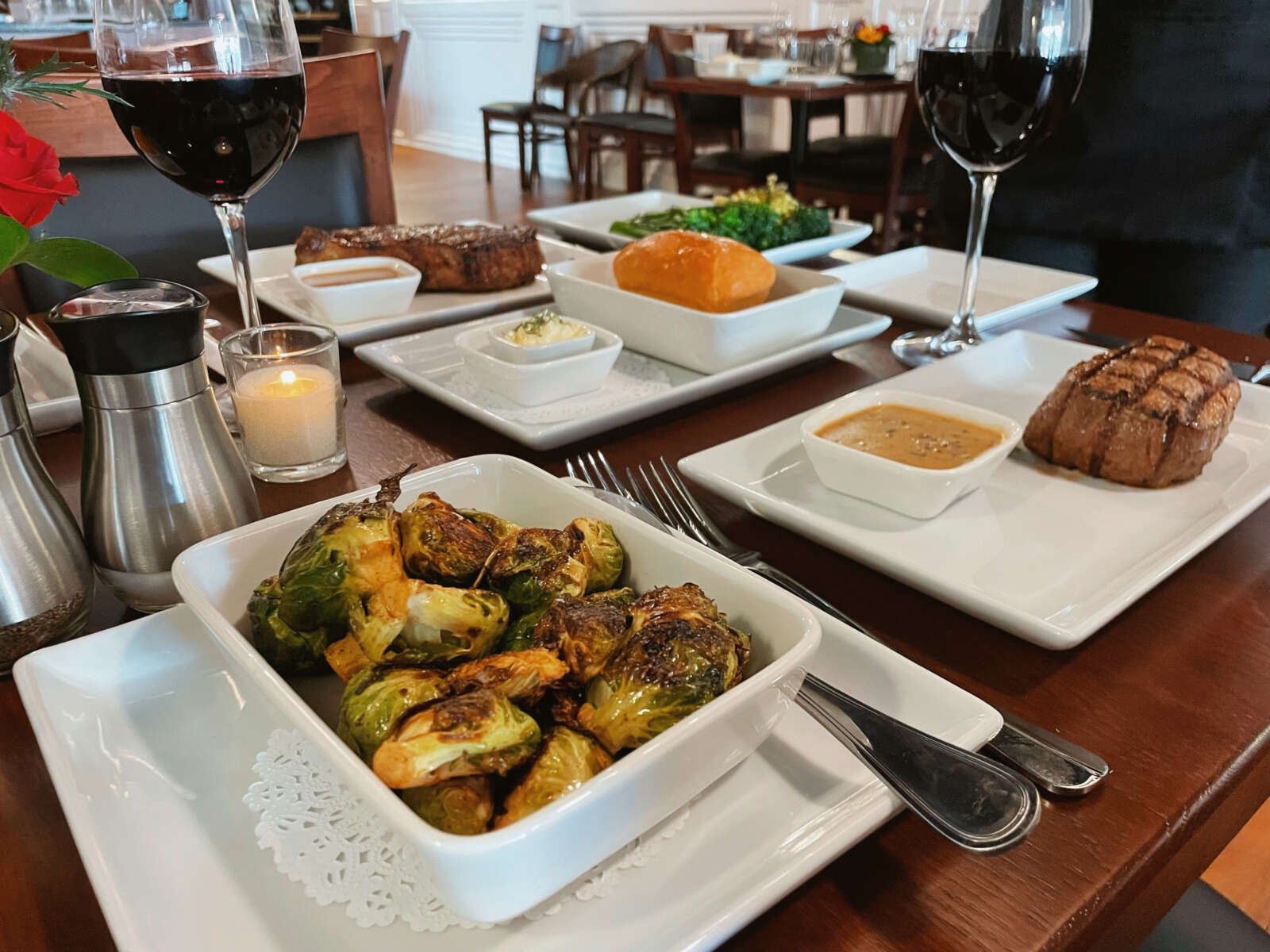
A meal at Guerra Steakhouse (courtesy of Guerra Steakhouse)

Some relief from the heat is on tap this weekend, though it will come at the cost of enduring a bit of rain.

It was quite a week on the site, despite some of our staff members being out of town. Here are the most-read articles of the past week on ARLnow:

  1. Local TikTok Star Arrested Amid Spat with Restaurants
  2. More Than 5,000 Without Power in Arlington
  3. Morning Poll: Have You Been Bitten By the Notorious Itch Mite?
  4. Residents Abuzz Over Mysterious Bug Bites Possibly Tied to Cicadas (July 28)
  5. Local Couple Killed in California Plane Crash (July 19)
  6. Local TikTok Personality to Face Trial, But Notches Partial Court Victory
  7. Guerra Steakhouse in Rosslyn Opens With Slow But Steady Start
  8. Get Ready for a Nine-Day Closure of Glebe Road
  9. Police Investigating Possible Abduction Attempt in Cherrydale
  10. Arlington Resident to Compete on Jeopardy Tonight
  11. Man Shot in Crystal City Hotel
  12. New Aquatics Center Expected to Open This Month

Feel free to discuss those stories or anything else of local interest in the comments. Whether you’re on vacation or hanging out in Arlington, we hope you have a nice weekend!


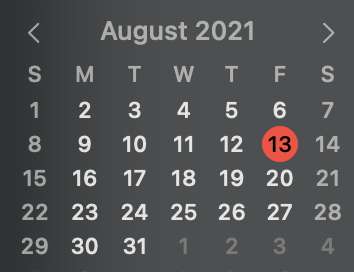
Today is Friday, August 13 — a day that some would consider unlucky.

Friday the 13th lore is at least a century old, and relates to various things, from Jesus’ last supper to the Knights Templar to Norse mythology.

While some may consider superstition about Friday the 13th irrational or silly, others have an actual fear of the day.

“According to the Stress Management Center and Phobia Institute in Asheville, North Carolina, an estimated 17 to 21 million people in the United States are affected by a fear of this day, making it the most feared day and date in history,” notes a Wikipedia entry.

Today we’re wondering: how many people in Arlington — a rather rational place — actually worry when the 13th day of the month falls on a Friday.


What’s Next with Nicole is a biweekly opinion column. The views expressed are solely the author’s.

As some say, local government is primarily pothole politics. Why aren’t the water fountains working? When will the snow be removed? How do I make sure dogs are leashed in my local park? How do I fix this big crack in the sidewalk on my path to the coffee shop? Why is the crosswalk sign not working?

Some of these things like snow removal, sidewalk repair, or crosswalk sign maintenance can be done as simply as using the Service Request/Report a Problem function on the County’s website. For items that fall into this category it consistently amazes me how quickly and efficiently the system works. If all other venues don’t work, you can always tweet the Arlington Department of Environmental Services and our personal miracle worker seems to never fail.

After a discussion started by the Clarendon/Courthouse Civic Association President, David Cheek, it reminded me of the ongoing efforts to improve the Neighborhood Conservation Program that provides funding for larger neighborhood projects.

Recently, a large six-foot sign was erected by the county in the 11th Street Park in Clarendon reminding patrons not to unleash their dogs in the park. Cheek immediately recognized that the underlying problem might not be that park but neighbors’ dismay at Clarendon’s James Hunter Dog Park. He compiled ideas from the community for park improvements and is working with the county for potential solutions.

Typically, improvements to existing parks for improvements suggested by the community would be submitted for consideration by the Neighborhood Conservation Program. The recently released 2021 Neighborhood Conservation Review notes that the Program continues to be cut significantly year after year resulting in only six projects getting approved out of 30 per year, and that the process generally favors low-density neighborhoods by a rate of two to one.

The review generally recommends 1) clarifying the County’s priorities for neighborhoods and their infrastructure, ensuring priorities are supported in plans and streamlining the procedures to achieve these priorities; 2) expanding financial resources to the NC Program; 3) Offering NCAC representatives to expand community outreach and provide a bridge to other neighborhood planning efforts; and 4) simplifying NC participation requirements for civic associations.

These considerations are important for empowering neighborhoods to make a difference in their own backyard.

Nicole Merlene is an Arlington native and former candidate for Virginia State Senate. She has served as a leader in the community on the boards of the Arlington County Civic Federation and North Rosslyn Civic Association, as an Arlington Economic Development commissioner, in neighborhood transportation planning groups, and as a civic liaison to the Rosslyn Business Improvement District.


Traffic on I-66 near Washington-Liberty HS (photo courtesy Eric)

August is the month of vacations.

Congress goes on recess, schools are still on summer break, and legions of D.C. area residents head out of town, to the beach or elsewhere. That leads to less local traffic and more out-of-office email replies.

Obviously not everybody leaves town in August. We’re wondering what percentage of ARLnow readers sticks around and takes their vacations during other months of the year.


Peter’s Take is a biweekly opinion column. The views expressed are solely the author’s.

Over the past 18 months — due to the pandemic — the majority of APS students, particularly minority populations and those with disabilities, have suffered severe learning losses.

APS must adopt a bold plan to remediate these losses which can be instructional, emotional, or mental. The appropriate remedies should also address various shortcomings — whether instructional or administrative — that preceded Covid-19.

Some community members are sensitive to using phrases like “learning losses.” They believe using terms like these will generate further feelings of inadequacy and hopelessness among APS students, or slight our very hardworking teachers. But there are far greater risks than semantics if our Arlington community fails openly to acknowledge this severe problem. Before Covid-19, we talked candidly about the “summer slide.” Post-pandemic learning deficits are far more serious.

Statistical information demonstrates that learning losses are severe

Virginia’s 2021 PALS, which annually identifies students at risk for reading difficulties, revealed the largest group of high-risk students ever in the assessment’s history. The PALS data also indicate that Black, Hispanic, economically disadvantaged and English-language learners were disproportionately in the high-risk category.

APS’s own earlier statistics at the elementary, middle and high school levels previewed this: “Black and Hispanic students, English-language learning students, and students with disabilities are experiencing the deepest drops.”

These are major problems that cry out for bold solutions.

APS’s flip-flops, silence compounds the harm

To date, APS has been reluctant to discuss these problems or propose solutions. Shortly after saying he was “very concerned” about learning losses, Superintendent Francisco Durán played down even their existence, and then just days ago, made not one mention of this in a 69-slide presentation to APS administrators kicking off the school year. These about-faces are damaging and wrong; the scant published information on how APS will address recovery is at best cursory.

Federal funding was awarded to APS specifically to remediate the impact of lost instructional time. Instead of taking full advantage of these resources using proven superior methods to identify students who need extra help catching up academically, socially and emotionally (as the Secretary of Education has called for), APS has designated the majority of its American Rescue Plan Elementary and Secondary School Emergency Relief (ARP/ESSER) funds — $11 million — for the creation of a virtual option for the 2021-22 school year. This virtual academy is slated to serve less than 1,000 (or 3%) of students. Sadly, only about $1 million will go toward hiring elementary reading and math coaches — and these funds are only to be spent at schools that are either Title I or have over 650 students. These precious federal resources are being misallocated to a tiny subset of students without any comprehensive, targeted effort to identify the likely many who, after last year, are at risk for academic struggles if not already struggling.

(more…)


The Right Note is a biweekly opinion column. The views expressed are solely the author’s.

The Arlington County Board is in the middle of its traditional August break. As such, it is a good time for a performance review.

What should we expect from local government?

Ultimately, the most important level of government to our daily lives, outside of self-government, is local government. It is where our tax dollars meet the asphalt. It is where our children attend school, our homes are kept safe, our water is dispensed, and our trash is collected. It is where we should be able to most easily and directly petition our elected officials for assistance. And, at least theoretically, it should be the most responsive to our needs with the smallest amount of bureaucracy and red tape.

As part of the review, let’s ask all of our elected officials to do a self-assessment.

Please rate your job performance based on the following four criteria and provide specific examples to explain your rating:

1) Exercising fiscal discipline
2) Responsiveness to community concerns, particularly in light of the pandemic
3) Meeting basic government services responsibilities
4) Actions to increase transparency and accountability

Points will be deducted for the use of buzzwords (as in “equity”) without concrete examples to back it up.

So where are we?

If you recall, one year ago the County Board had just passed a confusing emergency ordinance that would have prevented a family of five from walking down the sidewalk together and the School Board was scrambling to figure out how to implement virtual learning when teachers refused to return to school.

While APS met Governor Northam’s mandate to return to part-time in-person instruction in March, school officials are currently scrambling as enrollment numbers appear to be lower than anticipated again. While officials are hoping for a turnaround, it seems thus far to be a vote of “no confidence” after a lost year of learning. Many parents who could afford to get their kids out did, and they may not be coming back.

Elected officials have reacted to rising crime by relaxing prosecutorial standards, creating a new disciplinary board for police, and removing school resource officers.

The County Board continues to drive up cost of living by raising taxes, spending surpluses rather than returning them to the taxpayer, adding to our debt, building in higher labor costs, and permanently raising construction costs. The board also made it harder and more expensive for many people to park in front of their own houses.

How would you rate your elected officials this year? Now consider rating them again as if they were all independents and had to run on their record, not on their party label.

Mark Kelly is a long-time Arlington resident, former Arlington GOP Chairman and two-time Republican candidate for Arlington County Board.


A new week of voting in the summer Arlies is here. First, the results from last week’s voting.

Arlington’s favorite gym/fitness studio is Gold’s Gym, followed by Arlington Jazzercise and a three-way tie among MADabolic, Earth Treks and Vida Fitness.

Your favorite OB/GYN is Northern Virginia Physicians to Women, followed by Physicians and Midwives and Healthcare for Women.

Now, let’s vote on this week’s category. Do you have a favorite sports bar where you go to watch the big game? A go-to happy hour spot with plenty of TVs tuned to live sports? Let us know below or by clicking this link.

Voting is open until next Tuesday, when we announce the winners and vote on a new category.

Photo by Julianna Arjes on Unsplash


View More Stories