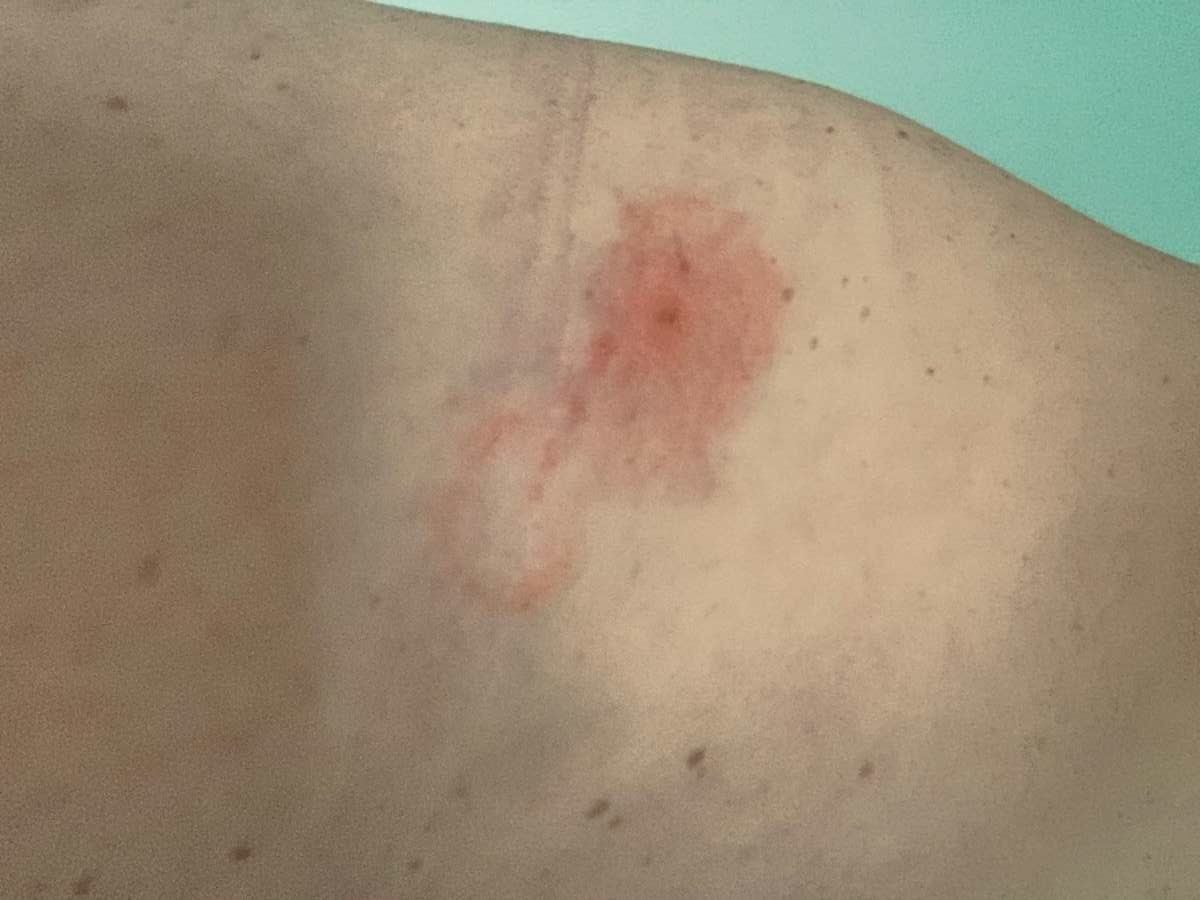
Suspected oak mite bite (courtesy photo)

ARLnow was the first local news outlet to report on the mysterious, highly itchy bug bites many residents were reporting.

Following our article two weeks ago, the bites — red, relentlessly itchy and lasting up to two weeks — have become the talk of the town. Our reporting has been echoed by TV stations, the Post, national outlets, and our friends at PoPville.

County officials and the expert interviewed by the Post believe the bites are from microscopic bugs known as  oak itch mites, or pyemotes, which are thought to feed on cicada eggs. They’re nearly impossible to see on your skin and fall from trees where cicada nymphs have been hatching.

You can’t feel the bites, but after about half a day they produce red bumps that can inflame the skin around it and are seemingly impervious to over-the-counter itch creams. The bumps also form a characteristic pimple-like center.

There’s some bad news for folks who have been suffering from the mite bites: an “oak mite apocalypse” in Kansas City in 2016 persisted well into the fall, until a couple of hard freezes finally brought relief. It’s unclear whether the D.C. area might see the mites scourge end earlier due to their presumed food source — the cicada nymphs — hatching and burrowing into the ground for the next 17 years.

Regardless, today we’re trying to find out the extent of the mite bites so far by asking readers: have you been bitten?


Progressive Voice is a biweekly opinion column. The views expressed are solely the authors’.

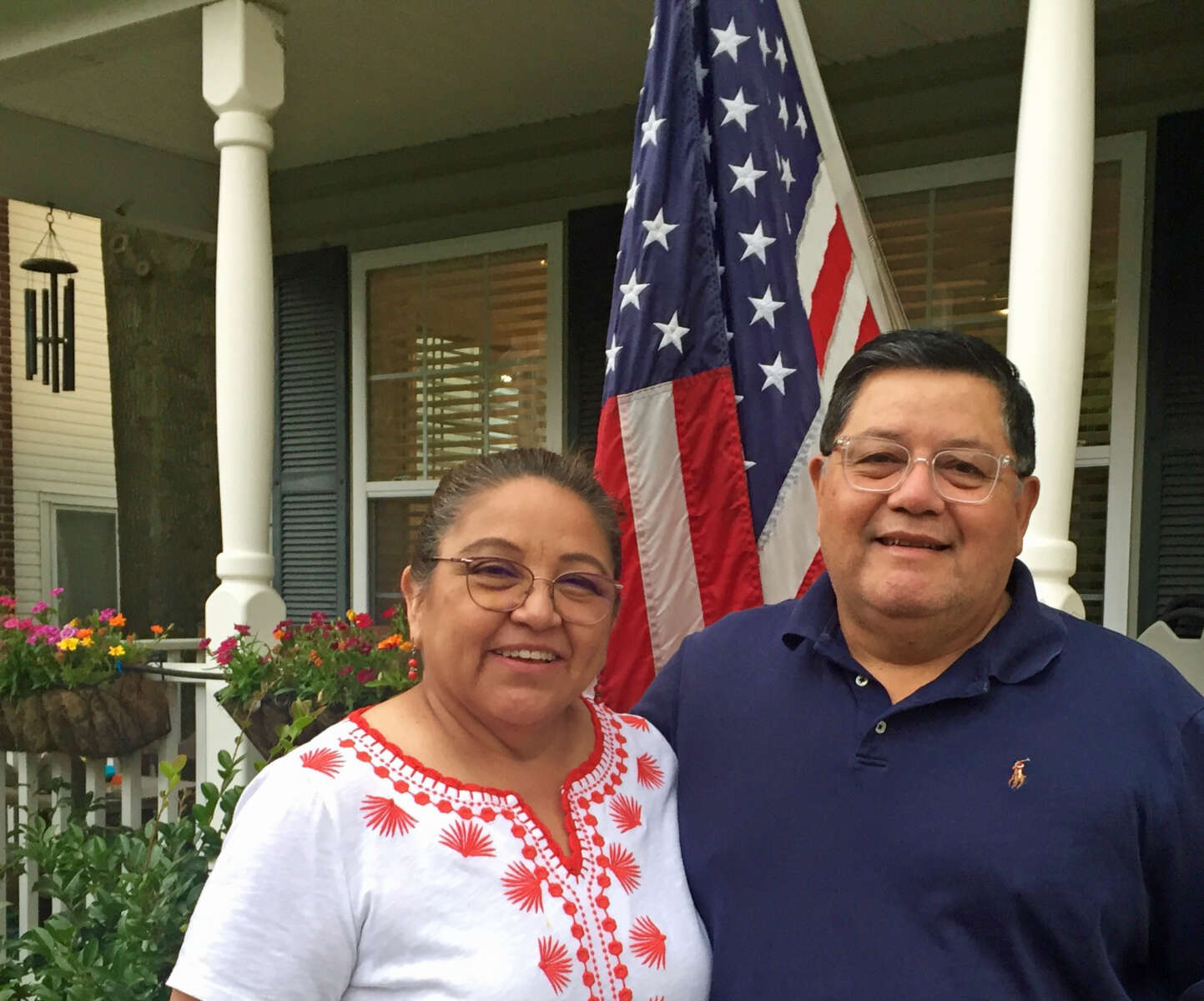
By Gabe and Dolores Rubalcava

The editors of Progressive Voice recently talked with long-time Arlington residents Gabe and Dolores Rubalcava to hear their opinions on how Arlington has changed over the past decades, and what strategic decisions are most important now for county decision-makers.

PV: As an Army family, you moved to Arlington from Ft. Hood, Texas in 1991. Since then, you’ve both worked and raised a family, with all four children now college graduates in their careers. Over time, what have you seen as the most significant changes in Arlington?

Dolores: All the development has been the biggest change. When we first drove up, I thought, “No way this is close to Washington D.C.”…this was a cute little sleepy town…there were one-story houses in Ballston…the miniature golf course there had just been taken down.

Gabe: I was working at the Pentagon and a friend had told us to “find a house inside the Beltway” if we could [to avoid a long commute], so we squeezed ourselves into a smaller place close to Carlin Springs, even though we paid more than we would have farther away. Then later we moved [to the Bluemont area] to a bigger house.

Demographics have changed. When we got here, there were a lot of Vietnamese, Salvadorans. We were one of the few Mexican families. When the Vietnamese got more money they moved to Fairfax. Now we’re seeing Eritreans, lots of Mongolians.

PV: What county decisions and trends have concerned you or pleased you?

Dolores: The development has attracted new people, visitors . . . on the flip side, I wish the south side would get better. For one, the streetcar on Columbia Pike being nixed was so sad. Businesses were looking forward to it, restaurants were so hyped up about it.

Gabe: So instead of the streetcar, people were talking about what buses could do. But . . . that hasn’t happened. In the end, what did we get? Nada. So that was a promise not kept.

PV: How do you think Arlington County should change moving forward?

Gabe: Today it seems in Arlington we have people ’til they are about 30-35 years old, then they move out, whether because of children, or need a bigger house. So a big question is: what could Arlington do to keep people after that point? And then there are older people like us. I want to stay here until we kick off.

PV: What are your ideas to address such needs?

Gabe: On housing, we have to get more creative with solutions. What does it take to change the dynamic? Like recently they approved an apartment building with 228 apartments, and of those, you know how many committed affordable housing units? 12! Just one was set aside for [people with] disabilities! It’s well within our power to fix that. We’re a county with a $1 billion budget.

The county makes decisions on land use. Let the market decide the price point. But, do we want people to stay in Arlington? Let’s look at the duplex idea, other housing ideas so more people could stay here when they want to start families. Most of all, do not be afraid to try something. Sometimes we overthink solutions until we are overcome by events, or we fail to take advantage of the committee recommendation . . . we really do have an educated populace — let’s take advantage of it!

(more…)


Ed Talk is a biweekly opinion column. The views expressed are solely the author’s.

In recent months, parents across the country have disrupted school board meetings and threatened school board members.

The issues drawing the ire of parents include wearing masks, school reopening, transgender student policies, and critical race theory.

There is no doubt that these are hot button issues. Parents have been under great stress during the pandemic and they are passionate about what is right for their children. But this is no excuse for these behaviors.

For example, in Utah 11 people have been criminally charged with disrupting a public meeting after they chanted about masks and approached school board members at the dais, causing the meeting to be adjourned.

Private security officers have been hired in Columbia, Missouri due to safety concerns as some parents have come to school board members’ homes to object to their positions on issues.

The Board of Education for the Blue Valley schools in Kansas recently cancelled an in-person meeting and met virtually following reports of threats by parents.

Similar incidents are happening in our area as well.

The Loudoun County School Board recessed a meeting in June to restore order after parents booed, jeered, and chanted. One person was arrested and charged with disorderly conduct.

Police in Fairfax launched an investigation of complaints that flyers were delivered to homes with antisemitic, homophobic, and threatening language towards school board members.

ARLnow reported on an Arlington School Board meeting in April that required the Chair to make repeated calls for order during public comments about the return to in-person learning and that another Board member characterized as having an unprecedented level of vitriol.

Parents have many appropriate ways to express their strongly held opinions. These include lawful protests outside of school board meetings and speaking at school board meetings, following board guidelines for public comment. They can write letters to the editor and meet with school board members.

Another avenue is working through parent-teacher associations (PTAs). While PTAs cannot engage in partisan, political activities, they can advocate about a wide variety of issues.

In Arlington, the County Council of PTAs has done just that, sharing concerns and making recommendations to school officials about issues such as virtual and hybrid learning, school resource officers, and the school boundary process.

PTAs have elected leaders and have by-laws consistent with the National PTA. Their mission is “to make every child’s potential a reality by engaging and empowering families and communities to advocate for all children.” Their values include collaboration, respect, and accountability. All of this helps PTAs promote civil discourse as they address contentious issues.

Many parents are working outside of PTAs to advance their causes. For example, Parents Defending Education encourages parents to create organizations to push back against “destructive and radical ‘woke’ curricula.” Its website details how to create an anonymous Instagram account to document instances of “woke indoctrination” at schools.

The website of the Arlington Parent Coalition suggests that parents check the social media of their children’s teachers and “like” and “follow” them, as well as to do internet searches of the teachers to see what their views are on social and political issues.

The Open Fairfax County Public Schools Coalition is seeking signatures on petitions to remove duly elected Fairfax County School Board members from office related to their views on school reopening.

Parent voices are an important part of school board decision-making. As parents advocate for their children, they also should model for their children — and for all children — how to engage in civil discourse about high-stakes matters. This means at a minimum focusing on the issues, not engaging in personal attacks, and not disrupting school board meetings.

Abby Raphael served on the Arlington School Board from 2008-2015, including two terms as Chair. She also led the Washington Area Boards of Education for two years. Currently she co-chairs the Destination 2027 Steering Committee, is a member of the Board of the Arlington YMCA, and works with Project Peace, the Community Progress Network, and Second Chance.


Modern Mobility is a biweekly opinion column. The views expressed are solely the author’s.

Protected bike lanes on Fairfax Drive are a project whose time has come.

It’s a critical link that would connect commercial areas, parks, and trails to thousands of Arlington residents. It deserves a place in Arlington’s next 10-year Capital Improvement Plan.

Why Protected Bike Lanes?

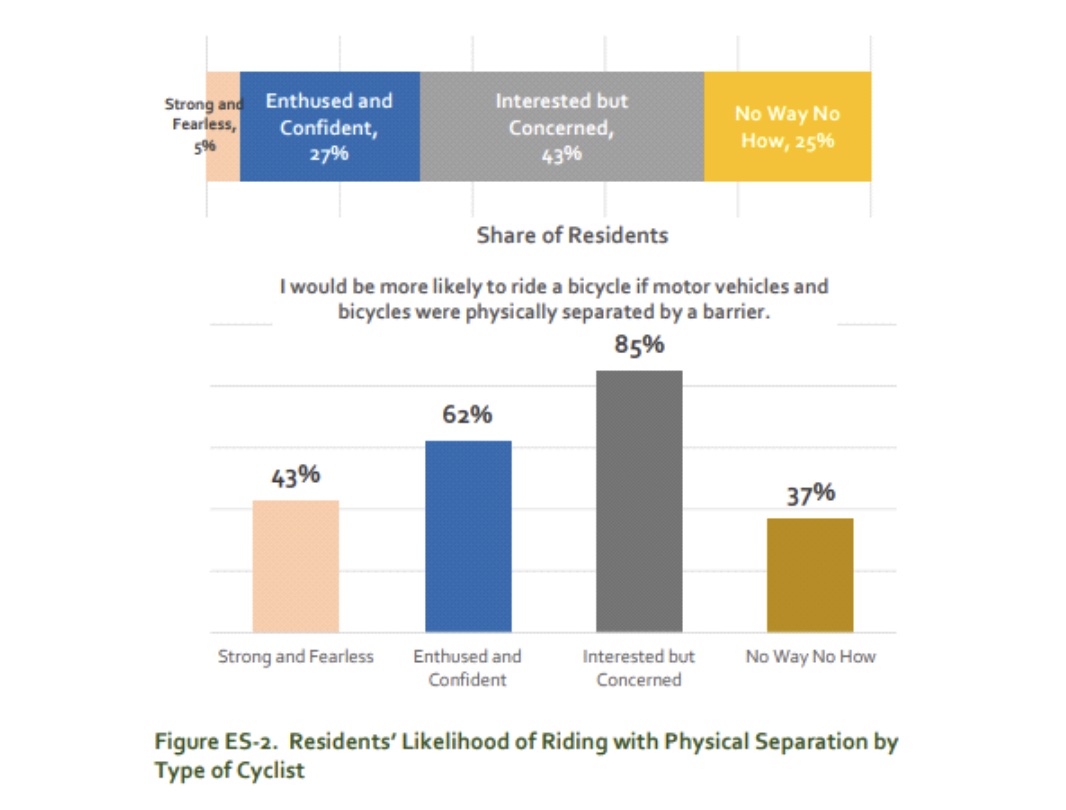
Over the years, we have learned that standard painted bike lanes, like the ones currently on Fairfax Drive, mostly benefit people who are already biking — the confident and fearless cyclists who are already out there on the streets. To making biking work for a wider audience, those who are interested but concerned, we need low-stress facilities like protected bike lanes and trails.

Arlingtonians support more protected bike lanes — when surveyed as part of the last update of the Bicycle Master Plan, 48% of respondents indicated that safety concerns were their primary reason for not biking more and 64% supported more protected bike lanes to solve that problem. Nationwide, we find that once people have experienced protected bike lanes for themselves, support climbs even higher. 75% of people who live near a protected bike lane project say they support more of them in other locations.

Additionally, protected bike lanes are good for business. Protected bike lanes bring more riders – the average protected bike lane sees rider counts increase 75% in the first year alone — and bike riders spend the same at retail each month as people who arrived by car. They buy less each visit but visit more frequently. A Protected Bike Lane project in Salt Lake City that removed 30% of the street parking to install a protected bike lane saw retail sales along the corridor rise by a higher percentage than sales in the rest of the city. A Protected Bike Lane project in NYC on 9th Avenue resulted in drastically higher retail performance.

Finally, protected bike lanes help prevent scofflaw drivers from parking in the bike lanes — a common issue on Fairfax Drive.

https://twitter.com/CCsaywhat/status/1367897904065699844

Why Fairfax Drive?

Fairfax Drive forms a critical east-west path through the County, especially for bikes and scooters. On the west end, it connects to both the Custis Trail and the Bluemont Junction Trail. In the east, it connects to Clarendon Circle where the Wilson Blvd and Clarendon Blvd bike lanes begin. In between in connects commercial areas, Metro Stations, parks, Central Library, the George Mason University campus and more.

There are few, if any, nearby parallel streets appropriate for cycling. Neither Washington Blvd nor Wilson Blvd in the vicinity have bike facilities. One can piece together a decent stretch of 9th Street N., but safely crossing Quincy Street without a four-way stop or traffic signal is difficult, it does not connect well on the West end to the trail network and it falls apart on the East end well short of Clarendon Circle.

Finally, adding protected bike lanes to Fairfax Drive is a chance to make a host of design changes that would make the street safer for everyone. As a former VDOT road, Fairfax Drive has been built almost exclusively to speed motor vehicles — safe crossings are far apart, corners were built to allow high speed turns across crosswalks, lanes are wide and encourage speeding. This section of Fairfax Drive is not just on Arlington’s High Injury Network, it’s #2 in fatal and serious injury crashes per mile in Arlington County.

(more…)


The summer Arlies continue this week with two categories. First, the result’s from last week’s voting.

Your favorite real estate agent for sellers is Liz Lord, followed by Kristin Francis Team and Paul Cachion.

Arlington’s favorite home renovation company is… undecided. No one company received enough valid votes in order to declare a winner.

Now, let’s vote on this week’s categories. Do you have a go-to gym or fitness studio at which you work out? A favorite for lifting weights or taking spin or yoga classes?

Also, do you have an OB/GYN that you favor?

Let us know below or by clicking this link. Voting is open until next Tuesday, when we announce the winners and vote on a new category.


Community Matters is a biweekly opinion column. The views expressed are solely the author’s.

Last week I moderated a conversation on Covid-19’s impact on Black women and girls, specifically around health and education. It was an important discussion, and the topic naturally raises questions about data collection.

We highlighted several topics including the current vaccination rates, the myths preventing someone from taking the vaccine and how some students have benefited emotionally and psychologically from learning in a virtual environment, away from the pressures and microaggressions they face at school. In order to find solutions to these challenges, good data collection is critical.

While there are always people who do not want to provide their demographic information, I am a firm believer that the disaggregated data should be readily available and easy to understand. For example, Arlington County sets a great example by providing easy to read statistics divided into different categories. Arlington County’s COVID -19 dashboard clearly provides Covid-19 data by race and ethnicity, age, etc.

It feels like it was not so long ago when there was a significant debate about whether data on minority groups should be collected, whether someone should be asked their race, and how it should be used. Some believed we shouldn’t call attention to anyone’s race or differences in our “post racial” society, and others simply didn’t want to acknowledge that inequities existed. Today, I think there are more organizations and individuals who see the value in collecting demographic data to better understand where the disparities exist.

The Robert Wood Johnson Foundation uses the following principles when outlining their data collection practices:

Principle 1: Survey respondents, whether internal or external to our organization, must be asked to report on the same set of demographic measures.

Principle 2: Survey respondents must only be asked to report demographic data for themselves.

Principle 3: Inclusivity of all identities is key across all demographic measures.

Principle 4: Transparency is important, but sharing demographic data should be an anonymous, confidential, and voluntary process.

Principle 5: The storage and use of collected demographic data and any related dissemination efforts must be disclosed prior to surveying respondents.

Additionally, one should consider that sensitive questions can affect your outcomes, demographic questions should generally be placed at the end of the survey, and you should explain why you are collecting the data.

Despite the fact that data collection has evolved, we should always advocate for more disaggregation. For example, as I seek to encourage more advocacy for Black women and girls in Arlington and throughout the Commonwealth, it would be helpful to have more statistics on our current status.

There are many components to consider as we strive to build a stronger Arlington, some of them more glamorous than others. While data is not always top of mind, it is a critical part of our work to ensure a more equitable community.

Krysta Jones has lived in Arlington since 2004 and is active in local politics and civic life. This column is in no way associated with or represents any person, government, organization or body — except Krysta herself.


Making Room is a biweekly opinion column. The views expressed are solely the author’s. 

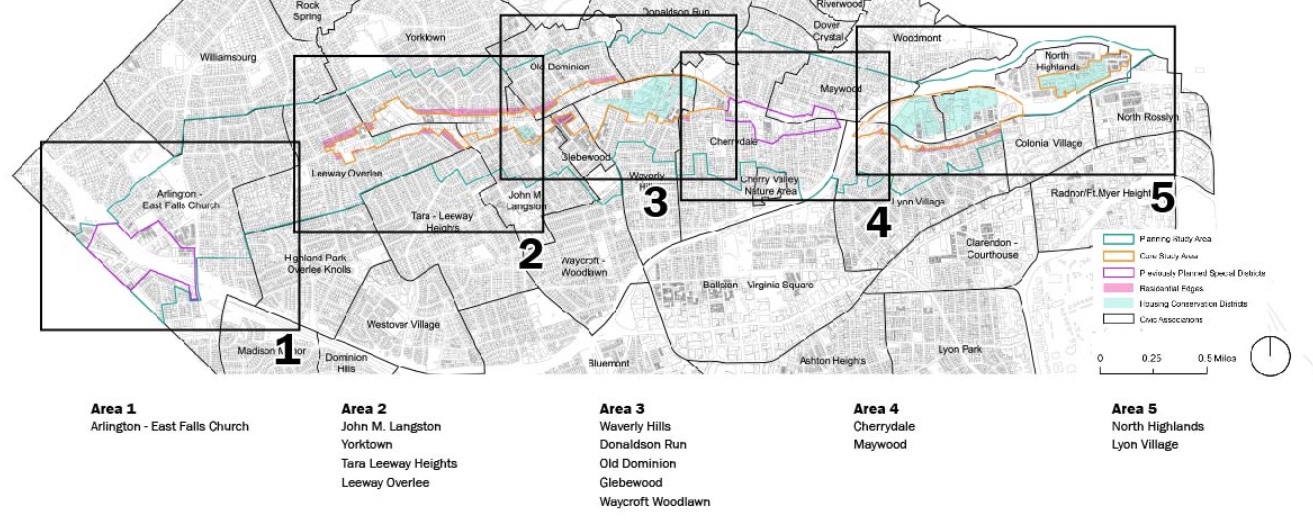
The Langston Boulevard Corridor (formerly Lee Highway) runs along the southern portion of Arlington’s most expensive and exclusive neighborhoods.

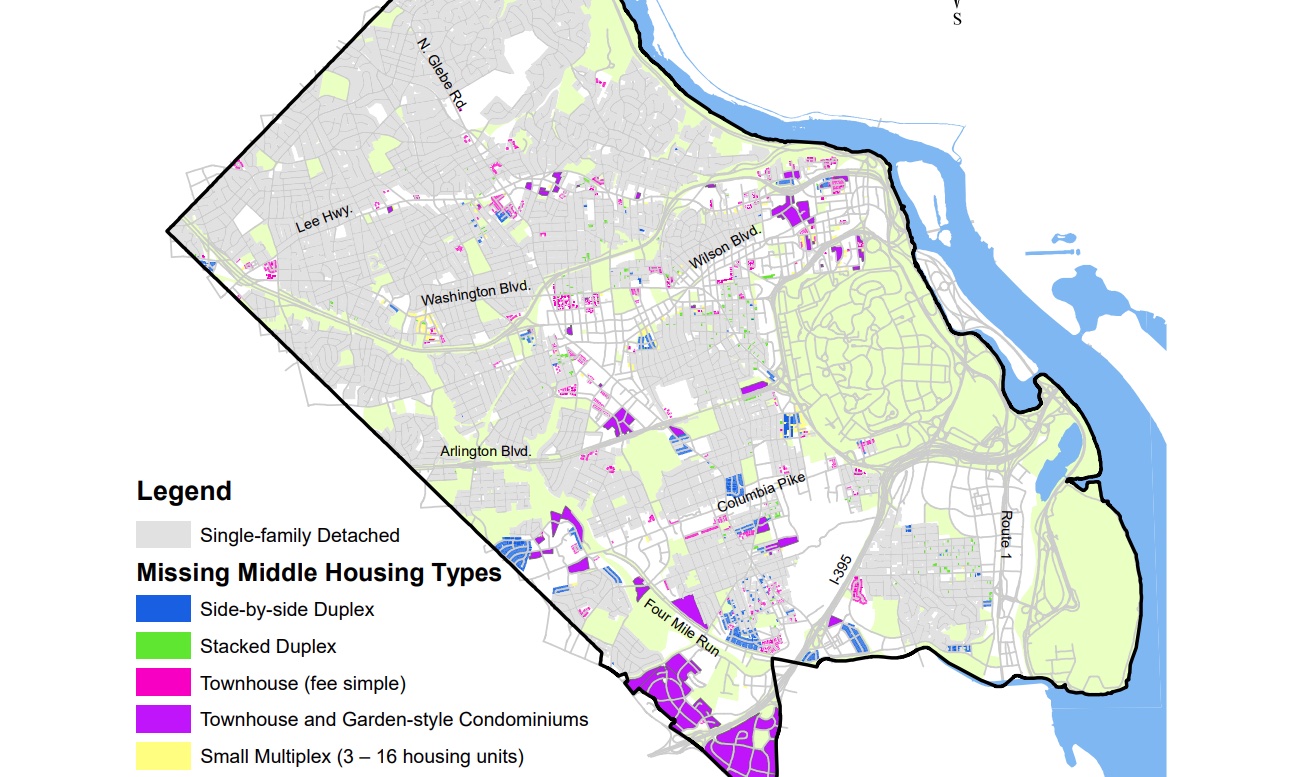
The lots are large, the homes cost a fortune and rental options are few. Arlington County is considering zoning changes along Langston Boulevard that would allow new types of housing, including duplexes, triplexes and small apartments that would be attainable as rental or ownership for moderate-income Arlingtonians.

If you want Arlington staff to take an important step forward by allowing transitional zoning, including missing middle housing, at the edges of the Langston Boulevard Corridor, let them know by August 3.

The Plan Lee Highway process is a revisioning of several neighborhoods surrounding the existing commercial nodes to create more walkable communities, increase the development opportunity, and form a new sense of place. The Plan Lee Highway Concept Plan will come out in the fall.

Langston Boulevard is an ideal place to showcase the benefits of Missing Middle housing. As Arlington’s northern-most arterial road, with regular bus service and a Metro station on each end, it can easily accommodate more residents while allowing people to drive less. To become a modern Main Street, new and existing businesses need more customers to live and shop near their homes. Duplex, triplexes and small multi-family dwellings will provide less expensive homeownership opportunities and more rental units in an area that is financially out of reach to most Arlingtonians.

Missing middle benefits all types of Arlington residents. Young families have more options for their starter home. Senior citizens can find something nearby when they want to downsize. Homeowners have more options if they want to redevelop their property. Gentle density makes our neighborhoods more vibrant, which supports more local businesses and nearby amenities and services. North Arlington has the least affordable housing in Arlington because it has the largest homes, the largest lots, and the fewest rentals. Let’s allow landowners to build the types of housing that fit existing market needs.

Langston Boulevard already has a smattering of small multi-family housing, some of which is now considered “nonconforming” because zoning laws became more restrictive after they were built. Changing the zoning will enhance the existing neighborhood character. Increased density around the East Falls Church Metro Station is especially important because the station has low ridership and was considered for closure by WMATA in a recent budget proposal. Putting more residents within walking distance of the Metro makes good use of this public asset.

Unfortunately, staff have received significant negative feedback from neighbors who are resistant to change. Positive comments about new housing options show our leaders that Arlington is full of people who are looking toward a future of Arlington that is inclusive and sustainable. That means allowing more people to live in opportunity-rich neighborhoods like those along Langston Boulevard.

The Arlington Way is designed to heighten the feedback of older, wealthier, and more established Arlington residents, not to achieve a representative sample of our community (which is 60% renters), or to highlight the perspective of those most in need. “Eternal vigilance is the price of low density,” County Board Member Leo Urbanske said in 1962 when he voted to dissuade “lower income people” from coming to the county by banning three-story walk-ups. Sixty years later, this attitude still holds sway in the county.

Those of us who embrace density, who want housing options for renters and non-millionaires, and who want a place for newcomers, people aging in place and everyone in between, need to show this same vigilance by sharing feedback with the County Board and staff at every opportunity. Please send your comments in favor of missing middle zoning along Langston Boulevard to [email protected] by August 3!

Jane Fiegen Green, an Arlington resident since 2015, proudly rents an apartment in Pentagon City with her family. By day, she is the Membership Director for Food and Water Watch, and by night she tries to navigate the Arlington Way. Opinions here are her own.


If readership is any indication, it seems like a lot of Arlington residents have the same itchy red insect bites described in this week’s most-read story.

It was, in fact, a busy week for readership given that we’re in peak summer vacation season. Speaking of which, August begins on Sunday — enjoy summer while it lasts! Saturday in particular should be a perfect summer day.

Here are the most-read articles of the past week on ARLnow:

  1. Residents Abuzz Over Mysterious Bug Bites Possibly Tied to Cicadas
  2. Local Couple Killed in California Plane Crash (July 19)
  3. New County Logo Designs Released
  4. Apartment Management Tells Parents to Get Kids Off Their Lawn
  5. Apartment Building with Grocery Store Proposed for Ballston Macy’s
  6. President Biden Speaks at McAuliffe Campaign Event in Arlington
  7. Olympic Heartbreak for Huske in Tokyo
  8. Police Investigating Serious Bike Crash Near Yorktown HS
  9. Morning Poll: Which Proposed County Logo Do You Like the Best?
  10. What $1 Million Can Get You in Northern Virginia Real Estate
  11. Coronavirus Cases Still Rising in Arlington Amid Renewed Focus on Masks
  12. Local Democrat Challenges Rep. Don Beyer in 8th District Primary

Feel free to discuss those stories or anything else of local interest in the comments. Have a nice weekend!


It’s not a good year to be an allergy sufferer.

“Allergy season in North America has been the lengthiest and the most severe in decades,” Axios reported yesterday. A number of factors are making allergies worse, from climate change lengthening the pollen-producing season to an overabundance of pollen-producing male trees in urban areas.

That’s not to mention added air pollution from western wildfires and the pandemic potentially leading to more outdoor activity.

Today, we’re asking how this year compares with last year those with seasonal allergies in Arlington. Is it worse, better, or about the same?


Peter’s Take is a biweekly opinion column. The views expressed are solely the author’s.

It’s long past time to get big money out of our politics in Virginia.

During her 2020 Presidential campaign, Senator Elizabeth Warren explained why we need robust campaign finance reform: “[B]efore the legislative process even starts — lobbyists and billionaires try to buy off politicians during elections. Candidates and elected officials often spend hours and hours a day doing call time with big donors, instead of learning about policy and working for their constituents.”

Our political process continues to be eroded by the corrosive role of big money and the impact of pay-to-play practices on our public policies.

While “much of this corruption of our representative democracy is perfectly legal,” some states have done a much better job than others in curbing the influence of big money.

Sadly, Virginia has done a much worse job.

Virginia has failed to strengthen its weak campaign finance system

Virginia’s track record on campaign finance reform is poor. The 2021 Virginia legislative session was no exception. A very modest reform bill died near the end of that session:

Del. Marcus Simon, D-Fairfax, who carried the bill — which passed the House of Delegates 100-0 — said he was “obviously disappointed [the Senate] couldn’t find a way to live under the same rules as the federal government and at least 47 other states.” He had told the Associated Press, when it looked like a breakthrough was possible, that it was his eighth year sponsoring the bill.

Virginia has the dubious distinction of being one of only a tiny handful of states with no campaign contribution limits.

Virginia ranks worse than all but five other states on the Coalition for Integrity’s S.W.A.M.P. index. Virginia needs to lower substantially the water level in this swamp.

2021 Governor’s race exposes the weaknesses in Virginia’s campaign finance laws

The current election for Virginia Governor already has been negatively distorted by the weaknesses in Virginia’s campaign finance laws. An extremely wealthy Republican candidate, Glenn Youngkin, is fulfilling his promise to spend whatever he thinks it takes to win, forcing his Democratic opponent, former Virginia Governor Terry McAuliffe, to spend almost all of his campaign so far raising lots of money and pleading for more.

Predictably, the media’s campaign coverage has concentrated on their money race not their policy differences. This focus adds to the corrosive effect Elizabeth Warren described. Even if there’s a subsequent shift to greater coverage of policy differences, each of these candidates will be unduly influenced by the big money already raised.

(more…)


The Right Note is a biweekly opinion column. The views expressed are solely the author’s.

As expected, the County Board put more pressure on Arlington taxpayers’ checkbooks at its July meeting. The Board voted unanimously to adopt a prevailing wage for contracts over $250,000. That is expected to add 15% to the cost of almost everything we build and buy moving forward.

Then the Board voted to increase our annual debt service obligations by $10.7 million by authorizing an additional $86 million in bonds. Technically the voters will have to approve it in November, but local Democrats will endorse the bond measures on their sample ballot which means it is all but certain to pass. Presumably, the latest round of borrowing would have cost taxpayers just $75 million before the prevailing wage vote.

The Board also voted to adopt collective bargaining which is estimated to cover up to two-thirds of its public employees. Instead of taking responsibility for hiring and paying county staff appropriately, the County Board is punting the accountability to a labor negotiation process which time and again has put local and state governments under financial strain.

While it is difficult to estimate the long term impacts of labor agreements, there is little doubt that it will ultimately result in millions of dollars of additional spending each year down the road with little flexibility afforded to future County Boards to make reasonable adjustments. As Chairman Matt de Ferranti said, “elections have consequences.” In this case, it will be higher taxes to cover the costs.

Higher prices for contracts, more debt, increased labor costs and higher tax rates are on the way. The County Board’s inflation is going to be added on top of climbing gas prices, grocery bills, housing costs and higher health expenses. One might ask what does driving up the cost of living do for equity in Arlington?

Speaking of public employees, the County Board voted to implement a civilian oversight board for the Arlington Police Department, complete with an independent auditor. No doubt this auditor will have more financial resources than the County Auditor who is tasked with examining the efficiency, effectiveness and transparency of Arlington government overall. If so, it’s another reminder that the Board does not place a high priority on responsible spending.

The County Board also voted away its subpoena power for the investigative process to this unelected administrative panel. And the Board ignored warnings that this new panel could put unhelpful pressure to recruit and retain good officers on a department that should be focused on the recent uptick in crime. One thing is sure, when added on top of the removal of School Resource Officers from schools, the signals being sent to the men and women of law enforcement is that Arlington’s elected officials do not trust them.

And finally, Arlington released its latest set of logos for public consideration. The new set is a very slight improvement over the previous set released earlier this year. You can vote here for your favorite. The winner will last until the County Board decides to change our name altogether.

Mark Kelly is a long-time Arlington resident, former Arlington GOP Chairman and two-time Republican candidate for Arlington County Board.


View More Stories