

Peter’s Take is a biweekly opinion column. The views expressed are solely the author’s.

The Arlington County government urgently must act to help ALL tenants at AHC’s Serrano apartments who wish to move.

ARLnow.com exposé

In a May 6 exposé, ARLnow.com reported on deplorable conditions at The Serrano — an affordable housing complex at 5535 Columbia Pike, financed with Arlington taxpayer dollars, and managed by the Arlington Housing Corporation (AHC).

ARLnow revealed numerous health and safety issues, including:

“Mice and rat infestation. Balconies with broken glass and rust. Dirty HVAC units with water damage underneath. Shoddy maintenance.”

Housing Commission recommendations

After ARLnow published, the Arlington Housing Commission held a hearing focused on The Serrano’s long-standing maintenance problems.

Subsequently, the Commission sent a scorching letter to the County Board Chair, including these recommended corrective actions:

  • Immediate Safety of Residents: County staff should conduct an immediate analysis of the ventilation system and rodent infestation. Should the County determine that any units are not currently habitable, County staff should work with affected residents to relocate them to new units, including but not limited to using County financial resources to assist them.
  • Review of AHC Properties: County staff … should begin a review of other AHC properties within the county … to determine if a more thorough review of AHC’s property management policies, procedures, and practices is warranted.
  • Future Development Agreements with AHC: County staff should consider taking into account the failures of AHC … in maintaining their properties when reviewing any future proposals for development and/or County assistance.
  • Sufficient Resources for CAF Oversight: The County Manager should prepare a recommendation to the County Board to increase resources dedicated to code enforcement, compliance, and tenant assistance to address the issues at AHC.

County government appears to have begun to take some of these actions, but has promised help only to those Serrano tenants who are receiving additional federal or local housing rent subsidies (Section 8, housing grants or supportive housing grants), not ALL Serrano tenants who wish to move.

How and why we got here

County government has known about serious maintenance problems at The Serrano and other AHC properties for many years, but County government has failed to take effective steps to fix those problems.

The minutes from a 2018 Tenant-Landlord Commission meeting are illustrative:

Ms. Spencer a resident of Serrano apartments suggested that attention should be given to evictions at affordable housing properties to see the pattern and determine whether there was a problem, and if specific policies may be needed to address this.

BU-GATA reports… in conversations with AHC concerning various properties… issues are primarily, customer service, frequent staff turn-over, violation notices, building maintenance issues across several properties. [M]eetings [should] be reinstated to hear from tenants, for example at Harvey Hall, Gates of Ballston.

But well prior to the pandemic, the County was very solicitous of AHC’s financial health.

County government reduced the interest on at least two AHC loans (AHIF, HOME and CDBG) because AHC was not making a sufficient return. Examples are here, and here (Berkeley/AHC, Shelton/AHC and Cameron Commons/APAH: interest rate reduced).

The County’s loss of this interest income reduced the amount of capital being returned to the AHIF revolving loan fund.

(more…)


The Right Note is a biweekly opinion column. The views expressed are solely the author’s.

The rotating writers of the Progressive Voice often make some interesting claims.

In yesterday’s column, Craig Hines suggested that the results of the past two years in Richmond were “the will of voters.”

While Mr. Hines did point out a handful of Democrats’ wish list item wins, he did leave off a few less popular outcomes.

  • Kids shut out of schools for a year which ignored science and the best interest of children at the behest of special interests.
  • Cities being allowed to burn during riots.
  • A parole board that let convicted murderers with life sentences out of prison without so much as notifying the victims’ families.
  • Energy rules and regulations that will make every good and service more expensive.
  • COVID mandates added on top of tax hikes that are crushing small businesses.

For years, Virginians at large have benefitted from a strong economy fueled by the federal government and a relatively stable regulatory and tax environment. However, Virginia is now ranked 26th for its business tax climate by the Tax Foundation. According to the Chief Executive, Virginia was the 16th best place to do business in 2020, down from 13th in 2019. And according to the Motley Fool, Virginia was the 49th best place to start a small business in 2020.

Mr. Hines’ assertion that the Democrat record is “common-sense” and backed by the public will be put to the test this November across Virginia. There is no question they have more to answer for than liberalizing marijuana possession or eliminating voter ID requirements.

While the assertion that every outcome was the “will of voters” may not hold up, Mr. Hines’ assertion that “elections matter” is spot on. Adopting a total blue state posture will bring blue state results.

In Arlington, after nearly five years of having an independent serve on the County Board, the five member body has snapped back to group think. And, it has been made even worse by a year of virtual meetings.

Contrary to Mr. Hines’ suggestions, John Vihstadt did not lose the 2018 election because an engaged electorate disapproved of the job he was doing. Vihstadt ran more than 30 percentage points better than the Republican on the top of the ticket, and he received over 11,000 more votes than he had four years prior.

Vihstadt’s re-election effort was unsuccessful because Democrats turned out tens of thousands of voters who did not usually vote in non-presidential elections, and who came out to vote the straight party ticket. Anyone who watched closely knows that Matthew de Ferranti’s entire campaign was “I am a Democrat, and John Vihstadt is not.”

It was a prime example of election results in the current age of political tribalism rather than the evaluation of a record or the promise of an agenda. As a result, Arlingtonians are all feeling the loss of Vihstadt’s independent voice which held his colleagues accountable.

Mark Kelly is a long-time Arlington resident, former Arlington GOP Chairman and two-time Republican candidate for Arlington County Board.


Progressive Voice is a bi-weekly opinion column. The views expressed are solely the author’s. 

By Cragg Hines

The past two sessions of the General Assembly have been the most progressive in the more than 400 years that Virginia has had a legislative assembly.

As the House of Delegates and Senate met in 2020 and 2021, they abolished the death penalty;  marijuana possession by adults was legalized; voter rights were expanded, including same-day voter registration; and gun-safety laws were strengthened, including background checks for private gun sales. The state minimum wage was increased; conversion therapy for homosexuals as adults was banned; and the age-old problem of racial discrimination based on hair, including its texture and type, was outlawed. The proposed Equal Rights Amendment to the U.S. Constitution was finally supported — four decades after Congress sent the measure to the states.

These actions were not happenstance, nor were they strokes of luck, and certainly not inevitable. No, each was the result of electoral choices across Virginia that produced partisan swings in the Senate and, especially, in the House of Delegates, albeit narrowly. Democrats today lead the Senate 21-19 and the House of Delegates 55-45.

As each landmark measure was enacted, I took to social media to remind: “Elections matter,” because they do, and elections will matter again this fall as common-sense Democrats defend their hold on the three statewide offices — governor, lieutenant governor, attorney general — and their majority in the House of Delegates.

Similarly, the Democratic edge in the State Senate will be on the line when all 40 members are up in 2023.

Elections matter locally, too. Longtime Republican John Vihstadt, calling himself an independent, first won an Arlington County Board seat in a quirky special election in 2014. But when Democrats focused laser-like in 2018, Vihstadt was swept right back out by a determined Democrat, Matt de Ferranti.

Democrats across the Commonwealth this fall will need a similarly tight focus on the progressive, common-sense nature of their reforms, almost all of which have public support gauging by recent statewide polls. The main task for Democrats is getting their voters to the polls.

None of the common-sense measures that passed in 2020 and 2021 would have been enacted without the legislative elections in 2017 that cut into Republican control of the House of Delegates and the one in 2019 that put Democrats in control of both House and Senate. For the first time in 25 years, Virginia voters produced a Democratic “trifecta” — Democratic majorities in the House and Senate to add to a Democratic governor, Ralph Northam, elected in 2017.

Early in Northam’s term, he proposed election reform, but Republicans with legislative majorities “just dismissed it,” Northam has recalled. When Northam called a special gun-safety session in the summer of 2019, after a mass shooting (13 dead, including the shooter) in Virginia Beach, Republicans dug in their heels and adjourned after only two hours.

Such Republican intransigence was a red-meat talking point for many Democratic legislative challengers in the fall campaign of 2019. It was one of many issues (including the shambolic performance by Donald Trump) that worked to Democratic advantage, especially in the vote-rich Washington suburbs.

There were historic leadership shifts as well. Democrats running the House of Delegates elected the first woman speaker, Eileen Filler-Corn of Fairfax, and the first woman — and first person of color — as majority leader, Charniele Herring of Alexandria. In the Senate, the job of President Pro Tem went to Louise Lucas of Portsmouth, also the first woman and first person of color to hold that post. Yes, elections matter.

Democratic candidates were clear about what a legislative majority would mean, and delivered much of their program.

This year’s elections could continue along a common-sense path, or Republicans, if victorious, could begin to roll it all back. Year after year, and not just in presidential contests, elections matter.

Cragg Hines is a longtime journalist and former member of the Arlington County Commission on Aging. 


Ed Talk is a biweekly opinion column. The views expressed are solely the author’s.

May 17 marks the 67th anniversary of Brown v. Board of Education (1954), the landmark Supreme Court case that overturned the doctrine “separate but equal,” which became law in 1896 when Plessy v. Ferguson upheld the constitutionality of racial segregation laws for public facilities, as long as the segregated facilities were “equal” in quality.

In Brown, the Court unanimously held that “separate educational facilities are inherently unequal,” and violated the equal-protection clause of the 14th Amendment. However, the Court declined to specify remedies for school segregation, asking instead for further argument.

The following year, in Brown v. Board of Education II, the Court remanded future desegregation cases to lower federal courts and directed district courts and school boards to desegregate schools “with all deliberate speed.” Although Brown has been the law of the land for much longer than Plessy was, little has changed in our schools vis-à-vis segregation and inequality.

To commemorate the 67th anniversary of Brown, the Department of Education, Office of Civil Rights and the Department of Justice, Civil Rights Division considered it paramount to host a joint symposium, Brown 67 Years Later: Examining Disparities in School Discipline and the Pursuit of Safe and Inclusive Schools, to highlight strategies for addressing racial and other disparities in the administration of school discipline.

Three panels composed of legal and education experts discussed the impact of exclusionary school discipline policies and practices such as suspensions and school-based arrests on students of color, students with disabilities, and LGBTQI+ students. They shared strategies for addressing harmful and discriminatory school discipline practices and creating more positive school climates.

Two main strategies emerged for achieving this; removing School Resource Officers (SROs), and implementing restorative practices, neither of which APS has managed to accomplish yet as neighboring districts have. As a result, Black students are suffering irreparable harm. The school board has convened a community-based SRO Work Group to consider and recommend in June whether to keep SROs.

APS’s 2019-2020 suspension data in a partial pandemic year shows that Black students accounted for 27% of all out-of-school suspensions despite comprising 11% of APS’s population. By contrast, white students accounted for 16% of suspensions despite comprising 41% of APS’s population.

The 2018-2019 suspension data, more consistent with the 10-year average, shows that Black students accounted for 34% of all out-of-school suspensions despite comprising 10% of APS’s population. By contrast, white students accounted for 18% of suspensions despite comprising 44% of APS’s population. The disparities by school are even more stark.

Not surprisingly, the word “restorative” does not appear anywhere in APS’s discipline policy (J-7.4) or its accompanying policy implementation plan (PIP) (J-7.4 PIP-1), nor does it appear in the Draft Student Rights & Responsibilities: Code of Conduct Handbook. When these documents were circulated for revision and amendment, stakeholder groups deemed them retributive in tone and advised that restorative practices be added. The discipline policy is scheduled for “action” by the school board in August. Whether the school board will adopt the recommendations remains to be determined.

Notwithstanding Restorative Arlington’s Strategic Plan, there is no-one in the county with expertise in school-based implementation. While APS blithely promised a one-year pilot, that promise remains unfulfilled as APS disregards the only operational restorative practices program for school-aged youth in Arlington — Promoting Empathy through Equitable Resolution (PEER) — operated by a community-based organization.

(more…)


Modern Mobility is a biweekly opinion column. The views expressed are solely the author’s.

May is Bike Month, and from what I’ve seen out and about so far, lots of you are already celebrating.

The pandemic has caused a lot of folks to drag an old bike out of the garage, pick one up from a local bike shop or just ride more frequently, which is fantastic to see. There are some great, free activities this month to help keep you on your riding journey.

Celebrate Bike Month with BikeArlington

BikeArlington is doing a bunch of fun events and challenges for the whole month of May, you can still register here. The first week, we got a prompt to encourage us to ride (Replace One Car Trip: try to make one trip this week that you would normally make in a car, on a bike) as well as delicious weekend deals (25% off at Nicecream? Yes, thank you!).

Bike to Work Day

Bike to Work Day is back for 2021 on Friday, May 21, after being cancelled in 2020, with some modifications to support COVID safety. Get your free T-shirt, some exercise and some fresh air. You can register here. Aren’t going in to the office? No problem – it’s a good excuse to just bike to your local pit stop, or anywhere really.

Bike to Work WEEK

If Bike to Work Day isn’t enough for you, the National Landing BID is continuing their tradition of hosting Bike to Work Week from Monday (May 17) to Friday (May 21) from 7 a.m.-9 a.m. at the Crystal City Water Park. Again, modifications have been made to ensure COVID safety, so don’t expect to linger. Participants who check-in all 5 days will earn coveted, exclusive National Landing Cycling Swag. Register here.

This beautiful May weather is a great chance to explore and learn how easy it can be to bike for those short trips that make up the majority of our typical travel. The majority of trips the average American takes are less than 6 miles. Bike to dinner, bike to ice cream, bike to the park, bike to the dentist, or bike to the pharmacy to pick up your prescription. You won’t sit in traffic, you won’t have to pay for parking, and it’s amazing what you’ll notice about your neighborhood when aren’t inside a steel & glass bubble.

I hope to see you out there! Be sure to wave!

Chris Slatt is the current Chair of the Arlington County Transportation Commission, founder of Sustainable Mobility for Arlington County and a former civic association president. He is a software developer, co-owner of Perfect Pointe Dance Studio, and a father of two.


Community Matters is a biweekly opinion column. The views expressed are solely the author’s.

The Network NOVA Friday Power Lunch recently focused on how little lies, or misinformation, can grow into bigger lies if they go unchecked.

Lowell Feld, editor of Blue Virginia, noted that the Washington Post made the case that one fifth of Democrats were being challenged by far left challengers in the 2021 House of Delegates primaries.

After analyzing the data, he found that there were only four challengers who were running to the left of the incumbents. He asserted that there is a common refrain in the media that the Democratic Party is at war with its “left wing/progressives” and this story fit the narrative. This “misrepresentation” can help shape a false narrative and impact other issues.

He also mentioned the idea of false equivalencies. For example, lies and misinformation spread through the radical conservative community and led to the January 6 insurrection on the U.S. Capitol. Furthermore, a ridiculous comparison was made between the attack and the earlier Black Lives Matter (BLM) protests. The police response was much different for the BLM protests, and included tear gas, detentions and multiple arrests, which likely falsely fueled the public perception of the intent of the protestors.

When one side promotes racial justice and one side promotes white supremacy, we have to be clear that one is right and one is wrong. Yet, they were presented as if they were two equal sides of an issue, which also means that we feel we have to give them equal time and attention.

If gone unchallenged, this cycle changes how we think of the issue, and fuels supporters on the side of the “wrong” issue. It makes it harder for those on the side of the truth to recognize that they are in fact supporting the truth, and not just the opposite of the other side.

It’s obviously not always simple. For example, similar to any cause, there are some rogue Black activists who have strayed from the original BLM mission. Highlighting the few bad actors on any issue is a misrepresentation. It changes public perceptions, our individual conversations and thinking, and muddles policy.

Arlington is debating several issues as a community. We have already made a concerted effort to engage community voices as we reform our police practices, and are in the process of selecting a new police chief.  I challenge us all to remember why we are talking about police reform now, and push back if we see the coverage or conversations switch to a different narrative. We have also recognized a need to reform zoning laws through the Missing Middle Housing Study. Due to the history of housing discrimination and links to systemic racism, we know some may want to hold on to a system which has allowed them to thrive. As we continue to discuss these and other issues, it is important for us to check the facts, and challenge how views are presented in all forums.

The manner in which we handle each conversation, in addition to the outcome we seek, helps define who we are. A part of that process is expressing our views in a number of ways including through traditional media, social media, events, speeches and informal dialogue. We should all be aware of false equivalencies and misinformation that have insidiously shaped the narrative and coverage, and do our part to root out all lies, whether they are “sweet little lies”, or not.

Krysta Jones has lived in Arlington since 2004 and is active in local politics and civic life. This column is in no way associated with or represents any person, government, organization or body — except Krysta herself.


Making Room is a biweekly opinion column. The views expressed are solely the author’s. 

If the last year has taught us anything, it is that half measure never provide real solutions to our most pressing problems.

In the realm of housing, our leaders should be taking bold action to address affordability and ensure a sustainable future. This means being courageous in championing an end to exclusionary zoning and embracing policies that will allow multifamily housing throughout the County.

Housing affordability and the terrible legacy of exclusionary zoning are making national headlines. In recent weeks, this has been spurred by a proposal within President Biden’s American Jobs Plan to “eliminate state and local exclusionary zoning laws.” National opinion writers have clarified that restrictive zoning policies are antithetical to both progressive values of inclusivity and conservative values of the free market.

As the national conversation moves toward acceptance of inclusive and open zoning, advocates at the local and state level have succeeded in pushing elected officials to act. Communities across the country are making news by taking bold steps to add housing, in the name of racial justice, as well as economic necessity.

The City Council of Berkeley, California, voted to eliminate single-family zoning, a century after it was the first city to establish the practice. This is a symbolic but significant step, recognizing the racist legacy of exclusionary zoning. Other cities in California have made similar moves, including Sacramento and San Jose. This follows Minneapolis’s transformative zoning change in 2018, and statewide zoning liberalization in Oregon in 2019.

Why isn’t Arlington making news on this front?

We were the beneficiaries of the biggest economic development decision of the past decade when National Landing was selected as the location for Amazon’s second headquarters. This decision made news across the country. The anticipated, and ongoing, challenges to housing affordability, displacement, and tenant advocacy also made news.

But Arlington County is not making news with its policy response. Instead, we are taking miniscule steps, deferring to entrenched interests at every point. Everything is undertaken from the perspective of an incumbent landowner who demands a low-density, car-centered neighborhood blocks away from corridors rich with opportunity.

Arlingtonians pushing for affordable and attainable housing, as well as safe streets and reduced car traffic, face a gauntlet of public meetings. It takes hours of our lives to get a half mile of protected bike lane or an extra unit of housing on a single-family lot.

The Vernon Street Duplex is a proposal for a two-unit dwelling on a corner lot along Washington Blvd. Because of zoning rules, the builder must go through the same site plan review process that the County has for large-scale apartment or office buildings. “Missing middle” housing will never be attainable for middle-income families if it is forced to incur onerous planning processes.

(more…)


Arlington seems stuck in a relatively slow news cycle, with few significant breaking stories to speak of over the past few weeks, but that may change next week.

First, we have a County Board meeting next weekend that should keep us busy with coverage. Second, these slow cycles never last for long and we’re due for a big story or two. Third, you’ll be seeing a new byline here over the next couple of weeks, and more staffing allows us to cover more local stories.

Despite being a bit slow, there were still plenty of interesting local stories this week. Below are the most-read articles of the week.

  1. Police Investigating Bomb Threat in Crystal City
  2. Pupatella Named One of the Best Pizza Places in Virginia
  3. Pierogi Joint in Ballston Cooks Up Star Wars-Themed Specials
  4. Rodents, Mold, Shoddy Maintenance Plague Affordable Apartment Building
  5. Lower Enrollment Could Help Bail APS Out of $11M+ Deficit
  6. Police: Erratic, Armed Driver Arrested
  7. Morning Notes (May 4)
  8. Pedestrian Walkway Coming to Sidewalk-Less Side of Rosslyn Street
  9. Arlington’s Vaccination Rate Now Higher Than N. Va. Neighbors
  10. Coronavirus Cases and Vaccinations Both Down in Arlington

Feel free to discuss those or other topics of local interest in the comments. Have a nice weekend and, for all the moms out there, happy Mother’s Day!


Lyon’s Legacy is a limited-run opinion column on the history of housing in Arlington. The views expressed are solely the author’s.

A century ago, white supremacy in Arlington was bigger than Frank Lyon. It reached up into the County Board, down into secret societies, and so deeply into our county’s life that its fingerprints are still found in our elections, our zoning laws, and traces hiding in our rafters and backyards.

This is the fifth part of Lyon’s Legacy, a biweekly series on ARLnow (you can read the whole thing, with citations, here). It will tell an eight-part history of how Black people, and other groups that experience racial or economic discrimination, have been excluded from living in Arlington County.

Last time, we saw how Frank Lyon and other private developers used three strategies to keep Black people out of their new neighborhoods: racially-restrictive covenants, economically-exclusive zoning, and automobile-oriented design. This week, we’ll see how Arlington’s government — like governments across the country — adopted these techniques of segregation and imposed them everywhere.

Lyon wasn’t alone in wanting an all-white Arlington. In 1912 the County Board passed a segregation act preventing the sale of houses to Black people in all new developments. The law was in effect for five years until a 1917 Supreme Court decision nullified such government-imposed segregation policies across the nation. But private restrictive covenants like those used by Lyon, on individual homes and neighborhoods, weren’t made illegal for another few decades.

The County Board’s first attempt to keep Black people out of Arlington was vexed by the Supreme Court. But they didn’t give up. The Board adapted Lyon’s technique of exclusivity through expense into Arlington’s first-ever county-wide zoning code in 1930.

Almost the entire county was zoned exclusively for single-family detached houses. The code made it illegal to build apartments, rowhouses, duplexes, or stacked flats across Arlington. This ban kept poor people out of new suburbs and it arrested the growth of existing Black communities, most of which already had the middle-density housing that the zoning code forbade. Unlike the restrictive covenants, which were nullified decades ago, this economically-exclusive zoning remains in effect on almost three-quarters of our county.

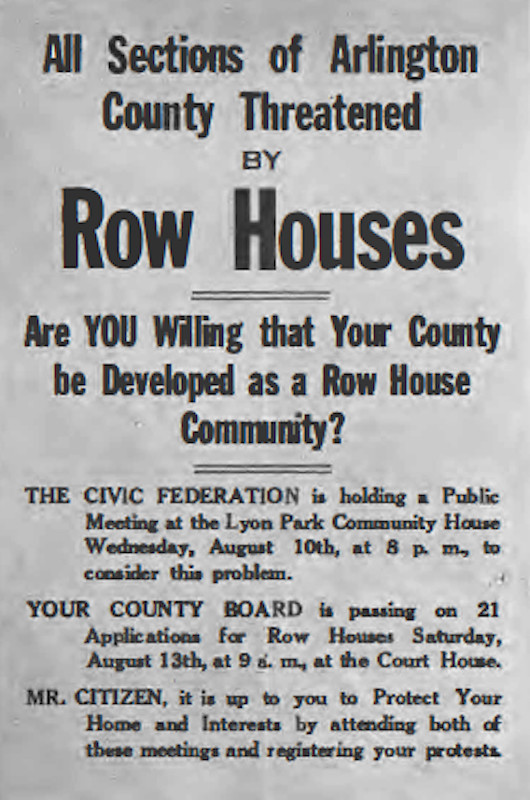
A 1930s community poster advocating against rowhouses. One wonders who these ‘threatening’ rowhouse residents were expected to be. Image by Arlington County Historical Society.

Exclusive zoning was motivated, in part if not entirely, by white supremacy. The same zoning code also enabled the construction of a racial segregation wall to separate Hall’s Hill, which was Black, from the white neighborhoods of Fostoria and Waycroft. Parts of this wall still stand today, though many of the remains were toppled in 2019’s July flash flood. One of the code’s authors, Edward Duncan, helped to write the 1912 segregation law. The 1930 zoning code was not racist in its language, but it was racist in its intent and its impacts.

The racial segregation wall in Hall’s Hill, photographed before the storm of 2019. Image by Frank da Cruz. Much of the wall still stands in neighborhood backyards.

Arlington wasn’t uniquely racist. The story was familiar across the country.

Legal historian Richard Rothstein shows: “…there was also enough open racial intent behind exclusionary zoning that it is integral to the story of de jure [legal] segregation. Such economic zoning was rare in the United States before World War I, but the Buchanan decision [by the Supreme Court to ban explicit segregation] provoked urgent interest in zoning as a way to circumvent the ruling.”

Still today, in many major American cities, as much as 90% of residential land is zoned exclusively for single-family detached houses.

Nor was the zoning code the only county-wide racist policy that Arlington witnessed in 1930. In the beginning of that year, four members of Arlington’s Black community offered their candidacy for County Board. At the time, that body’s seats were determined on the basis of district, unlike our at-large elections today.

In the light of Arlington’s geographic segregation, the district voting system meant that a Black candidate actually had a shot at winning. For white Arlingtonians, this was unacceptable.

(more…)


Peter’s Take is a biweekly opinion column. The views expressed are solely the author’s.

APS has promised a return to “as close to pre-pandemic normal as possible” for Fall 2021,  but the details regarding what “in-person” really means have not been revealed.

Will the pandemic-era Plexiglas barriers, 10-foot distancing at recess, untouched libraries and art rooms, and no group work remain? What about the expansive quarantine policies, shortened days, and no aftercare that extend time out of school?

August 30, 2021 — the best of Sept 1, 2019

“In-person learning offers our young people the best opportunity to develop their passions, bond with their peers, and thrive. Let’s safely get our schools re-opened.” US Education Secretary Dr. Miguel Cardona, April 27, 2021.

APS MUST provide five FULL length days with a teacher in the room for all students who choose it in the 2021-2022 school year. Children should be able to collaborate with and learn from each other, touch materials, and play together without restrictions.

APS must ensure that the full range of its programs are in-person and active in Fall 2021, including enrichment classes, sports with fans, and in-person after school and evening activities, many of which are some children’s only chance to feel successful outside the academic environment.

Having school as normal as possible is also the best route to helping children feel comfortable returning to normal life and to send the message that school is SAFE. In particular, APS should hold in-person open houses in August so that children can see the building and spend time in their classrooms to be comfortable.

Coming together to address the impact of the pandemic

The Arlington community must come together to address the disproportionate impact of pandemic education, particularly among our most vulnerable populations.

APS’s own statistics at the elementary, middle and high school levels establish that “Black and Hispanic students, English-language learning students, and students with disabilities are experiencing the deepest drops.”

This crisis should be addressed using Federal Recovery Act and local funding. APS must:

The current shortened elementary day and expansive quarantine policies exacerbates this year’s childcare crisis. APS must update its quarantine policy to reflect  CDC guidance, offer a full school day and aftercare to prevent additional childcare crises and lost learning time in Fall 2021.

“We cannot undo the past, but we can recover in a way that is truly different than the inequitable system we should leave behind.” Dr. Pedro Noguera USC Education School Dean, March 31, 2021

Restore a healthy screen-use balance–particularly for our youngest learners

APS must restore a healthy screen-use balance. Excessive screen time damages children’s mental and physical health at all age levels, but particularly for our youngest learners.

In 2019 — the last full year before APS shut down in-person learning — APS had decided to end its 1:1 digital device program for students in K-2. This was welcome news to parents who were insisting on less school time iPads and the bulk of their classroom time “personally interacting with others, manipulating objects, playing and exploring outdoors, and doing art and science projects.” But in this year’s operating budget, APS reversed course and funded a 1:1 device program for K-2.

Beginning with the Fall 2021 semester, APS must restore its 2019 practice of eliminating the 1:1 program in K-2 classrooms.

APS should pledge now also to eliminate 1:1 sequentially in grades 3-5 for in-person classrooms by the end of the 2024-2025 school year.

School Board accountability and responsibility

Access to a free, quality public education is a Constitutional right in Virginia. Voting by elected officials is a fundamental element of representative democracy and critical to sustaining open dialogue. But APS’s School Board has not taken a single vote on any aspect of Return to School. The Arlington School Board should vote this month on the Superintendent’s reopening plans for summer and Fall 2021, take every opportunity to ask questions, and push for a return to normal.

Peter Rousselot previously served as Chair of the Fiscal Affairs Advisory Commission (FAAC) to the Arlington County Board and as Co-Chair of the Advisory Council on Instruction (ACI) to the Arlington School Board. He is also a former Chair of the Arlington County Democratic Committee (ACDC) and a former member of the Central Committee of the Democratic Party of Virginia (DPVA). He currently serves as a board member of the Together Virginia PAC, a political action committee dedicated to identifying, helping and advising Democratic candidates in rural Virginia.


The Right Note is a biweekly opinion column. The views expressed are solely the author’s.

For the second year in a row, the County Board voted to adopt what looks like a pay raise for itself.

On page 28 of the Pay Plan, the salaries for the five member board all jumped by 4.5% compared to the amount described on the county website. Board Members are currently paid $55,147, and the Chairman at $60,662. The Pay Plan for fiscal year 2022 appears to set to raise that pay to $57,648 and $63,413 respectively.

Last year when a 3.5% pay raise appeared in the Pay Plan, we were told in no uncertain terms that there was not funding for the pay raise included in the appropriated budget. However, no public explanation was given or correction made to clear up whether the county website was correct or the pay table was correct. For all the public knows, the Board could have taken the raise last year and just given itself another 1% increase, which mirrors what the Board voted for all county employees.

So for the second year in a row, a Thumbs Down to the County Board for at best creating unnecessary confusion about their compensation or at worst voting itself a pay raise and trying to keep it quiet.

A second Thumbs Down goes to the County Board for the effective 6% property tax increase for homeowners that was included in the budget. The increase was driven by assessments and a stormwater tax rate increase. Not only is the tax increase retroactive to January 1st, it comes as the Board is sitting on a $17.5 million contingency fund provided by the federal government.

Thumbs Up to the candidates for office, both Republicans and Democrats, who are asking questions about the possibility that the Virginia Board of Education may pull back its math curriculum. Our plan should be to maximize the academic opportunities and outcomes for every student, not to lower expectations in the name of equity.

Speaking of candidates for office, this coming Saturday tens of thousands of Republicans will go to convention sites throughout Virginia to cast their ballots for their statewide candidates. After four years of running against a former resident of Washington, DC, the Democrats in Richmond will have to run on their record in 2021.

Thumbs Up to the Republican candidates for focusing on key issues on the minds of many Virginians including: the loss of an in-person school year in too many places, the impact of lockdown policies on our economy, particularly our small businesses, and support for law enforcement to keep us safe.

Mark Kelly is a long-time Arlington resident, former Arlington GOP Chairman and two-time Republican candidate for Arlington County Board.


View More Stories