Last week the Virginia General Assembly approved a marijuana legalization law that will take effect this summer.

Yes, come July 1, you can legally possess, cultivate and share small amounts of marijuana for personal use. Regulated, commercial sales of cannabis products are not set to take place in Virginia until 2024 under the legislation.

When we asked ARLnow readers what you thought about marijuana legalization in the Commonwealth, about 85% of respondents said they supported it, either this summer or a few years from now, as originally proposed. (Gov. Ralph Northam sent the bill back to the General Assembly to move up the timeline for legalization to July.)

Given the support for legalization, we were wondering how many readers were actually planning to partake in the newly-legal weed.

Photo by Rick Proctor on Unsplash


It’s a soggy start to what should be at least a half-decent weather weekend.

The past five days haven’t been the busiest for Arlington local news, but there still have been some big stories nonetheless. Below are the most-read ARLnow articles of the past week.

  1. Police: Woman Danced on Car, Exposed Herself in Crystal City
  2. New Ballston Restaurant Aims for May 1 Opening Day
  3. Arlington Is Entering Vaccination Phase 1C
  4. State Sending More Vaccine to Arlington, County Says
  5. Developer Proposes New Retail Plaza in Crystal City
  6. Crystal City Water Park Getting ‘Sip and Stroll’ Alcohol Permit
  7. First Lady Jill Biden is Visiting Arlington
  8. Updated Stormwater Regs Could Add Cost, Aboveground Tanks to New Homes
  9. Morning Poll: Metro on Columbia Pike?
  10. What’s Next: An Ode to Whitlow’s

Feel free to discuss those stories, or anything else of local interest, in the comments. Have a great weekend, Arlington!


Carter Glass, delegate to the Virginia Constitutional Convention of 1901-02. (Image via Library of Congress)

Lyon’s Legacy is a limited-run opinion column on the history of housing in Arlington. The views expressed are solely the author’s.

“Discrimination! Why that is exactly what we propose… That exactly is what this convention was elected for — to discriminate to the very extremity of permissible action under the limitation of the federal Constitution, with the view to the elimination of every Negro voter who can be gotten rid of.”

Carter Glass, Virginia Constitutional Convention, 1902

Arlington wasn’t always white. Before 1900, the population of the county was nearly 40% African-American. By 1950, it was less than 5%. Today, the number is still less than 10%.

This is the third part of Lyon’s Legacy, a biweekly series on ARLnow (you can read the whole thing, with citations, here). It will tell an eight-part history of how Black people, and other groups that experience racial or economic discrimination, have been excluded from living in Arlington County. Last week, the story told who Frank Lyon was and what he found when he arrived in the county. This week, it will tell how he began to leave his mark.

In 1901, Frank Lyon and Crandal Mackey travelled to Norfolk to attend the Virginia Commonwealth Constitutional Convention. As at similar conventions across the South, the convention’s leaders hoped to use the resurgent power of white Democrats to upend the Reconstruction-era constitution that had enfranchised Black citizens.

Lyon served as Clerk of the Committee; Mackey was one of our county’s delegates. In Norfolk, they heard Senator Carter Glass say that the “white race” held the “divine imprimatur of that intellectual and racial supremacy which gave them the exclusive right of government.” Glass’s new constitution was about to give Lyon and Mackey just the advantage they needed to reshape our county in the convention’s vision of “racial supremacy.”

The 1902 Virginia constitution was imposed without popular approval and it systematically disenfranchised African Americans across Virginia. A poll tax was levied. Land ownership was made a condition for voting. The statewide electorate was cut in half. Jim Crow reigned. The new constitution remained in place until 1971.

Across the nation, the Progressive movement brought reforms at the turn of the century. It fought political corruption, regulated labor standards, and modernized the schools. But: “The blind spot in the Southern progressive record — as, for that matter, in the national movement — was the Negro, for the whole movement in the South coincided paradoxically with the crest in the rise of racism. The typical progressive reformer rode to power in the South on a disenfranchising or white supremacy movement.”

Crandal Mackey, and the rest of the Good Citizens’ League, was no exception.

A year after the constitutional convention, Mackey ran for Commonwealth’s Attorney. The incumbent, Richard Johnston, was a white landowner whose family sold a neighborhood’s worth of land to the county’s Black residents. Mackey took on Johnston in an election with heavy racial overtones.

“The reduction of the negro vote… under the new Virginia constitution, helped Mackey wonderfully,” wrote the Washington Times. He won by two votes.

Frank Lyon didn’t run for office. He bought the county’s preeminent weekly newspaper, the Alexandria County Monitor. As the historian Lindsey Bestebreurtje describes, “under Lyon’s leadership as owner and editor, The Monitor pushed League policies and opinions.” He built an image of Alexandria County as a desirable suburban retreat for Washington’s growing upper-middle class. He also built an image of Black people and saloons as obstacles to progress.

(more…)


What’s Next with Nicole is a biweekly opinion column. The views expressed are solely the author’s. Today’s post was guest written by Nicholas Beirne.

Whitlow’s oh Whitlow’s
We will miss you so
Booths from St. Patrick’s
That beautiful woodwork show

A storied place for the townie Arlington crew
The Wednesday before Thanksgiving
Whatever will we do

A friendly staff that always had your back
Thank you for sneaking us the coffee
Giving us our evening comeback

Crab legs & lobster mac
A classic birthday brunch
That alone keeps us coming back

The beach bar and tiki rooftop
Lines so long it’ll make your heart stop

Did you really want to play the ring game
Or were you just bored with your crew

Soja and Footwerk – our local tried and true
Those vibes that make your feet hurt
And DFMOs to make your Sundays hurt

The smokers tent —
Was it legal?
Now we’ll never know

Whitlow’s oh Whitlow’s
We will miss you so
This is an ode to Whitlow’s
Ever sad to see you go.

Nicholas Beirne is a lifelong Arlington resident. His best Whitlow’s memory: Ryan Zimmerman buying him a drink on his 21st birthday, on Thanksgiving eve, oh so long ago. Whitlow’s Crew, you will be missed.

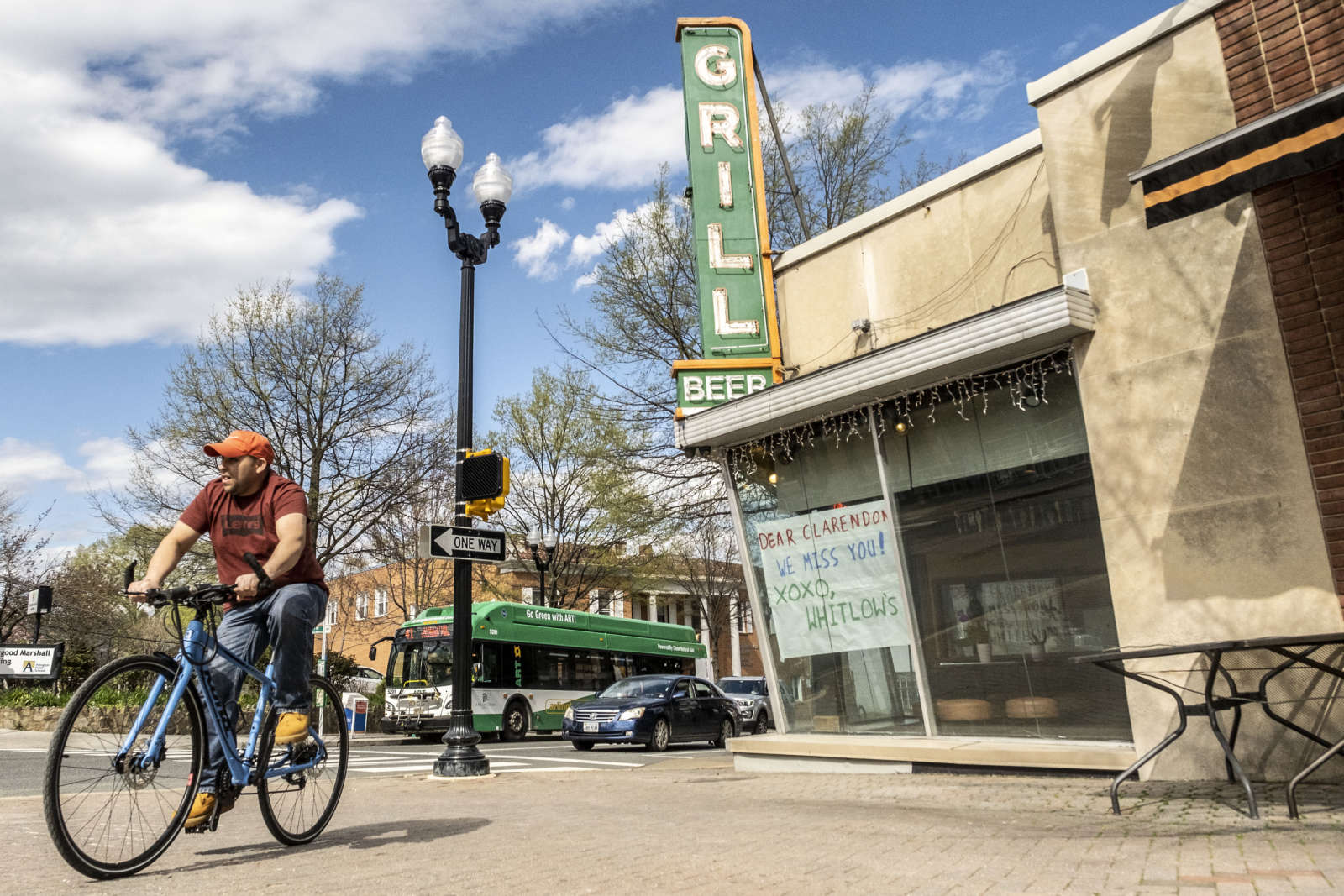
Mar. 30, 2020 – A cyclist passes Whitlow’s in Clarendon, which was closed at the time due to the pandemic (Staff Photo by Jay Westcott)

Peter’s Take is a biweekly opinion column. The views expressed are solely the author’s.

Long before COVID-19 and during COVID-19, I have been critical of APS’s excessive reliance on digital devices.

I’ve cited many scientific studies documenting the damage that excessive screen use causes to students who are suffering the health impacts emotionally and physically, showing that overuse of digital devices also affects students’ educational growth and development. Even though some APS students are doing well in a virtual environment, COVID-19 has aggravated and increased substantially these previously documented harms.

Although these risks to students’ health pre-existed COVID-19, the increased impacts from remote learning are now alarming health professionals.

Health impacts from remote learning

Children are worse off than before COVID-19 as their screen use is constant. Sedentary for most of their day, many don’t have the opportunity to learn and play outdoors. The screen’s blue light may be impacting healthy sleep patterns- creating serious secondary impacts from sleep disruptions and associated mental health issues.

Childhood myopia was well established as a worldwide epidemic long before the lockdown. But the damage done by constant screen use and lack of outdoor play in the last year has created a “crisis” according to the American Optometric Association, which just held an ’emergency summit’ to address the growing health threat to children’s eye health and vision associated directly with increased screen use among children.

Children’s eyes are more vulnerable to the impacts of digital devices because they are still growing and haven’t developed the same kind of light protection that adults have, so they are more likely to be impacted by the blue light coming from the schools’ digital devices they are required to use.

That blue light suppresses the production of melatonin, which is needed to fall asleep.  As a result, children are now suffering more than ever from sleep disruptions, which impacts nearly every other aspect of a child’s health, from the ability to focus and perform in school, to the development of mental health issues.

Childhood obesity has long been rampant, but now is sky-rocketing due to increased sedentary time imposed by relentless screen use.

APS parents should insist on digital device safety in school

Fortunately, a new Virginia law addresses the health risks associated with the schools’ digital devices. The new law requires “the Department of Education (VDOE), in collaboration with the Department of Health and medical professional societies, to develop and distribute health and safety best practice guidelines for the use of digital devices in public schools no later than the 2021-2022 school year.”

On March 29, VDOE posted a draft of the mandated Health and Safety Digital Device guidelines for public comment, asking the public to weigh in regarding classroom digital device safety before April 28th.

Every APS parent should seize this opportunity to comment to VDOE and insist to their child’s principal that these guidelines be followed.

APS’s over-reliance on digital devices and virtual learning, particularly in K-5, was already a serious problem pre-COVID-19. Although APS labelled this “personalized learning,” it detracted from the genuine, in-person classroom interactions which are vital for the development of young children.

(more…)


The Right Note is a biweekly opinion column. The views expressed are solely the author’s.

Last month I received the following advice from a fellow Republican, “our candidates should stop talking about taxes because it is not a winning issue in Arlington.”

Understandably frustrated, this well-meaning advisor is not totally off base. Many Republicans in Arlington accept high property tax burden as one of the costs of living here and want to talk more about how it is spent. Others certainly view the issue as something that turns away the crossover Independents and Democrats needed to build a winning coalition.

Keeping this in mind, it would be easy to stop pushing back on the County Board every six months or so when the spring budget development and the fall closeout spending spree roll around. However, while in a near permanent minority political status, there is something to be said for acting as the loyal opposition. Republicans believe in letting the people keep as much of their hard-earned money as possible as well as in holding elected officials accountable for how they spend what we give them.

Each year, the County Board is required by law to hold two public hearings. One is to gather input on their spending plan and the other the tax rate. Historically in Arlington, the how should we spend the money hearing is overwhelmed with speakers. Usually many people are there to talk about proposed budget cuts that the Board likely has no intention of ever making. These are the “closing the Washington Monument” cuts that are trotted out as the justification to keep the property taxes as high as possible. Rarely does anyone speak against a spending program. This year’s spending hearing is tonight if you wish to shake things up and speak up for fiscal restraint.

Decidedly less popular is the tax rate hearing which will occur on Thursday. Often there are not enough speakers to fill the statutorily mandated hour. This may be because people are satisfied with paying $7500 or more for the services the county provides, or because people who are not satisfied believe any complaints would fall on deaf ears. As in previous years, take this as encouragement to log on virtually and let your voice be heard. It has never been easier.

Knowing what their constituency thinks about how much money they are taking from us and how they are spending it is a good thing for the County Board, regardless of whether they choose to internalize it or ignore it. This loyal opposition offers a consistent reminder to Arlingtonians that we are the party asking for fiscal responsibility from our elected leaders.

Mark Kelly is a long-time Arlington resident, former Arlington GOP Chairman and two-time Republican candidate for Arlington County Board.


(Updated at 10:15 a.m.) Though coronavirus cases in Arlington are up over the past couple of weeks, there’s hope that progress is being made against the virus as vaccinations quicken.

Nationally, cases are up in some places and down in others — a stalemate as vaccinations are countered by increasing prevalence of more infectious variants. Still, some experts believe continued vaccinations will ultimately prevail, muting the impacts of new variants and leading to a relatively quiet summer in terms of infections.

Despite the optimism, there’s also new cause for concern about the longer-term health impacts of COVID-19.

It’s becoming more apparent that so-called “long Covid” — physical and neurological symptoms that linger even after the infection is over — is a significant public health problem. By one estimate, about 10% of COVID-19 cases result in long-term symptoms. In the UK, more than 100,000 of the country’s National Health Service personnel have varying degrees of debilitating, long-term symptoms, causing staffing problems.

Long Covid sufferers, also known as long-haulers, have been undergoing both physical rehabilitation, in an effort to increase endurance, and brain rehabilitation, to combat persistent “brain fog” and other cognitive problems. There’s also new evidence that vaccinations may help clear up lingering symptoms.

Still, the research into Long Covid is in the early stages, and the extent of it remains not fully known.

This morning, we’re hoping to take a local sample with a poll: have you had Covid, and if so, did your symptoms linger?


Progressive Voice is a biweekly opinion column. The views expressed are solely the author’s.

By Kathie Panfil, with the Abuelitas

“I feel like you really are my Grandma.”

The child who shared that thought with a retired Arlington teacher is an English Learner (EL). Her tutor is an “Abuelita” (grandmother) with both wisdom and special skills.

When schools went online, former Arlington teachers of English as a Second Language knew how hard distance learning would be. Acquiring skills and vocabulary from English-speaking peers couldn’t happen. Relationships would have to be developed remotely. Parents would have to figure out the technology, and support their children’s learning, while fearing job loss and illness.

While we knew our community would face overwhelming challenges during the pandemic, we did know one we could tackle in Spring 2020 — we knew how to teach. Identifying the children who would most benefit from our one-on-one tutoring was done through our networks. Old friends still teaching in our schools told parents about the Abuelitas, and soon we had waiting lists. The Abuelitas also needed a communication platform, so we learned to use WhatsApp, which most parents preferred, letting the children both see and hear us on their parents’/caretakers’ phones. Abuelitas had translators within our ranks when needed.

Abuelitas know oral language is critical for English learners, and that it develops both on the playground and in the classroom. So the Abuelitas ask questions, such as “Is there anything you want to talk about?” Some days the children tell about the lessons they are learning online from their “real” teachers, practicing new vocabulary. Sometimes, the Abuelita and the child talk about feelings. One child beginning hybrid classes said, “What if my friends don’t remember who I am?” His Abuelita reassured him, and phoned later to hear about his wonderful day. The personal connection is a gift to both the student and the Abuelita.

How do we know what to teach? “The scope of what the children must learn is huge,” one Abuelita explains. Sometimes we hear from the child’s teachers, but mostly, we use hands-on activities, and we follow the interests of the child. Sometimes we work on reading and writing, but often we read to the children, fiction and non-fiction, because they need listening skills. “Don’t stop,” the children say. Some of us have developed and published materials: on gratitude, on the coronavirus and more.

We’ve taken advantage of free resources in Arlington: we thank Arlington Library for its Take and Make Crafts which we sometimes send to our children. We got Mars Base Camp kits from Virginia Cooperative Extension Service, and some gooey slime kits from Arlington Parks and Recreation. The whole family often gets involved in craft projects.

We became strong advocates for internet access, because despite efforts within the schools and the community, some families lack sufficient connectivity. We joined broadband advocacy efforts. We know connectivity is as essential as water and electric services. We like ArlFiber.org.

In fall 2020, when schools continued virtually, we heard about pods forming in some Arlington homes. Our students lacked the space, strong internet and English-speaking supervision needed for a pod. We continued one-on-one tutoring but we also wanted to form pods for students who lived in Gilliam Place, affordable housing apartments.

We looked for a location nearby and Arlington Presbyterian Church became a caring sponsor. A skilled parent volunteered to run our first pod in fall 2020, and a second pod was added in January 2021. Two nonprofits, Edu-Futuro and Our Stompin Ground, became strong collaborators. These pods worked well, with Covid safety protocols, Arlington Schools online, and everyone working together.

Throughout, we have been deeply impressed by the dedication of our former colleagues: teachers, other school staff and those providing technology. Abuelitas have touched the lives of about 40 learners, although there are many more children who need support. Each of us knows the strong contributions our former EL students made to American society, so as these children grow, we are eager to see what lies ahead.

Kathie Panfil is a former principal at Key and Randolph elementary schools. She is now a retiree active in Arlington community affairs.



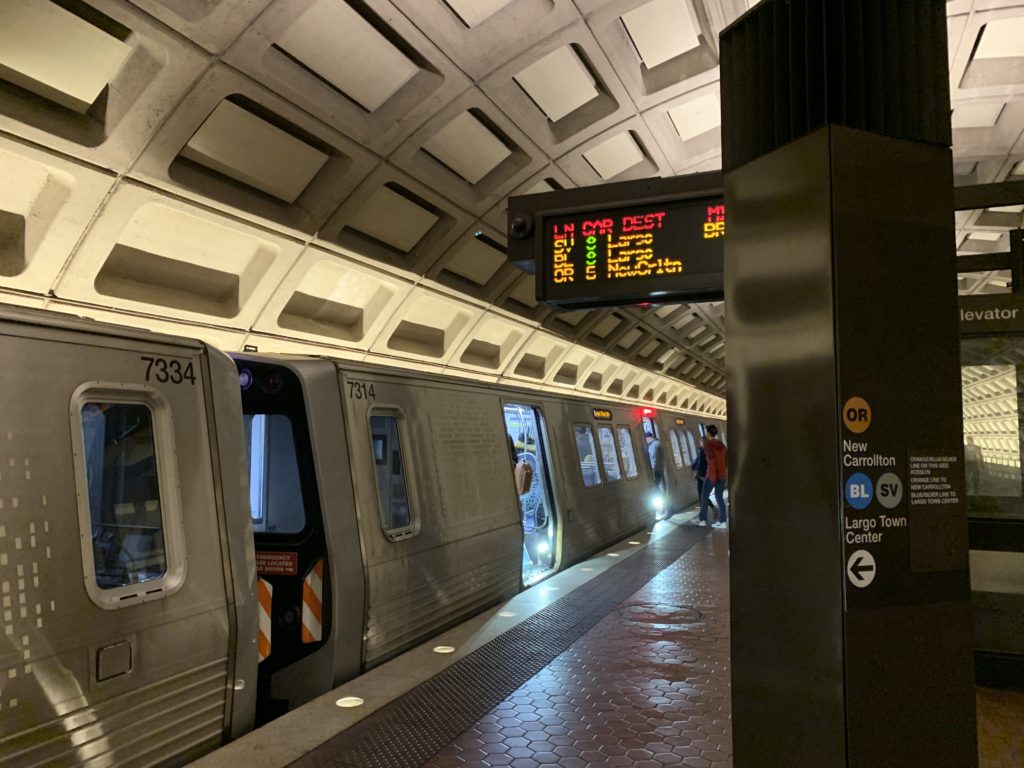
President Biden’s $2 trillion infrastructure plan has added a glimmer of hope to those who would like to see an expanded Metrorail system.

The initial planning for the system in the 1960s envisioned a line down the Columbia Pike, ultimately terminating in Annandale, but the proposed line was nixed in order to save on costs. A physical remnant of the planning is a pair of stub tunnels near the Pentagon Metro station, built to accommodate a potential future Columbia Pike expansion.

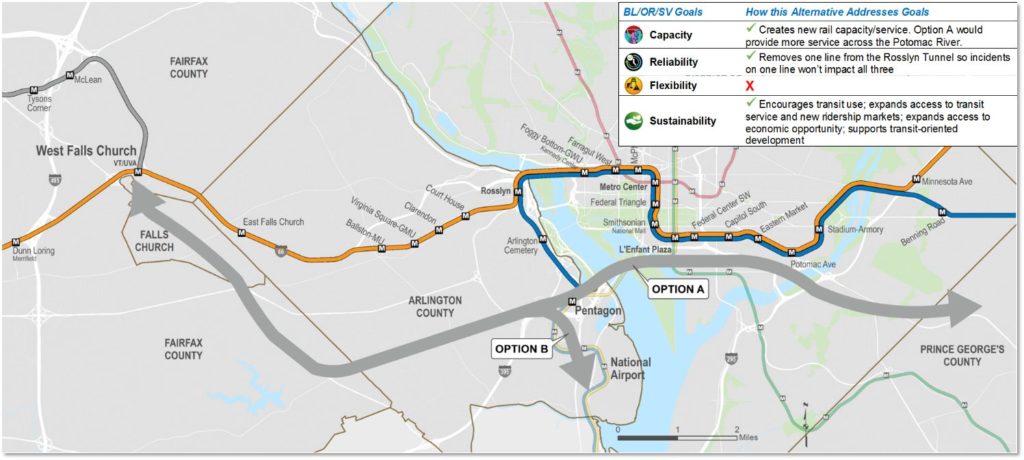
Decades later, in 2019, Metro published the results of a study that suggested a number of ways to expand the capacity of the Metrorail network, including a second Rosslyn Metro station and tunnel, and a Silver Line expansion down the Pike and up Route 7.

Proposed new Silver Line Connection through Columbia Pike (via 2019 Metro study)

The possibility was especially enticing considering the disappointment of transit advocates following the 2014 cancellation of the planned Columbia Pike streetcar line.

While Metro faces plenty of maintenance, service, budget and ridership challenges — the latter three exacerbated by the pandemic — that hasn’t stopped some from dreaming of a world in which more local residents are within easy walking distance of a light rail commute.

Among those discussing such a possibility, given the massive infrastructure spending that would result should Biden’s plan pass, are some of Arlington’s state lawmakers.

Even should the stars align and federal funding become available, digging up Columbia Pike and building a new Metrorail tunnel and stations would be fantastically expensive and would likely require a decade or more of planning and construction.

The new connectivity would also result in new development, sharply higher property prices, and other big changes, which could be viewed in a positive or a negative light, depending on your perspective.

What do you think about the idea of a Metro line on Columbia Pike?


Warming temperatures should make for a sunny and pleasant holiday weekend, weather-wise.

Happy Easter and end of Passover to our readers who observe either faith. Due to the holidays, we’re getting started on today’s weekend discussion a bit early.

Below are the most-read Arlington articles of the past week.

  1. This Toothless 19-Year-Old Dachshund Has Captured Arlington’s Heart
  2. Arlington Opening Joint Vaccine Site With Amazon Today
  3. Arlington School Board Asks Superintendent for More ‘Aggressive’ Return Plan
  4. Residents Ask ACPD to Spare Them from Bowling Alley Commotion
  5. Virginia to Expand Vaccine Eligibility to All People 16+ by April 18
  6. New Alcohol-Free Restaurant to Open in Former Purple Lounge Space
  7. Morning Poll: Legal Weed in Virginia This Summer?
  8. Annual Tap Water Change is One Week Away
  9. With Dominion Hills Mansion Demolition Underway, Locals Ask: What’s Next?
  10. Construction Begins on New Towers in Crystal City
  11. Shirlington Salon Shutting Down, Citing Pandemic Impact
  12. Arlington County to Use Drones to Count Deer

As for today’s breaking news out of the District, some local reaction is below.

Feel free to discuss the above stories or anything else of local interest in the comments. We’ll be back Monday with more local coverage.


It’s April Fool’s Day, which in the Before Times might mean elaborate workplace pranks.

Alas, there’s still a pandemic going on, and those working from home while their kids go to remote school might not have the same pranking energy as in the days of yore.

Nonetheless, we imagine there are some who are going to take full advantage of April Fool’s Day regardless of the circumstances. We can all use a bit more levity these days, after all.

Here at ARLnow, we were planning to sell our Gondola Now logo as an NFT, but — well — couldn’t figure out how to do it on short notice. So aerial lift transport enthusiasts will still have to settle for sweatshirts, t-shirts and — for the upcoming beach season — tank tops.

What are your April 1 plans?

File photo


View More Stories