Our stretch of dry weather is set to continue, and after a chilly weekend we’ll have warming temperatures next week.

While we look forward to the spring-like weather, you can peruse the most-read ARLnow articles of the past week, below.

  1. While the Capitol Was Stormed, A Group of Men Gathered Near the Marine Corps War Memorial
  2. Arlington County Hosting Mass Vaccination Clinic on Saturday
  3. Bracket Room in Clarendon Has Closed
  4. Health Matters: What to Expect After Getting the COVID-19 Vaccine
  5. Chick-fil-A in Pentagon City Opening Next Week
  6. Mushroom Art Has Sprouted Up In Crystal City
  7. Columbia Pike Ethiopian Restaurant ‘Overwhelmed’ with Community Support
  8. ‘Irish Farm-to-Table’ Concept from Cathal Armstrong to Replace Siné
  9. Commonwealth’s Attorney Launches Unit to Investigate Wrongful Convictions
  10. New Restaurant ‘Maison Cheryl’ Coming to Clarendon

Feel free to discuss those stories or anything else of local interest in the comments. Have a nice weekend!


Ed Talk is a biweekly opinion column. The views expressed are solely the author’s.

The pandemic has shown us that reopening schools safely should not be left solely to school districts. Local governments have a critical role to play both financially and logistically in helping with reopening.

On March 2, APS began a phased return of additional students for the hybrid in-person option two days per week, since Level 1 students returned on November 4.

For nearly an entire year since schools closed, our County Board members have been either silent, reluctant to engage on reopening, or have been outright dismissive when pressed for their involvement in helping APS with the necessary infrastructure to ensure a safe return to schools. Their callous responses that reopening schools is not their responsibility and not within their legal authority — while technically accurate — is morally wrong. It is outrageous.

While virtual learning is working well for some students, it isn’t for many others. Some students are suffering mentally, emotionally, and academically. The most vulnerable students are losing ground they may never regain. The academic and economic impact of nearly one year of school closings on these families is dire and may be lifelong. While APS and the school board bear the responsibility for reopening schools, the failure of our County Board to help stem this tide of inequity is an abdication of its moral responsibility.

The real blame for the tepid COVID response lies with the federal government, but where national and state governments fail, local governments must step up, improvise, and lead. Schools alone cannot bear this burden and it is shameful that our County Board has turned its back on our students.

A global pandemic requires all hands on deck, and our county leaders neglected to do their part to take all reasonable and feasible measures to contain community spread. Over the past year, there is so much more they could have done in addition to food distribution — that they were asked to do — to help our schools reopen sooner. They simply ignored the pleas.

They could have enforced mask-wearing in crowded public spaces, but they failed to. They could have enforced social distancing in public spaces and outdoor dining areas, but they failed to. They could have required appropriate ventilation inside restaurants and bars, but they failed to. They could have limited capacity, alcohol, and operating hours in bars on popular nights like New Year’s Eve but they failed to.

Moreover, the county could have partnered with APS to provide COVID-19 testing and nurses so our schools could reopen long before now, but they failed to. They could have provided supervised indoor and outdoor spaces for virtual learning, but they failed to. They could have formed public-private partnerships with corporations, churches, and other organizations to assist with childcare needs and space, but they failed to.

(more…)


Health Matters is a biweekly opinion column. The views expressed are solely the author’s.

Fevers. Chills. Headache. Sore arm.

All of these hit at 1 a.m. after my second Pfizer COVID-19 vaccine shot. However, it was the happiest fever, chills and headache I’d ever had, because I knew this short-lived post-vaccination ailment would protect me from severe COVID-19 illness.

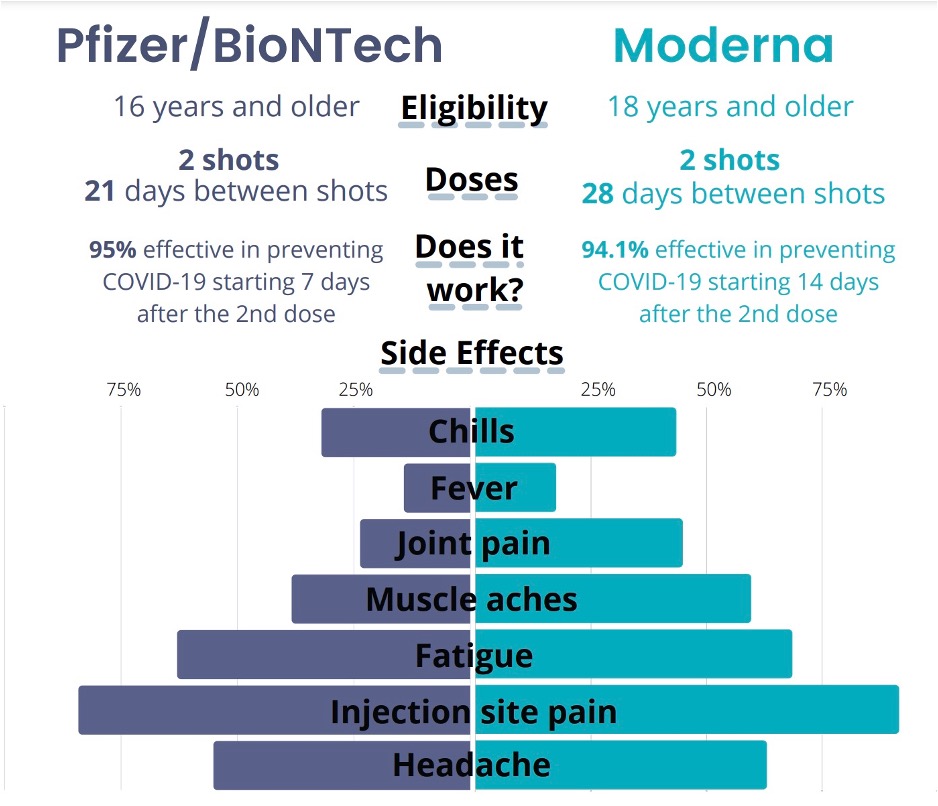
Despite knowing about the side effects, I was surprised at how much they affected me and how prevalent it was with my coworkers. With several weeks of vaccinations under way, it is important to ensure everybody getting the vaccine is patently aware of the side effects in order to plan the next day accordingly and assuage the fear of the vaccine doing more harm than good.

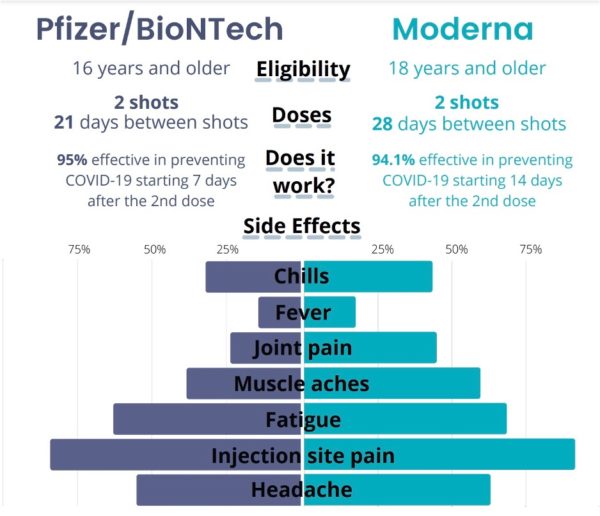
The chart below summarizes the two vaccines currently administered in Arlington. Both Pfizer and Moderna are considered “reactogenic” in that they stimulate a strong immune response with unpleasant but temporary side effects. Moderna, despite being less efficacious (94.1% vs. 95% for Pfizer), has 3x more vaccine than Pfizer (100 micrograms vs 30 micrograms for Pfizer), which may contribute to more side effects observed.

Reactogenicity awareness is particularly important because more Arlingtonians want the vaccine than anywhere in the U.S., and as of 2/18/21, about 27,895 doses have been administered and 8,371 fully vaccinated according to the Virginia Department of Health Vaccine Dashboard.

So why does your body react this way to the vaccine?

The immediate response is from the introduction of the vaccine materials into your arm. This immediate response is courtesy of the first branch of the immune system called innate immunity, which fights anything it doesn’t recognize. As your cells take up the mRNA that encodes a version of the coronavirus’s spike protein, the innate immune system sets off alarms to recruit more immune cells to your arm, causing inflammation and soreness, which then results in more immune cell recruitment causing the bigger picture symptoms of fever and fatigue.

During this cascade of recruitment, the second, more specific branch of the immune system is activated, called adaptive immunity. The main players in adaptive immunity are B cells, which are targeted, selective assassins that create antibodies that bind to the spike protein, and T cells, which creates a cellular “wanted” poster of the infecting pathogen so that the B cells know when and where to attack.

Adaptive immunity is the fine-tuned part of the immune system that protects against COVID-19 after the second shot. When the second shot reintroduces the pathogen to the body, the adaptive immune system sends off a cytokine flurry, overlapping the reengaged innate immune response, resulting in the fever, aches and chills.

(more…)


Community Matters is a biweekly opinion column. The views expressed are solely the author’s.

This year, I was honored to be named a 2021 “Strong Woman in Virginia History”, along with four other outstanding Virginians, including fellow Arlingtonian Evelyn Syphax. I must admit that the award challenged my idea of history and how we celebrate.

I was impressed by looking at past honorees that the Library of Virginia and Dominion Energy, the program sponsors, seem to have consistently recognized Virginians at all stages of their lives.

The program is designed to engage students by providing a class of school aged children  an opportunity to speak with the awardees, and learn more about their lives. The Library also sends posters featuring the honorees to schools and libraries throughout the Commonwealth.

As we reflect on Black History Month and embark on Women’s History Month, I challenge you to think about your process of viewing, teaching,  promoting, and integrating history into your leadership roles, throughout the year.

Look at history holistically and critically

I was speaking with someone last weekend and they noted that people tend to look at recent history, and not consider how we got to that point. History can also be complex. For example, we are taught about the Civil Rights Movement without understanding the short term progress made during Reconstruction. If you are trying to strategize about how we move forward as a nation, you should understand both.

Avoid compartmentalizing

For so long, we have forced all the black history into February, only highlighted women during March, etc. We should use these months as a reset or kickoff to  yearlong commemorations and discuss how we can integrate knowledge learned throughout the year.

Focus on living history

We should continue to celebrate those who are currently living and making history. Examining their accomplishments in real time is instructive, and can also add another dimension to our study, by viewing them and their work as evolving, instead of static.

Make it relevant

When we have an opportunity to discuss or commemorate a historical event, compare it to current events, or have a discussion about how it may be similar or different. For example when discussing social services or early transportation planning, we might continue to mention leaders like Ellen Bozman, and use that opportunity to reflect on the challenges she faced and her contributions.

Remind youth that they are making history

We should do even more to focus and celebrate youth accomplishments, and what they mean in the context of current events. When recognizing community members, we should consider also honoring a youth, and even including their perspective on the nominating committee.

Include a community engagement perspective

Many of our organizations honor people who are making history, and similar to the Library of Virginia’s Strong Men and Women of Virginia History award, we should consider how we will educate people about their accomplishments beyond a press release or awards ceremony.

Many of us are excited about and pressing for rapid change. I fear that change won’t happen unless we get everyone up to speed on what we have already experienced. It is critical that we put our current challenges in context, or history will truly be forced to repeat itself.

Krysta Jones has lived in Arlington since 2004 and is active in local politics and civic life. This column is in no way associated with or represents any person, government, organization or body — except Krysta herself.


Making Room is a biweekly opinion column. The views expressed are solely the author’s.

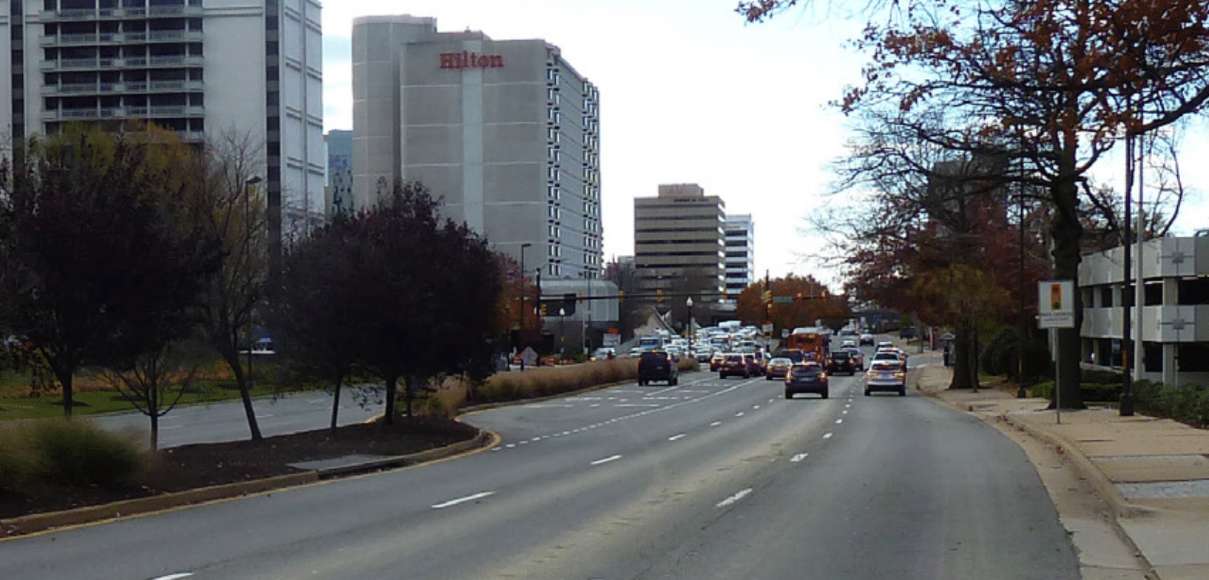
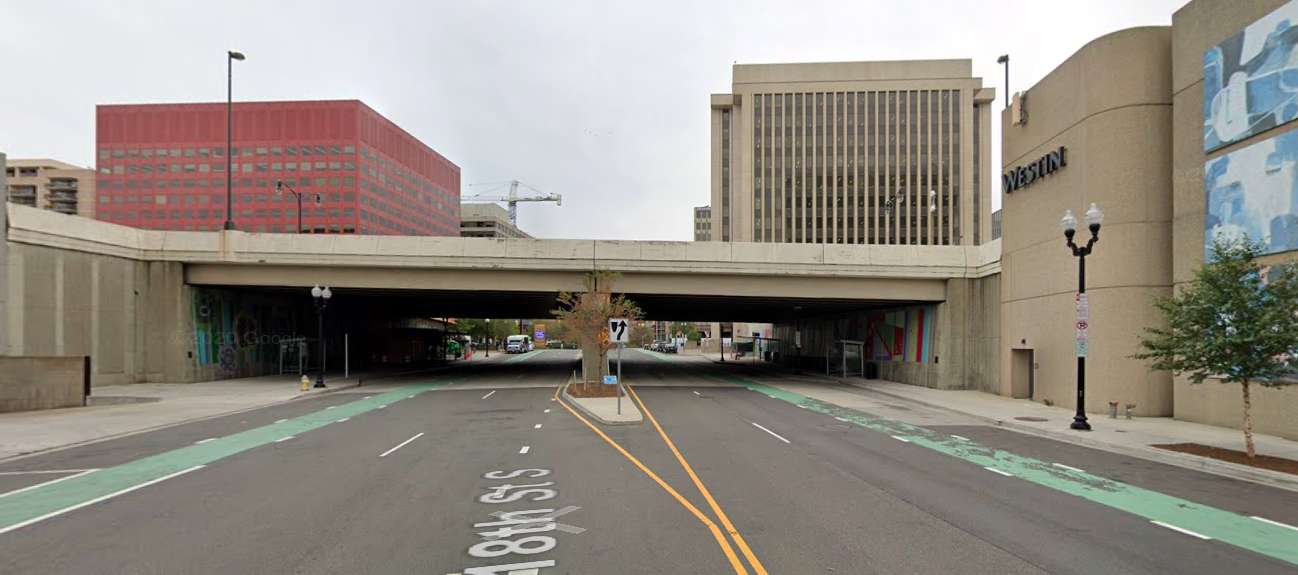
Crystal City and Pentagon City have long been a patchwork of single-family homes, dense retail, and aging office buildings, cut up by wide roads. Nothing divides the neighborhoods more than Route 1, which is elevated as it comes from DC into Arlington.

Two years ago, when Amazon selected Arlington for its second headquarters, it pushed to include a plan to bring more sections of the highway to ground level. Although many urban highways should be removed, the Route 1 plan is imperiled by the decision to maintain current traffic volume.

Without an absolute commitment to lower speeds, reduce car travel lanes, build protected bike infrastructure, and reduce the total width, a lowered highway is a death trap running through our front yard.

Route 1 is a dividing line between Pentagon City and Crystal City, cutting people off from recreation, shopping, and jobs, to say nothing of the Metro Station and the Mount Vernon Trail. The elevated portions of the highway allow pedestrians and cyclists easier access. Many of my neighbors share the fear that an at-grade Route 1 will be a further impediment to connectivity.

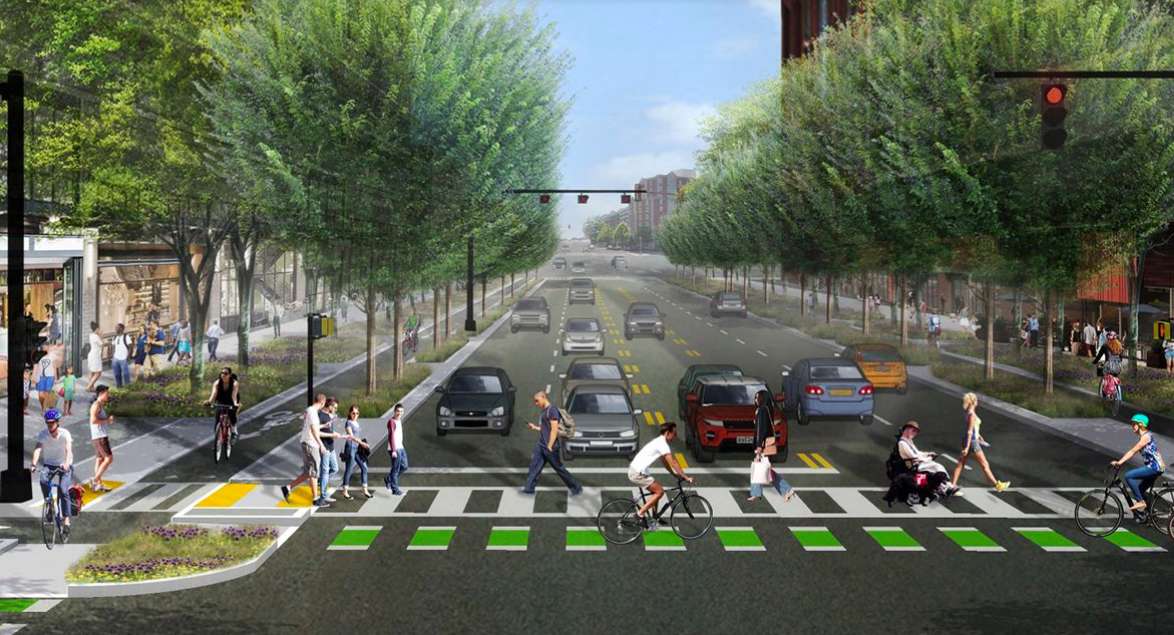
The National Landing BID has been one of the leading forces in favor of the new “urban boulevard.” They assured us that lowering the highway would enhance connectivity and improve the road for all users. They emphasized multimodal improvements and likened their vision to Connecticut Avenue in D.C. or the Michigan Ave in Chicago. Left unstated is that this is only possible with a significant reduction in traffic volume through Crystal City.

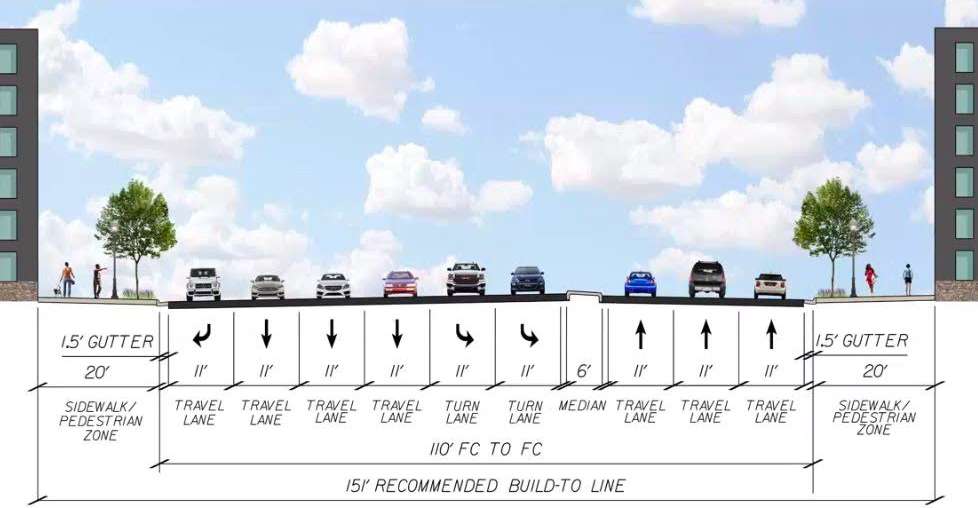
Now VDOT shared a preview of its vision for Route 1, confirming everything locals feared and expected. In contrast to the vision championed by the BID (only 5 or 6 lanes, with protected bike lanes and wide sidewalks), VDOT proposes expanding the highway with 9 lanes and no bike infrastructure. The plan includes two left turn lanes, against the explicit wishes of the BID. To appease neighbors worried about commuter traffic cutting through nearby local streets, VDOT has to put drivers’ speed and convenience first.

This outcome is not surprising. VDOT consistently pushes to widen roads and views traffic safety as the need to keep cars moving. Arlington and VDOT are also pursuing a widening project on Route 50/Arlington Blvd, over the objections of adjacent residents and the Transportation Commission, under the auspice of “safety.”

Now that I see VDOT’s rendering alongside the purported study goals, the dissonance is laughable. These 9 lanes of traffic are neither safe nor environmental. They do nothing for transit effectiveness or multimodal accessibility. They do not mend the urban fabric. Instead, VDOT’s plan would put a dangerous, polluting highway through a growing downtown neighborhood.

VDOT’s unfortunate reality check might be enough to kill this project altogether. But we can do better than Route 1’s status quo. A committed group of local residents has been exploring alternative ideas, informed by extensive outreach to neighbors. It is time for our elected leaders to get involved and push for a real commitment to safety and connectivity. We can praise Arlington for approving large-scale development, both commercial and residential, to meet obvious demand. But unless we also commit to reducing car traffic, we will fail to bring inclusive, sustainable, humane growth.

Community members can voice their concerns at a public meeting on March 3.

Jane Fiegen Green, an Arlington resident since 2015, proudly rents an apartment in Pentagon City with her family. By day, she is the Membership Director for Food and Water Watch, and by night she tries to navigate the Arlington Way. Opinions here are her own.


With County Board meetings, budget news, and plenty of other things going on, it was a busy week in Arlington.

Expect more of the same next week, with County Board budget sessions instead.

Here are the ARLnow stories that received the most reads over the past five days:

  1. Va. Rolls Back Some Restrictions on Dining, Outdoor Gatherings
  2. Metro Asking Public To Weigh In On Cuts, Including Closing Several Arlington Stations
  3. Arlington Safeway Stores Are Offering Vaccine Appointments
  4. Queen Mother’s Fried Chicken is Thriving in Arlington
  5. Ask Eli: Condo Smoking Bill Passes in Virginia
  6. Work Underway on First Phase of Ballston Harris Teeter Development
  7. Virginia State Police Chased a Suspect Through Arlington Last Night
  8. Car Theft Suspect Apprehended After Chase, Crash
  9. Morning Poll: Which Pandemic Restaurant Closure Hits the Hardest?
  10. Arlington Man Sentenced to Nearly 13 Years in Prison for Trafficking Fentanyl

Feel free to discuss those articles, or anything else of local interest, in the comments. Have a great (albeit rainy) weekend!


What’s Next with Nicole is a biweekly opinion column. The views expressed are solely the author’s.

Arlington is beginning to wrap up an important long-term plan for Arlington street safety: Vision Zero.

In July 2019 the County Board resolved to the concept that no death or severe injury in Arlington County streets or trails is acceptable. To achieve these ideals staff and community members have joined the Vision Zero Network to create a comprehensive plan based on analysis of traffic collisions in the county.

Vision Zero recommendations have been made in engineering, enforcement, education, and data analysis. Focus has also been paid to ensuring no one is disproportionately affected by crashes and creating a culture of safety so every member of our community feels responsible for contributing to the safety of our transportation system.

Last year I was able to join this working group and see how it has incorporated some of the best parts of urban planning and also exposed some of the systemic issues that exist in many transportation related planning initiatives.

Two of the most important and impressive parts of Vision Zero has been their data driven evaluation and the partnerships with the many agencies that make up our transportation network. One hurdle to this process, and many other transportation related processes, is a complex network of agencies that are required to be involved in the implementation of these improvements.

The data collected for Vision Zero is vast and detailed. The High Injury Network captures about 80% of all serious or fatal crashes and is able to zero in on just 7% of the roadways in the county. This is further broken down by transportation mode, and hot spot locations.

As shown in the map, a significant amount of these incidents occur on state owned (VDOT) roadways such as Arlington Boulevard, Glebe Road, Lee Highway, I-395 and I-66. If improvements need to be made to any of these areas there is a more onerous process that is needed to alter the landscape of these roads.

In order to receive funding for a project on these roads local jurisdictions must apply to the Northern Virginia Transportation Authority (NVTA). Recently this has been in six year program plans that are conducted every other year. Recently there has also been a decrease in total NVTA funds available from the state legislature.

All of this makes it more likely that local jurisdictions will apply for major funding projects that will have a big impact on our regional transportation network and less likely that localities will apply for smaller projects or improvements that would help with safety concerns like crosswalk improvements.

In my opinion it would be helpful for NVTA to create a small separate fund with an expedited process for smaller scale projects that are needed more immediately for safety improvements.

Overall the Vision Zero program will be a significant help in creating regular system-wide checks for street safety and reducing serious injury or death in our community. The last opportunity for feedback closes this Sunday February 28th and I encourage everyone to provide your own thoughts on the process.

Nicole Merlene is an Arlington native and former candidate for Virginia State Senate. She has served as a leader in the community on the boards of the Arlington County Civic Federation and North Rosslyn Civic Association, as an Arlington Economic Development commissioner, in neighborhood transportation planning groups, and as a civic liaison to the Rosslyn Business Improvement District.


Peter’s Take is a biweekly opinion column. The views expressed are solely the author’s.

Historic numbers of Virginians voted in the 2020 Presidential election. Virginia Democratic legislators have introduced important new voting rights legislation which deserves to be enacted. The 2021 Virginia Legislative Session is expected to adjourn about February 28.

Virginia Voting Rights Act

The Virginia Voting Rights Act is a centerpiece of these 2021 Democratic voting reform initiatives:

[I]t is designed to prevent last-minute poll closures and other election changes that could disproportionately affect voters of color. … Backers say it’s partly a response to a 2013 Supreme Court decision that effectively stripped the federal government’s close oversight over elections across the South, including Virginia.

The House of Delegates version of this legislation is HB-1890.

HB-1890 prohibits:

  • any standard, practice, or procedure related to voting from being imposed or applied in a manner that results in the denial or abridgment of the right of any United States citizen to vote based on his race or color or membership in a language minority group.
  • at-large methods of election from being imposed or applied in a locality in a manner that impairs the ability of a protected class, defined in the bill, to elect candidates or influence the outcome of an election, by diluting or abridging the rights of voters who are members of a protected class.

Certain unlawful actions, including knowingly communicating false information to voters, that are currently subject to criminal penalties will create civil causes of action under the bill.

The bill also authorizes the Virginia Attorney General to commence civil actions when there is reasonable cause to believe that a violation of an election law has occurred, and the rights of any voter or group of voters have been affected by the violation. Civil penalties are payable into a Voter Education and Outreach Fund established by the bill.

The sponsor of HB-1890, Delegate Cia Price (D-Newport News), noted:

[T]here are still attacks on voting rights today that can result in voter suppression, discrimination and intimidation. …We need to be clear that this is not welcome.

Price also said she has compiled examples of voter suppression ranging from moving polling places off public transit lines, or from a community center to a sheriff’s office. (more…)


The Right Note is a biweekly opinion column. The views expressed are solely the author’s.

On Saturday the County Board met and slashed parking permits for some residents while paving the way to move forward on the county and school budgets.

The County Board resisted the urge to raise the real estate tax rate, but only because residential assessments went up by 5.6% over last year, which means the average Arlington homeowner will already pay $382 more in taxes this year in a addition to the new proposed stormwater tax. This residential increase offsets a drop in commercial assessments. The Board is also counting on a new round of federal COVID spending to backfill local needs.

One of the budget savings proposed is eliminating 56 currently vacant positions. Many residents may push back at the decision not to fill 10 police officer positions as well as cuts to 9-1-1 dispatching. There were 16 carjackings in Arlington in 2020 after just three the past two years.

You can check out the full budget proposal here or the summary presentation here.

Arlingtonians will also see the proposed schools budget later this week, but the county budget documents suggest they will not see a significant revenue boost. With enrollment down by 10% over projections for the current school year, it will be interesting to see whether APS will assume that those students will return. We do know that according to Superintendent Durán’s most recent presentation, Arlington is operating with a projected $6 million surplus for the current school year even after paying for COVID mitigation measures.

The schools do face a very real challenge of a lost year of learning. Not every student fell behind, but many did. Hopefully the superintendent and School Board use the current circumstances to not only evaluate the needs created by virtual learning, but how to come back better when it comes to preparing our students academically.

The new parking permit program cuts permits from four to two for people who have a driveway. It does not matter how many cars can practically use the driveway. It does not matter how many people of driving age who are related to each other live in the house.

While this is unlikely to create a hardship for a lot of families, it gives no flexibility to families who have a retired parent living with them or an adult children home from college or working while living at home. County Board member Libby Garvey was particularly dismissive of these concerns. Her response was that kids coming home from college in the future probably wouldn’t have cars. Speaking from personal experience, many of them do in fact have cars and now they may have no place to park them.

The County Board should at the very least consider an amendment to the plan that allows a family to apply for additional permits in certain situations before the changes go into effect on July 1st.

Mark Kelly is a long-time Arlington resident, former Arlington GOP Chairman and two-time Republican candidate for Arlington County Board.


Progressive Voice is a bi-weekly opinion column. The views expressed are solely the authors’. 

“A thankless job.”

“Your life is not your own.”

“A toxic environment out there.”

These are perceptions among some in the community of what it’s like to be on the School Board these days. If even some of the comments are true, why should a good person run? And why should we care?

For starters, the decisions the School Board makes deal with two things most valuable to many people who live here–their children, and their property values. Good schools are a top factor in choosing where to raise a family and they contribute to strong property values. Good schools also strongly influence what makes Arlington an attractive place for businesses to locate and grow. With all that at stake, we need strong, principled, experienced leaders making the decisions on the School Board and thinking strategically.

Given the upcoming School Board vacancy and a Democratic caucus likely in May, the Progressive Voice editors sat down with a few knowledgeable experts to ask their thoughts on what makes a top-notch board member.

Big-Picture, Whole System Outlook. “The primary quality I want to see is somebody that sees all of Arlington,” says Stacy Snyder, who has served on the APS Advisory Council on Facilities and Capital Programs (FAC) and is currently vice-chair of the Joint Facilities Advisory Commission (JFAC). “They understand that every decision, whether a boundary or something else, affects all of Arlington.” Snyder understands that “we all come with our own perspectives, experiences with certain schools,” but says, “I’d want to see someone who’s open to learning, evolving.”

Long-Term Perspective. The Arlington school system has had challenges with growth and capacity of buildings over the past decade, leading to a slew of construction projects amid frustration over a lack of land. Greg Greeley, a veteran of FAC over several years, refers to this situation when explaining why he’s looking for a candidate’s long-range mindset. “The thinking has been more ‘Where can we build the fastest?’ when it should have been ‘Where can we build to best fit the needs of the system?'”

Greeley adds that “There’s a good chance we’ll need a fourth high school in the next 20 years.” Hearing a candidate detail how she or he would approach the problem would “reveal a lot.” Greeley explains that in discerning a candidate’s long-term perspective, he would be listening for depth in how “they describe the problem.”

Deep Knowledge of Facts, Strong Work Ethic. Many candidates list various organizations they’ve been involved with. But a person’s depth of experience and contribution can vary greatly. To get a clearer picture, former School Board member Tannia Talento says, “I’d zero in, like ‘I see you were on the Budget Committee. What did you think of last year’s budget?’

Snyder observes, “When candidates talk…I want to see that they know their facts. If I heard a candidate talk about an inequity that’s not really based on fact, but more in outrage, then it’s a sign.” She worries “when people choose outrage over information.” Snyder says, “If x percent of third-graders aren’t reading at grade level, I don’t want [candidates] giving a solution without showing me how it’s going to work.”

Greely agrees that School Board candidates and members must go beyond platitudes. “The question should be ‘How would or could you make this good idea happen?'” (more…)


A bill that has passed the Virginia House of Delegates would allow bicyclists in the Commonwealth to treat stop signs as yield signs in certain situations.

HB 2262 would legalize a common practice: cyclists rolling through stop signs when no other traffic has the right of way.

“Supporters say it will make roads safer for bicyclists after increases in traffic injuries and deaths, while opponents argue it makes the movements of cyclists less predictable,” the Washington Post reported. “The bill also would require drivers to change lanes when passing a bicyclist if three feet of distance isn’t possible and would allow two cyclists to stay side-by-side in a lane.”

The bill is now set to be considered by the Virginia State Senate.

What do you think?


View More Stories