
Progressive Voice is a biweekly opinion column. The views expressed are solely the author’s.

By Wesley Joe

Despite the heroic efforts of Arlington Public Schools (APS) staff, students and parents, our K-12 students are sustaining consequential learning losses this year. The declines are sharpest among more vulnerable students, such as English learners, special education students, and low-income minority kids. By the end of the school year, losses could be disastrous.

Looking at national achievement data from the fall, McKinsey and Co. found that “students of color could be 6 to 12 months behind, compared with 4 to 8 months for white students.” While the community grapples with the challenges of learning during a pandemic, we must also consider measures that enable students to make up the year’s lost ground.

In the hope of initiating a broader community conversation, I offer some suggestions. Planning for these efforts and finding funding must begin now. The recovery measures will cost money, preferably offset by temporary, supplemental state funding. Hence we must encourage our elected officials to put this issue on the agenda of the state legislative session that begins later this month. APS and the County Board also will need sufficient lead time to create alternative funding sources. A School Board member with whom I spoke acknowledged the difficulty of finding substantial new funding.

Recovery work should proceed mostly in face-to-face mode, once it is safe to do so. This view is based on parent feedback I’ve heard as a member of APS’s Math Advisory Committee, and my own experience as both an APS parent and someone who teaches online (albeit postsecondary, which in some ways is easier than K-12). APS students and teachers will recover learning losses more quickly and effectively in a live classroom. That said, virtual options should be available for families who need them.

As a start, APS should offer supplemental coursework to help reduce the learning losses. In high school, current students should be able to take an additional semester of classes. If doing so delays matriculation to college, a student could devote the remaining time to compensated community service, such as tutoring (more about this below), or earning transferable (and probably less expensive) college credits at an area postsecondary school (e.g. Northern Virginia Community College, George Mason University). Richmond should make this financially viable for the next several years, even though it’s expensive, because the long-term costs will be even greater than neglecting the learning losses.

The state, the Arlington County Board, or both should provide funding for APS to hold at least part-time summer school on a larger scale. Students who received D or lower grades, or who received low scores on key assessments, such as the highly predictive Math Inventory (a progress test that students take several times each school year), should be required to take summer make-up classes to achieve at grade-level. If we temporarily need additional teaching staff, hire some qualified, limited-term teachers. Indeed, Martin West at Harvard’s Graduate School of Education found that teachers who join the profession during a recession are at least as effective as those who start during boom times.

Additionally, limited mathematics and English language arts options (such as APS classes, Virtual Virginia, or postsecondary classes) should be available for students who perform at grade level but still need the deeper instructional engagements, such as deeper math work or more complex writing assignments and feedback, that were possibly sacrificed this year.

Summer school alone, however, will not suffice. APS must also offer supplements during the school year. APS could partner with local postsecondary schools to establish a Community Tutoring Corps. This group could be teachers’ “force multiplier” for high-intensity tutoring of small groups of students who have fallen far behind. Qualified college students and high school students could earn some kind of experiential learning course credit or perhaps tuition assistance for assisting with the tutoring.

The need to narrow the learning gap is urgent. I am certain that a community as creative and resourceful as Arlington can come up with even more ideas, which the superintendent and School Board can assess. Delay will only multiply the learning loss damage that is measured in financial costs, mental health problems, dropout rates and diminished prospects in life. Let’s begin that urgent conversation now.

Wesley Joe is a current APS parent, a member of the APS Math Advisory Committee, and a former member of the APS Advisory Council on Instruction. He has lived in Arlington for more than 20 years and teaches at Georgetown University’s McCourt School of Public Policy.

Modern Mobility is a biweekly opinion column. The views expressed are solely the author’s.

Two regional governmental bodies, that don’t receive much detailed coverage in the press, could have a big impact on the transportation options available to you, the quality of the air you breathe and our ability to meet our climate goals.

Have you heard of the National Capital Region Transportation Planning Board (TPB)?  Or the Northern Virginia Transportation Authority (NVTA)?

The Transportation Policy Board (TPB)

The TPB is the DC area’s Metropolitan Planning Organization and it is supposed to do transportation planning for the entire DC-area – including all regionally-significant transportation projects in the Maryland and Virginia suburbs as well as DC itself. By federal law it is responsible for ensuring that those projects improve the area’s air quality.

TPB has some great “aspirational goals” that could really lead the region into a healthier, more sustainable transportation future:

  1. Bring jobs and housing closer together
  2. Expand bus rapid transit and transitways
  3. Move more people on Metrorail
  4. Increase telecommuting and other options for commuting
  5. Expand the express highway network
  6. Improve walk and bike access to transit
  7. Complete the National Capital Trail

The chair of the Metropolitan Washington Air Quality Commission’s comments on the current transportation plan note that it is critical for the region to reduce per capita vehicle miles travelled (VMT) in order to achieve air quality standards and implores TPB to invest in “Metro, ride-sharing, pedestrian and bike infrastructure, and other travel demand management strategies to continue to mitigate future growth in vehicle emissions.”

Unfortunately, when the rubber meets the road – in this case, when it comes time to put together its “constrained long-range plan” of all regionally-significant transportation projects, the TPB seems content to basically staple together MDOT’s, VDOT’s and DDOT’s transportation plans, without significant examination of whether any given project moves the region forward toward those “aspirational goals” or prepare us for future, cleaner air quality standards.

A good example here is Maryland’s reconstruction of the “Nice” bridge across the Potomac south of DC. Maryland’s DOT was looking to drop plans for a promised bicycle and pedestrian accommodation on the replacement bridge (which will double capacity for cars) the TPB passed an amendment to the regional plan allowing the project to move forward with no dedicated space for non-motorized traffic on this important river crossing which has no alternative for miles in any direction. Another is their acceptance of Maryland’s I-495 and I-270 Express Lane projects without any commitment that they will allow High Occupancy Vehicles to travel toll-free.

TPB will be updating their regional plan “Visualize 2045” over the course of the next two years. You can sign-up for email updates here.

The Northern Virginia Transportation Authority (NVTA)

The NVTA gets 70% of the regional tax revenue that is dedicated to transportation (from a wholesale tax on gasoline, along with some other sources). It then doles that money back out as grants for transportation projects.

(more…)


Community Matters is a biweekly opinion column. The views expressed are solely the author’s.

There is no doubt that 2020 was a difficult year that presented revelations for many, and left almost all of us with unanswered questions.

As we cautiously step into 2021, decisions loom about everything from police-community relations, schools, COVID management, economic development, political leadership, and race. As a community, we have a responsibility to act on many of the conversations that we started. Memories are often short, therefore we should pause to recognize that we took several positive first steps, specifically on diversity, equity and inclusion.

Financial investments — Minority communities have long stressed the need for increased financial investments in sustainable organizations which serve underrepresented groups. As noted in a June 2020 Washington Post article, Bank of America pledged $1 billion to fight racial inequality in America. Tech companies have invested in Black Lives Matter, the Center for Policing Equity, Colin Kaepernick’s Know Your Rights Camp and other entities engaged in racial justice efforts. Businesses in other industries have also announced significant investments.

NEXT STEP: Follow the impact of these dollars and rebut claims that investing in minority communities is discriminatory. See the recent case in Oregon.

Diversity statements- – While a statement is just words, we can be hopeful that there was also positive intent in the flurry of press releases,  social media posts and black squares declaring commitments to diversity and inclusion. In 2021, we must hold those who made the statements (and posted squares) accountable.

NEXT STEP: Did your organizations, employers, or favorite companies issue statements? What steps have they taken to fulfill the meaning of the statements? How will you help with the implementation?

Support for Black businesses — The Economic Policy Institute stated in 2017 that average wealth for white families was seven times higher than average wealth for Black families. By supporting Black businesses, you are also supporting Black families, and helping to decrease the gap. The current list of Arlington Black businesses is paltry, but it is a start.

NEXT STEP: Encourage an African-American in Arlington to start a business and help them strategize about access to capital, support the Northern Virginia Black Chamber of Commerce, or patronize an Arlington Black business.

Acknowledging and Celebrating Juneteenth — Juneteenth is “the oldest nationally celebrated commemoration of the ending of slavery in the United States. From its Galveston, Texas origin in 1865, the observance of June 19th as the African American Emancipation Day has spread across the United States and beyond.” Juneteenth is now officially a recognized holiday in Virginia, and Nike, the Washington Post and many other companies now observe it. 

NEXT STEP: Plan now how you will commemorate Juneteenth this year.

Policing and criminal INjustice reform — The General Assembly passed a number of reforms in 2020 including creating Marcus alert mobile crisis co-response teams to mental health incidents, prohibiting no knock warrants and neck restraints, and allowing localities to create citizen review boards. Arlington County also created the Police Practices Work Group to provide recommendations to the County.

NEXT STEP: Be vigilant and ensure appropriate and complete implementation of new laws and policies, and continue to support additional reforms in line with your beliefs.

If you made progress last year, whether you read a book about race, had a deep conversation with a friend about inequality, or recognized your own implicit bias, congratulate yourself on taking that first step, and continue accentuating the positives in 2021. 

Krysta Jones has lived in Arlington since 2004 and is active in local politics and civic life. This column is in no way associated with or represents any person, government, organization or body — except Krysta herself.


Making Room is a biweekly opinion column. The views expressed are solely the author’s.

Development planning in Arlington is guided by the idea that density is a burden which must be paid for with public benefits.

If a property owner wants to add more units to their planned apartment building that they are allowed ‘by-right,’ they must also fund something off the community’s wish list. But if the price of this is too high, the community loses both new homes AND the improved urban space.

We see this dynamic at play with the Clarendon Sector Plan. Most recently amended in 2006, the Sector Plan sets forth a vision of the “urban village” where “people of all income levels, ages and household make-ups can walk to home, work, shop, and play.”

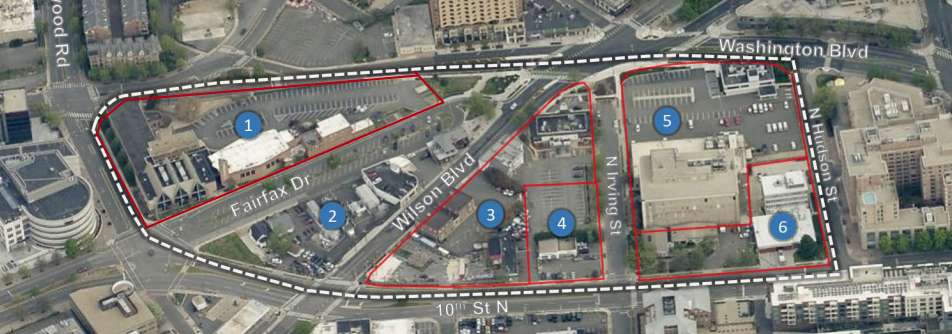
Fifteen years later, some items on the community’s “wish list” haven’t come through. Large blocks south of Washington Boulevard remain half-used parking lots. No parks have been added. Cars still reign supreme. The goal of relocating Fire Station 4 has not been achieved. The Sector Plan does not allow enough density and height to fully maximize the community benefits these sites could provide.

A Sector Plan guides the private development around Arlington’s Metro stations, establishing the density, height, and uses of future buildings, and lays out the community features (affordable housing, LEED building certification, parks, improved streetscapes, etc.), that new developers will provide if they want to “buy” additional density. It can be specific, including where a new road should break up a superblock and which blocks should have a hotel vs. retail or office space.

The Sector Plan implements Arlington’s Comprehensive Plans, specifically the General Land Use Plan (GLUP), which “establishes the overall character, extent and location of various land uses.”

Sector Plans are visions of what a community wants but has almost no power to realize. The fulfillment is left up to the development process. In the update to the Clarendon Sector Plan now underway, County staff and community members hope to create the right recipe to achieve their urban vision. Private development could transform these empty parking lots into vibrant streetscapes and buildings for people to live, work, and stay, all within a short walk of the Metro.

But before these planned developments can even begin their long process toward approval by the County Board, they need amendments to the Sector Plan. The projects need taller heights and steeper building tapers than what the 2006 Sector Plan calls for. Additionally, they need to shift the location of the desired new street (“10th Road”) and the owner of the Silver Diner site wants to redevelop their property as a hotel rather than an office building as the Sector Plan indicates.

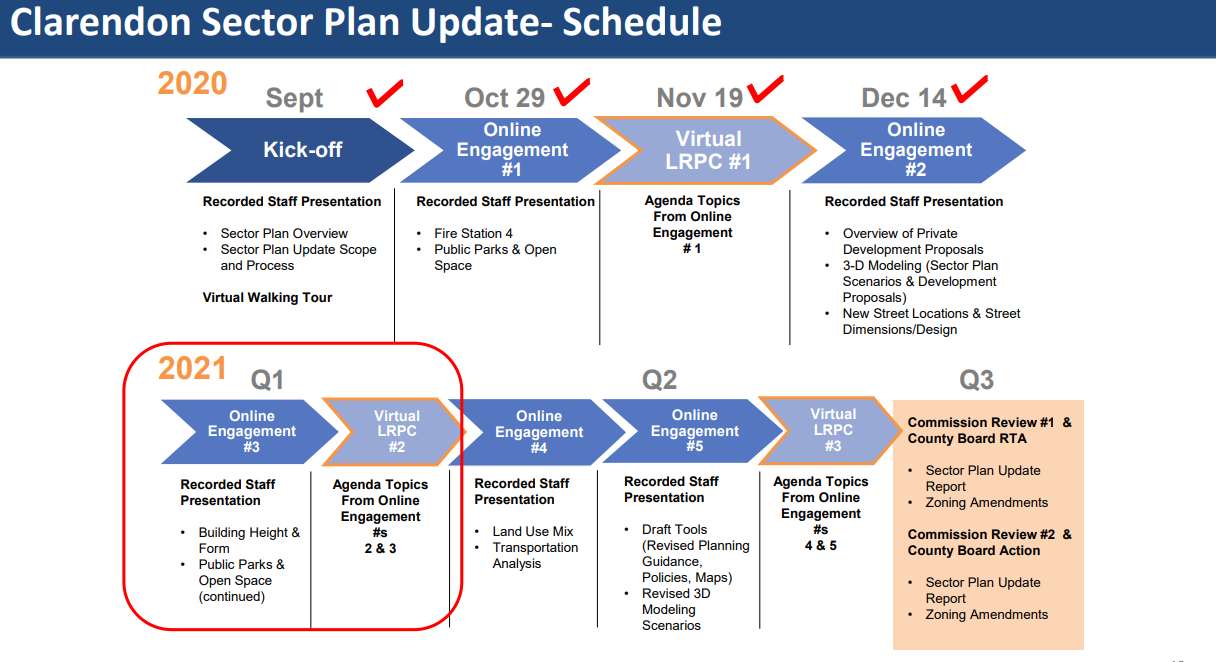
Over the coming months, participants will determine how they can “advance the sector plan’s vision” with new “guidance and zoning for private development.” These changes will hopefully allow Clarendon to replace more parking lots with residential and commercial buildings, offering more productive uses of our scarce urban land. But the Sector Plan process also reveals the central flaw in our development planning.

In the short term, you should participate in the Clarendon Sector Plan process to allow more height and density in these blocks south of Washington Boulevard to maximize the direct and indirect benefits to the broader community.

In the longer term, Arlington should rethink the development process that treats new housing or office space as a problem that must be mitigated through expensive public benefit projects. By funding public improvements through fees from new development, the costs end up borne almost exclusively by renters and new buyers, rather than on the whole community.

Instead, we should make it easier to build homes and offices and use general revenue to pay for community needs. Funding infrastructure and amenities through property taxes, or better yet a land value tax, would put urban improvements in the hands of citizens, rather than leaving them to the whims of the development process.

Jane Fiegen Green, an Arlington resident since 2015, proudly rents an apartment in Pentagon City with her family. By day, she is the Membership Director for Food and Water Watch, and by night she tries to navigate the Arlington Way. Opinions here are her own.


By all accounts, 2020 was terrible.

A pandemic claiming hundreds of thousands of lives. Police killings. Riots. Violence in the streets. Unemployment. Hunger. Businesses closing. Rising levels of crime. Election controversy. Schools closed. Medical workers exhausted. Lockdowns. Social isolation. To name just a few.

Yikes.

Overall, this year sucked. But on an individual level, there are undoubtedly people for whom 2020 had some redeemable qualities.

Maybe you got engaged, or had your first child, or got a big promotion at work. Maybe spending more time at home and with family wasn’t so bad.

At the risk of making some feel guilty, this morning we’re asking: was 2020 actually a better year for you, personally, than 2019?


During the pandemic, many who formerly commuted to work are now working from home.

Some are eager to go back to the office full time when it’s safe to do so, while others may be contemplating a switch to either working from home permanently or at least a couple of days per week.

A wide range of companies are moving to or considering moving to a “hybrid workplace” model post-pandemic. Among them is Microsoft, which will let employees opt to work from home up to 50% of the time, or permanently with a manager’s approval.

It seems likely that many office-based employers in Arlington and elsewhere in the D.C. area will be implementing similar policies as the pandemic (hopefully) comes to an end this year. That has made us wonder about the impact on commuting.

More work from home days collectively would mean less commuting, which is generally a good thing for the environment and for traffic. There may be second order effects, as well, especially in cases where an employer offers flexibility in deciding when you go into the office.

Such flexibility, for instance, may have implications for bike commuting

Arlington County has long worked towards the goal of having more people bike to work, thus taking cars off the road during peak commuting times. So far it’s still a niche commuting option: only 1.5% of Arlington residents report biking as their primary means of commuting, compared to 51.1% who drive alone, according to the latest U.S. Census data.

Should you have the ability to pick and choose when you go to the office, it could allow you to go in on good weather days and skip bad weather days, a big deterrent to regular bike commuting. All of a sudden, with bad weather largely out of the equation, the idea of being able to commute for free without worrying about traffic, while getting a workout and fresh air, may become more attractive.

What do you think?


What’s Next with Nicole is a biweekly opinion column. The views expressed are solely the author’s.

While Virginia prohibits municipalities from banning dogs based on breed alone, this discrimination still persists in housing.

In Arlington where 70% of homes are in multi-unit buildings, and 60% rent, this law is essentially rendered useless for a majority of our population.

Virginia Code states that “No canine or canine crossbreed shall be found to be a dangerous/vicious dog solely because it is a particular breed, nor is the ownership of a particular breed of canine or canine crossbreed prohibited.”

While it is reasonable to ban animals that have been deemed dangerous or vicious, and ban dogs or animals all together, it seems unreasonable to allow for certain breeds of animals but not others — particularly when this practice is banned at the municipal level. This has an adverse effect on certain breeds that are at high risk for euthanasia, such as cross-breeds of pitbull terriers, and the living situation of their owners.

For a real world example of how flexibility on breed discrimination in housing plays out here in Arlington, I will use an experience that I went through three years ago when I had a roommate with a pitbull terrier. My experience in search of housing with a pitbull was what initially spurred my advocacy for renters rights.

At the time we could not find a single two bedroom apartment in a building that would allow for pitbull related breeds. We had to move into a single family household that was run by someone I would classify as a slumlord. At the time, small landlords were exempt for basic services such as providing running or hot water, which were not working 30% of the time we were living in this home. Since the sweeping improvements provided by the 2019 Tenant Landlord law that is now illegal. Having a breed restricted dog is one of many factors that discrimination plays in people moving into questionable living situations.

Locally, Prince George’s County, Maryland banned pitbull related breeds in an effort to decrease serious dog bites in the county. In their own Vicious Animal Task Force it was found that this ban did not reduce biting incidents from pitbulls to any degree of significance. Despite this, in Prince George’s 900 pitbulls are impounded a year because of this law and 80% of them are euthanized.

While I am glad that Virginia is one of 22 states to have breed specific legislation (BSL) to ban breed discrimination, it is unhelpful that this does not extend to housing. I would encourage the Board to look at options of extending our state requirement of banning breed specific discrimination to housing units, if not prohibited by Dillon Rule.

Nicole Merlene is an Arlington native and former candidate for Virginia State Senate. She has served as a leader in the community on the boards of the Arlington County Civic Federation and North Rosslyn Civic Association, as an Arlington Economic Development commissioner, in neighborhood transportation planning groups, and as a civic liaison to the Rosslyn Business Improvement District.


Peter’s Take is a biweekly opinion column. The views expressed are solely the author’s.

On December 4, ARLnow documented APS’s conclusions that:

Black and Hispanic students [in K-2] dropped off the most [with respect to foundational literacy skills] during remote learning, while students with disabilities continue to perform far below neurotypical children and the overall student population.”

Former School Board candidate Symone Walker correctly observed that “COVID-19 exacerbates a problem that has persisted for years, one she said is partially rooted in inconsistent methods of teaching literacy.”

In pre-COVID-19 columns, I highlighted why independent experts concluded that APS should:

The current upsurge in Arlington COVID-19 community spread may be great enough to require APS temporarily not to provide in-person instruction widely, but independent experts and APS’s own data establish that virtual learning causes serious harm to thousands of children, especially our community’s youngest and most vulnerable.

These are the critical steps that both APS and Arlington County government must join together to take NOW to address our community’s instructional crisis:

  • make virtual learning much better
  • adopt a plan to open schools safely ASAP in 2021 for students whose parents choose in-person learning

Make virtual learning much better, especially for the most vulnerable

APS must make virtual learning the very best it can be. But for many thousands of our community’s children, in-person learning will always be infinitely better.

Students with disabilities are being left behind by APS’s shelve-them-in-classrooms approach. These children currently go to school where only an aide monitors them logging on to an iPad. They need so much more in-classroom, in-person professional help. Why isn’t APS providing it?

APS needs to work with parents to adjust significantly the current virtual school day. Sitting online for a full school day is not developmentally appropriate for K-5. Children in this cohort need maybe 2 hours of instruction in math/reading/writing to stay on track. The rest of it should be optional. Many excellent suggestions by Sal Khan of Khan Academy are here.

Adopt a crash program to open APS schools safely ASAP in 2021

January 6, 2021 marks 300 days since the vast majority of APS students were in school.

APS and the Arlington County government must collaborate to plan NOW to open schools safely ASAP in 2021 for parents who choose in-person learning. That plan requires a specific reopening target date.

When to reopen schools is among the most important educational policy decisions currently facing the School Board. That board’s claim that this decision is purely an “operational” decision (entirely up to the Superintendent) is just plain wrong. Dr. Durán (and tacitly the School Board) continue to default always to the wrong message: schools will not reopen.

But the message that thousands of parents and residents want to hear is: we are working day and night to develop a plan to reopen schools safely. The School Board also needs to direct Dr. Durán to articulate more clearly APS’s air quality and lunch arrangement plans.

The County Board must step up

The County Board has a vital role to play in helping the School Board open schools safely. The County Board’s current claim that this decision is entirely up to APS also is a cop out. In our health emergency, the County Board must step up.

(more…)


The Right Note is a biweekly opinion column. The views expressed are solely the author’s.

It would not be 2020 without at least one unexpectedly strange story from our County Board. Last week it was revealed by the Washington Post that Christian Dorsey’s bankruptcy claim was dismissed with prejudice for “an overt act of misrepresentation.”

This is the second time in recent memory that Dorsey has had a very public revelation of difficulty with being forthcoming after last year’s failure to disclose a $10,000 improper campaign contribution. And for the second time in a year, he has received a less than enthusiastic vote of confidence from fellow Arlington County Board members for his continued service. Board Chair Libby Garvey said she backed Mr. Dorsey “despite his personal financial issues.”

On Saturday, the Arlington County Board moved ahead and approved its legislative package. Included in the requests are the ability to lower speed limits below 25 mph and to install speed cameras. This is on top of last week’s revelation that the County Board would use tax increases to fund spending priorities like ranked choice voting and collective bargaining.

Also on the docket was the Board’s move forward to advertise changes to its residential parking program. If you live in a house with a driveway, your ability to park on the street will be cut in half even if parking on your street is never a problem. The program will not take into account if you have multiple generations living together who need access to cars to commute to school or work where Metro is not a viable option. And in order to pay for a program that will issue fewer permits, the proposal would more than double the parking fees. It is another anti-car, completely arbitrary change that will be forced on many unsuspecting Arlingtonians very soon. It should not be passed under the cover of a pandemic.

This is the last column of 2020. Presumably, the next one will be after Arlington County Board Members have made their vision speeches for the New Year. Almost certainly, the speeches will be filled with a look back at the challenging year behind them. And the Board will no doubt paint a picture where they will have no choice but to ask homeowners to pay considerably more to help them “dig out of a hole.”

Between now and then, they should talk to the small business owners who are barely hanging on in the face of COVID restrictions. They should talk to families who have lost jobs and taken pay cuts. And they should talk to parents who are struggling to balance work with helping their kids get through the virtual school day.

Ask them all what their priorities are from their local government. Then the board Members should consider rewriting those speeches and reordering their priorities.

Mark Kelly is a long-time Arlington resident, former Arlington GOP Chairman and two-time Republican candidate for Arlington County Board.


It has been a boom year for live Christmas trees.

Various news outlets, including the New York Times, report that sales of Christmas trees — the real ones — have soared amid the pandemic, leading to shortages in some areas. Those stuck at home, it seems, have taken to holiday decorating as a way to enliven one’s living space and spend some quality indoor time.

Despite the good news for Christmas tree farmers, the overall Christmas decorating trend has been moving toward artificial trees, the sales of which seem destined to overtake their live counterparts.

Real trees may look pretty and smell nice, but the convenience factor of artificial trees — and the long-term cost savings — has led people to increasingly opt for the latter.

Which, if any, are you putting up in the living room this year?

Flickr pool photo by Dennis Dimick


Progressive Voice is a bi-weekly opinion column. The views expressed are solely the author’s.

By Rosaelena A. O’Neil

My daughter finally convinced me to upgrade my cell phone. I had been operating with a device that was about seven generations behind the times. She said, “Mom, it’s an investment worth making. What are you waiting for?”

When I fired up the new phone I couldn’t believe what I had been missing. I have a new appreciation for a “cell phone” – turns out it is a super computer!

In a similar vein, when we talk about higher education – and community colleges in particular – some people maintain an outdated, limited world view. Some believe community colleges like NOVA are “grade 13” or the higher education alternative for those less fortunate.

While the mission has always been to promote economic and social mobility, NOVA (Northern Virginia Community College) has seen an enormous “upgrade” in recent years. NOVA embodies equity and excellence in higher education.

Joel Vargas, a 2011 Wakefield alumnus, went to NOVA and earned his Associates degree in engineering. “My NOVA education gave me skills and perspective that positioned me to be successful leading diverse teams,” says Vargas. Today he is an established business owner and project manager and notes, “In my business we like to groom and grow talent. I see a bright future and long-term career in construction management.”

In education, NOVA has enabled equity through cost (less than half of the tuition and fees of other institutions); access (easy enrollment, flexible schedules, targeted advising and nearby campuses on public transit); responsiveness and agility (wrap-around services that meet students where they are and a key partner to the business community). A few examples:

  • NOVA is urgently deploying the Reemploy Virginia Initiative launched by Gov. Ralph Northam in October. NOVA already distributed nearly $1.8MM for tuition and fees to re-skill northern Virginians jobs in high-demand fields who are unemployed or underemployed due to the pandemic.
  • NOVA was awarded the Greater Washington Innovation Award for Jump Start, a tuition-free summer online course program for graduating high school seniors to earn college credit – a pandemic rapid-response program.
  • NOVA and Arlington Public Schools are partners. Arlington graduates pursue technical and baccalaureate pathways or launch into ADVANCE – a co-enrollment pathway with George Mason University concluding in a four-year degree at a fraction of the cost. Our high school students benefit from increasingly diverse dual enrollment opportunities – college credit-bearing freshman and sophomore courses in English, social sciences, math and specialized science labs.

Kate Bates, President and CEO of the Arlington Chamber of Commerce, notes, “Businesses in Arlington need a well-educated and skilled talent pipeline. NOVA is essential to achieving the goal of an educated regional workforce.” Looking at its range of students, NOVA is a living example of equity, serving high school graduates, adult learners, career switchers, veterans, and individuals wanting to upskill to maintain a competitive edge.

Arlingtonian Kallan Moore, who says she “wandered” after finishing a liberal arts degree, notes, “I’m more confident today in my ability to gain new skills. I credit NOVA for helping me see that I was capable of working in a field that I had perceived as inaccessible and intimidating.” Moore says that “NOVA took the mystery and jargon out of tech. I can see building a career that connects tech with my current work in the law.”

(more…)


View More Stories