The Right Note is a biweekly opinion column. The views expressed are solely the author’s.

Thumbs up to the School Board for announcing the pathway for bringing kids back to school in person this year. According to the most recent update, Arlington Public Schools are on track to bring back students who need direct support this month and begin the in-person hybrid learning option in early December. After the false start this summer and a refusal to disclose specific metrics for the return, APS has a big communications hurdle to overcome over the next two months.

As parents continue to work through the logistical issues around their ongoing “home e-learning academies” and balancing their own work responsibilities, APS also put forward its proposed boundary changes for Fall 2021. According to APS, 1,400 students from Ashlawn, Science Focus, Glebe, Long Branch, McKinley, Taylor and Tuckahoe schools would be impacted, and the School Board will approve the changes December 3rd. There is no good time to finalize boundary changes, but the middle of pandemic school from home seems less than ideal.

Also of note, APS stated that the “data used in this process comes from elementary school enrollment on September 30, 2019.” First-day enrollment this fall was 911 fewer than a year ago. And APS has not yet announced the September 30th number for this year. Nothing in the announcement discussed how APS is taking into account any decrease in enrollment this September, or which schools are most impacted by it. We can only assume they believe enrollment will bounce back, but it is a question the School Board should answer before moving to a final vote.

Interested parents can join the first virtual meeting on the changes Wednesday evening and ask questions.

Thumbs up to the County Board for voting to end the sidewalk gatherings ordinance. Four members of the Board rightly recognized the ordinance as constructed was unworkable and did not continue to forge ahead anyway. The Board should consider looking for other unworkable ordinances to get rid of in the future.

Mark Kelly is a long-time Arlington resident, former Arlington GOP Chairman and two-time Republican candidate for Arlington County Board.
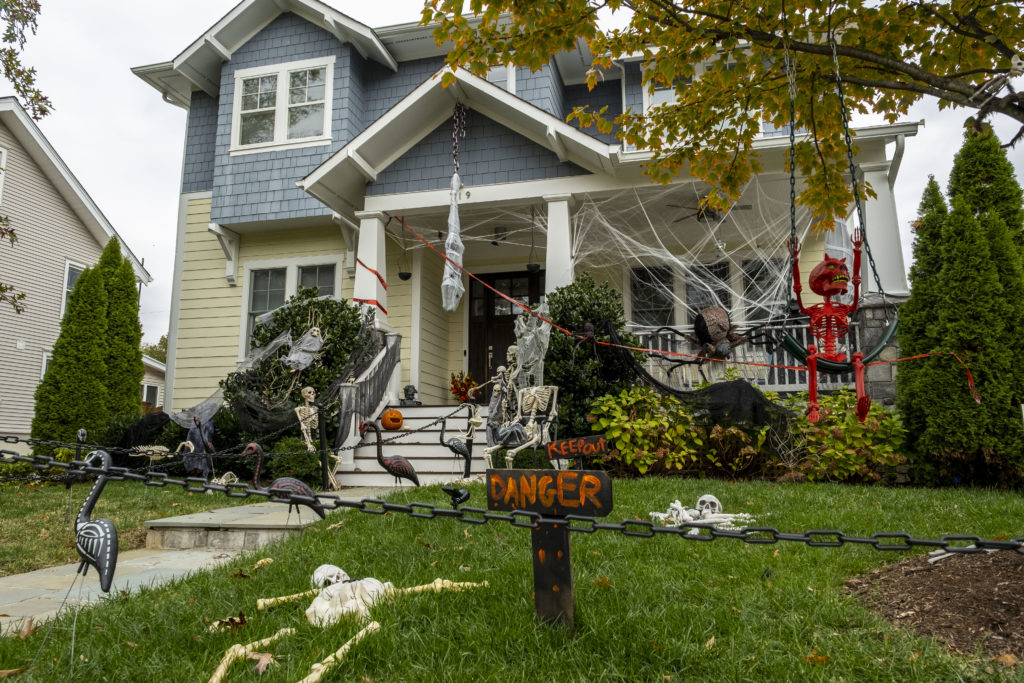
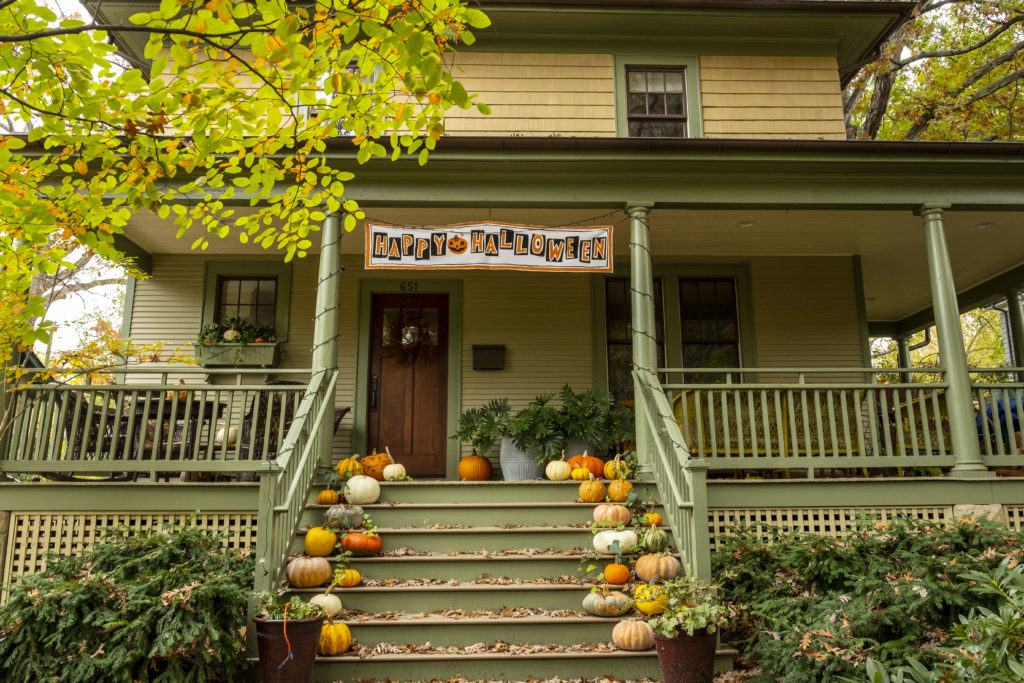
(Updated at 9:45 a.m.) Halloween has not been cancelled, but the pandemic is putting a damper on the usual spooky spirit of the holiday.

The owner of a local costume store in the Crystal City Shops told the Washington Post that his sales are down 80%, amid a nationwide drop in Halloween spending. Sales of adult costumes in particular are down significantly, as parties are curtailed.

Overall Halloween spending is expected to fall 8%, according to the Post, citing the National Retail Federation.

Around Arlington, Halloween decorations can still be found, but three-and-a-half weeks out from Oct. 31 it feels like there are fewer ghouls, goblins, fake spiderwebs and pumpkins to be seen.

Are residents reluctant to decorate when trick-or-treating will be much diminished and when fake skeletons feel a bit, well, insensitive? Or is it actually business as usual for most people, despite the deadly global pandemic?

Let’s find out.


Progressive Voice is a bi-weekly opinion column. The views expressed are solely the author’s.

By Maya Jones

At five, I cast my first ballot for president, during an elementary school mock election.

In that moment, I felt I was making change, but that feeling was fleeting. I soon learned a hopeful child’s voice did not matter, and voting is a privilege. Frustrated, I vowed that at 18, I would exercise this privilege.

Seven years later, in 2008, I witnessed the world change as I watched the votes tally in favor of the first Black president. Being a young Black girl in Atlanta, I prayed my voice would matter someday. On my eighteenth birthday, keeping my childhood promise, I registered to vote.  Despite being excited and empowered, I was consumed with worry as I walked up to cast my first ballot. “Did I have my driver’s license?” Because without it, I could not vote.

Now, with the October 13 voter registration deadline approaching for the 2020 election, we must ensure every voter knows they matter. We must resist voter suppression tactics and register all eligible citizens. We must empower voters regardless of race, ethnicity, gender identity and sexual orientation to be the change they want to see in the world.

In July, there were only 434 net new registrations, in Arlington, compared to the 1,645 net new registrations in 2016. The pandemic’s reduction of person-to-person interaction is partially to blame. However, some Arlingtonians remain unregistered due to the limitations of Virginia’s Online Voter Registration (OVR) system. These eligible citizens may not have access to the internet, possess a Virginia identification card, or simply are new to the area.

That’s why I and many others spent many hot summer Saturdays, standing in front of places like the Arlington Food Assistance Center (AFAC), Shirlington Library Plaza or Penrose Square on Columbia Pike, registering voters (with our faces covered) hoping to encourage community members to join the electorate. Our efforts to help close the gap paid off and, in August, we saw 1,300+ net new registrations in Arlington, keeping pace with the upward trend in Virginia.

Our guiding principle is every person registered is a new voice being heard. A quick glance at history reminds us of the struggles we endured to obtain the privilege of voting and why we must keep fighting the good fight.

(more…)


It was, to be honest, a relatively light news week in Arlington.

Most of the local news revolved around restaurants, at a time when much of the population is still not even considering dining out at a restaurant. The restaurant stories did well, readership-wise, but not as well as we would expect during normal times.

The lived experience of this week probably doesn’t feel like it was light on news, given what’s happening nationally. Given the presidential debate, reports about the president’s past tax returns, the president’s COVID-19 diagnosis, and — for those sport-inclined — a constant barrage of sports news and post-season action, the last few days have been exhausting for many.

Here are the ARLnow stories that had the highest readership this week:

  1. Summers Restaurant Closing Permanently After 38 Years
  2. Reduced School Bus Capacity Prompts APS to Expand Elementary ‘Walk Zones’
  3. Democratic Precinct Captain Booted for Supporting Independent School Board Candidate
  4. Arlington World of Beer Location to Open Next Week
  5. New BBQ Restaurant Launches Fried Chicken Virtual Restaurant
  6. Connecticut Pizza Restaurant Sets Mid-October Opening Date for New Clarendon Outpost
  7. Man Arrested After Accidentally Firing Bullet into Apartment Below
  8. AWLA Still Seeking More Information on Abandoned Dog
  9. Making Room: Will Pentagon City Make Room for People or Cars?
  10. Punch Bowl Social in Ballston Sets Reopening Date

Feel free to discuss those articles or anything else of local interest in the comments. Have a nice weekend!


Health Matters is a biweekly opinion column. The views expressed are solely the author’s.

Fall weather has arrived in Arlington, and colder temperatures mean more people migrating indoors to stay warm. For restaurants, cold weather presents a unique challenge since many patrons are still hesitant to dine indoors due to COVID. Restaurants are finding that they have to again adapt to ensure safety for their patrons and employees.

To preempt the “stay-in-your-laners,” I am clearly not a restaurateur. I am, however, a front line healthcare worker (HCW) and there is a surreal parallel between what I experience in the hospital and what I have seen in restaurants since reopening.

In the hospital, there are many of the familiar safety measures: masks for patients and HCW, constant cleaning of waiting, exam and operating rooms, hand sanitizers at every corner and conspicuous signage. In addition, appointments are staggered to minimize waiting room crowds, all patients are screened for COVID symptoms, temperatures are checked before entering areas with immunocompromised patients and chairs physically distanced in waiting rooms.

As an anesthesiologist taking care of COVID patients, I wear an N-95 respirator (usually a recycled one these days), eye shield, head cap, full gown and gloves. Every patient getting a procedure needs a COVID test within 5 days. If a known COVID positive patient comes for a procedure, it should be in a negative pressure room or at least have a large HEPA filter.

(more…)


Modern Mobility is a biweekly opinion column. The views expressed are solely the author’s.

The title of today’s column is a common adage in the planning world that’s at least 30 years old; I regret that I do not know its original source to provide credit.

At its heart, it reflects the insight that the best way to ensure people can quickly and easily get to the places that they need to go is to ensure that they don’t have to go as far to get there – trips, on average, become shorter.

For motorists, shorter trip lengths mean you drive through fewer intersections and along fewer segments of street which means fewer cars on each street at a time which means less congestion. Shorter trips are also more convenient for active transportation like walking and biking – many folks would walk a few blocks to a restaurant who wouldn’t walk a mile. Many folks would bike a mile to a doctor’s appointment would wouldn’t bike 10 miles. The result? More trips by means other than car.

Many parts of Arlington’s land use plan embrace this. Arlington’s original “urban village” planning maxim was designed around creating neighborhoods, centered around good transit, where people had ready access to work, play and everyday needs like shopping.

For someone living in the denser corridors of Arlington, a huge number of useful destinations are reachable on foot, many more by bike and even more by frequent transit. They may choose to have a car, or some may need a car because of a job located far from transit or a job that requires traveling to many different sites on a daily basis, but many are able to happily live car-free or car-lite and those who do drive generally make shorter trips in those cars.

This growth strategy, along with continued investment in multimodal transportation facilities has allowed Arlington to grow its economy and its population while also holding traffic levels relatively stead, adding new parks (like Long Bridge Park and Mosaic Park) and reducing the relative carbon impact of our residents.

As Arlington embarks on a Missing Middle Housing study, a look at transportation and density in Pentagon City, the Plan Lee Highway Study and a re-examination of some details of the Clarendon Sector Plan, we would do well to remember that everything is easier, from a transportation standpoint, if you let people live nearer to where they want to go on a regular basis.

Chris Slatt is the current Chair of the Arlington County Transportation Commission, founder of Sustainable Mobility for Arlington County and a former civic association president. He is a software developer, co-owner of Perfect Pointe Dance Studio, and a father of two.


Community Matters is a biweekly opinion column. The views expressed are solely the author’s.

Earlier this month I attended the Arlington Historical Society (AHS) virtual event on the private school desegregation case, Runyon v. McCrary.

According to the AHS website, “the US Supreme Court outlawed racially segregated public schools in 1954, but whites-only private schools flourished throughout the South for decades. The Supreme Court’s 1976 decision extending the ban on racial segregation to private schools involved a segregated pre-school here in Arlington.”

As I was reminded of the behavior of Arlingtonians in the 1970s regarding attitudes about exclusivity and discrimination in education, I thought about how some of these attitudes still persist today. As we begin to conclude the 100 year anniversary of Arlington being named Arlington, it’s natural to think about how Arlington has, or has not, changed during that time.

Join this conversation hosted by Arlington County government today at 7 p.m. to learn more. It’s also an opportunity to discuss  where Arlington will be in five, 20 or 100 years, and how we can be intentional as a community about getting there.

I moved to Arlington in 2004, and have been involved in several community activities. While Arlington has grown, one observation I have made over the last 16 years is that the same people are involved in several leadership roles and organizations. While most people in organizations understand that a small number of people do the bulk of the work, as we move into the next 100 years, Arlington should grow our leadership table.

We should consider:

Actively fostering succession planning and limiting your time in one role. Organizations should have policies in place which encourage members to participate in different committees, shadow leaders, and provide opportunities for members to socialize with leaders and members across the organization. We should also encourage members to advance in leadership instead of remaining as general members, and begin the process of identifying someone to take your place. While we generally believe that if people have the time and talent they should not be denied the opportunity to serve, we should consider how that affects our community over time.

Creating a culture of impact and productivity instead of busyness. We tend to reward people who are “busy,” and have long resumes with additional leadership roles. We should focus on the impact made during time spent with an organization, and begin to use that as an indicator of whether someone should be offered another role. When you are offered the opportunity to serve, consider whether you should suggest someone else who is qualified.

Intentionally recruiting new leaders outside of your network.  It is generally easier to socialize with people who are like you. That’s one of the many reasons that white parents wanted their children to be in segregated schools up until 1976, and why many still want their children in segregated schools today.

I am the first to admit that I have fallen into the trap of being perpetually “busy.” Yet as I have grown in leadership, I have realized the importance of actively seeking and mentoring new leaders for the long term success of our organizations and Arlington. We should encourage each other to evolve into new roles at a higher level within Arlington, transfer our skills to the state or national level, or step back.

Those simple steps could go a long way in embracing new thought leaders and fostering change in Arlington during our next 100 years.

Krysta Jones has lived in Arlington since 2004 and is active in local politics and civic life. This column is in no way associated with or represents any person, government, organization or body — except Krysta herself.


Halloween is a month away, but people are already starting to wonder how it’s going to play out.

Health authorities are cautioning against trick-or-treating during the pandemic. So far it has not been officially banned, but there is historical precedence for doing so.

During the 1918 influenza pandemic, which was at its deadliest between October and December, a number of U.S. cities banned Halloween parties and celebration, according to CNN.

What to do about Halloween is a hot topic on local Nextdoor threads.

“As tough as it is we are not going to engage in this this year to protect not only ourselves but others,” one resident said, on a recent thread visible to those in some North Arlington neighborhoods. “I really wish everyone could just buckle down so we can get the schools back open, even if it means sitting it out this year.”

Others disagreed.

“If people can safely protest, kids can trick or treat,” said another local resident. “This is nuts. This is an outdoor activity. I’m certain kids and their parents can social distance and those over the age of 2 yrs can wear proper masks.”

Given the current likelihood of there being some trick-or-treaters out and about this year, what is your plan for offering candy? Will you be answering the door, leaving a jar outside, or skipping the holiday altogether?


Making Room is a biweekly opinion column. The views expressed are solely the author’s.

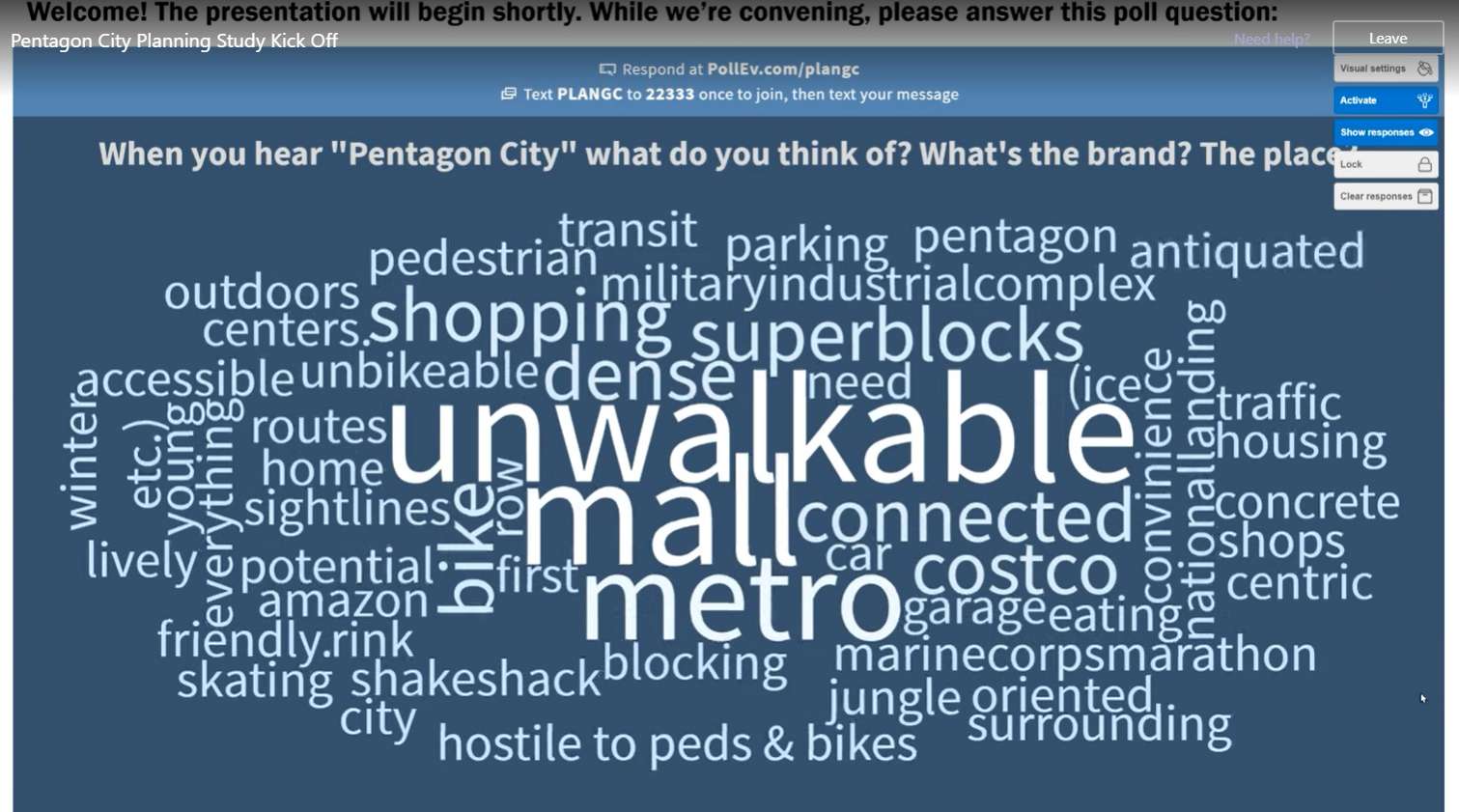
Last week, Arlington County staff held the community kick-off for the Pentagon City Planning Study.

The purpose of this multi-phase process is to determine the area’s capacity for future growth and ultimately make suggestions for zoning and land use changes. I hope the County recognizes the incredible opportunity to welcome more people into our dynamic, transit-accessible neighborhood by putting room for people above capacity for cars.

With the addition of Amazon’s second headquarters, Pentagon City will max out its designated density. But the demand for housing and office space continues to grow.

The master planning process for Pentagon City is an important step because the community can identify improvements that we hope development can bring, with walkability being one of the key attributes that neighbors want. The weakness in this process is the reliance on car-centric transportation analysis that could limit new housing by putting the needs of drivers ahead of current and future residents.

As Chris Slatt recently showed, our transportation forecasts, produce with each Site Plan Development, are flawed. They overestimate the number of car trips that a development will generate. The Multimodal Transportation Analysis (MMTA) reports produce reams of data for car trips and how those car trips may create rush-hour delay at intersections in the area in some future year, which can result in a development being downsized.

The overestimation of driving trips also pushes developments to have more parking spaces than they truly need. Our zoning code requires new developments to have enough parking for “all motor vehicles that may be expected to come to the premises at any time under normal conditions for any purpose.” But research shows that cheap and plentiful parking actually creates more parking demand by motivating people to drive.

The MMTA only addresses transit, walking, and bicycling in shallow terms. It doesn’t show the specific conditions of nearby transit, such as the wait times, trip times, reliability, or crowding. It doesn’t use data on the comfort level of nearby bicycle routes. It doesn’t offer objective measures for pedestrian safety that discourage people from walking.

This means that if the Pentagon City study finds that new housing could cause intersection delays, we would approve less housing. But that forecast is based on bad data on how many people might drive and no analysis of how to improve non-auto modes.

Why should the County set the capacity for residents and workers based on analysis of existing infrastructure, rather than adjust the infrastructure to meet the demand as it arrives? We can actually use density to decrease congestion by making the neighborhood more walkable and making room for people to live within walking distance of shops and offices.

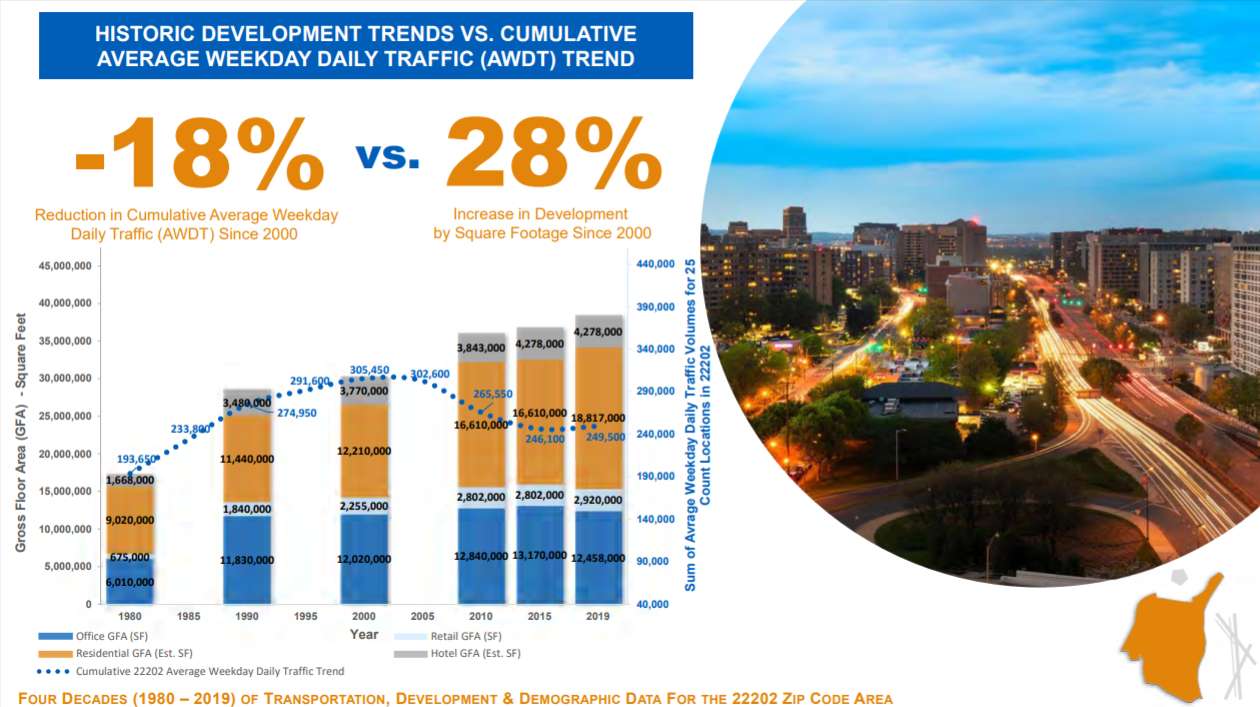
The County’s own Pentagon City transportation data shows that this is possible. Currently, 24% of the households in the area are car-free and we added 1,100 new car-free households in the past 5 years. Three-quarters of all trips in Pentagon City occur by a mode other than a single-occupancy vehicle. In the past 20 years, the developed square footage in 22202 has increased by 24%, car trips have decreased by 18%.

(more…)


Has September been a total blur or anyone else?

This week summer turned to fall and one was left to ask — wasn’t it August just, like, last week? Apparently not. We’re already less than a week away from October.

Speaking of things that went by too fast, the tenure of Steve Quartell as the writer of the Your Beermonger column has come to a much-too-early end. Farewell, Steve, and good luck in New York — but, at the same time, welcome Jace Gonnerman!

Now, here are the most-read ARLnow articles of the past week:

  1. UPDATED: World War II Flyover Postponed
  2. Police Called After Man Attempted to Lure Teen Girls to Car
  3. Bed Bath & Beyond to Close at Pentagon Row
  4. Cafe Pizzaiolo in Shirlington to Be Replaced by ‘Neo-Neapolitan’ Pizzeria
  5. As Flu Season Approaches, New COVID-19 Cases Continue to Fluctuate
  6. Local Organization Plans ‘Ride for Black Lives’ This Weekend
  7. Affordable Apartment Complex in Green Valley Slated for Redevelopment
  8. Renderings Released for New Public Plaza in Virginia Square
  9. Progressive Voice: I’m Holding My Nose and Voting Yes on the Stormwater Bond, But Arlington Must Do Better

Feel free to discuss those or any other local topics in the comments. Have a great weekend!


What’s Next with Nicole is a biweekly opinion column. The views expressed are solely the author’s.

At the beginning of this month, Metro took a step into the 21st Century by allowing SmarTrip to be added to Apple Wallets.

A Google spokesperson also said they plan to roll out a Google Pay version later this year. This move has significant short term benefits, some improvements that are needed to improve equity, and in the long term will provide a significant boost to the efficiency of our entire bus system.

What will be improved right now

Customers save money: Do you even know the number of times you have lost your plastic SmarTrip? I have lost hundreds of dollars from misplaced SmarTrip cards over the years. When you lose your card you lose both the money you put on the card and the cost of the new plastic card. While there is an online option to save your SmarTrip number and connect employer benefits, many do not utilize this option. Having payment functions on your phone will save Metro customers big in the long run. 

Bus efficiency: To increase funds on SmarTrip cards for bus riders, riders usually have to do so while in line to get on the bus. Every time a bus rider has to add money to their card it averages 20 seconds of time per person, slowing down the bus route significantly. As fellow columnist, Chris Slatt, has mentioned, a quarter of bus travel time is spent boarding, and if you can halve that time you have sped up bus route speed by 12%. Allowing riders to update payment on their phone will increase bus speeds on every route in the county.

How tap-and-go tech can be more equitable 

Android capabilities: The average cost of an Android is lower than an iPhone, and ensuring that an Android rollout is successful will be key to achieving equity. While Google has stated they would like to roll out by the end of the year, Metro has said “it is coming,” and that definition is sometimes loosely defined by Metro. As a community we should hold feet to the fire to get a concrete timeline on when this capability will be rolled out.

Disability, UPass, & other reduced fare cards transferable funds: Reduced fare cards are not able to be used with this function yet. Only full fare and Senior SmarTrip cards are able to be transferred at this time. The reason we give people with disabilities, students, and others reduced fares is to have a more equitable transportation system. Ensuring these cardholders can transfer their funds is an obvious oversight that I hope can be addressed in a timely fashion.

Long-term infrastructure improvements

Columbia Pike & Route 1 off-board fare collection for Bus Rapid Transit (BRT): Off-board fare collection is a significant part of how to create time-saving BRT. In 2014 off-board fare collection had an anticipated 20 hours of time savings per day just along Columbia Pike from off-board fare collection.

(more…)


View More Stories