What’s Next with Nicole is a biweekly opinion column. The views expressed are solely the author’s.

We have an obvious north-south divide in Arlington County. One state highway uniquely crosses the entire county from north to south — Glebe Road, Route 120.

Traditionally, Arlington has planned along horizontal corridors including Route 50, Columbia Pike, Lee Highway, and Washington/Wilson Boulevard. This is likely because these major road arteries were designed to transport people from the suburbs of Virginia to Washington D.C. These arteries also happen to be in central Arlington and literally divide Arlington between north and south.

Driving along Glebe Road you might notice narrow sidewalks with cars zooming by, and occasional townhomes or duplexes on both the north and south side of the highway. These characteristics are very similar to Lee Highway, which we have already begun a planning process for.

It is a known statistic that north Arlington is more wealthy than south Arlington. American Community Survey data shows that our three lowest per capita income census tracts (excluding Fort Meyer) are between $25,000-40,000, all below Route 50; our three highest per capita income census tracts are $104,000-115,500, all above Route 50.

Planning is a scary topic to broach. This is because it might “change the nature of the neighborhood”. I would note a few things.

Paul Holland and Sandra Chesrown have done a great job leading the Plan Lee Highway process by actively involving neighborhoods in their plan with a block by block approach. This type of engagement in the planning process has largely put at ease early fears by those living along the planning corridor because neighborhoods with varied ideas of what their neighborhood should look like are listened to.

“Planning” also does not necessarily mean massive apartment buildings are coming to your neighborhood. Even in our Metro corridors, we retain single-family households in Ashton Heights and Lyon Park just blocks from Metro stations and Dominion Hills and Boulevard Manner neighborhoods that back right up to Meridian Pint and Patrick Henry Apartments along Wilson Boulevard. Planning in non-Metro corridors often means permitting light density such as townhouses or duplexes on the arterial road and not often does it permeate further into single-family household neighborhoods.

Heavier housing density makes more sense in areas of S. Glebe Road with proximity to I-395, and sections of N. Glebe Road that are close to I-66. Light housing density already exists on N. Glebe north of Lee Highway by way of townhomes such as The Birches, Cathedral View Townhomes, Carriage Hill, and others that most would agree these existing varied household types do not change the “nature” of the neighborhood.

According to the just-released 2020 Arlington Profile, single-family houses on average are assessed at $949,500, single-family townhomes at $805,000, condominium townhouses at $683,900, and condominiums at $421,400. It is also worth noting that Housing Arlington data shows that Arlington’s teardown-rebuild single-family households had an average sale price of $1.7 million. The difference between someone that has the financial means to purchase a $1.7 million home and a $683,900 townhome is vast.

To state the obvious and reiterate what I have already stated, there is high demand for single-family households in both north and south Arlington. Planning Glebe Road would not change that. It would provide, directly along the arterial road, a chance for families in the middle class to access to the north Arlington school system via additional housing diversity, while improving walkability along north and south Glebe Road, and might finally start to create equity between north and south Arlington.

If we want to address issues of geographic equity such as diversity in our schools, I would encourage us to consider planning our north-south arterial corridors and not just those running from east to west. The most obvious first step to do so would be studying Glebe Road.

Nicole Merlene is an Arlington native and former candidate for Virginia State Senate. She has served as a leader in the community on the boards of the Arlington County Civic Federation and North Rosslyn Civic Association, as an Arlington Economic Development commissioner, in neighborhood transportation planning groups, and as a civic liaison to the Rosslyn Business Improvement District.

Peter’s Take is a weekly opinion column. The views and opinions expressed in this column are those of the author and do not necessarily reflect the views of ARLnow.com

Among the County government’s recent blunders are its disrespectful behavior as described by residents of the historically African American Green Valley neighborhood and its erasure of Black Lives Matter supportive chalk art on Juneteenth.

The Juneteenth erasure generated justified outrage and inspiring community-wide responses.

These latest inequitable actions come on the heels of other poor County government decisions I’ve discussed recently.

Would changes in the form of our government help?

Elect 7 County Board members

Arlington’s current “County Manager Plan” form of government was adopted in 1930:

[T]he County Board elected at large meant a governing body more responsive to the needs of the county as a whole… [T]he ‘continuous, contiguous, and homogeneous’ nature of Arlington had now found expression in its form of government.

Arlington has had five County Board members elected at large ever since. But in 1930, those five members represented 26,615 residents (5,323 per Board member). Now they represent 236,842 (47,368 per member).

Alexandria — a city not a county — has seven elected representatives (including the Mayor) representing a current population of 159,428 residents (22,775 per representative).

If Arlington had seven County Board members elected at large, that would be 33,835 residents per member. Having seven members elected at large would be a significant improvement. It would provide many more opportunities for our elected leaders to hear directly what many more residents think of actual or proposed government policies and practices.

Don’t elect County Board members by district

Some residents believe Arlington should elect at least some County Board members from geographically defined districts. But, where to draw the lines? Electing members by districts would not be a net plus. There are many very important communities and issues in Arlington that have a confined neighborhood focus, but these tend to be so localized that we’d need too large an increase in the total number of County Board members. Instead, we should study the benefits/costs of adopting something like D.C.’s elected Advisory Neighborhood Commissioners.

Alter election times & terms

Our current five Board members are elected in a 1, 1, 1, 2 annual sequence, and serve four-year terms. The costs/benefits of alternatives should be carefully studied. The most substantial changes include simultaneous elections of all at once and/or two-year terms. I support simultaneous elections of all at once, four-year terms, and a two-term limit.

Adopt ranked-choice voting

Arlington County should exercise its recently obtained authority to adopt an ordinance providing for ranked-choice voting (“RCV”) in both County Board primary and general elections.

(more…)


The Right Note is a weekly opinion column. The views and opinions expressed in the column are those of the author and do not necessarily reflect the views of ARLnow.com.

After the sudden school closure and the controversial decision not to teach any new material to our kids this spring, Arlington Public Schools have been wrestling with the question of what school will look like this fall.

According to the recent APS surveys, 73 percent of parents are comfortable with sending their children back to school with safety measures in place. Just 9 percent of parents said they were not at all comfortable. Conversely, only 38 percent of teachers want to go back while 39 percent said they were not comfortable going back to school.

The American Academy of Pediatrics recommended that the goal should be for students to be physically present in school this fall. The benefits of, among other things, face-to-face learning, nutrition, social skills, counseling services and physical activity contribute to the overall health of students. The report weighed available scientific evidence of the impact of COVID-19 on kids:

Although many questions remain, the preponderance of evidence indicates that children and adolescents are less likely to be symptomatic and less likely to have severe disease resulting from SARS-CoV-2 infection. In addition, children may be less likely to become infected and to spread infection. Policies to mitigate the spread of COVID-19 within schools must be balanced with the known harms to children, adolescents, families, and the community by keeping children at home.

In late June, APS announced a compromise position. They created a hybrid learning model so kids could get back in the classroom two days per week. They also gave parents the ability to elect an all distance learning plan for their kids. Thousands of parents had already signed their kids up for their preferred option.

Arlington teachers began pushing back almost immediately. The pressure culminated in a statement by the Arlington Education Association yesterday which called for APS to abandon its plan and conduct classes in the fall by online-only learning.

Today, new APS Superintendent Francisco Durán abruptly reversed course. In an email to parents, he announced school would resume online only in September. And instruction will not begin until September 8th, two weeks later than planned.

Parents, particularly single parents, who do not have the option to telework will have to decide on how best to ensure their kids are cared for, and participating, during online learning. This would have been difficult three days a week, and it just got harder.

Hopefully Superintendent Durán will provide a more complete explanation in future communications. And hopefully our students will not be put at too much of a disadvantage because of today’s decision.

Disappointing GOP Performance

The Arlington voters have been open over the years to competing points of view on local decisions. While Democrat Takis Karantonis ultimately took 62% of the vote in last week’s County Board special election, the performance of Susan Cunningham proved that there is still some appetite for an independent voice. But after Republican Bob Cambridge received just 5% of the vote, the Arlington GOP has some serious work to do moving forward.

Mark Kelly is a 19-year Arlington resident, former Arlington GOP Chairman and two-time Republican candidate for Arlington County Board.


Progressive Voice is a bi-weekly opinion column. The views expressed are solely the author’s.

By Yassmina Hassoun

The good reputation of Arlington Public Schools was mainly why I moved to Arlington about five years ago.

But if we want to maintain that reputation, we have to be more inclusive. We have to do our best to include parents who don’t have the courage to speak up. It might look easy to attend a meeting or speak up for something that negatively affects you and your children, but it is not. Many of us feel helpless to make a change because we don’t have the right tools.

One of the most important tools is to understand “the system” — where to go, who to communicate with, say what we want exactly and how to find what we need. Many newcomers, limited-English speakers, and low-income families don’t have these tools. That makes it harder for them to advocate for their kids. This is where the community should play a bigger role to secure an equal education for all students.

I have not always been brave myself. Several years ago in another city, I went to a meeting at my daughter’s school. My English was not so good then. My daughter was having trouble because she didn’t understand the directions they gave her in class. For instance, if she was supposed to draw so many birthday candles to say how old she was, she would draw flowers on the page or something else, because no one explained.

So that night, I started talking. My voice was, you know, sort of shivering at first. But they listened and they started getting my daughter some help. I realized I could help my daughter and other people, too.

Since I moved to Arlington, I felt kind of lost until I was invited to an event called Roundtable, organized by Arlington County and the Community Progress Network. The purpose was to hear from people who usually are underrepresented. This event was unique because they made everyone feel welcomed and that their voice matters. They had translators for the most often-spoken languages to make sure that everyone could fully participate. They also documented participants’ concerns. For the first time since I moved to Arlington, I finally felt that I belonged and that I was included.

(more…)


After four months of consistently high readership, today is the first non-holiday Friday during which our Google Analytics stats suggest that a fair number of people are on vacation.

If you have left Arlington to head to the beach, the lake or elsewhere, we hope you’re having fund and staying safe.

Here are the most-read articles of the past week:

  1. Petition Calls for Renaming Fairlington Bridge Amid Battle Over ‘BLM’ Art
  2. 14th Street Bridge Blocked By Protests
  3. Morning Poll: Should APS Students Go Back to Class Full-Time in the Fall?
  4. Arlington Sees Uptick in Coronavirus Cases While Hospitalizations Fall
  5. Backyard Homes: Building a Second Home on Your Property
  6. Takis Karantonis Wins County Board Special Election in Landslide
  7. Making Room: Uniting Against the McMansion
  8. ACPD Arrest Data Shows Race, Residency Disparities
  9. Arlington County Names New Chief Race and Equity Officer

Feel free to discuss those stories, or anything else of local interest, in the comments. Have a nice weekend!

Flickr pool photo by Vincent


Ed Talk is a biweekly opinion column. The views expressed are solely the author’s.

Last week, as our nation celebrated Independence Day, protests continued across America for racial equity and justice. The dissonance between the promise of the Declaration of Independence — that all are created equal with the rights of life, liberty, and the pursuit of happiness — and the failure to live up to that promise, has a long history.

In a speech on July 5, 1852, abolitionist Frederick Douglass praised the founding fathers. He also laid bare the simple truth that slaves, as well as free Black people like him, did not have the rights that the framers declared, saying:

I am not included within the pale of this glorious anniversary! Your high independence only reveals the immeasurable distance between us. The blessings in which you, this day, rejoice, are not enjoyed in common. The rich inheritance of justice, liberty, prosperity and independence, bequeathed by your fathers, is shared by you, not by me.

These words, uttered 168 years ago, ring true today.

The “immeasurable distance” between whites and Black people in 1852 persists in the disparities we see in 2020 in education, employment, health, wealth, criminal justice, and more.

To make progress in eliminating these disparities, we must better educate all students about Black history and current events.

In recent comments, Virginia’s Secretary of Education, Atif Qarni, made clear that Virginia has more work to do on this front: “We talk about freedom and justice and spreading democracy throughout the world. I would argue that a lot of those principles came from the struggles of African Americans throughout our history, and that history is not being told in our classrooms.”

Qarny is a member of Virginia’s Commission on African American History Education, which was created to improve the teaching of African American history. The Executive Order creating the Commission also calls for a new high school elective course on African American history, to be offered online through Virtual Virginia starting this fall.

An initial outline of that course includes a comprehensive study of history, literature, the arts, race and racism. This course will benefit the students who choose to take it. In addition, all students should learn Black history by including it across academic disciplines. Students should read Black authors in their language arts classes. They should study the contributions that Black Americans have made to the arts, mathematics, and science in those classes. And their history and government classes should include more focus on the centuries-old struggle for racial equity and justice.

The history of slavery, segregation, and discrimination makes many uncomfortable and ashamed. That not everyone enjoys the same rights and opportunities today is not easy to discuss. Acknowledging this history and our current reality, and discussing these in classrooms, are critical to real learning. Learning can lead to change.

In his 1852 speech, Douglass found hope in the principles of the Declaration of Independence, even while urging the country to acknowledge the injustice of slavery: “The feeling of the nation must be quickened; the conscience of the nation must be roused; the propriety of the nation must be startled; the hypocrisy of the nation must be exposed…”

Decades later, Langston Hughes wrote about patriotism, resilience, and hope in the face of segregation his 1926 poem, which begins, “I, too, sing America.” Though sent “to eat in the kitchen when company comes,” Hughes says that tomorrow, “I’ll be at the table.” And, “They’ll see how beautiful I am and be ashamed.” His poem concludes, “I, too, am America.”

Recognizing that Black history is American history, and teaching it effectively, can help this country make progress in realizing Hughes’ vision of a more equitable and just America.

Abby Raphael served on the Arlington School Board from 2008-2015, including two terms as Chair. She also led the Washington Area Boards of Education for two years. Currently she co-chairs the Project Peace Prevention Committee and Destination 2027 Steering Committee, is a member of the Board of the Arlington YMCA, and works with the Community Progress Network and Second Chance


The Hurtt Locker is a biweekly opinion column. The views expressed are solely the author’s.

Not surprisingly, Arlington voters affirmed the political status quo in Tuesday’s special election for County Board. Takis Karantonis, bolstered by an impressive 71% of the absentee vote, easily dispensed with “progressive independent” Susan Cunningham and Republican Bob Cambridge.

Cunningham, who was endorsed by former independent County Board Member John Vihstadt, performed well in a half-dozen precincts and got more votes than Karantonis in nine precincts, including her home precinct Marshall. With little insight into the Arlington County Democratic Committee’s campaign operation, one can reasonably assume the political machine went into overdrive for the absentee ballot program. Kudos to ACDC.

As far as Republicans are concerned (speaking with some authority here), there’s a lot of work to do. Arlington Republicans struggle to recruit credible candidates, given the political reality in this community, and the campaign machinery is nowhere near as robust as the ACDC’s operation. Still, it’s important for Republicans and independents alike to show up to the public policy discussion — and even file as candidates.

A one-sided debate on the campaign trail or in the County Board chamber is no debate at all. And even if Republican candidates serve as “sacrificial lambs” on the ballot, the ideas still permeate the discussion. And sometimes those ideas are considered and even adopted by local policymakers. It’s one of the reasons I eagerly accepted the challenge of writing this column.

With the recent passing of respected longtime civic activist (and dues-paying Arlington Republican) Jim Pebley, Republicans should reflect on what makes a successful civic activist, regardless of partisan label. And while Pebley rose through Arlington’s civic infrastructure long before the hyper-partisan era we find ourselves in, I’m certain there are public policy conversations that can take place in neighborhoods without partisan labels that seem so toxic at the national level.

Consider Takis Karantonis’ resume: 25 years of urban and regional planning experience, 6 years as Executive Director of the Columbia Pike Revitalization Organization, as well as service on a number of boards and commissions. Likewise, Susan Cunningham’s record of public service in the community is impressive.

As one of the more public figures in the Arlington Republicans, I get asked about candidate recruitment and community messaging a lot. Arlington voters elect public officials with a track record of community service. Karantonis had the support of ACDC campaign machine, but someone with a robust community resume could build out campaign infrastructure that would rival a traditional political party.

Neighborhood associations, the Arlington County Civic Federation, the Committee of 100, and the myriad interest groups that meet to advance policy interests are all ways more diverse viewpoints can have a seat at the table and channels through which someone with interest in strengthening this community could raise their public profile.

It starts by saying hello to your neighbor.

For the last eight months, it’s been an honor and a privilege saying hello to you and engaging in a community conversation around important issues. I’m grateful to the editors at ARLnow for giving me this space to both challenge myself and this community. And I’m thankful for those of you who chimed in along the way. I’m also encouraged by the conversation taking place between and among the other columnists. The discussion is as robust as it is diverse.

This will be my final column for ARLnow for the foreseeable future. Like many young professionals who come to Arlington after college to find work in public policy and activism, I must move on to the next opportunity. I encourage more young people who call Arlington home (even temporarily) step up and engage community and civic leaders around issues that are important to them. Thank you.

À la prochaine et laissez les bons temps rouler!

Matthew Hurtt was an 11-year Arlington resident, and he is still passionate about localism and government transparency and accountability. Hurtt was a member of the Arlington Heights Civic Association and the chairman of the Arlington Falls Church Young Republicans. Hurtt prides himself on his ability to bring people of diverse perspectives together to break down barriers that stand in the way of people realizing their potential. He now resides in New Orleans, Louisiana.


Arlington Public Schools is planning to start the fall semester with most students spending just two days a week in classrooms.

The “hybrid” model would see students spending the other three days a week leaning remotely, from home, a plan similar to that just announced by the country’s largest school system.

Arlington parents will also be able to opt their kids out of physical school entirely, in favor of full-time remote learning. For those students going to schools, however, masks and physical distancing will be required.

There are parents, however, who say that the APS plan is inadequate, and students should be going back to school full-time. A new volunteer coalition, Arlington Parents for Education, has formed to advocate for just that. From the group’s website:

The group recently penned a letter, sent to local news outlets, arguing that “the average citizens of our county will be worse off and those with the fewest resources will be left significantly further behind” if APS does not fully reopen.

The decision the members of the Arlington County School Board will make regarding the Fall semester will be the single most consequential decision they ever make. Superintendent Durán stated that a plan for full-time instruction was his preference. He needs to make it his priority. The need to protect Teachers and Students is tremendously important, but this decision must be made with the fullest picture of health and safety in mind. Unclear references to teacher and student physical and mental health are not a sufficient explanation for failing to provide a full-time option.

Full-time instructions is not some outlier position and should be possible given Virginia’s final phase guidance. Massachusetts, New Jersey and numerous districts all over the world are figuring how to manage their risks and are making plans for students to return in the fall. Considering all the factors, the American Academy of Pediatrics strongly advocates that: “all policy considerations for the coming school year should start with a goal of having students physically present in school.” Arlington needs to follow suit. Conditions on the ground can change and we need to be prepared to meet those conditions. However, that is not an excuse for failing to provide a full-time plan given the current information at hand.

There has been no substantive assessment of why full-time instruction was not selected, and no public guidance from the county on what standards, if any, need to be met to get kids back in school. Even more concerning, there was no assessment provided about the consequences of the superintendent’s proposed plan. APS owes its citizens a breakdown of the expected cost of their plan on the mental, economic, and educational well-being of students and their families. It’s unsound policymaking to offer vague one-sided justifications without being transparent about the consequences their decision will have. This is particularly important when discussing our most vulnerable populations.

Among the advocates for five-day-per-week schooling in the fall: President Trump, who is threatening to cut off funding to school districts that do not physically open in full.

Those who want a full return to classrooms are not alone in their critique of APS. ARLnow has also heard from parents and teachers who do not believe any return to classrooms this fall will be safe.

APS, for its part, recently sent a School Talk email to parents further explaining the rationale for the hybrid back-to-school model and answering other parent questions.

Why APS is not offering a full-time in-school option: We understand there are difficult decisions to be made with both models. The full-time in-school scenario is not possible at this time, due to physical distancing requirements issued by the CDC, Virginia Department of Health and local health officials. Physical distancing limits the number of students and staff who can be inside a school at any one time, so the hybrid model allows half of students to be in school part of the week in order to reduce capacities in classrooms and on buses.

What APS will do if health conditions improve: If health conditions improve and physical distancing and other health requirements are adjusted in a way that would allow APS to resume in-person instruction for all students, we would reassess our operating status at that time.

What APS will do if health conditions worsen: We continue to monitor COVID-19 guidance from the CDC and state and local health officials on a daily basis. Our hybrid in-school model is contingent upon the school year beginning in Phase 3 of the state’s reopening plan. If health data and recommendations from the Arlington County Public Health Division necessitate closing schools, students and staff participating in the hybrid model will transition to full time distance learning similar in substance to the existing full time distance learning model which will include a blend of teacher-led/synchronous instruction and asynchronous instruction.

Do you think APS should change its plan for the fall?


Community Matters is a biweekly opinion column. The views expressed are solely the author’s.

In the last several years there has been more conversation around historical symbols and their meaning. How should we address monuments, streets, fight songs and buildings if they cause pain to some people but are a source of pride, tradition and patriotism for others? Until our most recent period of national racial discourse, there was a debate.

In the last several weeks, monuments have been taken down and drenched in paint. Governments have moved quickly to vote on name changes. Sports teams which had previously resisted mascot name changes are suddenly reconsidering past decisions under the weight of corporate pressure. Now that more people are recognizing the pain of systemic racism today, the voices and feelings of the oppressed are being heard loud and clear.

Research suggests that some symbols may cause psychological harm. On July 6, 2020, the New York Times Idea of the Day: Racist Mascot Psychology noted, “that a team of leading psychologists once conducted an experiment to see how popular images of Native Americans affected Native American high school and college students. The students mostly used positive words…but when the researchers then asked a series of follow-up questions… students who had seen the images reported lower self-esteem and more negative views of their community compared with a control group of similar students who had not seen the images.” The mascots “function as inordinately powerful communicators, to natives and non-natives alike, of how American Indians should look and behave.”

Around 2009 I was at a Black friend’s house and I asked her young son what was special about Barack Obama’s presidency. My friend interrupted me and said, “I don’t want him to think anything is ‘special’ about Obama being the first Black president, I want him to believe (at least for now) that it is normal to see a Black man as president.”

That comment stuck with me because I realized that while his election was an accomplishment for a country that has struggled with racial inequality, we should learn how to master the delicate balance of celebrating successes while normalizing them, especially for children. There is a positive psychological impact of living in a world where we are not an “other”, where people that look like us are part of the conversation and leading.

Examining street names or even the name “Arlington” to determine whether they should be changed is only one step. We have to plan for how we will teach an inclusive history to all residents, not just students, how we will normalize the inclusion of underrepresented groups in our current community, and how we will work to create symbols and positive representation which will benefit us all and not cause harm.

Arlington Magazine’s handling of the recent Extraordinary Teen nominations is a model for all of us. Whytni Kernodle with the Black Parents of Arlington and others noted that the annual recognition did not include students of color this year. On July 2 Arlington Magazine announced on its Facebook page that they would be changing the selection process to include a diverse and inclusive five-person panel,  would add a question about race so the panel could ensure the teens that are chosen represent the entire community, and would be proactive about reaching out to a broader network for nominations.

I believe that many of our current Arlington institutions could learn from the changes that Arlington Magazine is making. While they may seem small to an organization or body, collectively, they will prove to represent Arlington well as we evolve to be a more inclusive community.

Krysta Jones has lived in Arlington since 2004 and is active in local politics and civic life. This column is in no way associated with or represents any person, government, organization or body — except Krysta herself.


Making Room is a biweekly opinion column. The views expressed are solely the author’s.

The McMansion is the universal punching bag for housing politics in Arlington.

It is a symbol for both pro-growth and anti-growth advocates of everything that is wrong with our land use and zoning policies.

For those who fear growth and decry upzoning, the McMansion is a threat to the suburban Arlington of yore, when a couple of middle-class public servants could afford a three-bedroom home on a tree-lined street. “Greedy developers” snatch up these modest bungalows and bulldoze them to make way for a monstrosity, leveling trees in the process.

For those who embrace growth and welcome upzoning, the McMansion is a failure to accommodate our growing population, allowing access to a single, affluent family, rather than allowing 2 or more families the same opportunity. Restricting density in popular neighborhoods limits our ability to create walkable urban places that are vibrant and full of opportunity for people at all income levels.

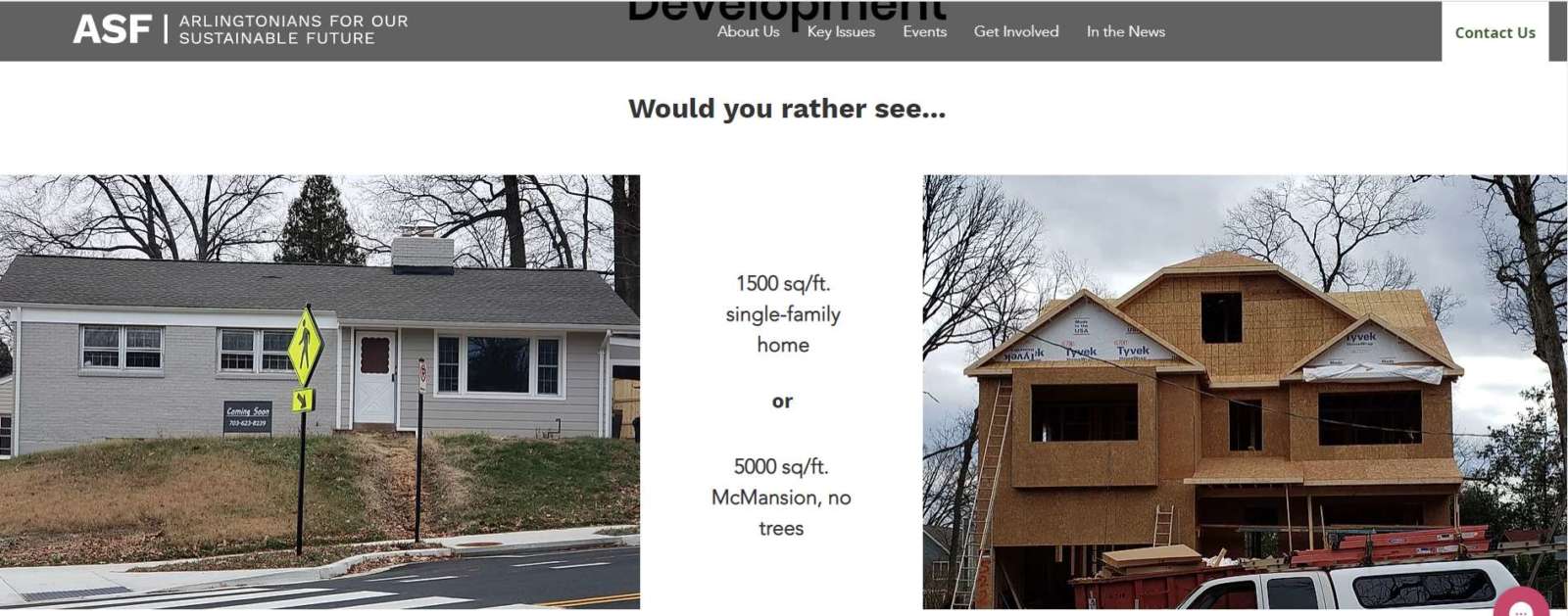
While I harbor no ill-will toward anyone who lives in a newly-constructed, 5,000 sq. ft. million+ dollar home, the prevalence of this type of dwelling signifies a failure of our housing market to meet the demand of our residents. If we conclude that McMansions are a symptom of a problem, perhaps we can agree on a solution.

In the first “research compendium” published as part of the Missing Middle study, Arlington County staff lay out the impact that single-family redevelopment has had on our housing supply.

Much of Arlington was developed in the 1930s through 1950s, which means many of our homes are older stock, roughly 1,500 square feet with 2 or 3 bedrooms. In just the past ten years, 8% of all of Arlington’s single-family detached homes have been either been torn down and replaced or substantially renovated. The newly-constructed replacement homes average 4,750 sq. ft. and cost an average of $1.7 million dollars.

Overall, Arlington County analysis shows that “the average sales price for a detached single-family house increased 45% between 2010 to 2019.”

With the increasing price of single-family homes, middle-class Arlington families have few opportunities to buy. At an average of $1.7 million dollars, a McMansion is only affordable to a family making $485,000 per year, which is more than three times the income of the average Arlington family of four.

McMansions are also outsized for the needs of most families. Data shows that the size of a typical household is decreasing, while the size of new homes continues to rise. In the last fifty years, the average square feet of living space per person has nearly doubled.

(more…)


Happy Fourth of July weekend!

We’ll make this short and sweet so you can get on with your grilling, fireworks and travel (most likely via car). Here are the most-read articles this week on ARLnow:

  1. Police Investigating Fatal Columbia Pike Shooting
  2. People Keep Cutting Across I-395 to Get to the HOV Bridge
  3. Legal Insider: Fairfax Students with Learning Disabilities File Complaint Against FCPS
  4. Coronavirus Down to Six New Cases Per Day in Arlington
  5. Man Staggers to Police HQ After Being Stabbed at Party
  6. Taco Bamba Coming to Ballston
  7. ACPD Officers Punched, Splashed and Bit
  8. After Surviving COVID-19, Arlington Restaurateur Hopes to Bring New Meaning to His Life
  9. NPS Trying to Figure Out How to Remove Car That Ran Down GW Parkway Embankment

Feel free to discuss those or any other topics of local interest in the comments. Have a great holiday!


View More Stories