Making Room is a biweekly opinion column. The views expressed are solely the author’s.

This piece was co-written by Gillian Burgess.

Next month, the Arlington County Board will approve its Capital Improvement Plan (or CIP) after a truncated process. This critical component of Arlington’s budget outlines the investment that the county will make in infrastructure in the future.

Unfortunately, the County Manager’s proposed CIP budget is setting us up to perpetuate inequities in our infrastructure investments at a time when we should be responding to a crisis by pursuing equity.

The typical CIP budget process involves months of community input. It also typically projects out the investments that the county will make over the next 10 years. This long-term planning is essential for infrastructure projects that will serve residents across the county for many years to come. It is so time-consuming that it typically only happens every other year. The last CIP was adopted in 2018.

However, under the shadow of the COVID-19 pandemic, County Manager Mark Schwartz has proposed a budget with only one year of investments, with a promise to come back next year with a longer-term (4-6 years) investments. Mr. Schwartz said he was guided by five principles in these making the county’s investments:

  1. Finish projects that are underway;
  2. Repair infrastructure that is failing or at the end of its life;
  3. Meet legal and regulatory obligations;
  4. Make investments to address the pandemic;
  5. Implementing the body-worn camera for police, sheriff, and fire marshalls; and
  6. Invest in strengthening stormwater infrastructure.

The first five categories can be described as “needs and requirements,” but the sixth is the only new investment the county is considering. Funding for the projects come from many sources: grants, specific fees, real estate taxes (through the annual operating budget) and bonds, which the public votes on in November. Many of those sources are restricted in what they can be used for, such as grants for transportation projects.

The Manager’s Proposal leaves new projects that we typically see in the CIP — everything from parks to bike lanes — unfunded and delayed for at least a year. This year, the Manager is recommending a bond referendum of $51 million to fund the first round of stormwater projects. If approved, this would be the first time a bond was issued specifically for stormwater infrastructure (previously, stormwater had been funded by the stormwater tax and utilities bonds).

(more…)


What’s Next with Nicole is a biweekly opinion column. The views expressed are solely the author’s.

Right now Arlington has an opportunity to rethink and expand our public feedback process. Since the pandemic began, in-person meetings have been canceled and our county and school system’s public engagement processes have been required to adapt.

More than half of the school advisory committees were canceled for just a month and began meeting again in May via Microsoft Teams.

All county commission, committee, and advisory group meetings have been canceled for the past three months, and some have a tentative meeting date for July, as long as the agenda topics are related to items on this flow chart. A significant number of commission leaders signed a letter to the Board with concerns that commissions have been unable to meet about a host of important topics such as the Affordable Housing Master Plan, Capital Improvement Plan, Tenant-Landlord related issues, public space use for recreation during COVID-19, and more.

Some of these items are related to COVID-19, some are not, but most continue to be topics that are immediately important for public feedback.

It is understandable that overhauling the meeting structure of more than 60 citizen advisory groups takes a bit of time. Preparing the technology required to meet virtually and ensuring that all state Freedom of Information Act (FOIA) requirements are met is no small task, particularly as staff themselves continue to adapt to this new environment.

What this does provide is an opportunity for expanded engagement moving forward. Virtual meetings should not just be used during the pandemic, but for years to come. It is a forum that provides better transparency, equity, and community input. Parents with kids don’t have to miss dinner, people who hear of meetings last minute can jump on rather than make a plan to attend in person.

Virtual meetings put a dent in leveling the playing field for the diversity of opinion. Think of it this way: if there is a building being built next to you and you support it, it is highly unlikely that you will take time out of your day to wait in a room for hours to say that you want the project to happen, whereas if you oppose it, you might be more willing to make that sacrifice. If you are able to join by phone or computer, you might be more willing to quickly make a supporting comment.

County Board meetings also seem to be getting higher viewership with these expanded forms of communication. On Facebook Live, virtual town halls have received between 2,000 to 12,500 viewers, whereas in-person County Board meetings rarely break 300 viewers in person or on Arlington TV. Virtual options have also incorporated options to text in questions while discussion is happening rather than signing up in advance.

(more…)


Peter’s Take is a weekly opinion column. The views and opinions expressed in this column are those of the author and do not necessarily reflect the views of ARLnow.com

Arlington County and APS face extraordinary challenges because of COVID-19.

With many questions left unanswered, on June 9 Governor Northam approved general guidance for a phased reopening of Virginia public schools.

COVID-19 must become the catalyst for County government and APS completely to reorganize and integrate their operating and capital planning now.

County Board July 7 special election

Independent candidate Susan Cunningham appropriately devotes an entire press release to many helpful suggestions for accelerating County/APS collaboration, including:

“The County Board, School Board, County Manager, and new Superintendent should sit down together immediately to prioritize what’s essential for our school community and the entire Arlington community.”

Democratic nominee Takis Karantonis astutely concludes:

“I am a strong supporter of the work done by the 2015 Community Facilities Study group [“CFSG”]. I have been frustrated by a seeming lack of support among School and County Board members for the thoughtful recommendations in that study.”

Republican nominee Bob Cambridge correctly confirms that “effective management requires initiatives such as cost-benefit analyses.”

School Board November 3 general election

In responses to a questionnaire sponsored by my colleagues at Arlingtonians for our Sustainable Future (ASF), the three School Board candidates also advocate major reforms now:

Symone Walker, the Independent candidate:

“[I]t is time … to better manage and direct Arlington’s growth in a more paced and modulated manner. I favor the approach to retrofit and repurpose existing APS and county facilities as has been done in Fairfax County and the City of Alexandria. I favor this approach as practical, more efficient and environmentally friendly, and the most cost-effective.”

The two ACDC-endorsed candidates:   

Cristina Diaz-Torres has “long supported APS and the County engaging in more robust cost-benefit analysis procedures for construction. This is particularly important given the current economic crisis and the likely drop in both tax revenue and (potentially) bond capacity.”

David Priddy states “for years we have had conversations around facilities owned by the county and facilities owned by APS. The two were not in agreement. That meant we did not have the full picture when properly planning for future growth.” (more…)


The Right Note is a weekly opinion column. The views and opinions expressed in the column are those of the author and do not necessarily reflect the views of ARLnow.com.

Back in mid-March, no one could have fully predicted just how long or extensive the lockdown for COVID-19 would be.

Over the past three months, the County Board moved the most essential functions of governing to online platforms. Essential services and public safety continued largely without interruption. A modified budget moved through a revamped public comment process, though not without a couple blips. For example, the county’s pay plan set to take effect on July 1st still says County Board members will receive a raise. There has been no public announcement on how they will deliver the promised fix to prevent the raise from taking effect.

On June 9, the chairs of 25 county advisory groups wrote to the County Board and raised concerns that these avenues for public input were unnecessarily lying dormant. Despite plenty of online options, meetings were not happening at all. It was not until May that county officials unveiled a plan to determine how staff and other resources would be allocated as well as how meetings would be prioritized. Based on the county guidance, many groups may effectively be shelved for the remainder of the year.

The defenses of the County Board on Saturday rang a little hollow to the thousands of county residents who have been successfully teleworking for the past 90 days. Most of us participate in multiple video conferences every week — often multiple times on the same day. Meetings that used to take place in person simply moved online. Screen sharing is enabled. “Rules of the road” for recognition to speak are quickly developed. It has changed the way we exchange information.

Surely Arlington officials could do better than “we’re working on it” by now.

Restricting public input in this way is one concerning trend. On today’s County Board agenda is a report on the County Auditor’s work plan that should also raise some eyebrows.

For fiscal year 2021, the County Auditor is proposing new audits into COVID-19 cost reimbursement, non-profit funding allocations, housing grants, and risk management. These are all fine areas to look into for a robust audit function.

Unfortunately, the County Board never fully embraced the auditor’s role to identify waste and efficiencies on behalf of the Arlington taxpayer. They have not dedicated significant staff resources to evaluate a $1.5 billion budget on a regular basis. As a result, there have been just a handful of audits produced thus far.

According to the draft work plan for the coming year, the Auditor is suggesting they stop the audit of economic development incentives — presumably without a report. The audit was supposed to be done by the end of last year and feature a look into the taxpayer-subsidized Amazon deal. It was taking the place of a jettisoned audit of business improvement district activities which should have been done as well. If no audit is ever produced on the Amazon deal, it represents a disturbing loss of promised transparency. And it is being quietly jettisoned during this time of a pandemic and civil unrest.

The work plan is also proposing that an audit of real estate assessments and appeals be postponed until some unknown date in the future. The message from the County Board appears to be: taxpayers will just have to wait on accountability if they get it at all.

Surely the County Board can do better.

Mark Kelly is a 19-year Arlington resident, former Arlington GOP Chairman and two-time Republican candidate for Arlington County Board.


Progressive Voice is a bi-weekly opinion column. The views expressed are solely the author’s.

By Cheryl Moore

In times of tragedy and uncertainty, those of us who are part of faith community often turn to that community for comfort and support. But since mid-March, turning to your faith community often meant turning on your computer and logging into Zoom.

The staff at Mount Olivet United Methodist in Arlington began preparing for disruption in early February upon hearing news about the strange new virus. The initial plans to figure out contact-less communion went out the window on March 12 when large gatherings were banned for health safety reasons.

Moving quickly is not the norm for many religious institutions, but when Covid-19 hit, things had to change immediately. And that has had implications for faith communities.

Times of crisis can also be times of opportunity and growth. Faith communities that are willing to provide new points of connection, experiment with new initiatives, and build community partnerships will likely prove resilient and more relevant.

Prioritize communication and connection

Mount Olivet associate pastor Teer Hardy related that he and other staff were first inundated with questions about the virus. He said that seminary didn’t train him about what to do in a pandemic, but it did train him in “connectedness.” Keeping its members feeling connected became goal one.

Mount Olivet expanded its Sunday worship online, and added online Sunday School, youth activities, and email devotionals. Volunteers made weekly check-in calls to older members. Callers found many seniors felt isolated even before the pandemic, so this initiative will likely continue.

Worship attendance has been surprisingly high. Said senior pastor Ed Walker, “Even members who haven’t been very active have been attending.” And one Sunday School class reported that a class member who is temporarily working in Riyadh, Saudi Arabia, gets up at 2:00 a.m. their time to join the class via Zoom.

For some in the Jewish community, however, technology has its limits. Rabbi Lia Bass, of Congregation Etz Hayim, explained that Shabbat services in her Conservative congregation cannot be live-streamed, because it would entail use of electronics, which is not allowed on Shabbat. Services on Thursday mornings and classes on Sundays are now live online, offering new opportunities for the community.

Our Muslim neighbors had the additional challenge of celebrating Ramadan, the holiest Muslim holiday, from April 23-May 23. The observant fast all day, and a nightly gathering with food and prayers at the mosque is an integral part. Those communal activities had to be canceled.

Hurunnessa Fariad, the outreach/interfaith/media coordinator at ADAMS (All Dulles Area Muslim Society) Center, said that she and her colleagues realized that social media was the most effective way to connect with its members. They quickly ramped up daily communication, reminding people to stay at home. “In the Muslim faith, saving a life is even more important than communal prayer,” Fariad said.

(more…)


A busy week has has given way to what looks to be a beautiful weekend.

We are grateful this week for the passion of those protesting in Arlington and elsewhere, the medical recovery of long-time ARLnow commenter Flood Czar, and the support of our readers and sponsors — who have propelled our readership to record levels and who have allowed us to stay business through the pandemic with no layoffs.

Now, here are the most-read articles of the week:

  1. Northern Virginia to Enter ‘Phase 2’ Reopening on Friday
  2. Ballston Hosting ‘Retro’ Drive-In Movie Showing
  3. Vice President’s Maskless Visit to Trump HQ in Rosslyn Criticized
  4. Pupatella Searching for New Arlington Location
  5. After Lull, A Rise in Coronavirus Cases in Arlington
  6. Sixty Years Ago, A Two-Week Civil Rights Battle Raged Across Arlington Eateries
  7. Thousands Participate in Saturday Marches in Arlington
  8. List: Black-Owned Businesses In Arlington
  9. More Demonstrations Planned Today in Arlington
  10. Crash After Police Chase Blocks I-66

Feel free to discuss those and other issues of local interest in the comments.

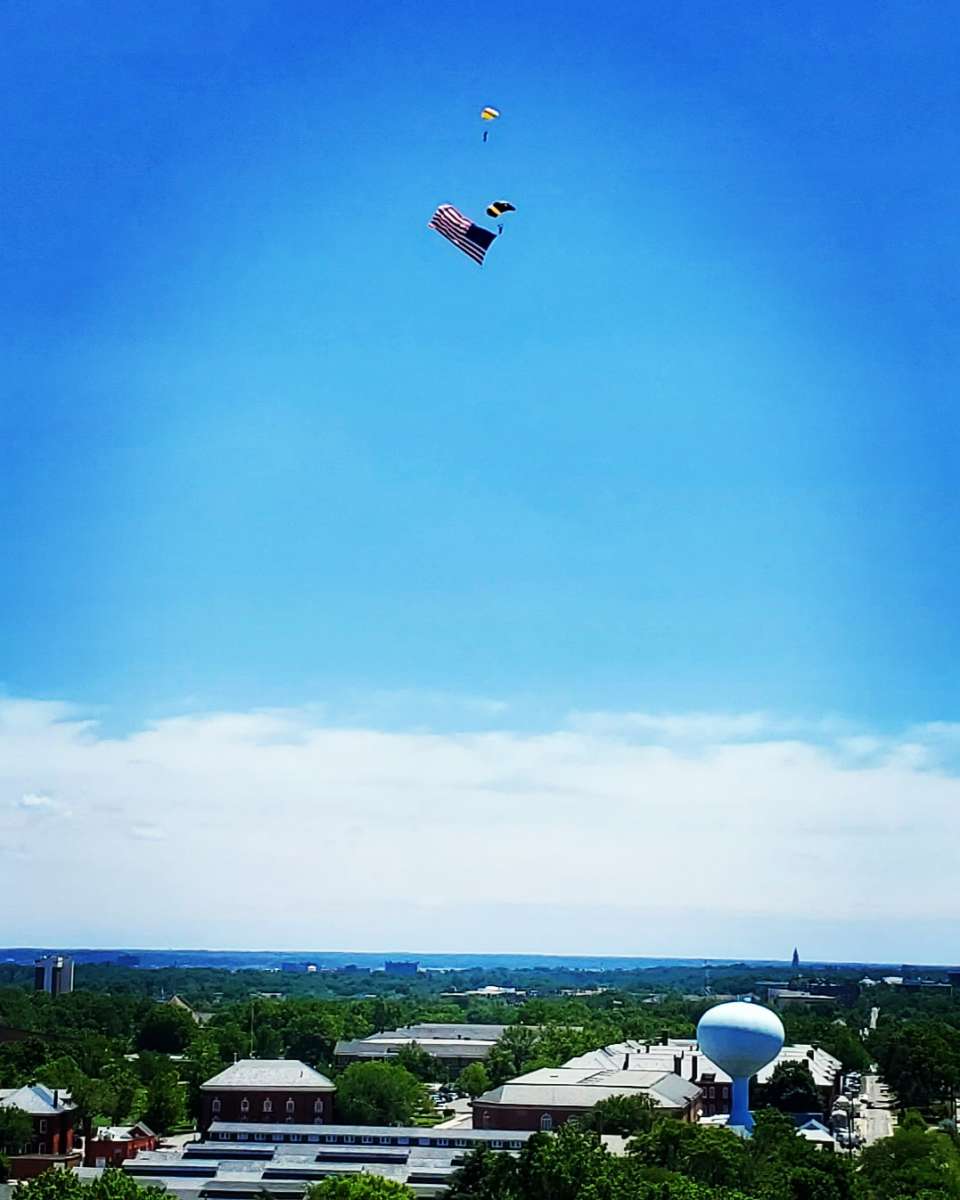
Photo courtesy James Mahony


Ed Talk is a biweekly opinion column. The views expressed are solely the author’s.

Virginia Governor Ralph Northam issued detailed guidance this week for the phased reopening of schools. Because each of the three phases includes six-foot social distancing in school and on buses, Arlington Public Schools (APS) will have to provide a hybrid model of education this fall, with limited in-person instruction, combined with online learning.

The Governor’s guidance for instruction is as follows:

  • Phase I – continues remote learning and allows in-person instruction for students with disabilities;
  • Phase II – adds limited in-person instruction for preschool through third grade and English learner students; and
  • Phase III – allows in-person instruction for all students, with new content taught.

While the timing of moving through these phases is not explicit, it appears that Phase II is intended for summer school and Phase III is anticipated for the fall.

APS class sizes are too large for social distancing. A recent report of the American Federation of Teachers on school reopening states that classes should have 12-15 students to maintain recommended social distancing. The APS 2019-20 Class Size Report shows average class sizes of 22 students for elementary schools, 21 students for middle schools, and 20 students for high schools.

APS does not have enough buses to maintain social distancing for students who ride the bus. An APS presentation on school opening estimates that school bus capacity will be reduced by 75% with social distancing. Given that more than 65% of students ride the bus, ridership would be cut from 18,942 students to 4,736 students in the fall, based on projected fall enrollment of 29,142 students.

Recognizing the impact of social distancing, the Governor’s guidelines offer sample school schedules for Phase III, with students attending school physically one or two full days per week, half-days four days per week, or two to three days per week every other week.

APS must determine how many hours per week each student can attend school for in-person education considering Arlington’s student enrollment, square footage of classrooms, and bus capacity. An additional consideration is the effect of COVID-19 on the APS workforce and how many teachers and staff will request to work remotely because of health considerations.

Another factor affecting the number of hours available for in-person instruction is the APS budget. The School Board’s adopted FY 2021 budget slashed expenditures by $55.6 million, compared with the interim Superintendent’s proposed budget. The budget lacks funding for more buses and drivers or for more teachers to reduce class sizes. In fact, the budget increases class sizes by one at each grade level, for a savings of $4.9 million.

Phase III school reopening in Arlington could have all students return to school for significantly reduced hours per week, or it could allocate the limited resource of in-person education in a different way.

The Governor’s guidance has a focus on equity and identifies “vulnerable” students who should receive targeted attention.  These include young learners, English learners, students with disabilities, those at risk of not moving to the next grade level or not graduating, and students from low-socioeconomic backgrounds.

APS Superintendent Dr. Francisco Duran has convened a task force of parents, teachers, students and citizens to advise him in developing the APS reopening plan. Key to the task force considerations should be the APS core value of equity: “Eliminate opportunity gaps and achieve excellence by providing access to schools, resources, and learning opportunities according to each student’s unique needs.”

Arlington has significant achievement gaps between groups of students, and these gaps are expected to increase as a result of school closures. Such disparities have long-term consequences, affecting post-secondary educational opportunities, jobs, and wages. Therefore, in-person education in Arlington this fall should focus on those students who need it the most.

Abby Raphael served on the Arlington School Board from 2008-2015, including two terms as Chair. She also led the Washington Area Boards of Education for two years. Currently she co-chairs the Project Peace Prevention Committee and Destination 2027 Steering Committee, is a member of the Board of the Arlington YMCA, and works with the Community Progress Network and Second Chance


Following protests over the killing of George Floyd, there’s now a national movement to #DefundThePolice.

Most proponents say they want to redirect a portion of sizable police budgets to social services, investing in community rather than punishment.

The idea has yet to catch on with most Americans. Nearly two-thirds of respondents to a recent survey opposed reducing police funding.

Here in Arlington, the police department makes up about 5% of the county’s general fund, less than that of the Dept. of Human Services, which provides health, housing and social services help. Aside from the decision to send officers to help control protests in D.C., at the request of U.S. Park Police, the police department has faced few major, recent controversies.

(There have been four officer-involved shootings in Arlington over the past decade, all deemed justified uses of force in subsequent investigations. Complaints against police rose in 2019, but remained relatively low given Arlington’s population.)

In the upcoming 2020-2021 budget, ACPD will get a slight boost in funding, to just under $75 million. With less funding for the department in subsequent budgets, more could be spent on social services and community programs. With more funding, ACPD might be able to increase training and provide body cameras to all officers.

What do you think should be done?


The Hurtt Locker is a biweekly opinion column. The views expressed are solely the author’s.

As Arlington enters Phase Two of Governor Northam’s re-opening strategy, I have really struggled to empathize with my neighbors.

Despite the polarization and tribalism we see in debates that rage across social media and populate the headlines, I try to believe people are more nuanced and complex than the red and blue avatars we create for them. I refuse to concede the young couple walking their dog, or the woman on a run, or the family sitting out in their front yard during my evening walks, are as divided or as divisive as some would have us believe.

But we’re hardwired to sort ourselves into tribes, and political leaders and pundits often take advantage of our biology to drive their own agenda. It seems to have gotten to a fever-pitch.

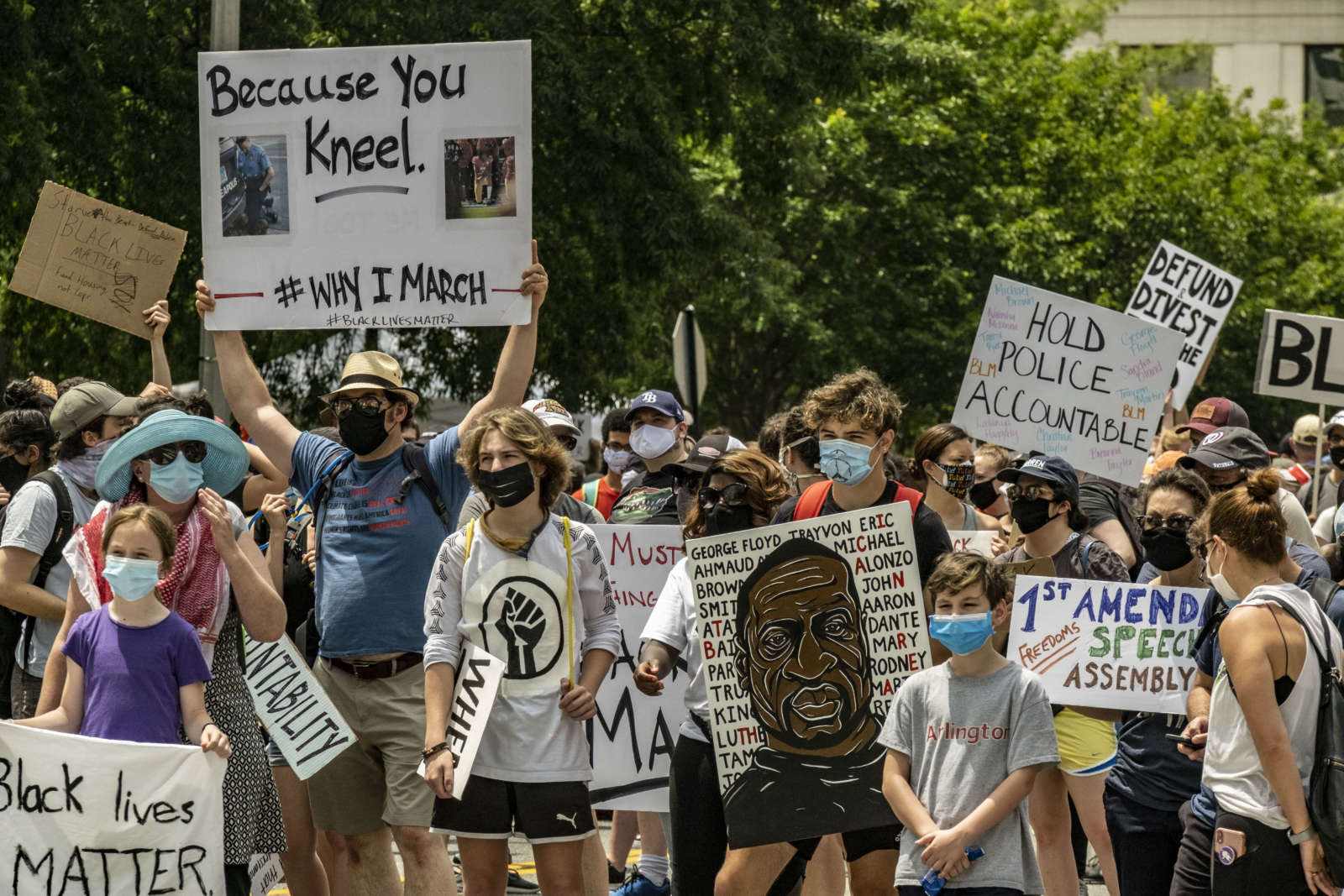
The recent killings of Ahmaud Arbery, Breonna Taylor, and George Floyd reignited the conversation about race and policing practices in America and right here in Arlington. After more than a week of peaceful protests organized by community and religious groups — flanked by instances of rioting in other major American cities — we are seriously re-thinking our relationship with law enforcement in this country.

I marched from Courthouse to Clarendon and back at last Thursday’s peaceful protest, holding a sign that read #SayTheirNames along with the names of nearly a dozen black Americans who either died during an altercation with police or later in police custody. As someone who is passionate about criminal justice reform and works in the policy space, I recognize many of these tragedies are a product of overcriminalization and police practices.

There are evidence-based bipartisan solutions that can be implemented that guarantee human dignity and reduce the likelihood of adverse (or even deadly) interactions with police. Those in attendance at last Thursday’s march weren’t red Americans or blue Americans, they were the kinds of people who could come to the table and support bipartisan solutions.

But for as much faith as I have in people who are involved advancing solutions to the criminal justice problems we face, I am dragged kicking and screaming back into the debate about re-opening, where the battle lines are much clearer… and much more partisan.

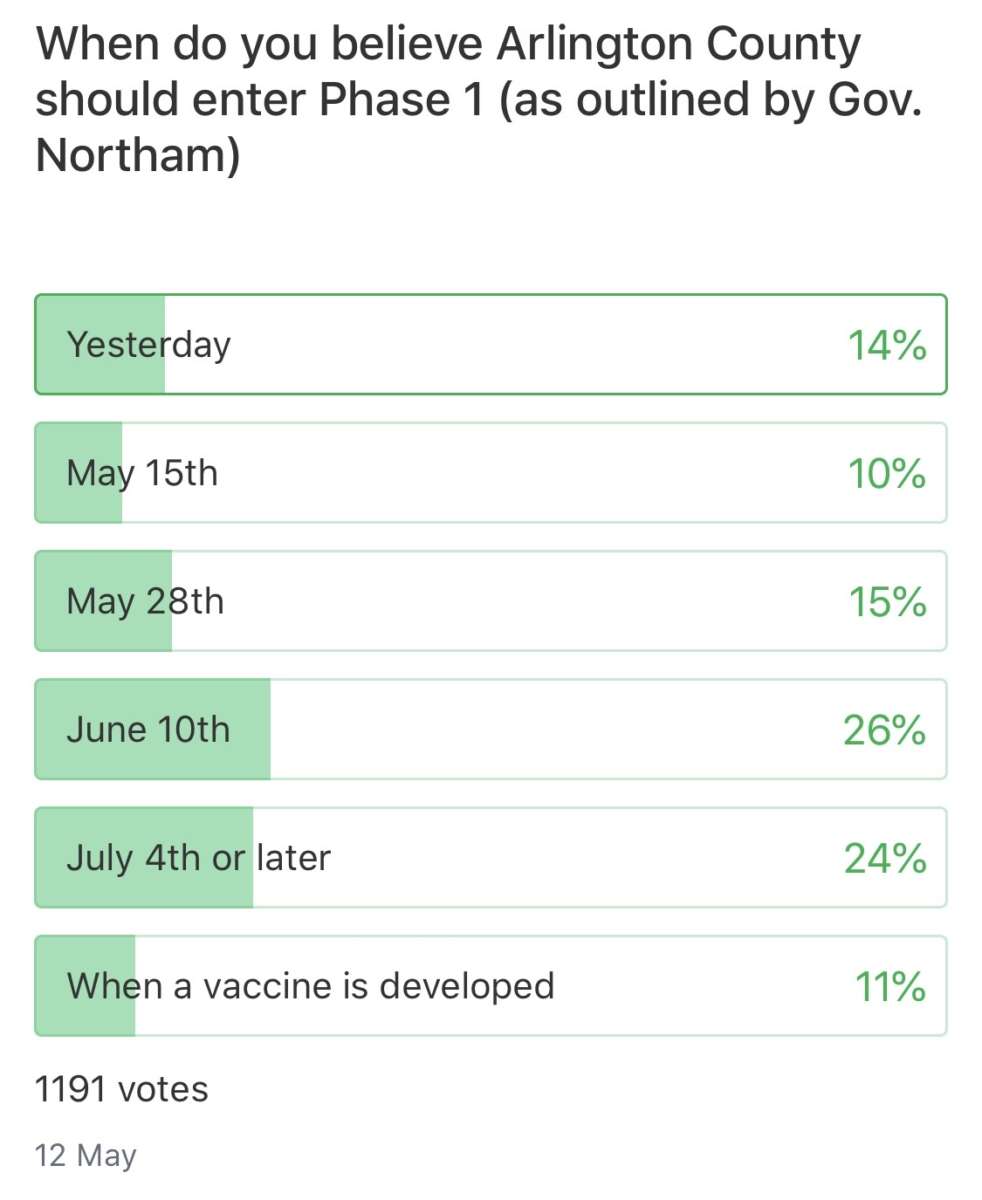
A question posed on May 12 on the community social networking site Nextdoor asked, “When do you believe Arlington County should enter Phase 1?” Of the nearly 1,200 respondents, more than 60% said either “June 10” (yesterday), “July 4 or later,” or “when a vaccine is developed.” I was baffled by this.

Part of the reasoning didn’t become clear to me until several weeks later when Arlington released its unemployment numbers from mid-March to mid-April. Arlington’s unemployment rate? 7%.

It’s easy to rationalize keeping the economy shuttered for an extended period of time when 93% of the workforce is still drawing a paycheck. Worst of all? The shutdowns disproportionately impact people of color at the lower end of the socioeconomic spectrum, moving economic security and the American Dream further out of reach.

Somewhere along the way, the tribalism kicked into high gear and people ascribed the worst intentions to others with whom they didn’t agree. People who wanted to re-open the economy simultaneously wanted to kill the vulnerable and immunocompromised, while people who favored keeping the economy closed wanted to drive us into a prolonged recession. Neither of these assertions is true.

(more…)


Modern Mobility is a biweekly opinion column. The views expressed are solely the author’s.

As Northern Virginia prepares to enter Phase 2 and our community businesses and organizations begin to look for ways to safely resume activities, I have noticed a distributing trend — the use of cars as required Personal Protective Equipment.

The first time it caught my eye was Arlington’s drive-through COVID testing site that opened in March, offering convenient testing for any citizen… as long as they own a car. Thankfully the County recognized the inherent injustice in this arrangement and opened a walk-up testing site, though unfortunately not until nearly two months later. Sadly, other local organizations don’t seem to have taken this lesson to heart.

My children’s elementary school, Fleet, recently had a pick-up and drop-off day where families could pick up remaining items that were left at school when the COVID closure hit, as well as drop-off library books and other items. The logistics of this event were entirely built around the idea that everyone had a personal automobile.

No directions were given about how to drop-off or pick-up without a car and parents were warned in bolded and underlined letters that they were to stay in their car at all times. This despite Fleet having a sizable walk and bike to school rate.

Finally, the Ballston BID has recently announced a Retro Drive-in Movie Night.  While less egregious than the above examples since it is purely for entertainment, it also stands out due to the demographics of Ballston. In a neighborhood where less than 40% of household drive alone to work and more than 16% are car-free, the BID has chosen to hold an event that requires a car to participate.

Likely none of the above organizations were trying to exclude anyone. Some may have been driven primarily by fear of the virus, others are certainly just suffering from what is known as “windshield perspective.” When you so often view the world from behind the wheel of a car, not only do you begin to implicitly assume that everyone owns a car, but it also colors your perceptions of people, places and events.

Research in 2013 found that not only do people who drive through less-affluent neighborhoods view them more negatively than people who walk, bike or take transit through the same neighborhoods, they even viewed the exact same event differently.

Participants in the study were shown one of four versions of a video of an ambiguous event (two boys fighting over a piece of paper). The only difference between the videos was that they were shot from either the perspective of a driver, a bus rider, a cyclist, or a pedestrian. Researchers found the participants shown the video from the driver’s perspective rated the actors higher on negative characteristics (threatening, unpleasant, etc.) than those shown the other videos.

If we are to meet our climate goals, we must make our transportation sector more sustainable. While electric vehicles can help, they aren’t enough. We need to be increasing the number of trips made via less carbon-intensive, not bowing to our windshield perspective and allowing COVID to push us in the direction of more cars.

Chris Slatt is the current Chair of the Arlington County Transportation Commission, founder of Sustainable Mobility for Arlington County and a former civic association president. He is a software developer, co-owner of Perfect Pointe Dance Studio, and a father of two.


Community Matters is a biweekly opinion column. The views expressed are solely the author’s.

Recently I was walking through a single-family neighborhood in South Arlington. As I turned onto the street of my destination I immediately second-guessed my decision to walk instead of drive. I wondered if I would be threatening as an unfamiliar Black person walking down their street.

As many of us have heard through countless testimonials of African Americans since the murder of George Floyd, on a daily basis, Blacks often have to assume that our presence and actions can be construed as dangerous. This is just one example of the effects of racism.

Arlington should be a leader in eliminating racism at all levels and in all spaces. The “Arlington Way” should include steps to actively combat racism. Here are just a few ways we can continue to incorporate anti-racism in the “Arlington Way”.

Take responsibility for your learning — I have heard several Black people over the last few days say, “I am tired. I can’t help white people right now; I am dealing with so many other issues.” It is critical that we talk to each other about race, but we also have a responsibility to read and learn through the vast amounts of information that exists. Arlingtonians should learn about Arlington as told through the perspectives of Black Arlingtonians including Wilma Jones Kilgo author of “My Hall’s Hill Family Neighborhood” and Dr. Alfred O. Taylor, author of “Bridge Builders of Nauck/Green Valley“, and visiting the Black Heritage Museum of Arlington.

Speak Up — While it’s hard to admit, white voices are valued more than Black voices. The reason that the conversation/protests around race feel different this time is because so many young white people are involved. Do you have an opinion or a personal story on racial justice issues, police brutality and inequality? Are you able to influence where your organization’s or company’s dollars are spent? You should speak up and consider requesting funding or adding thought leadership to one or more of the many organizations including the Arlington NAACP, Challenging Racism, and Vote Lead Impact, or not invest in organizations which do not support racial justice.

Support Black Economic Empowerment and Advancement — According to Black Enterprise, Black buying power is projected to reach about $1.5 trillion by 2021. I was heartened to see the list of Black businesses in ARLnow and several groups sharing Black business that covered the DC metro area, but it does make one wonder why there are not more Black businesses in Arlington. In a June 6 New York Times article, Darren Walker, president of the Ford Foundation and board member of Pepsi questions the authenticity and commitment of corporations that have issued statements supporting racial justice. He notes that “generations of well-intentioned pledges by businesses have resulted in only marginal advancement for the black community. The coronavirus pandemic has exacerbated grim employment trends, and today fewer than half of black adults in America have a job. Black workers make less money than white workers. That is due in part to the fact that they are more likely to have poorly paying service jobs, but research also shows that highly educated black employees are paid less than their white peers.” We should all advocate for fair wages, and support businesses and corporations which have shown their commitment through action.

Do your part to make sure Blacks are represented — If you serve on boards or commissions, and participate in civic associations, look at the racial diversity. Think about your current practices which may discourage a wide variety of participants including inconvenient meeting times, unwelcoming attitudes, or unwillingness to consider new points of view.

What I find most interesting is that we immediately look to Black organizations and leaders to solve racism, when whites perpetrate and condone it. The solution lies in us coming together. White leaders, white-owned businesses, and white-led organizations need to take an active role. Together, we must ensure the “Arlington Way” continues to complement the protests with sustainable action, and root out racism whether it be overt or implicit.

Krysta Jones has lived in Arlington since 2004 and is active in local politics and civic life. This column is in no way associated with or represents any person, government, organization or body — except Krysta herself.


View More Stories