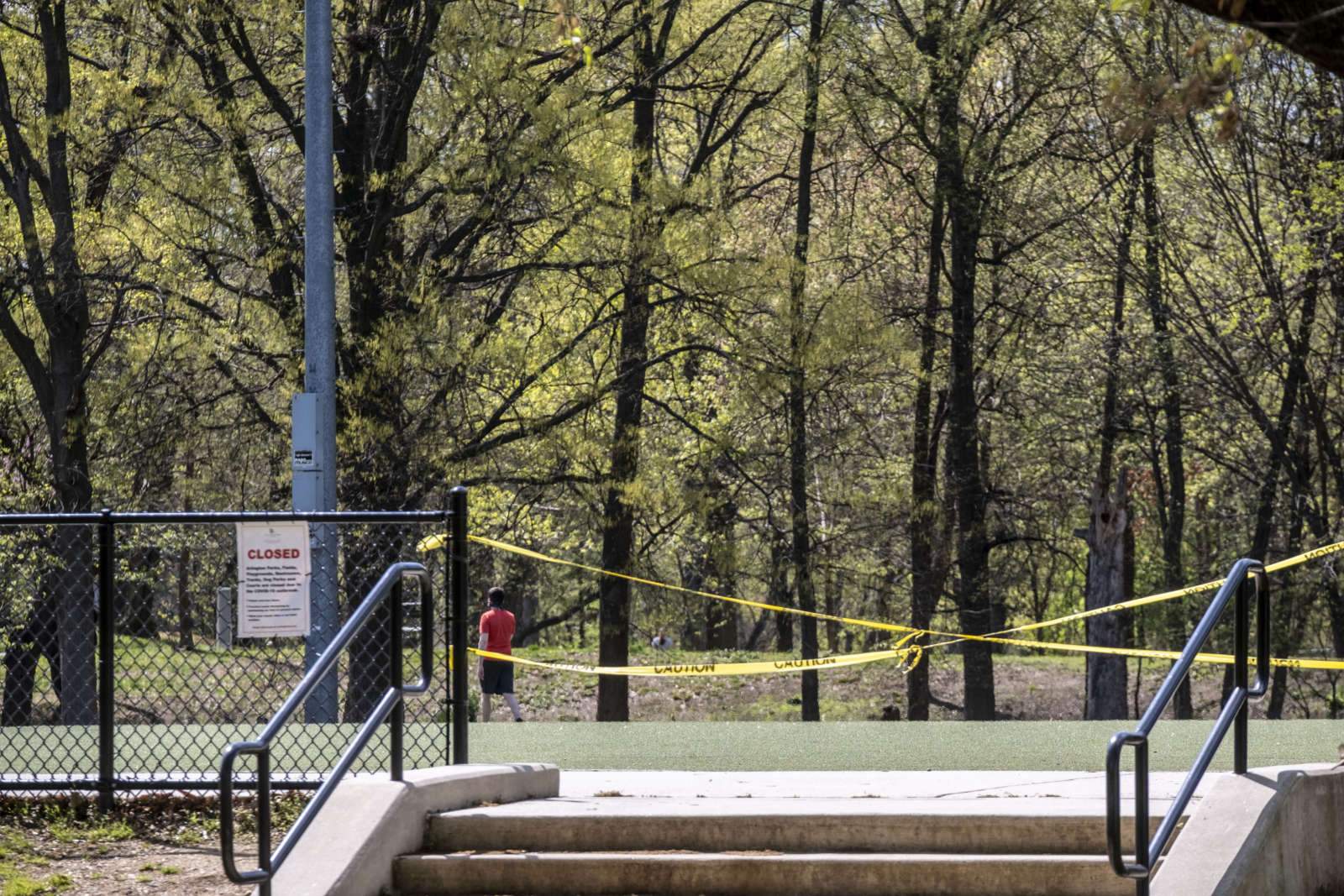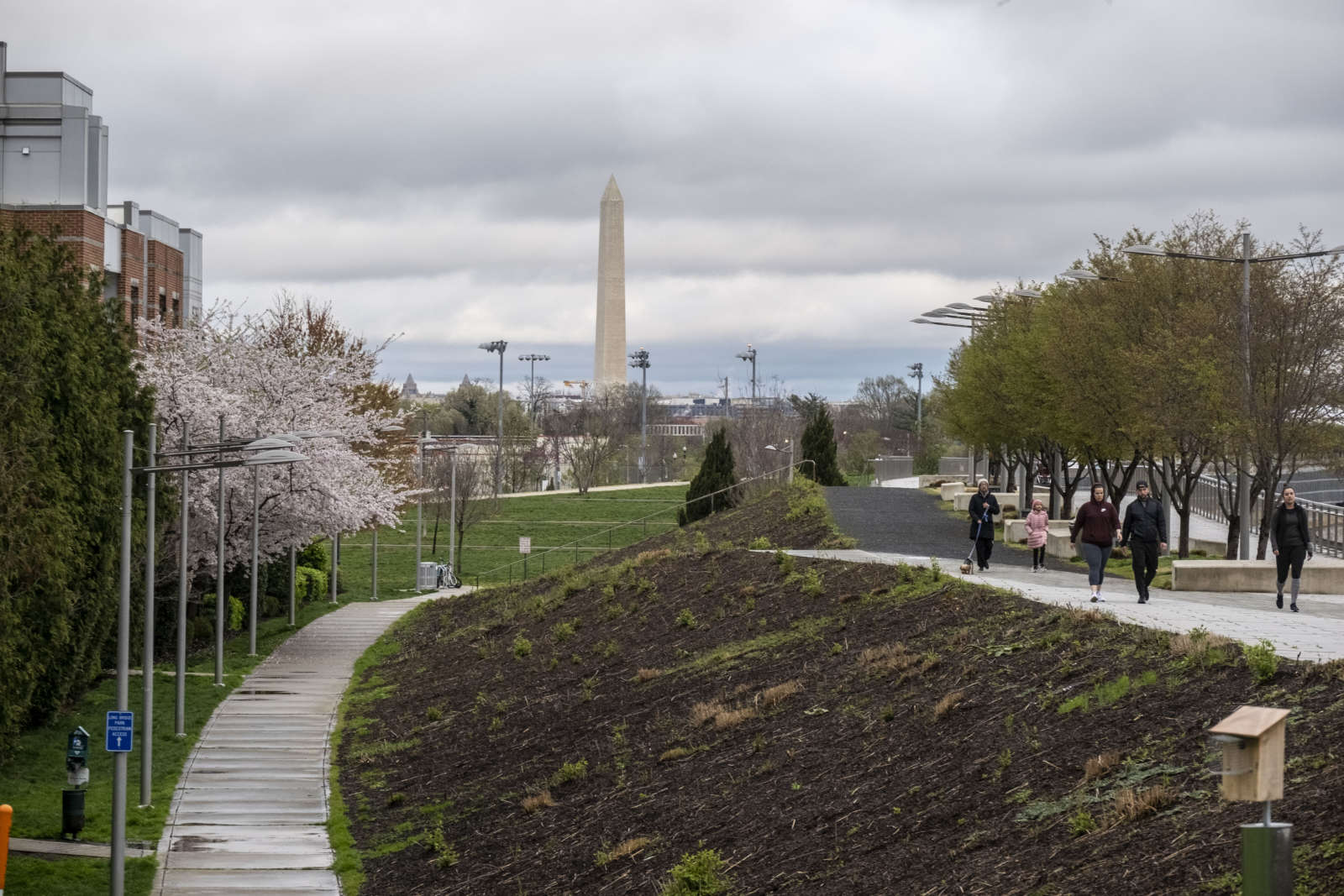
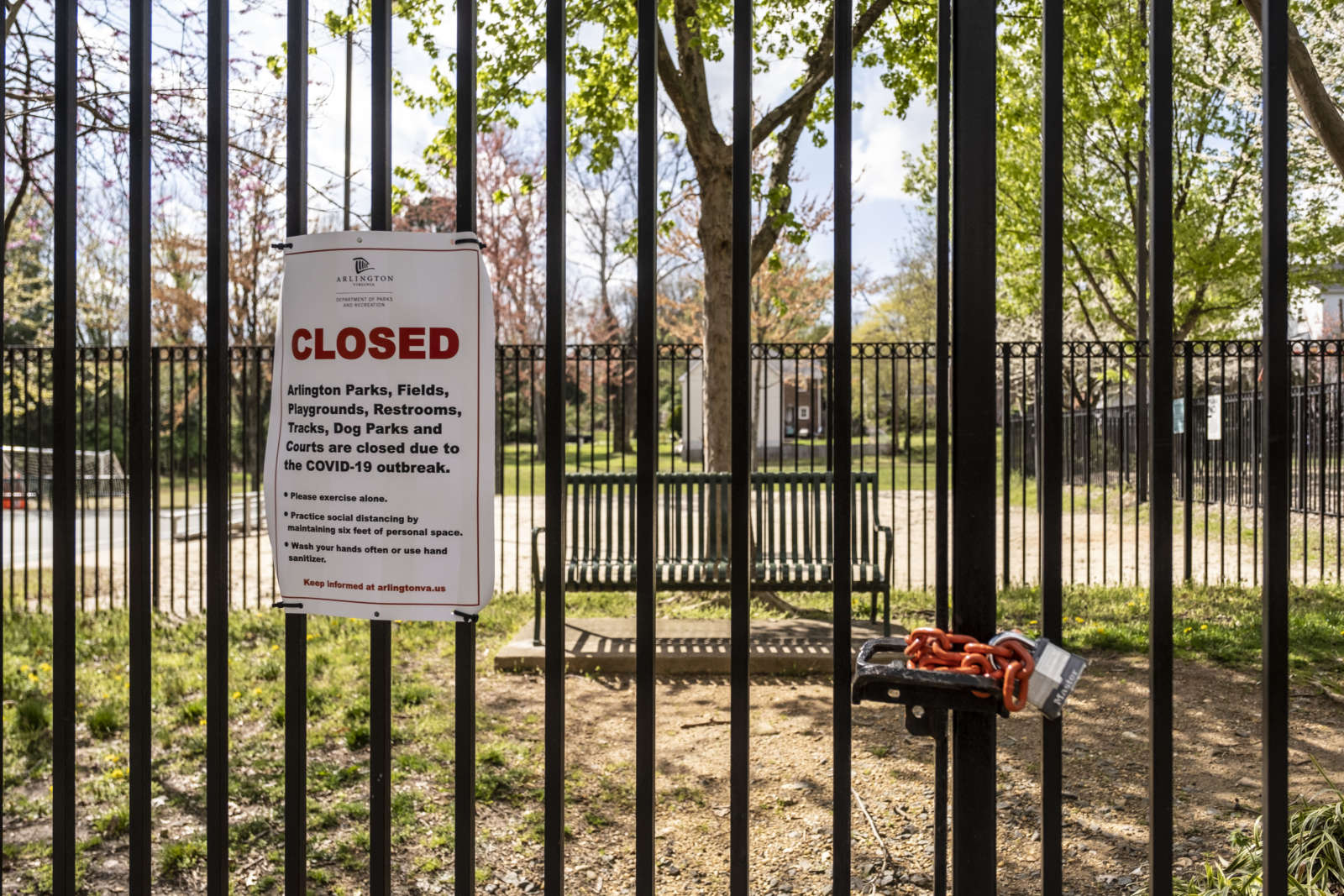
Arlington County’s parks are closed, a safety precaution intended to prevent overcrowding and the spread of the coronavirus.

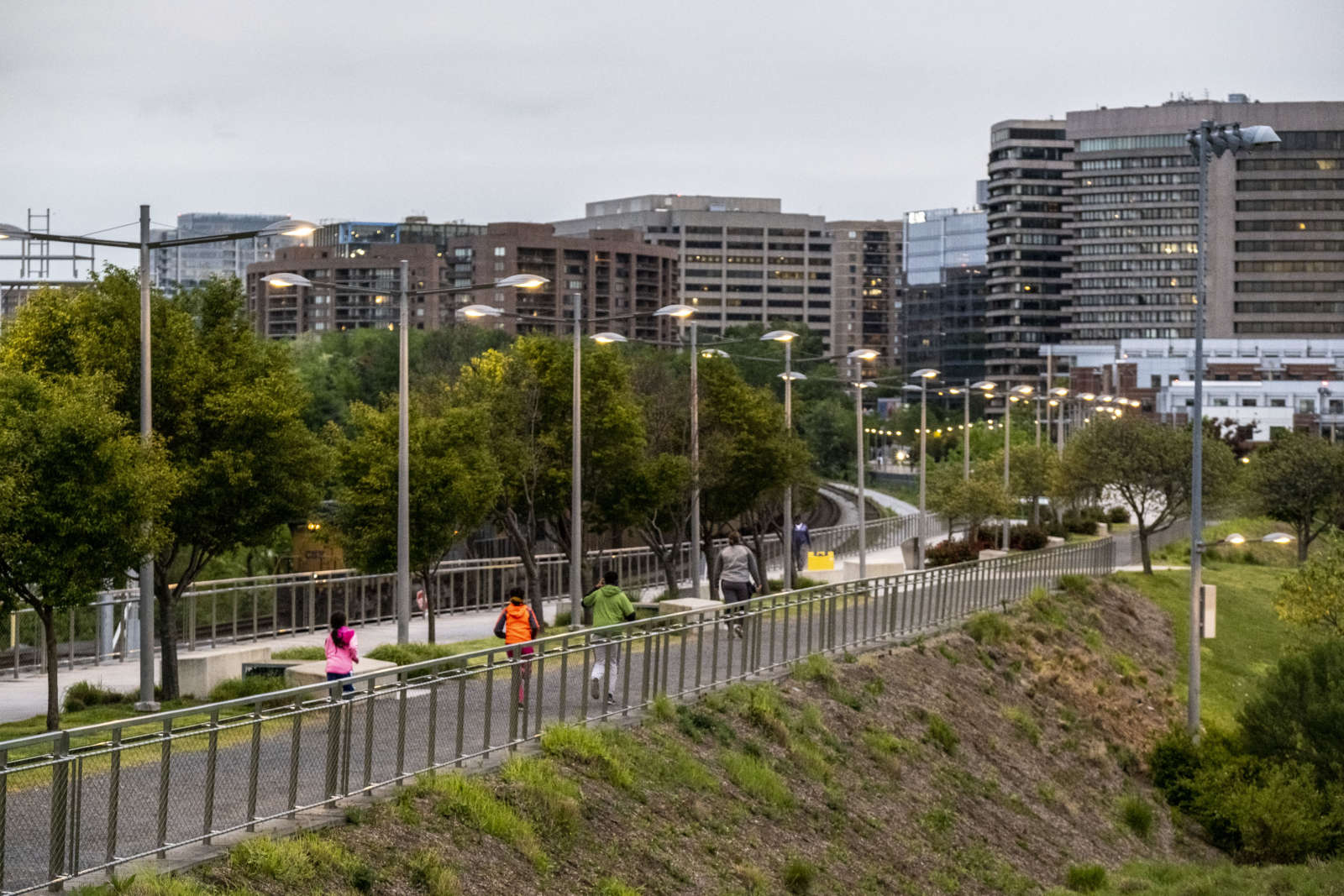
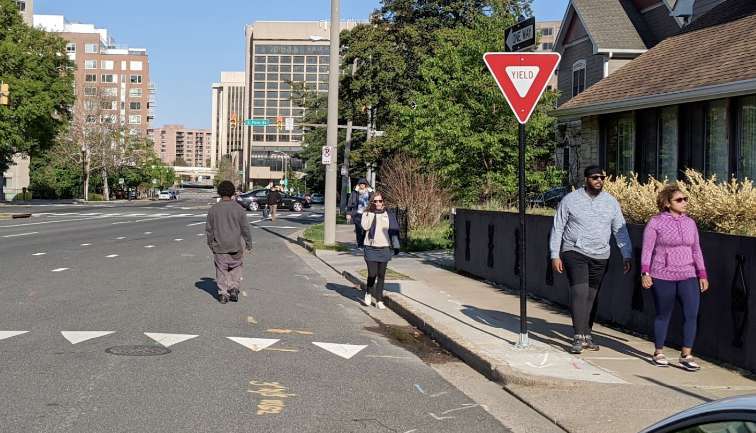
While trails are open, the closure of parks has reduced recreation options for those seeking to get outside as the weather gets warmer. That, along with the county deciding against closing vehicle lanes for extra space, may be factors contributing to more crowded sidewalks and trails.

“While we recognize how important our parks are to our community, we also recognize the trust the community has in us to do the right thing,” Dept. of Parks and Recreation spokeswoman Susan Kalish said. “Arlington parks remain closed for play; crossing through parks to get to a trail or non-park destination is allowed. Our trails and community gardens are open as long as people practice social distancing.”

Kalish said that the county is working with the Metropolitan Washington Council of Governments to arrange a safe reopening of amenities on a regional level.

“It is essential that we continue to coordinate across borders to combat this virus and plan for our economic recovery,” Kalish said.

In Maryland, state parks and beaches are reopening today. Parks have reopened recently for passive recreation — walking, sitting, etc. — in parts of New Jersey and Florida.

In Arlington, the park closures are being lightly enforced, with police issuing warnings and working to remind residents about the closures instead of making arrests.

Might it be time, however, for Arlington to consider loosening the park closures? Specifically, do you think it would be a good idea to open parks for passive recreation?


Peter’s Take is a biweekly opinion column. The views expressed are solely the author’s.

The Rouse property is a 9-acre parcel of privately-owned land, located in the Dominion Hills neighborhood at 6407 Wilson Boulevard (corner of N. McKinley Road). On March 4, ARLnow.com reported this property might be for sale for “around $30 million” (roughly double the current assessed value):

“The property is listed as a ‘generational’ site in the county’s Parks Master Plan (page 162).”

Columnist Charlie Clark reported on April 27 that the owner is evaluating a serious offer. If the County loses the strategic opportunity to acquire this unique property, that represents a serious leadership failure.

Declining parkland to population ratio

Arlington comprises only 26 square miles, significant portions of which are controlled by the federal government. We are the smallest U.S. county.

As approved in April 2019, the Parks Master Plan included a public commitment to acquire 3 acres of open space per year for the next 10 years. Honoring this commitment is vital because of the continuing decline in Arlington’s ratio of parkland to population.

A comprehensive 2016 report by the Arlington Civic Federation (“Civ Fed report”) documents this decline (at p. 5):

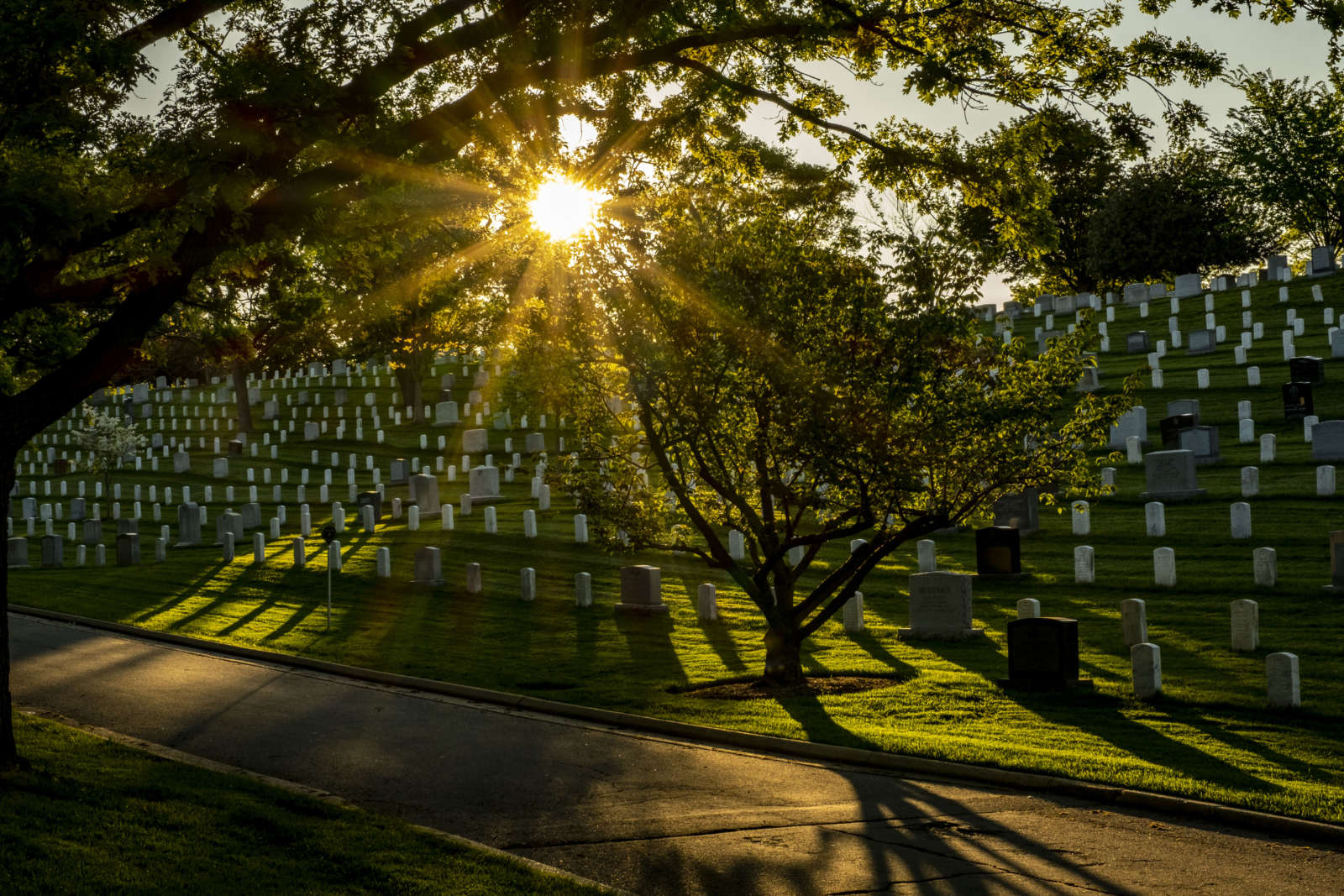
“As of 2015, Arlington County had 1,784 acres of parkland within its borders. Of those 1,784 acres, 949 acres were owned by Arlington County, 700 acres were owned by the National Park Service (most of which is Arlington Cemetery), and 135 acres were owned by the Northern Virginia Regional Park Authority.

“In 1995, Arlington County had 10.8 acres of parkland per 1,000 residents. By 2014 the County’s population had grown by over 43,000 residents, and the parkland to population ratio had declined to 7.9 acres of parkland per 1,000 residents.

“By contrast, Washington, DC, has 13.2 acres of parkland per 1,000 residents, and Fairfax County has 28.3 acres of parkland per 1,000 residents.”

Arlington’s ratio of parkland to population certainly has continued to decline since 2016, as Arlington’s population has surged, enabled by repeated County government decisions to accelerate development and to authorize even more density.

An Arlington Profile 2019 report projects that Arlington’s population will rise by about 50,000 people by 2040. Without adding more parkland inventory, our ratio of parkland to population will continue to degrade.

As explained by my colleagues at Arlingtonians for our Sustainable Future (ASF), many public uses for this land — if not developed for market-rate residential housing — include parkland, flood maintenance and/or a community land trust for affordable housing (e.g., see here) If the last, some affordable housing units could be built, carefully blended into the parkland setting.

Despite the Parks Master Plan’s commitment to acquire 30 acres of open space over the next 10 years, the County’s current (pre-COVID-19) Capital Improvement Plan (CIP) contains zero dollars to acquire open space. Acquiring the uniquely large Rouse property, and devoting all or significant portions of it to parkland, would be a major down payment on this commitment.

Even in these challenging budget times, the County still could afford to make this acquisition because of the flexibility provided by the County’s ample cash reserves.

(more…)


The Right Note is a weekly opinion column. The views and opinions expressed in the column are those of the author and do not necessarily reflect the views of ARLnow.com.

Last Thursday as I tuned into the County Board’s special meeting to pass the Fiscal Year 2021 budget, I began clicking on the links to the Board reports accompanying the agenda. One of the measures to be voted on was the Pay Plan to take effect July 1. Knowing the Board had originally planned a $10,000 pay raise for themselves, I searched the document to ensure the raise had been scrapped.

In less than 60 seconds, I located County Board pay on page 28. It called for a 3.5% pay raise. I double checked my figures with several Board watchers and online sources to make sure I had it right. Board Members are currently paid $55,147, and the Chair $60,662, and the Pay Plan was set to raise that pay to $57,077 and $62,785.

After no County Board member mentioned the pay raise during the debate on the Pay Plan, I began writing a column giving the County Board a big Thumbs Down on the raise and opining as to why the Board may have been trying to sweep it under the rug. Following submission of my column, ARLnow’s editor informed me that, during a fact check, county officials disputed whether a raise had been approved.

After some back and forth, including a call between me and county staff, I have to take the County Board at their word that they did not authorize any pay raise to be included in the Pay Plan. If it was in the plan, I was informed that there was no money in the budget for it, and it would be fixed.

I was left to wonder though, out of four County Board members it seems like not a single one read the Pay Plan closely enough to notice the pay raise was there. Do we think John Vihstadt would have missed this if he were still on the Board?

You might also wonder, if no one read the Pay Plan closely enough to notice the increase, are there mistakes in the items that were approved on last week’s agenda that will also have to be fixed?

Thumbs Down to all four County Board Members who did not notice the pay raise in the Pay Plan before they voted to approve it last Thursday.

Thumbs Down to County Manager Mark Schwartz for not ensuring the County Board instructions were reflected in the Pay Plan that was approved.a

Thumbs Up to ARLnow for starting the dialogue with county officials, and for what I’m sure will be a follow up to make sure the Board works to undo the raise.

Switching gears, I did want to offer a Thumbs Up to Governor Northam for allowing non-essential medical care to move forward again. With the COVID-19 curve long flattened and no longer threatening to overwhelm our health care system, it was past time to ensure people are receiving the deferred health care they need. It also ensures health care providers, particularly in more remote parts of Virginia, are able to receive the income they need to stay open and keep providing these essential services into the future.

While Governor Northam is moving slowly to reopen Virginia and still has not released the details of his larger plan for our overall economic health and well being, at least his administration retreated from the notion that a first phase could last two years. So a final thumbs up for hope that we can recover, and soon.

Mark Kelly is a long-time Arlington resident, former Arlington GOP Chairman and two-time Republican candidate for Arlington County Board.


Progressive Voice is a bi-weekly opinion column. The views expressed are solely the author’s.

By Maurine Shields Fanguy

For many Arlingtonians, a School Board election may be far from top of mind. So many in our community are struggling to hold down jobs or to keep businesses afloat. Others are facing unemployment–many for the first time ever. Families in dire financial circumstances are cobbling together a patchwork of meals for their children from Arlington Public Schools (APS) and groceries from generous community organizations.

Even before COVID-19, this was set to be a critical year for the Arlington School Board. Two Board members announced they would not seek re-election. Five contenders are vying for two seats in the Democratic endorsement process. The two candidates selected in November have an opportunity to fundamentally reshape our schools and drive innovative strategies to address a broad range of issues.

Now, more than ever, it is important for us to thoroughly question the School Board candidates and carefully decide who are the best leaders for a yet unwritten chapter for Arlington schools. Although COVID-19 may have curtailed in-person campaigning, here are the questions I would ask each candidate in a virtual meet-and-greet:

  1. What is the most pressing policy issue the School Board needs to resolve in the coming year? What legal or policy impediments or community reactions do you foresee? Does this issue impact most or all students, and why?
  2. What do you see as increased needs in the school system because of COVID-19, and how would you appropriately budget for those, as well as your top three budget priorities in what will be tight budget cycles during your term in office?
  3. Share your advocacy and leadership experience with an issue that affected more than one school, and how you interacted with people countywide who did not share your view. Did you change your mind or change anyone else’s, and if so, how did you accomplish it?
  4. How can we build on the current remote learning to drive a more robust school resilience plan? What instructional and testing practices should we preserve, in whole or in part, when it is safe to reopen schools? How would these practices support achievement for all students?

I hope the candidates will answer these questions and share their responses with voters.

Experienced, countywide experience in Arlington school issues is particularly crucial because of multiple tough situations that already were challenging School Board members.

Difficult decisions earlier this year to move three schools laid the groundwork for even more challenging community discussions on elementary school boundaries that will move thousands of students to new schools in 2021. When Arlington landed Amazon HQ2 in 2019, many Arlingtonians voiced concern about the strain on a school system that already had more students than seats and was expected to grow by 7,000 more in the coming decade.

The 2019 U.S. Department of Justice settlement over services for English language learners underscored the need for tangible action on inequities between schools, long-standing achievement gaps and closer supervision by the School Board to enforce accountability.

Former Superintendent Patrick Murphy announced his retirement in June. Interim Superintendent Cintia Johnson graciously stepped into the role, facing the challenge of leading through the most trying time for APS in decades. Every school is shut down until at least June and nearly 29,000 Arlington students and their families are struggling to adapt to learning from home because of Covid-19.

A schools’ budget that was already stretched has now been slashed by $54M in response to the economic uncertainties resulting from COVID-19. The cuts include hard-to-swallow teacher pay raises, class size increases, and dipping into reserve funds.

The challenging scenario was set in motion even before COVID-19 became our harsh reality and not a news story from another continent. So, who do I think should write the next chapter in Arlington schools?  I believe that when voting for new School Board members this month, it is time we choose sound, experienced and clear-thinking leaders who have a countywide perspective and vision, and who can resolutely approach decision-making.

The Arlington County Democratic Committee is going virtual with a mail-in endorsement caucus. Request your ballot by May 7. Ballots must be received by May 30.

Maurine Shields Fanguy, a parent of 4th and 7th grade APS students, has served as a PTA President, on APS advisory committees, and in other volunteer roles. An Army brat who attended 11 schools, she is proud to have adopted Arlington as her hometown.

 On April 24, School Board member Barbara Kanninen announced her candidacy for a seat on the Arlington County Board left open by the death of the Erik Gutshall. If she wins, a third seat will be open on the School Board.

This column has also been submitted in Spanish: (more…)


May has arrived, and with it some warmer, sunnier weather — at least for now.

The past week saw literally more local news than we could cover, so we’ll be trying to catch up on some of the stories we have not gotten to yet on Monday.

In the meantime, here are the most-read stories from the past week:

  1. Police: Man Threw Dogs from Apartment Balcony
  2. Blue Angels, Thunderbirds to Fly Over Arlington on Saturday
  3. Driver Charged in Serious Crash on N. Glebe Road
  4. AWLA: Rabid Fox Attacked Two Cats in Fairlington
  5. Protest Against Rent Planned Along Columbia Pike Friday
  6. Arlington Coronavirus Deaths Rise as Cases Approach 1,000
  7. Just Reduced Properties in Arlington (April 29)
  8. N. Glebe Road Blocked By Serious Crash
  9. Arlington County Summer Programs Cancelled

Feel free to discuss those or other topics of local interest in the comments. Have a safe and healthy weekend!


Ed Talk is a biweekly opinion column. The views expressed are solely the author’s.

On February 27, the Centers for Disease Control (CDC) reported that there were 16 COVID-19 cases in the United States.

That same day, the Arlington Public Schools (APS) interim Superintendent presented her proposed FY 2021 budget, with total expenditures of $725.9 million. That reflected an 8.4% increase in expenditures over the current year, added 265 positions, and increased per pupil spending from $19,921 to $21,290. It included a step increase and cost of living adjustment for employees. Revenue was estimated at $698.4 million, with options presented for spending reductions to reduce the $27.5 million budget deficit.

In March, schools were closed, non-essential businesses shuttered, and stay-at-home orders were issued for most of the nation. By April 23, the number of reported COVID-19 cases in the United States had increased to 865,585.

When the School Board met on April 23, the economic impact of COVID-19 was evident in the proposed budget it adopted. Following the revised recommendation of the interim Superintendent, expenditures proposed in February were cut by $54.8 million — a 7.5% reduction in spending.

The School Board’s proposed budget is balanced, with expenditures matching the revised revenue estimate of $671.1 million.  Most of the change in revenue results from a decrease in the transfer that APS will receive from Arlington County: $21.6 million less in ongoing funds and $3.7 million less in one-time funds. That is based on the County Manager’s revised budget, which estimates $55.7 million less County revenue than was included in his initial proposed budget.

The new budget reality means that APS will spend next fiscal year about the same that it does this year, while educating more students, and facing other increased costs. As detailed in the interim Superintendent’s revised budget, FY 2021 expenditures will increase by about $1.5 million. That does not cover the $11.77 million estimated cost of enrollment growth, which is projected to increase by 4%, adding more than 1,100 students next year.

In the new budget reality, most of the proposed increases in the February proposed budget are eliminated and its reductions are retained, including cutting the Foreign Language in Elementary School program.

The compensation increase costing $15.3 million is eliminated. According to the Washington Area Boards of Education (WABE) Guide, which compares 10 local school divisions, Arlington ranks at the bottom of the 10 school divisions in salary for a teacher with a master’s degree at step one of the pay scale, and at or near the top for teachers with more experience. Because employing quality teachers is a key factor in student success, Arlington’s ranking for new teacher pay is cause for concern.

Class size is increased by one at every grade level, for a savings of $4.9 million. The WABE Guide shows that Arlington now has the lowest class size (students per classroom teacher) for high school, second lowest for middle school, and is in the middle of the pack for elementary school.

To balance the budget, reserved funds are used, reducing these from a current balance of $28.5 million to $12.1 million.

The School Board’s final FY 2021 budget, to be adopted on May 7, likely will be very similar to its proposed budget. If revenues come in higher than now projected, the School Board should first replenish its reserve funds.

It is hard to find a budgetary silver lining in any of this. But maybe it is this. Arlington’s commitment to quality public education continues. APS now spends the most per pupil in the region, at $19,921. Even with the new budget reality that reduces per pupil spending to $19,624, that is more than our neighboring jurisdictions invest now.

Abby Raphael served on the Arlington School Board from 2008-2015, including two terms as Chair. She also led the Washington Area Boards of Education for two years. Currently she co-chairs the Project Peace Prevention Committee and Destination 2027 Steering Committee, is a member of the Board of the Arlington YMCA, and works with the Community Progress Network and Second Chance.


The Hurtt Locker is a biweekly opinion column. The views expressed are solely the author’s.

(Updated at 3:30 p.m.) Arlington’s civic-minded voters are learning lessons in the art of campaigns and elections in the Age of COVID-19 — lessons in innovation that may well be a model for other jurisdictions and localities as election season heats up across the country.

On Tuesday night the Arlington Young Democrats and the Arlington Democrats co-hosted a Facebook Live debate with the 6 candidates for school board who are vying for the Democratic nod. The hour-and-a-half-long debate fielded questions from viewers that ran the gamut from COVID-19 response to the search for a superintendent to equity in the classroom, The debate was shared dozens of times and viewed by more than 1,600 people at the time of this writing.

Despite the occasional mute-unmute technical issues, an online debate rarely devolves into candidates talking over one another – one of the more annoying aspects of a traditional modern political debate. But the Facebook Live debate is just one way the Arlington Democrats have innovated in response to COVID-19. Democratic voters are endorsing their two school board candidates in an all vote-by-mail caucus, which is running from April 7 to May 7.

The Arlington Democrats write on their caucus webpage, “This change from the traditional in-person caucus process is necessitated by the current public health crisis. The impact of COVID-19 on our community remains uncertain, and timelines for peak medical impact, social distancing, and other repercussions are still unknown.” Readers of ARLnow’s alternating Thursday columns have until next Thursday (May 7) to request a Democratic mail-in ballot for school board, but the deadline to submit that ballot isn’t until May 30.

However, the most interesting electoral race in the Age of COVID-19 will be the Democratic primary for the County Board seat vacated by the late Erik Gutshall in early April. Circuit Court Chief Judge William Newman Jr. ordered the special election for Tuesday, July 7, in compliance with the Code of Virginia. (more…)


Modern Mobility is a biweekly opinion column. The views expressed are solely the author’s.

Back in January, I kicked off this series looking at the Pike Premium Transit Network.

2020 is the year that the Columbia Pike Streetcar was supposed to start running; since many folks claimed that a “Modern BRT” system could be implemented more quickly than a Streetcar, I’m examining how far we’ve come in that implementation compared to what was envisioned.

If you need a refresher, Part 1 introduces what was envisioned for the Pike Premium Transit Network. Part 2 looked at progress on features to improve bus travel time.  Today, we will look at convenience & dependability features.

Hours of Operation

Our BRT system was supposed to be there, and reliable, at all hours to support a car-free lifestyle.  5:30-1 a.m. on weekdays, 6:30-1 a.m. on Saturdays, 6 a.m.-11:30 p.m. on Sundays according to the FTA Alternatives Analysis.  This is the kind of “all-day, every day” operations that people can count on for their primary means of transportation.

For some parts of the Pike, we are achieving or even exceeding this.  Where all of the Pentagon City Pike Buses overlap (approximately Carlin Springs Road to Pentagon City) there is service from 6 a.m. until 2:30 a.m. on Weekdays & Saturdays, as well as Sundays 6 a.m.-11:30 p.m. thanks primarily to the early & late night service of the 16E.  Service to Skyline, however, falls far short of this service achieving something more like 6 a.m.-10 p.m. on weekdays, 7 a.m.-9:30 p.m. on Weekends.

Grade: B

Peak Frequency

To be transit that “just works” for people, our BRT system needs to come frequently enough that you can just show up without having to consult a schedule and plan your trip around said schedule.  This is especially important during peak commuting times, with the BRT alternative to the streetcar planning a bus every two to three minutes.

Once again, the County is pretty close on the core of the Pike, but falling down a bit if you are coming from Skyline, if you are trying to get to a specific metro station, or if you are heading west from a particular MetroRail Station.  For those traveling east on the core of the Pike and who don’t care whether they’re going to Pentagon or Pentagon City, a bus comes approximately every 3 minutes and 20 seconds, but this falls if you you’re westbound or need to get to one of those two MetroRail stations and not the other.

Grade: B-

Off-Peak Frequency

To really enable car-free living, our BRT system needs to be convenient and reliable for non-commute trips as well.  The majority of trips that people make take place off-peak.  The BRT alternative envisioned a bus every six minutes off-peak and, to be honest, we aren’t every hitting that and we’re only close if you’re starting on the core of the Pike (not from Skyline), heading east and don’t care which Metro station you’re going to.  In those cases, while mid-day headways are just over six minutes, trying to catch a bus between 10-11 p.m. on a weekday you’re looking at a bus every 12 minutes, Saturdays are generally around every 7.5 minutes and Sundays every 8.5 minutes.  If you’re heading west from Pentagon or Pentagon City you’re only getting half of those buses so you can double those numbers (so every 24 minutes weekdays from 10-11 p.m.).  Same if you’re heading east but specifically trying to get to Pentagon or Pentagon City.

Grade: C

(more…)


Community Matters is a biweekly opinion column. The views expressed are solely the author’s.

I have always been intrigued by how organizations adapt. As an Arlingtonian, I am beyond impressed by the outstanding work of Arlington’s organizations and businesses during the pandemic. Due to their leadership and long-standing collaboration, they have thrived in ways that will have a positive impact on Arlington for decades to come.

Coordination — The Arlington Community Foundation was established in 1991 when the Honorable William T. Newman, Jr. observed the work of the San Francisco Community Foundation after the earthquake of 1989. Today the Foundation coordinates critical initiatives including Shared Prosperity and Bridges Out of Poverty. The Foundation’s extensive work with other nonprofit organizations has allowed them to seamlessly provide Rapid Response grants to local organizations during COVID-19.

The Cooperative for a Hunger Free Arlington was created in early April as a collaboration between the Arlington County Department of Human Services, Arlington Public Schools, Arlington Food Assistance Center (AFAC) and a number of organizations providing meals to those in need through school PTAs and local neighborhood groups. AFAC is working with the Cooperative to provide groceries that can be delivered to homebound individuals, those in quarantine, and those with active cases. Having a strong organization such as AFAC has been critical during COVID-19 and they are seen as a key collaborator

Resources — Funds, materials, food and other resources have been critical to ensuring our community is served during COVID-19. Amazon contributed $1M to four area community foundations, of which the Arlington Community Foundation received $350,000. Arlington County is giving $300,000 to Arlington Thrive which delivers same-day emergency funds to our neighbors in crisis, and has been a leader in Arlington for 45 years. Businesses are offering free meals to seniors, students and families.

Adaptability — Many organizations, businesses and churches did not skip a beat to continue their work despite the social distancing and stay at home orders. The Arlington Committee of 100, founded in 1954 to foster open and vigorous discussion of issues involving all facets of community life in Arlington,  held its April gathering via Zoom. The Rosslyn BID will be holding virtual trivia nights. The Arlington Chamber of Commerce is connecting businesses with resources for signage to alert customers about delivery and carryout options. Several organizations and businesses have updated their websites or apps to facilitate ordering and general communication. The League of Women Voters of Arlington has started Pandemic Postcarding where they wrote 1000 postcards to rural African American voters in Virginia for the NAACP.  I am sure dozens of budding entrepreneurs and existing businesses have started making and selling masks.

I recognize that in addition to these formal organizations, there are countless smaller and information gatherings of people who are doing similar work. Oftentimes the collective of these organizations and businesses characterize a community. They can be our vehicles to solve community problems. They represent the fabric of who we are. When times are good, it is easy to forget about the dedication and the innovation it takes to run both businesses and organizations. When challenges arise we expect them to rise to the occasion. It may be months before we fully realize the impact that our businesses and nonprofits are making, but whether we are having a pandemic or not, they deserve our full support.

Krysta Jones has lived in Arlington since 2004 and is active in local politics and civic life. This column is in no way associated with or represents any person, government, organization or body — except Krysta herself.


Making Room is a biweekly opinion column. The views expressed are solely the author’s.

It is impossible to follow Virginia’s “stay-at-home” order if you do not have a home.

The emerging economic crisis across the country, as layoffs skyrocket, could leave millions of people with unaffordable housing, or even homeless. It goes without saying that increased homelessness and crowding within homes puts our community at risk for an even worse outbreak than we are already experiencing. For this most obvious reason, the County Manager’s proposed budget for FY 2021 puts a high priority on funding acute housing needs during the COVID-19 pandemic.

Arlington’s FY21 budget had to undergo a complete makeover in the past month, given the expectation of lower tax revenue and higher costs from the COVID-19 pandemic. However, the County Manager has wisely prioritized support for housing in the coming year. This includes:

  • Maintaining the Affordable Housing Investment Fund (AHIF), Arlington’s revolving loan program for creating and preserving long-term housing for low-income families, at its FY 2020 level of $16 million.
  • Increasing the funding for Arlington’s housing grants, which provides rent vouchers to eligible low-income residents.
  • Increasing the funds for permanent supportive housing, which helps residents coming out of homelessness.

The County Manager also introduced a new contingency fund to address emerging needs in the wake of the coronavirus pandemic. Crucially, this fund designates $2.7 million “to ensure that the basic needs of food and shelter are met for our residents, particularly those who have lost their jobs.”

This is a critical area of need that will not only help residents in the greatest need, but support overall public health by giving vulnerable residents a home to shelter in during the pandemic. In the original FY 2021 budget, the County Manager proposed an increase the Affordable Housing Investment Fund. However, shifting this money to address acute needs is prudent giving the current crisis.

It is unfortunate that this budget does not include new funding to support the Housing Arlington initiative, that held promise for addressing the systemic issues limiting our housing supply and prohibiting moderate-priced housing. We must increase our production of housing, both market-rate and subsidized, in order to keep people in housing that is affordable at their income. An ample supply of housing at all price points is a public health priority.

Disease spreads in conditions of crowding, not density. And while programs like the Missing Middle Study cost money now to fund staff time and community engagement, they could lead to new tools for increased housing affordability without county funds, such as reducing permitting burdens and updating zoning regulations.

In the immediate term, however, we need to help people stay in the housing they already have. That is why the County also needs to consider expanding the qualifications for the Housing Grants program. Restrictions on these funds prevent them from assisting some of Arlington’s most vulnerable residents.

The County should work with the Department of Human Services and other relevant stakeholders to find ways to include immigrant households that lack documentation and individuals who have never had a prior lease in their name, which could include young people aging out of foster care or people experiencing domestic violence.

Jane Fiegen Green, an Arlington resident since 2015, proudly rents an apartment in Pentagon City with her husband and son. By day, she is the Development Director for Greater Greater Washington and by night she tries to navigate the Arlington Way. Opinions here are her own.

Housing is critical to public health. Arlington needs to be judicious with its funds and continue to look for ways to support housing for our neighbors in the midst of this pandemic. The Arlington County Board will vote on the FY 2021 budget on Thursday, April 30. Let us keep everyone housed and beat the virus together.


After a week’s hiatus, the weekend discussion post is back.

Given the lack of a post last weekend, we’ll take a look back at the most-read Arlington stories of the past two weeks.

  1. N. Glebe Road Blocked By Serious Crash
  2. Food Giveaway Causes Huge Traffic Jam on Columbia Pike
  3. Clarendon Trader Joe’s Closed Again As More Local Store Employees Test Positive
  4. Police Investigating Death Behind Fairlington Fire Station
  5. Former County Board Member Erik Gutshall Has Died
  6. Arlington Restaurants Open for Takeout and Delivery
  7. APS Plan to Delay Teaching New Material Until Fall Irks Some Parents
  8. Local Restaurant Sues Insurance Company Over Lack of Business Interruption Payment
  9. Metro to Close Silver Line This Summer

Feel free to discuss those stories or anything else of local interest in the comments. Have a nice weekend!


View More Stories