
What’s Next with Nicole is a biweekly opinion column. The views expressed are solely the author’s.

Arlington is a beautiful community with so much to be proud of.

For my last column of the year, here are some things that have been special to me, that I recommend, or that I want to acknowledge.

Arlington Heros

For 37 years Kip was a staple in thousands of Arlington student’s lives. In athletics he ran the Patriot Girls Hoops Summer Camp, coached Yorktown girls basketball, boys baseball, and the Special Olympics unified track and basketball teams.

More notably, he was a good friend. I don’t think many people knew his actual job, but as I have grown older I realized how important it was to have a non-parent adult at APS that you could always go to without judgement, and Kip was that person. Happy retirement, Kip.

Arlington County Police said goodbye to one really good boy this year. Koda was one of the best bomb sniffers in the region and spent time with his SRO handler welcoming students. Rest in peace and thank you for your service, Koda.

Civic Organizations

A powerful and consistent voice for our tree canopy. Arlington’s trees are what make us less of a concrete urban jungle and more of a livable, sustainable, and aesthetically pleasing community to live in.

  • Black Parents of Arlington

If you didn’t read their Washington Post Op-Ed, I highly recommend it: Why black parents of Arlington are joining forces 

Date Ideas

Make sure you or the person you are with knows how to tie a figure 8 knot and belay! Rock climbing is a great way to cheer someone on, overcome failure, and get your endorphins running.

  • Neighborhood events

Local organizations provide great events like Fridays at the Fountain in Crystal City, Rosslyn Movies in the park, and more. Find a full list for your neighborhood: Ballston BID, Columbia Pike Revitalization Organization, Crystal City BID, Lee Highway Alliance, and Rosslyn BID,

Artists

Music

A Grateful Dead sound and some killer guitar solos. Having played with Junior Marvin of the Wailers these native Arlington twins are sure to get you grooving. Next local concert: Jan. 21 7:30pm @ Jammin’ Java.

With over 1 million Spotify streams on their hit, Tired Boy, this local rap group of Arlingtonians is truly a group to keep an eye on.

Paint

You can see this Arlington local’s work at the newly opened Open Road Grill in Rosslyn with his district vibrant portraits of Ryan Zimmerman and Bruce Springstein.

Queen of the “polka daub” you can see her art at local gift boutique, Covet.

(more…)


Peter’s Take is a biweekly opinion column. The views expressed are solely the author’s.

The American Public Media podcast by Emily Hanford, “At a Loss for Words: How a flawed idea is teaching millions of kids to be poor readers”, thankfully is shining a national spotlight on non-scientifically-based reading instruction. Ms. Hanford specifically criticizes Lucy Calkins’ Units of Study for Teaching Reading (Readers’ Workshop), the Fountas & Pinnell Leveled Literacy Intervention (LLI), and Marie Clay’s Reading Recovery, for perpetuating the vicious cycle that “prevent(s) kids from focusing on words in the way they need to become skilled readers.”

Arlington Public Schools (APS) uses all of these resources, and in some cases, with our most vulnerable students.

APS reading SOL’s:

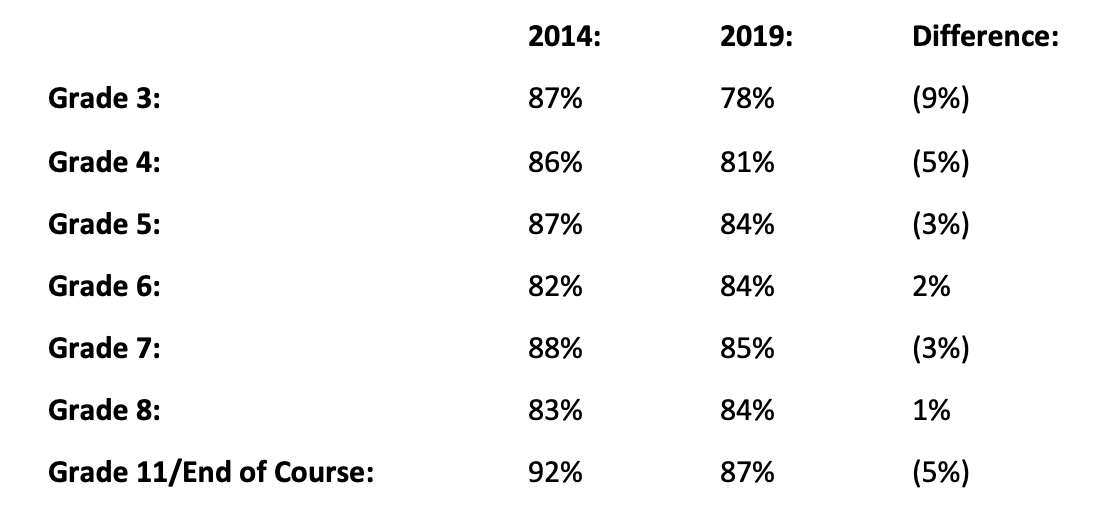
Although it’s debatable if the Virginia Reading Standards of Learning (SOL) is a valid and appropriate measurement of reading proficiency during any given year, the Reading SOL is what Virginia uses to measure reading proficiency over time. Here’s a comparison of APS’ proficiency rates on the Reading SOL from 2014 and 2019:

Overall, APS is trending in the wrong direction. Today more students are non-proficient readers than in 2014. The most significant declines have occurred in third grade — the pivotal year in which a student reads to learn versus learns to read. As noted by the Annie E. Casey Foundation’s report, “Early Warning! Why Reading by the End of Third Grade Matters”, a failure to read proficiently by third grade often puts a student on a success or failure trajectory. It’s imperative that APS laser focus on this downward trend in the K-2 grades.

What is APS doing about it?

Literacy Training: Many of Virginia’s university teacher preparatory programs fail to teach our teachers how a student learns to read and how to identify, instruct, remediate, and accommodate students with reading disabilities. Therefore, the burden falls on the K-12 schools to train teachers after they are hired. Last year, a small cohort of APS supervisors and specialists were trained in LETRS, to help teachers embed scientifically researched-based literacy instruction in the classrooms, regardless of what resources are used.

Early Identification: Since 1997, the Virginia Department of Education (VDOE) has provided districts with the Phonological Awareness Literacy Screening (PALS) tool to identify students in K-3 who are at risk for reading failure. But PALS isn’t effectively identifying all of our at-risk students and isn’t identifying the root causes for why a student is struggling or may struggle when text becomes more complex. Although PALS takes considerable time to administer, it doesn’t provide the information required to meet students’ needs. Therefore, APS began piloting the Rapid Automatized Naming/Rapid Alternating Stimulus Test (RAN/RAS), to supplement PALS. As a result, APS now identifies additional students that may not have been identified using PALS.

(more…)


The Right Note is a biweekly opinion column. The views expressed are solely the author’s.

As the year draws to a close and we reflect on the year behind us, it is natural to start peaking around the corner into 2020.

When the Arlington County Board next meets to open the new year Libby Garvey will assume the center chair to lead the body. What will be her priorities on transportation, public safety and housing? Will she seek a property tax rate cut or will she endeavor to spend every penny of revenue generated from surging property tax assessments?

At the same time Garvey will face a primary challenge for her re-election. After the far left forces defeated Commonwealth Attorney Theo Stamos in June, elected officials can no longer take these races for granted. Like Stamos, Garvey angered many Democrats by backing John Vihstadt. So there is a very real question about whether she will hold off her electoral challenger.

Speaking of elections, with both Arlington school board members up for re-election next year opting to step down, who will be the next community members to step up to the plate? Will the new school board candidates be more concerned about name changes or improving classroom performance?

In the meantime, what will the final elementary school boundary changes look like? Passions will run high as parents find out that the school they moved into a neighborhood for may no longer be where their children will attend.

While Arlington schools are flush with cash relative to almost anywhere else in the country, there is no doubt that the school board is one of the toughest jobs in politics. Nothing is more personal to voters than changes to how their children are being educated.

Changes are coming to Richmond in 2020 as well. In the lead up to the November elections, Delegate Alfonso Lopez promised voters they could pass a sweeping agenda in “two afternoons.”

Democrats now own that capital and face the reality that they will no longer be able to blame Republicans for being unable to pass legislation there. They should be judged solely on their own agenda. So, what will the 2020 session of the Virginia General Assembly actually produce?

Many Democrats have already backtracked from promises of independent redistricting reform. The idea that they can redraw the lines to lock in General Assembly and Congressional seats for their own party seems to have conveniently outweighed the promises so many of them made on the campaign trail.

Some other big ticket items on their agenda included gun control laws, ending right to work, passing the Equal Rights Amendment, creating new energy regulations, allowing abortion up until the end of pregnancy, raising the minimum wage, expanding Medicaid eligibility and raising taxes as necessary to pay for it.

If the agenda goes too far, will it help push voters back toward the GOP in 2020? Did Democrats watch what happened in last week’s parliamentary elections in the United Kingdom or do they think Virginia is ready for a leftward lurch?

Finally, seven years ago, the editor of ARLnow asked me to consider writing a weekly column. The content has often infuriated many, but more often that not the feedback has been “I don’t always agree with you, but thank you for writing your column.” Thanks for reading them.

Mark Kelly is a 19-year Arlington resident, former Arlington GOP Chairman and two-time Republican candidate for Arlington County Board.


Progressive Voice is a biweekly column. The views expressed are solely the author’s.

 By Colleen Pickford

If you are an Arlington parent, you likely have heard that Arlington Public Schools staff presented two proposals in November for moving various elementary neighborhood and option programs in advance of a new elementary school opening at the Reed site in 2021.

These proposals are big, bold, and complex, and last week the process was narrowed down to Proposal 1.

The elementary school population in Arlington continues to grow faster than we can fund buildings — our land and funding are limited. In order to manage elementary school enrollment over the next 10 years, we must take a hard look at all our school buildings and how we are using them and consider program moves and boundary changes as part of a plan for making full use of existing space.

Community response to these proposals has been swift. Letters are being circulated, coalitions are being built, t-shirts are being printed and parents are insisting the process is flawed and must be halted for a year until more data or other solutions are provided to allay all concerns. Shouting from audience members and interrupting staff comments have recently disrupted public engagement meetings on the proposals, drawing media coverage from a local television station. For those who are concerned, I implore you to partner in this process rather than immediately work against it.

I understand the anxiety that comes with these changes. My children’s school, Oakridge Elementary, was part of the boundary process last year that resulted in nearly 200 of our students moving to Hoffman-Boston this year. The boundary change was the culmination of a five-year process where our community sought relief from overcrowding — but more time to discuss boundary changes didn’t make the conversation with our neighbors any easier. Even with triple-booked PE classes and so many classes our specialist teachers could barely rotate through the school, no one wanted to move.

I can tell you from living through this process that there are no perfect data and no perfect solutions. But the challenges before our school system grow with each newly enrolled student. Delaying those decisions now doesn’t make that any easier and it doesn’t change the fact that some students are going to have to move.

(more…)


Ed Talk is a biweekly opinion column. The views expressed are solely the author’s.

While many believe that Arlington Public Schools (APS) currently is engaged in an elementary school boundary process, it is not. Instead, APS proposes moving entire school populations from one school to another. It then will consider boundary changes in the fall of 2020, offering no details on what those might look like.

Making adjustments to school assignments is necessary to create an attendance zone to fill seats at the new elementary school at the Reed building opening in 2021. In addition, APS intends to redraw the attendance zone for Arlington Science Focus School to address significant crowding in that part of the County.

APS has a detailed policy for boundary changes, which includes consideration of the following factors: efficiency, proximity, stability, alignment, promoting demographic diversity, and contiguity. However, there is no policy governing the current “school move” process and APS has been explicit that it is not considering demographics.

Research is clear that students — all students — do better in diverse learning environments.

Yet many of our schools are not diverse. The socio-economic differences are stark: the average eligibility for free/reduced price meals for neighborhood elementary schools in south Arlington is more than three times that of neighborhood schools in north Arlington – 52.58% compared with 15.58%.

We also know that there are significant gaps in academic achievement between poorer and wealthier schools. For example, the Standards of Learning math pass rate last year at Carlin Springs Elementary was 62% (free/reduced price lunch eligibility — 81.15%) and for Tuckahoe Elementary it was 98% (free/reduced price lunch eligibility — 1.51%).

The School Board’s boundary policy appropriately considers promoting demographic diversity, recognizing that this has an impact on student achievement. Students in diverse schools also have the benefit of learning about and from others with different backgrounds, languages, and life experiences.

Among the APS core values is equity, which is defined this way: “Eliminate opportunity gaps and achieve excellence by providing access to schools, resources, and learning opportunities according to each student’s unique needs.”

APS should consider lack of diversity in schools as an opportunity gap.

As APS staff, community members, and the School Board engage in the current process, I suggest that the four equity questions I referenced in my November 1 column be asked:

  • Who benefits?
  • Who is burdened?
  • Who is missing?
  • How do you know?

Since APS is not considering demographics in its school move process, these questions cannot be fully answered. We do know that the burden of one of the proposals may fall disproportionately on low-income students, since it would move nearly all students at Campbell, Carlin Springs, and Key elementary schools. And given what appears to be the lack of any community support for the proposals, who benefits?

The Board should not move thousands of elementary school students in a process that is separate from a boundary process and that does not consider demographic diversity. To do so misses the chance to reduce opportunity gaps by increasing diversity at our elementary schools.

Instead, school moves and boundary changes should be considered together, with data about the free/reduced price lunch population and racial/ethnic composition of each elementary school that would result. And consideration should be given to other tools that have been used in the past to address crowding, diversity, and achievement, such as option and team schools.

Achieving more diversity across our elementary schools, most of which are neighborhood schools, is challenging. But we cannot make any progress if promoting demographic diversity is not even a factor in the process of assigning students to different schools.

Abby Raphael served on the Arlington School Board from 2008-2015, including two terms as Chair. She also led the Washington Area Boards of Education for two years. Currently she co-chairs the Project Peace Prevention Committee and Destination 2027 Steering Committee, is a member of the Board of the Arlington YMCA, and works with the Community Progress Network and Second Chance.


The Hurtt Locker is a biweekly opinion column. The views expressed are solely the author’s.

ARLnow posed the following Morning Poll question last week: Should homeowners have more of a say in local government than renters?

This question came on the heels of an editorial in the Arlington Sun Gazette about reducing the amount of single-family housing in exchange for multi-family units, a conversation currently being driven by affordable housing proponents that is sure to dominate the county budget conversation in the coming weeks and months.

Arlington County Board member Katie Cristol signaled support for a $9 million increase (or 54%) to the Affordable Housing Investment Fund (AHIF) over this fiscal year’s $16 million investment. “This is, I recognize, a lot of money,” Cristol said. No joke. But in politics — and in government — nothing moves unless pushed. And affordable housing proponents have been out in force at recent meetings.

Anyone who attends an Arlington County Board meeting or any of the myriad meetings of boards and commissions knows issues are debated and discussed and decided by representatives from competing local interest groups, many of which are comprised primarily of homeowners — even though renters make up 57% of household units, according to the 2017 Census American Community Survey (ACS). One might argue that homeowners already have a disproportionate say in local government over renters.

It’s not necessarily a bad thing. As a renter who is a member of my civic association and has an interest in local issues, I realize I’m probably an outlier — even in Arlington. Many of my contemporaries are renters who work on federal issues (either on the Hill or at a nonprofit or interest group), and they are not particularly interested in local issues. They won’t show up for a County Board meeting or a Civic Federation debate or a Committee of 100 dinner. But they make up a significant percentage of those impacted by decisions our County Board and School Board make, whether or not they always realize it.

And what about big and small business owners who don’t live and vote in Arlington? Should they have less of a say in local government? Representatives from Harris Teeter spoke at a recent County Board meeting regarding the proposed re-development of the grocery chain’s location at 600 N, Glebe Road in Ballston alongside residents who would be impacted by the development and the Ballston BID whose interest is economic growth in that neighborhood. Even former Delegate Rob Krupicka, who lives in Alexandria but owns a small business near Columbia Pike, probably deserves a say in local government if and when it impacts his business.

Are long-term, community-rooted homeowners and short-term, transient renters interested in different issues? Do they care about different and sometimes competing policy solutions? Sure. But both are important voices as we address important issues like affordable housing, school overcrowding, and infrastructure. Make no mistake: Renters have just as much of a stake in Arlington as homeowners do; and we pay just as much for county services, even though many of those costs are passed along in the total amount of the rent, rather than in a property tax bill from Arlington County.

All that to say this: If you made it to the end of this column, take a few minutes to fill out the County’s “How Should We Be Spending [Your] Money?” survey. Because you — as a renter, or homeowner, or out-of-town business owner — deserve a say in Arlington.

One additional note: Since my last column on November 14, I have met with a number of community activists from across the political spectrum to talk and learn more about local issues. As I outlined in my first column, I hope to take many of these conversations offline and into the community, so reach out if you’d like to sit down over a cup of coffee or a beer.

Matthew Hurtt is a 10-year Arlington resident who is passionate about localism and government transparency and accountability. Hurtt is a member of the Arlington Heights Civic Association and was previously the chairman of the Arlington Falls Church Young Republicans. Hurtt prides himself on his ability to bring people of diverse perspectives together to break down barriers that stand in the way of people realizing their potential. He is originally from outside Nashville.


Modern Mobility is a biweekly opinion column. The views expressed are solely the author’s.

Arlington has over 30 acres of valuable public real estate that it is terribly mismanaging.

The County provides it to some, but not all residents for the express purpose of storing their private property. Some residents can use it for free, others pay a tiny pittance of $20 per year. Many residents, primarily the young and least affluent are forbidden from using it at all. Virtually every inch of it has been paved over.

Perhaps worst of all, those special residents who are allowed to use it, rarely do so. Over 50% of the time this land is sitting completely empty.

I’m speaking, of course, about Arlington’s on-street Residential Parking Permit Program parking spaces.

You’d be forgiven for not realizing any of this — the conversations about on-street parking in the County would make you think the exact opposite. You can’t show up at a development approval public hearing without hearing about the parking scarcity in Arlington. Penrose’s “parking crisis” is a regular topic of conversation at my neighborhood’s Civic Association meetings.

The cold, hard, data from the County’s parking occupancy study paints a very different picture, however. While on-street parking on commercial corridors is often at 85-100% occupancy, especially during evening hours, neighborhood streets with Residential Parking Permit (RPP) restrictions average less than 50% occupancy, even in the hours when those RPP restrictions aren’t in effect. During school hours, nearly every residential block in the County’s detailed study area is under 50%.

In a County as space-constrained as Arlington, we simply must make better use of this public land. Our tax money is used to maintain it; its imperviousness worsens flood risks for all of our homes; and as long as it is on-street parking, it cannot be rain gardens, parklets or bike infrastructure to get our kids safely to school.

Two current problems facing the County could greatly benefit from this land, and some simple changes to the RPP program could accomplish them.

First, Restaurant Row on 23rd St in Crystal City, which is home to many dearly-loved and locally-owned restaurants has very little dedicated parking. This recently received a lot of renewed attention due to the potential redevelopment of a private parking lot in the immediate vicinity. One business owner, specifically lamented the loss of lunch business in his testimony to the Transportation Commission. A large part of the loss of nearby parking near Restaurant Row, is due to those blocks acquiring RPP restrictions of the last decade.

While some sort of restrictions may be necessary to prevent commuter parking, the existing RPP restrictions have clearly gone much, much too far, especially when it comes to during the work day. Nearly all of the nearby blocks are under 60% occupancy at lunch time on weekdays.

There are several ways the RPP program could be changed that would help support these businesses without overly burdening nearby residents. Two hour parking could be allowed in RPP zones without a zone permit. To make this easier to enforce, parking meters could be installed. If this might result in too much commercial parking it could be limited to only during the work day, or only on one side of the street.

Second, the expansion of Arlington’s Career Center is currently working its way through Public Facilities Review Committee and how to accommodate the school’s parking needs is one of the hottest topics of conversation. The County estimates that the expanded Career Center will need 400-500 total parking spaces.

(more…)


Community Matters is a biweekly opinion column. The views expressed are solely the author’s.

Last month I spent eight hours at Arlington Independent Media (AIM) taking an audio production class. I marveled at the backgrounds, perspectives and skill sets that my classmates could bring to the airwaves.

Among us were a female veteran who is a motivational speaker, a filmmaker who has an interest in the women’s suffrage movement, an engineer and writer who focuses on environmental stewardship and historical fiction, and a woman who wants to produce a show about the downside of romantic relationships.

Next year I will be producing and hosting the Arlington League of Women Voters’ (LWV) radio show “Making Democracy Work” through AIM which will explore the importance of exercising our rights, responsibilities and civic duties. The show will feature prominent voices on a number of topics including voting rights, redistricting, General Assembly legislation and the importance of inclusivity in civic engagement.

The radio booth brought back memories of my time in the Peace Corps. While I was serving in Paraguay one of my projects was with the community radio station, Radio Villeta FM. Paraguay was transitioning from a dictatorship to a democracy, and as a champion of free speech, Radio Villeta flourished in this environment. It was gratifying to see the programming that residents produced, and their passion for their community. Regardless of its quality, the radio station was representative of what democracy means to me – open and participatory, a hub for the community, creative, and while often imperfect, always striving to represent the community’s needs.

The LWV was founded in 1920 by suffragist Carrie Chapman Catt at the National American Woman Suffrage Association’s convention. The 19th amendment gave 20 million women the right to vote (although primarily only white women could vote in practice) and the LWV helped them exercise their newfound right. The Arlington chapter has been on the forefront of civic engagement and refining our democracy since our chartering in 1944 and encourages participation.

In the midst of what is happening at the federal level, it’s easy to fear that instead of strengthening our democracy, we are moving in the other direction. In 2018, former Secretary of Labor Robert Reich provided these 10 steps to make our democracy work. An underlying idea in these steps is a stronger civil society. Whether its community radio, or the LWV, we keep trying to move towards a more perfect union.

I served in the Peace Corps during the 2000 elections and Bush v. Gore. Day after day when I walked through the streets the neighbors would yell out “Is there a winner yet?” and “Are you rooting for Bush or Gore”? The United States is revered as a model democracy so it was somewhat embarrassing to teach about democracy during this time, but served as a great opportunity to demonstrate that while democracies are imperfect, we keep trying.

The LWV and AIM are only two examples of Arlington’s contributions to a strong civil society. While the national state of affairs may be disheartening, Arlingtonians don’t have to look farther than some of our longstanding institutions to be proud of the work we have done to strengthen our democracy, no matter how imperfect.

Krysta Jones has lived in Arlington since 2004 and is active in local politics and civic life. This column is in no way associated with or represents any person, government, organization or body — except Krysta herself.


Making Room is a biweekly opinion column. The views expressed are solely the author’s.

Any time Arlington County gets access to land within our 26 square miles is a cause for celebration. It also requires a firm commitment to make the best possible use of this extremely limited and valuable resource.

On December 14, the County Board may vote to acquire the benefit of a new piece of property just blocks from the Crystal City Metro Station. We need to make sure this opportunity isn’t undone by the cry for parking.

South Arlington’s Crystal House apartment complex, comprised of two 1960s-era high-rise buildings, is slated for infill development. The site plan will be on the County Board’s December 14 agenda.

The staff recommendation contains what Planning Commissioners called a “once in a lifetime opportunity” for achieving the Crystal City Zoning Ordinance’s affordable housing obligation. Instead of providing 47 units of committed affordable housing within the complex, Roseland is offering to convey one portion of their property, currently a surface parking lot, to the County. The understanding is that the County could develop this property with at least 81 units of committed affordable housing.

The benefits of this proposal are enticing.

First, by owning the land and working with an Affordable Housing developer, the County Board could create units that would remain affordable to low-income residents for 60 years, unlike the typical 30-year term for on-site affordable units within market-rate developments. Second, the location of this parcel at 22nd and Eads would provide excellent transportation access for the building’s residents. Third, by owning and developing the property, the County could provide a much-needed community facility for the 22202 ZIP code, in addition to the committed affordable housing, such as we see at Arlington Mill.

But these positive benefits are future opportunities that will require a commitment to realize. The only thing Arlington would get in the short-term is a surface parking lot. And it is a particularly contested parking lot. Business owners from the adjacent “23rd Street Restaurant Row” see these 96 spaces as the key to their business.

Any effort to build on the parking lot will continue to face pushback from the merchants. Roseland is offering this parcel not only to achieve bonus density on their site, but also to get out of the parking fight. By accepting the land, Arlington County is stepping into a battle that could stymie any effort to achieve affordable housing.

(more…)


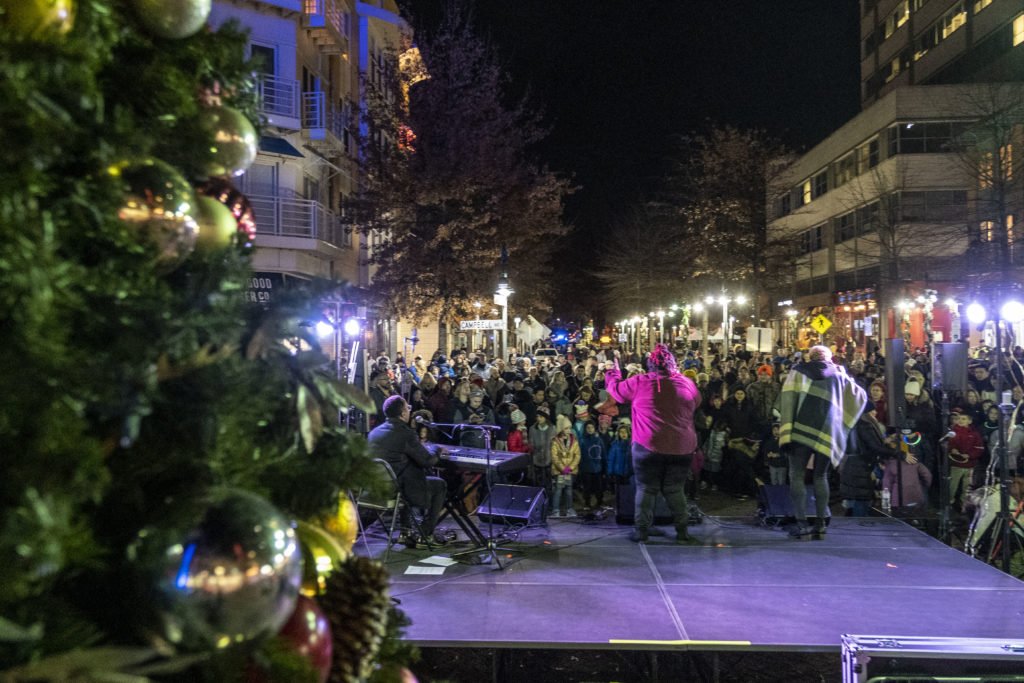
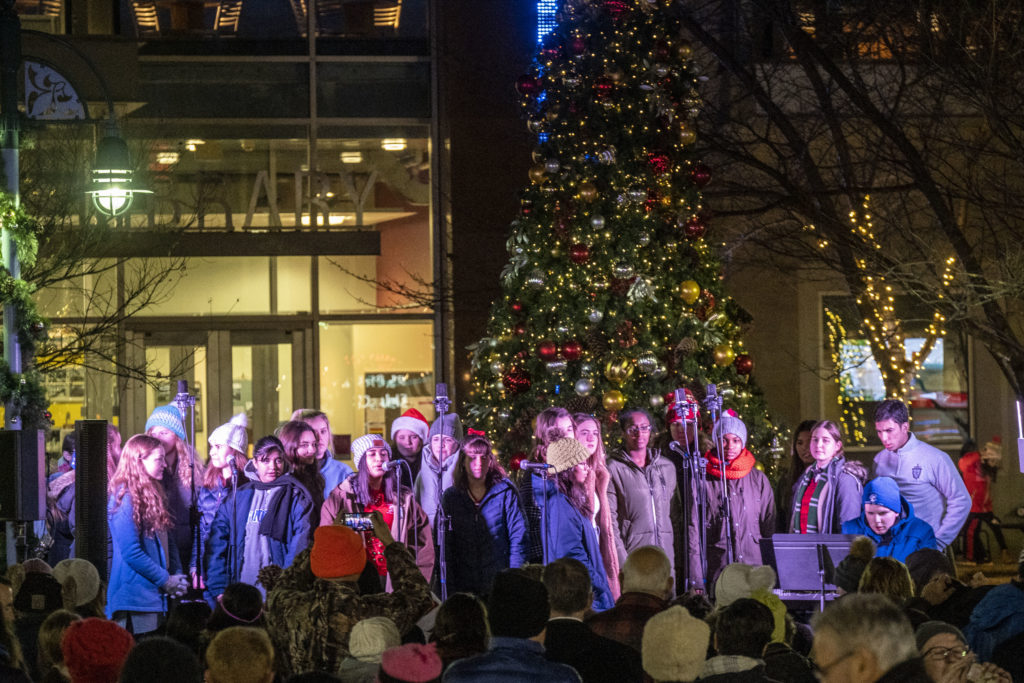
The first week of December was a busy one in Arlington, complete with lots of news, as well as a bevy of holiday and winter events — including the tree lighting ceremony in Shirlington last night, pictured above.

This weekend will bring more events, including a holiday extravaganza in Ballston on Saturday. The weather will be cold, but dry, on Saturday and Sunday for those heading to any events, stringing up lights, or picking up a Christmas tree.

Here are the most-read articles on ARLnow this past week:

  1. Arlington Named ‘America’s Most Handsome City’
  2. Bob and Edith’s Plotting Nationwide Expansion
  3. Metro Envisions New Rosslyn Station, Silver Line Down Columbia Pike
  4. State Police: Six Highway Workers Injured in I-66 DUI Crash
  5. State Police Investigating Fatal Crash on I-395
  6. Arlington PTA Leaders Speak Out Against Proposed Elementary School Changes
  7. Police Investigating Stabbing Near Ballston Metro Station
  8. ACPD Investigating Sexual Assault Near Ballston
  9. Morning Poll: Should Renters Have Less of a Say Than Homeowners?

Feel free to discuss any of those stories, your weekend plans, or any other topic of local interest in the comments. Have a nice weekend!


What’s Next with Nicole is a biweekly opinion column. The views expressed are solely the author’s.

‘Tis the season for holiday parties — and the season of wine and beer bottles, sauce jars, you name it.

It is somewhat of a misconception that Arlington recently stopped recycling glass. We really have just started recycling glass in a different and more efficient way.

This year I am thankful that the Arlington County Board voted unanimously to join forces with the City of Alexandria, Fairfax County, and Prince William County to make our glass recycling more environmentally-friendly and cost-effective. Loudoun County voted this week to pilot the program.

There are two ways to properly dispose of glass since the change:

Preferred: Bring glass to the “Purple Bins”

In this process our glass is broken down and turned into pavement for Northern Virginia roads, bedding for drainage and stormwater pipes, and new glass materials, among other sustainable resources. This process is done at Fairfax County’s glass processing machine “Big Blue,” where 20 tons of glass can be crushed per hour to various grades of sand and gravel.

There are five Purple Bin locations to drop off glass for Arlington residents and businesses:

  1. Quincy Park (Orange/Silver Line Metro corridor accessible)
  2. Trades Center (Shirlington/Four Mile Run area accessible)
  3. Aurora Hills Community Center (Blue/Yellow Line Metro corridor accessible)
  4. Cherrydale Library (East Lee Highway area accessible)
  5. Lee Community Center (West Lee Highway area accessible)

Pro Tip: At the Trader Joe’s checkout there are dozens of wine boxes that you can take home with you, and at other grocery stores you can ask for a box for free. This will help you store glass safely and separately without anything breaking before your next trip to the Purple Bin. You can also keep a separate reusable grocery bag dedicated just to glass.

Put Glass in Your Curbside Trash Bin

Before the policy change, when you “recycled” your glass it was sorted out of the recycling facility and taken to the trash facility. By putting glass directly in the trash you save the county money by skipping the step of going through the recycle facility just to be transported by diesel truck to the trash facility it could have been at if you put it in the trash in the first place.

At the facility your glass is melted, mixed with combusted ash, and put in a landfill. In a bit of irony, if you do not take your glass to a Purple Bin it is better to put it in the curbside trash than in the blue recycle bin.

I am excited about this new program for two reasons:

  1. It exemplifies the best of what is possible in a green economy. It produces materials that are carbon intensive and generally used in public works or construction projects. The process also currently pays for itself making it cost neutral and potentially cost positive
  2. Our region worked together to create an economy of scale to the benefit of us all. Northern Virginia in the past year or two has begun partnering on everything from economic development and housing to waste disposal. Our continued coordination in various sectors will result in a more resilient region.

So far, the Big Blue glass recycling machine has processed 1,400 tons (2.8 million pounds) of glass, and Arlington has delivered 200 of those tons through our Purple Bins. I challenge our community to become a bigger percentage of that glass in the new year, and why not start with your holiday parties. Putting out that new wine box or reusable bag to collect your glass is the first step to start new habits, so try it out!


View More Stories