Progressive Voice is a biweekly opinion column. The views and opinions expressed in the column are those of the individual authors and do not necessarily reflect the views of their organizations or ARLnow.com.

By Katie Cristol

You don’t have to be a parent of young children to appreciate the value of accessible, affordable and quality childcare.

A healthy childcare market supports families and also supports economic development — for large employers and for the small entrepreneurs behind childcare businesses — and can improve outcomes for young learners. Unfortunately, as community leader Anne O’Brien effectively described in ARLnow a year and a half ago, Arlington County’s supply of childcare, while high-quality, has been scarce and too often inaccessible.

Over the past two years, a coalition of providers, nonprofits, County staff and parents have spent hundreds of hours on the priorities in our Child Care Initiative Action Plan. Our theory is that these steps, such as eliminating zoning ordinance and regulatory barriers to opening and expanding childcare, as well as supporting providers in improving their staffing and training, can increase the supply of quality, affordable and accessible childcare in Arlington.

Making systemic changes to help all people succeed is a core progressive value. Just as important is taking a hard-nosed look at whether those changes are having the desired effect. So how are we doing?

The Childcare Initiative has been anchored in data. We began with a Demographic Risk and Reach study, which found that affordability is a huge concern for middle-class as well as low income families in Arlington. For two children in center-based care, child care expenses are 38% of our median income for a family of four — more than seven times the threshold that the federal government describes as “affordable.”

Supply shortages were worse than we thought: Known capacity is sufficient to serve only 54% of Arlington’s children under five, despite data indicating that most Arlington children live in families where all parents work. These gaps between supply and need were greatest in the 22204 zip code. This is particularly concerning, given that neighborhoods in 22204 are home to Arlington’s most vulnerable children and families.

These data — paired with extensive qualitative data from providers and parents about their greatest needs — were the basis for the policy changes that my County Board colleagues and I adopted this spring and summer.

We have some early indicators that our efforts are starting to work. Arlington saw a net increase of 247 spots in the initial year of the Childcare Initiative, most in South Arlington where they are most needed. Now with the code changes having taken effect July 1, we expect those numbers will increase significantly. Within just a couple of months of the changes, 30 family day care homes had submitted requests to expand. In support of our quality goals, 327 Arlington childcare spots were newly quality- rated in 2018, a 33% increase over the prior year.

As the Childcare Initiative “grows up,” the real measure will be if there are more high-quality spots available to families all over the County.

So, we’re debuting a dashboard to monitor what counts. That includes big-picture measures of availability (total capacity, capacity by ZIP code, and the percent of children in the County that can be served). It also includes progress on accessibility: How many students with special needs are being served? How many low-income families with subsidies are accessing quality care? Is back-up childcare, or childcare during nontraditional hours, increasing?

We won’t transform our childcare landscape overnight. But our childcare reforms are grounded in data, and it is data that will let us know whether these reforms are making a difference that counts.

A final note, since the policy is personal for Arlington families: If you’re looking for childcare in Arlington, you should know that we also re-launched our online directory, allowing filtering by languages spoken, type of care and subsidy acceptance.

Katie Cristol is a member of the Arlington County Board.


It has been a cold week throughout which big national news is being made across the Potomac.

Here in Arlington, though, the biggest story might be the one-year anniversary of the Amazon HQ2 announcement, and all of the ramifications of Amazon’s arrival coming into clearer view. The economic benefits of HQ2 are becoming more tangible, but the urgency of the housing challenges — and pushback on the effects of population growth — seems to be increasing as well.

Here are the most-read articles on the week on ARLnow.com:

  1. ‘Best of Nextdoor’ Highlights Lee Highway Taco Bell Drama
  2. Murder Suspect Found Dead in Arlington County Jail
  3. Public Meeting Planned for Possible Route 50 Changes
  4. Hurtt Locker: Christian Dorsey Scandal is Worse Than We Thought
  5. Arlington Public Schools Floating Pre-Labor Day School Start
  6. Arlington Agenda: November 11-17
  7. Coffee Shop Tip Jar Theft Turns Violent in Pentagon City
  8. Former Linda’s Cafe Building Torn Down on Lee Highway
  9. Woman Accused of Attacking Nannies in Lyon Park Due in Court

Feel free to discuss those or any other issues of local note in the comments. Also, it’s Airey’s last day, so if you’d like to wish her well, she’ll be reading the comments.

Have a nice weekend!


Ed Talk is a biweekly opinion column. The views expressed are solely the author’s.

Arlington Public Schools (APS) is moving forward with the implementation of a Chief Diversity, Equity and Inclusion Officer (CDEIO).

APS posted the vacancy in early October and hopes to have the position filled by January. There is a sense within the Arlington community that this process is being rushed – unnecessarily and to the detriment of APS’ own efforts.

Whether you believe the position is unnecessary or you consider it essential to eliminate systemic biases, there are legitimate concerns about the circumstances under which APS is pursuing its implementation:

  • APS has not indicated the specific situations or problems it is aiming to solve with this position;
  • A lack of explicit objectives and measurable goals to be achieved may be setting the stage for certain failure;
  • Filling a new, high-level position in the absence of a permanent superintendent may create inconsistency or incompatibility in expectations when leadership changes; and
  • The work of the CDEIO would likely be guided by APS’ policy on diversity, equity and inclusion, which APS is still developing and the School Board has yet to adopt.

Adding to concerns that this process is being rushed is the uncertain degree to which the School Board is committed to the continued investment needed to enable a CDEIO to succeed. After the recent successive budgets that have precluded the addition of other important personnel, will the future Superintendent and Board members commit the necessary funds in subsequent budgets for staff support, training programs, or other resources the CDEIO requires?

If the Board does not invest sufficient resources, opponents who argue a CDEIO is unnecessary or will be ineffective will be proven correct.  Community fears that creating this position is nothing more than checking a box to reassure the community of the Board’s commitment to diversity and equity will be confirmed. It will merely serve as distraction while the Board forges ahead with boundary changes, capacity solutions, and instructional program decisions without a sense of obligation or responsibility to address diversity or equity within those processes and decisions.

It is noteworthy that the Arlington County Board adopted an equity resolution this past September. Despite the County’s intention to establish an interdepartmental task force that includes Arlington Public Schools, the County did not consult with APS as it developed its resolution. A joint policy on diversity, equity, and inclusion would ensure consistency in terms and definitions used by County and Schools, a shared vision and uniform practices across County and Schools, and an acknowledgement of County policy impacts on APS’ ability to provide equitable educational and social opportunities to all students.

Nevertheless, APS’ policies on equity and inclusion and diversity will be driving factors in all aspects of administration and instruction. Therefore, this position must not be allowed to fail and APS must make every effort to maximize a new CDEIO’s chances for success.

(more…)


The Hurtt Locker is a biweekly opinion column. The views expressed are solely the author’s.

Arlington residents learned about a string of ethical and financial transgressions by Arlington County Board Chairman Christian Dorsey last week.

After waiting four months to disclose a $10,000 campaign contribution from Metro’s largest union, Dorsey – who serves as a principal director on the WMATA (Metro) Board – was removed as finance chair of the board in a special meeting last Thursday.

The WMATA Board found that Dorsey violated its code of ethics and likely voted on a number of issues for which he should have recused himself during the four-month period. Dorsey called it a careless oversight, but when independent candidate Audrey Clement raised the issue at the Committee of 100 candidate debate in early October, Dorsey said there was no conflict of interest as the Metro Board does not handle union business.

Dorsey’s rebuttal is patently false. According to Tom Webb, the VP for Labor Relations at WMATA, the WMATA Board not only votes to approve contracts negotiated with ATU 689 (the union that contributed $10,000 to Dorsey’s campaign) and other unions, it also provides direction to the WMATA General Manager in advance of those negotiations. In retrospect, Dorsey’s casual and condescending dismissal of then-candidate Clement’s line of attack reveals another layer of arrogance.

What readers may not realize is the $10,000 contribution is just the tip of the iceberg. On December 3, 2018, Dorsey received a $1,500 contribution from Volkert, which has a contract for the Dulles Silver Line extension. Nine days later, Dorsey used $1,250 of those funds to pay down a 2015 loan.

The second shoe to drop came just one day later when Arlingtonians learned about Mr. Dorsey’s Chapter 13 bankruptcy filing, which occurred on October 16. In the realm of politics, I’m hesitant to criticize anyone’s personal financial misgivings. Bankruptcy is a financial protection provided by law; however, as many readers with various levels of security clearance know, personal financial issues are a major concern when identifying (potential) employees who would be susceptible to ethical compromise.

An egregious aspect of this part of the story is that Mr. Dorsey blamed his public service for his diminished personal income, signaling to residents that he has taken a personal hit to govern over us. As readers will recall, the Arlington County Board voted to raise its salary cap in June of this year. Chairman Dorsey said, “I support increasing the salary cap because I believe it will encourage more people, from varied economic backgrounds, to think about serving on this Board.”

Given the new context, those words likely have new meaning to many readers here.

On top of all that, Chairman Dorsey championed a property tax increase in April of this year, advising Arlington taxpayers to “scrub the family budget” to cover the cost of the tax increase.

(more…)


This sponsored column is by James Montana, Esq. and Doran Shemin, Esq., practicing attorneys at Steelyard LLC, an immigration-focused law firm located in Arlington, Virginia. The legal information given here is general in nature. If you want legal advice, contact James for an appointment.

ARLnow readers know well that the Washington D.C. metro area has one of the largest Salvadoran populations in the United States. Many Salvadorans in our community have been living and working in the United States lawfully for many years under a program called Temporary Protected Status, also known as TPS. Other immigrants from Haiti, Honduras, Nepal, Nicaragua, Somalia, Sudan, South Sudan, Syria and Yemen also hold TPS. Quietly, cheaply and efficiently, TPS has offered a safe harbor for many of our friends and neighbors for decades.

The Trump Administration, for reasons best known to itself, has sought to wind down the program, particularly for Salvadoran, Honduran, Nicaraguan, Sudanese, Haitian and Nepalese citizens. TPS holders, employers and immigration attorneys throughout the country have been waiting on pins and needles to see if the Trump Administration would extend TPS for these countries, thereby allowing many immigrants to continue to be productive members of our community.

Thanks to litigation on a scale best appreciated by watching Game of Thrones battles through a kaleidoscope, TPS has indeed been extended until January 4, 2021 for El Salvador, Haiti, Nicaragua, Sudan, Honduras and Nepal. (Two years ago, one of your Infallible Writers told you that TPS was ending. He was wrong.)

This array of stopgap extensions is better than nothing. But what are employers supposed to do if they have to worry year after year about losing their workforce when TPS finally ends? Thankfully, there is an answer for these employers: sponsor TPS employees for permanent residency.

Employers who have trusted employees that are authorized to work under the TPS program can file petitions on behalf of these employees that can eventually lead to green cards. This process, called PERM, is a three-step process that allows immigrants to receive permanent residency in the United States. Any company, large or small, can use PERM to petition beloved employees or attractive potential employees.

It starts off with recruitment and certification overseen by the Department of Labor, followed by an immigrant visa petition with the Department of Homeland Security. If all goes well, the employee can then apply for a green card. This process helps employers keep their star employees without worrying about the whims of the government.

If you have TPS, or you work with a team that includes TPS employees, reach out to an immigration attorney to see if this process is right for you. Moving from TPS to a green card requires dealing with multiple bureaucracies, and small mistakes can have major consequences. We’re here to help. We’re also here to answer questions, so please feel free to leave a comment. We read and appreciate them all.


Modern Mobility is a biweekly opinion column. The views expressed are solely the author’s.

Every year, the DC region spends over half a million dollars on the Street Smart safety campaign. With pedestrian fatalities reaching their highest levels in decades, that budget is a resource we need to be maximizing to improve safety outcomes.

Instead, the campaign seems more concerned with watered-down messages that won’t offend anyone and visual gimmicks that catch your eye and jog your memory – but don’t actually send a useful message.

You’ve probably seen these ads before. For years it was tired faces, lately it’s shattered lives. The evocative imagery is great for getting you to remember that you’ve seen these ads, but doesn’t necessarily help you take away any sort of useful message from them.

The results are pretty abysmal, especially amongst drivers – those whose behavior is most likely to harm another individual. Only 13% of drivers surveyed could even remember seeing a Street Smart ad. The after-campaign survey either doesn’t try to determine if the “messages” of the campaign are getting through, or the results are so bad they don’t include them in the report.

The survey does highlight a remarkable amount of self-reported lawlessness and dangerous behavior – in the prior week alone, 23% reported that they have failed to stop for a pedestrian in a crosswalk, 60% reported speeding in a 30 mph zone.

The worst part of all of this as that there is actually a lot of important things that need to be said about traffic safety. We have new infrastructure on our roads that didn’t exist when most drivers on the road today were learning. Street Smart could be teaching people about Rectangular Rapid Flashing Beacons and HAWK signals, about Bike Boxes and Protected Intersections.

Additionally, Street Smart could be actually informing us instead of admonishing us. We all know we should slow down; we should look, we should give cyclists some space on the road. Is being told one more time really going to push someone over the edge to start behaving? Or would it be more effective to explain HOW speeding contributes to crashes, or why they’re more likely to hit a pedestrian while they’re making a left turn than if they’re making a right turn?

Finally, Street Smart needs to keep the focus where it can do the most good – on the behavior of those mostly like to harm others: drivers.

Yes, safety is a shared responsibility, yes there are things that everyone can do that can help a bit here and there, but you lose credibility with cyclists and pedestrians when you’re admonishing them to “be visible” and “be predictable” and “wear reflective clothing” while drivers regularly crash into stationary, well-lit and reflective objects. No amount of high-vis or carefulness can save you from a single distracted or careless driver – to say otherwise can quickly devolve into victim blaming.

Thankfully, Street Smart has gotten better about this over the last few years. And thankfully – the latest campaigns are a considerable step up from warning pedestrians “If you text, you’re next” or “don’t be caught dead wearing black.”

Chris Slatt is the current Chair of the Arlington County Transportation Commission, founder of Sustainable Mobility for Arlington County and a former civic association president. He is a software developer, co-owner of Perfect Pointe Dance Studio, and a father of two.


Community Matters is a biweekly opinion column. The views expressed are solely the author’s.

Last weekend I joined eight women activists for a retreat in Williamsburg, VA to plan the Network NoVA 2020 Women’s Summit. The third annual Summit in 2019 brought together almost 1,000 registrants who were motivated and inspired to build on and create a grassroots progressive movement powered by women.

Arlington County is revered as having an engaged citizenry, yet I would posit that oftentimes the same people are active in different areas of the community. If we want to continue to increase engagement we will need to adopt new methods to address the challenges of the next decade and expand the traditional base of leaders.

This year I managed the Commonwealth’s Attorney campaign in Loudoun County of Buta Biberaj, a previous summit attendee. With this campaign, we were faced with several challenges which included expecting traditionally low turnout in an  “off off year” election, the need to coordinate numerous individual campaigns, grassroots organizations, and party programs, and a desire to make sure state party resources flowed into our races proportionally to neighboring campaigns.

In order to overcome these challenges we felt we had to do something different. Buta’s record of community leadership, her journey to political office, and the role that women played in her campaign and so many others, provide an excellent template and justification for why we should rethink and how we can maximize engagement in Arlington.

The human element. We observed that traditional canvassing protocols (door knocking — the backbone of campaigns) didn’t take into account volunteers’ discomfort with knocking on a stranger’s door, so we provided a training before the canvass. Organizations in Arlington should encourage citizens to provide feedback on current processes and see what works for different types of people. Is meeting attendance low? Maybe the location, time or child care options don’t work for them. Are they fearful of not knowing anyone? Encourage the buddy system. It’s not enough to recognize these concerns, we must also find solutions.

Engagement, like fundraising, is a long term process. You may not get everything you want on the first ask. If you focus on cultivation, like you would a donor, with higher levels of asks over time and engaging them and thanking them each step of the way, you may get them to assume more responsibility. This also requires a coordinated tracking system to follow up with volunteers and participants.

Capitalize on our own resources and retain our institutional knowledge. During the campaign we were tempted to find a celebrity to motivate our base and recruit outside talent to work on campaigns, therefore one of our canvass launches featured local youth and they were amazing! Arlington community members should increase investments in local programs including the Leadership Center for Excellence to groom local talent. We should also invite new leaders to moderate panels and give keynote speeches at our staple community events. When you keep local leaders involved they can also develop and retain institutional knowledge which will eventually result in greater success for us all.

Continue intentional and authentic diversity and inclusion efforts. Organizations and teams are changing procedures and recruiting more diverse candidates and team members. While that’s a great start, these efforts must be authentic. We can’t only engage diverse communities when we need them to check a box. Invite them for all of their talents, not only their “difference”.

In order to continue our record of being an innovative and progressive county, we must embrace new ways of growing our community and rethink traditional engagement.

Krysta Jones has lived in Arlington since 2004 and is active in local politics and civic life. This column is in no way associated with or represents any person, government, organization or body — except Krysta herself.


Making Room is a biweekly opinion column. The views expressed are solely the author’s.

In one of its first concrete votes under the Housing Arlington umbrella, the County Board will consider a proposal on November 16 to revise its incentive zoning program that gives developers additional density in exchange for community amenities, particularly affordable housing or community facilities.

Within this admirable proposal to increase density, however, is a small but troubling indication that County staff may not trust the market to deliver housing for middle-income households.

Currently, developers can earn up to 25% additional density and up to 6 additional stories by including affordable housing or a community facility in their project. The County staff wants to remove the 25% cap on bonus density, but also eliminate the option to earn additional height.

This means that the County Board could approve buildings with higher density, if the height fits the zoning district or applicable adopted plan. The goal is to encourage more affordable housing and community facilities through site plan developments, while maintaining the height maximums that neighborhoods have come to expect.

The decision to lift the cap on bonus density is laudable, but removing the option for bonus height will not give our land use policies the flexibility to meet current market conditions. Much of Arlington’s land is governed by outdated zoning codes that don’t recognize or accommodate the current housing crisis. This change would perpetuate the “grand bargain” that allows height in narrow Metro corridors but restricts it even in other transit-heavy neighborhoods.

Planning staff want their planning process to take the lead, but this can mean years of work, managed through a community process that over-represents the most affluent, housing-secure residents.

However, more concerning is the less-discussed component of this proposal to modify the definition of “low- to moderate-income” used to determine whether affordable housing in a site plan is eligibility for bonus density. Currently, a project can receive bonus density for housing that is affordable to households making 60% Area Median Income (AMI), or $72,000 for a family of four, for rental units and 80% AMI ($97,000/year) for ownership. Given the emphasis on “missing middle housing,” staff wants to loosen these definitions and explore offering bonus density to projects that offer ownership units affordable to households making up to 120% AMI ($140,000/year).

Arlington County clearly lacks affordable ownership housing for middle-income households, especially those seeking family-sized units. However, the County Board should not use incentive zoning to create housing for families making $100,000 to $140,000 per year. We should allow missing-middle options by-right and let the market provide housing for these relatively affluent households. When we use incentive zoning to achieve housing for higher-income people, we limit the opportunity to produce housing stock that assists lower-income households who are not served by the market.

Expanding the upper income range for zoning incentives tells me that the County may be unwilling to push for market reforms that would make this housing a regular development. Housing for middle-income families is not a gift that developers give us. We should permit the density and housing forms throughout the county that will make this housing profitable to build without any special encouragement. If we can’t get housing for 120% AMI without using these tools, then our zoning is wrong.

Jane Fiegen Green, an Arlington resident since 2015, proudly rents an apartment in Pentagon City with her husband and son. By day, she is the Development Director for Greater Greater Washington and by night she tries to navigate the Arlington Way. Opinions here are her own.


A long, three-day Veterans Day weekend is here, as is a three-day stretch of dry and warming weather, ahead of the next blast of cold and precipitation.

(Sorry, Arlington snow lovers, Tuesday probably isn’t it, after all.)

It’s been an eventful week in Arlington, punctuated by this morning’s major water main break near Chain Bridge. A boil water advisory remains in effect for a large portion of the county.

Here are the most-read articles on ARLnow this week:

  1. Arlington Man Causes a Stir As Max Scherzer Doppelganger
  2. Chain Bridge, Schools Closed Due to Large Water Main Break
  3. Clarendon Sports Bar Offers to Refund All Checks If Nats Go Back-to-Back
  4. Reintroduction of Popeyes Chicken Sandwich Ties Up Route 7 Traffic
  5. Op-ed: Arlington is Nonbinary
  6. Parisa Dehghani-Tafti Elected Prosecutor as All Incumbents Win Down the Ballot
  7. I-395 HOV Lanes Becoming Toll Lanes in Two Weeks
  8. Police Investigating Armed Robbery at Pentagon City Mall Parking Garage
  9. Taco Rock Now Open in Rosslyn

Feel free to discuss these stories or any other topics of local interest in the comments. ARLnow will be back with a limited publishing schedule on Monday. Have a nice weekend!


The following op-ed was written by D. Taylor Reich, a native of Arlington and a graduate of H-B Woodlawn, whose writings have also appeared on ARLnow sister site Tysons Reporter.

I am not a woman or a man. I am an Arlingtonian.

In the twenty-first century, gender is social limitation. Biological differences between sexes are irrelevant in the age of AC, GPS, and iPads for middle-schoolers. ‘Gender roles,’ we often say, are archaic and obsolete. Gender limits women’s salaries to four-fifths of men’s, and limits men to emotionally-stunted friendships and a suicide rate three times higher than women’s. It limits girls from enjoying the thrill of a touchdown and boys from the elegance of a flowing dress. It limits how we eat, how we speak, and how we love.

But gender doesn’t limit me. I deny its two traditional roles. My friends refer to me as ‘they,’ rather than ‘she’ or ‘he.’ At work, I might wear a necktie, button-down, and a skirt. I don’t deny that I grew up with a gender, but I have chosen to live beyond it.

I call myself ‘nonbinary.’ Others use other terms: ‘gender nonconforming,’ or ‘two-spirit,’ or ‘genderfluid,’ or ‘enbie.’ My generation has found many labels for an identity that defines itself through freedom.

This life comes with its own limitations. I uninstalled some dating apps because they don’t include nonbinary options. At work, I have to walk up an extra flight of stairs to get to the gender-neutral bathrooms (which are legally mandated in D.C., but not in Arlington). Sometimes people look at me funny on the Metro. But I’m freer than I ever could have been as a boy or a girl.

On a sunny Saturday a few weeks ago, I visited the new makerspace at the Central branch of the Arlington Public Library. It’s an inspiring place, embodying our community’s respect for learning. In the building where I learned as a child to love to read, people are finding creativity in mediums from embroidery to 3D printing. That afternoon, I learned to make buttons.

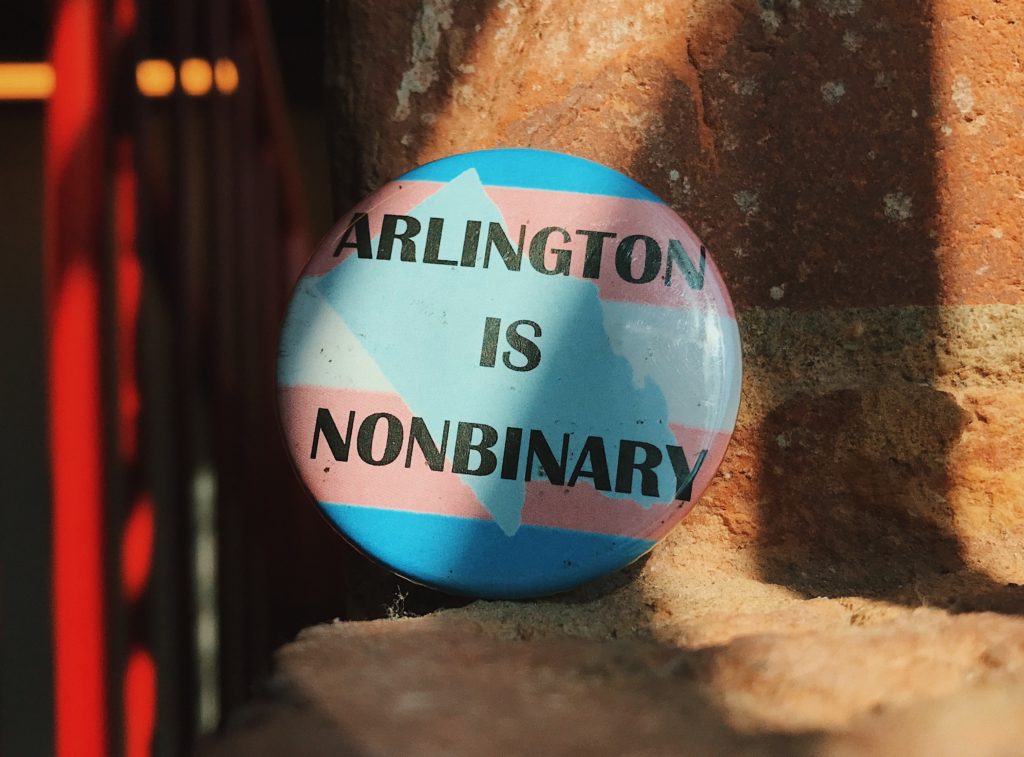
Buttons: they’re for politics, they’re for low culture, they’re for art, they’re for identification. I spun off a quick design. A shiny button an inch across, with the blue-pink-white-pink-blue transgender flag in the background (flip it upside-down and it’s the same). In the center, I drew the outline of our 26 square miles. Superimposed, three words: “Arlington is nonbinary.”

“Arlington is nonbinary.” What does that mean? For me, it holds three truths.

In the first sense, it’s literally true. Like me, this county is neither a woman nor a man. No geographic locale is a woman or a man. Maybe this is pedantic, but I think it’s a nice thing to remember.

In a second interpretation, Arlington is nonbinary because it is an exceptionally welcoming place for those of us who are nonbinary or transgender.

After I’d punched out a few dozen buttons, an adult at the next table interrupted.

“Excuse me,” she asked, “could I have one of those?”

She was a teacher at one of our middle schools, and had recently seen a student through a gender transition. The student, she said, never faced any bullying — at least, not for being trans. The teacher wanted a single button to put on her desk, and I gave her handfuls of them.

(more…)


Last week, we asked the two candidates in the 32nd District state Senate race to write a 750 word essay on why our readers should vote for them in the Nov. 5 general election. 

Here is the unedited response from Republican challenger Arthur Purves.

I am running to end racial inequality in Virginia public schools.  This is my eighth race in 24 years, and every time I have run on the same platform:  to end racial inequality in public schools by bringing back phonics, arithmetic drill, history, the Lord’s Prayer,  and the Ten Commandments, instead of tax hikes, busing, and police.

The minority student achievement gap that is so visible in high school actually appears in 4thgrade reading and math test scores, because reading and arithmetic are not taught successfully in early elementary school.

The most important years in anyone’s education are grades 1-3 because that’s where students are supposed to master reading and arithmetic facts.  If a student has not mastered reading and basic arithmetic by 4th grade, his academic and economic futures are ruined.  He is doomed to poverty, dependency, perhaps crime, and cannot get a good job, afford to marry, support a family, and father his children.  The resulting demand for welfare, Medicaid, and corrections drives up taxes and siphons money from transportation.

The reason for the low minority test scores in 4thgrade reading and arithmetic is the John Dewey (different from the Dewey of the Dewey decimal system used in libraries) “progressive education” that wrecked American public schools about a century ago. Dewey, a socialist and an atheist, taught at Columbia University Teachers College from 1904 to 1930.  He is considered the Aristotle of modern education.  He and his colleagues wanted America to become socialist, and to that end they developed a curriculum to dumb down the American public.

They replaced phonics with “whole word”, which expects children to memorize words without being able to sound them out.  “Whole word” has created a nation of 14 million dyslexics and an epidemic of ADD and ADHD, which are often associated with reading and learning disabilities.  They said arithmetic drill was unnecessary (“drill and kill”); now we have a STEM crisis.  They crowded out history with Social Studies, so Americans today do not know their history.

Dewey wanted the Lord’s Prayer and Ten Commandments to be replaced by secularism, which the Supreme Court mandated the 1960s.  The absence of religious restraint on the human character has resulted in family breakdown, domestic disputes instead of domestic tranquility, 40% of births outside of marriage, and is the underlying cause of violence, including gun violence. Gun violence is prevalent where fatherlessness is prevalent.  Fathers are the best form of gun control, and the Ten Commandments are the only gun control laws that ever worked.

Affluent children, who are generally white and Asian, learn phonics and basic arithmetic from their families.  The families of low-income children, who are generally Hispanic and African American are unable to teach at home what they were counting on the schools to teach, so Hispanic and African American children fall behind.  Thus, racial inequality in America is caused by the public schools’ embrace of “progressive education,” and not by the Founding Fathers. The legacy of “progressive education” is decades of racial inequality.  However, Dewey’s real goal is happening:  Forty percent of Americans support socialism.  To see the fruits of socialism, visit West Baltimore or North Philadelphia.

“Progressive education” has persuaded the public that low-income children cannot learn.  This is false.  They would learn with phonics and arithmetic drill.

The Virginia General Assembly is responsible for public schools.  However, for the 28 years my opponent, Senator Janet Howell, has served in the Virginia Senate, she has failed to “… ensure … an educational program of high quality …” as mandated by Article VIII of the Virginia constitution. Her solution is tax hikes.  She voted to raise the sales tax, a regressive tax, from 4.5% to 6%.  During her tenure, state spending on education increased from $4 billion a year to $15 billion, which was $5 billion more than needed to keep up with population and inflation.  And what has our “investment” in education bought?  Decades of racial inequality.

For 24 years my solutions have been ignored, while racial inequality, tax hikes, and gun violence have prevailed.  It’s time to vote for Arthur Purves Nov. 5, so you can have a voice in Richmond to stop raising taxes and instead fix the school curriculum to end racial inequality in public schools.  Ending racial inequality in public schools will end it in society as a whole.  That is a progressive goal I share with the citizens of Arlington!

Editor’s note: Purves’ opponent, Democratic incumbent Sen. Janet Howell, did not submit an essay by last night’s deadline. 


View More Stories