The Right Note is a weekly opinion column. The views and opinions expressed in the column are those of the author and do not necessarily reflect the views of ARLnow.com.

Two Thumbs Down to the County Board for advertising a tax rate that nearly doubled the county manager’s proposed increase.

Apparently a 4.7 percent spending increase is not enough “flexibility” for Board Members in setting spending priorities. If they passed their proposed rate increase, it would allow for nearly 6 percent spending growth versus the current fiscal year.

Kudos to Katie Cristol for opposing the higher rate. She would rate a thumbs up had she proposed no tax rate increase on top of rising assessments.

Thumbs Up to Christian Dorsey for not enforcing the one speaker per topic rule during the Board’s monthly public comment period.

There is no delicate way to put this: it is a stupid rule. The Board gathers once a month which gives Arlingtonians about one hour per month (11 months out of the year) to speak to all five Board members. If there is an issue or two that arises during the year that gets a few extra people out of bed early on a Saturday morning to speak to their elected officials, the Board can and should spend a few extra minutes listening. If they want to put a cap on it, how about something more reasonable like five speakers or ten?

I was going to give a Thumbs Down to the headline of this week’s Progressive Voice for asking “Do We Live in a Democracy?” The correct answer is no, we live in a Constitutional Republic. But, one could argue he meant a “representative democracy” which, while not quite as accurate, is close enough. So, let’s move on from to the subject of the piece — redistricting reform.

One source of argument for the author is that seats in Congress should look more like the popular vote in a state, although he inexplicably goes back three federal election cycles to 2012 for his examples of supposedly unfair Republican results. He does not take into account what many non-partisan analysts argue, that Democrats tend to pack themselves into urban areas.

This self-sorting would make it very difficult, if not impossible, to meet his desired goal without drawing less compact, possibly horribly convoluted districts (something reformers also tend to oppose).

The piece also compares popular vote percentages between parties when these urban districts are often uncontested by Republicans, meaning Democrats rack up a lot of votes with no votes on the other side. This tilts the final “popular vote” result in favor of Democrats.

But let’s look further at Arlington. Over the course of the past few years in our county, 30-45 percent of voters regularly vote for someone other than a Democrat for County Board. Yet, Democrats hold all five seats.

In reality, if the Board was supposed to look more like the county, Democrats should hold three seats with one going to an Independent and one to a Republican. When the Progressive Voice is ready to propose a plan to allocate County Board seats that way, we will know they are serious about redistricting reform. Until then, it is a Thumbs Down for advocating for redistricting reform only when it appears to work in your political benefit.

Mark Kelly is a 19-year Arlington resident, former Arlington GOP Chairman and two-time Republican candidate for Arlington County Board.
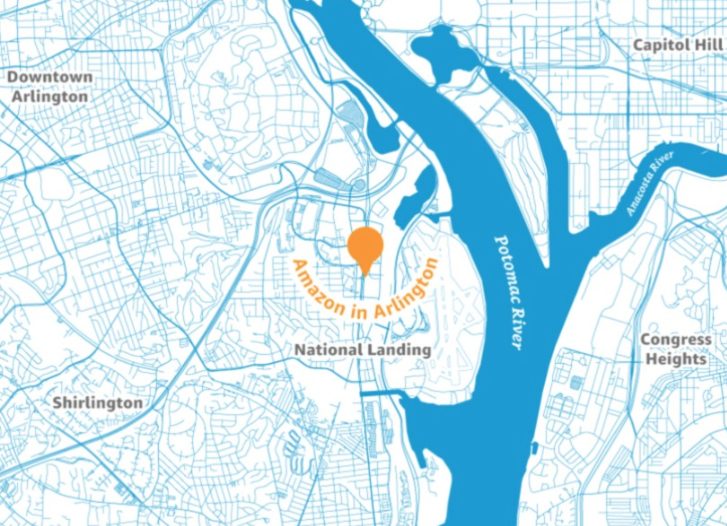

The following Letter to the Editor was submitted by Gary Shapiro, the president and CEO of the Consumer Technology Association (CTA), who writes in support of Amazon’s plans to open up a new headquarters in Crystal City and Pentagon City.

The Crystal City-based group lobbies on behalf of more than 2,200 consumer technology companies, Amazon included, and it has recently come out in strong support of the company’s vision for Arlington. Shapiro appeared at a recent forum of Amazon executives and regional leaders, and the CTA even organized a pro-Amazon demonstration at the event.

The County Board is set to consider an incentive package to formalize the company’s plans to move into Arlington next month.

When I first heard Amazon was considering coming to Arlington, I was thrilled – but not surprised. As head of the Arlington-based Consumer Technology Association (CTA), I can say with confidence there’s no better place for a major tech innovator such as Amazon than northern Virginia – and, for northern Virginians, there’s no better addition to the neighborhood than Amazon.

Working just across the Potomac from Washington, D.C. positions us to share our insights and input with federal leaders and other key influencers. Reagan National Airport is just minutes down the road, making travel a breeze. And top talent flows in and out of the region’s high-caliber universities, so we’re able to hire from the best of the best.

And those whom we do hire enjoy the benefits of living in this vibrant, connected area. Many commute via public transit, bicycle or even on foot. Arlington offers young employees exciting nightlife and cultural experiences, with some of the world’s top museums nearby. And parents can come to work with a free mind, confident their children are learning and growing in some of the nation’s premier public schools.

The choice was an obvious one for our company, and I’m glad it made sense to Amazon, too. But while I’m excited for Amazon, I’m keen to see the benefits the company’s arrival will bring to the area at large.

Amazon plans to invest $2.5 billion in Arlington for the new headquarters and create 25,000 jobs over the next 11 years. This will not only push the region to new heights of economic prosperity, but counterbalance the impact that 24,000 eliminated federal jobs has had on nearby Crystal City, Potomac Yard and Pentagon City since the early 2000s. And Amazon’s planned investment in the area spurred Virginia Tech’s announcement of an Innovation Campus in Potomac Yard, which will guarantee a top talent pipeline of STEM graduates for employers for years to come.

And Arlington County is proactively taking steps to minimize disruption to our streets, buses and Metro system. The county and the commonwealth have plans in place to expand transportation capabilities in the Arlington area. Five critical initiatives – updates to Route 1 in Crystal City, new entrances at the Crystal City and Alexandria Potomac Yard metros, additions to the Crystal City Potomac Yard Transitway and a new multimodal transportation system to National Airport – will be funded by the commonwealth.

Additionally, Arlington County has teamed up with Alexandria to propose $570 million in funding to make walking, biking, driving and traveling via public transit far smoother. Because of all the advance work to streamline traffic into Crystal City, locals should experience minimal disruption in their daily commutes.

This area is one of the most innovative and dynamic in the country. CTA’s Innovation Scorecard ranks states on the strength of their innovation economies, and Virginia has been named an “Innovation Champion” – the highest possible ranking – four consecutive times.

Virginia’s success stems from its embrace of new technologies and services, an emphasis on education, and high levels of entrepreneurial activity and tech jobs. The strengths that make Virginia great are the same strengths that make a game-changing global tech company like Amazon great.

And if those strengths are true of Virginia as a whole, they’re particularly true of northern Virginia. Each year at CES® – the world’s largest and most influential technology event –  northern Virginia tech companies make their mark, sharing their exciting new ideas on an international stage. The people who live here are forward-thinking, bold and creative – the kind of people who want to change the way the world thinks, works and lives, just as Amazon does.

Normally, the tech industry is an advocate for disruption. But when it comes to HQ2 and the innovation-rich neighborhood, I’m confident Amazon will fit right in.

ARLnow.com occasionally publishes thoughtful letters to the editor about issues of local interest. To submit a letter to the editor for consideration, please email it to [email protected]. Letters may be edited for content and brevity. 


Progressive Voice is a weekly opinion column. The view and opinions expressed are those of the author and do not necessarily reflect the views of ARLnow.com.

By Charles Head

Gerrymandering: an odd partisan game played by politicians. A quaint tradition of American electioneering played out in smoky back rooms, but of little consequence. Is that really true?

Well, not entirely. Gerrymandering is odd, and politicians do it, but it definitely isn’t of little consequence.

The following table gives results from the 2012 U.S. Congressional elections (shortly after the last round of redistricting, when the effects of gerrymandering can be seen clearly):

Gerrymandering caused these skewed results. However, the consequences don’t stop with simply changing election outcomes.

Gerrymandered districts can be reliably counted on to vote predominantly for one party instead of being competitive arenas where candidates need to listen to all constituents. The candidates aligned with the majority party feel little pressure to consider positions opposed by the party faithful, and are less likely to compromise when elected. This applies to all the districts in a gerrymandered state, not just the ones in which election results are flipped. The result is often uncontested elections with gridlock in Congress and state legislatures, and eternal political squabbling instead of effective bipartisan solutions.

Such ideological entrenchment is counterproductive to effective democracy. This, coupled with government shutdowns and Congress’ inability to make decisions on critical issues made a strong impression on me over the last 20 years or so, convincing me that I needed to do my part to fix the situation. I decided to join OneVirginia2021, a group committed to replacing gerrymandering with non-partisan redistricting.

How can we end gerrymandering? In most states, Congressional and state election districts are drawn by state legislatures. There’s an inherent conflict of interest in this approach because incumbents fudge the lines to get re-elected. To eliminate this conflict of interest, California, Arizona, Washington and other states have re-assigned the drawing of election districts to independent, non-partisan commissions.

OneVirginia2021 is trying to do the same thing in Virginia and drafted a proposed amendment to the Virginia state constitution to end gerrymandering. The following concepts were central to our proposal:

  • A non-partisan redistricting commission, independent of the state legislature.
  • Clear rules requiring fair, non-gerrymandered election districts.
  • A transparent process to enable the public to monitor the process.

The proposed amendment was not accepted by the legislature. Instead, a joint House-Senate conference committee negotiated an agreement that includes elements from competing Senate and House proposals.

This alternative includes a commission with membership equally divided between legislators and citizens from both parties, with a citizen serving as the chair. The process used to select citizen members of the commission, and the exclusion of unelected Congressional and General Assembly employees, is also intended to quell partisanship in drawing election maps.

While the compromise does not ban partisan gerrymandering outright, it does require a supermajority of commissioners for approval of election district maps, allows the General Assembly only up-and-down votes on the maps and excludes the governor from the approval process to avoid partisanship. The compromise also requires the redistricting process be transparent, so citizens can see what is being done and hold people accountable.

The legislature’s compromise was adopted on Feb. 23. Although the compromise doesn’t include everything that OneVirginia2021 asked for, I believe this version will empower citizen members of the proposed redistricting commission to prevent gerrymandering.

We still need to get this proposed constitutional amendment passed by the General Assembly a second time in 2020, and then get it accepted by the people of Virginia in the November 2020 election. We also need implementing legislation to fill in details and qualified, unbiased candidates to apply to be members of the Virginia redistricting commission. Finally, monitoring the work of the commission once it’s up and running is essential to ensure no one subverts its intended function. Democracy is worth the effort.

Charles Head is Co-Chair of the Arlington Local Action Group of OneVirginia2021. Readers can get more information about non-partisan redistricting and the Virginia General Assembly’s action on this issue at OneVirginia2021.


It may not be the snow we saw earlier this week, but the weather is looking a bit wet this weekend.

Forecasters expect a full day of rain Saturday, though most showers should clear out by Sunday.

So be sure to pack an umbrella if you’re heading out to the “Feel the Heritage” festival tomorrow or any of the other events around the county this weekend.

Or stay inside and catch up on our most popular stories of the past week:

  1. Residents of Ballston Apartments Feel Blindsided by Plans to Convert Building into Marymount Dorm
  2. New Curb Extension Blocks Off Right-Turn Lane in Ballston, Prompting Headaches for Drivers
  3. County Officials, Activists Say Amazon Executives Have Failed to Engage with Arlington Community
  4. Nauck Leaders to Mull Renaming Neighborhood, Pointing to Namesake’s Confederate Ties
  5. As Amazon Moves In, Crystal City Business Group Works to Expand to Pentagon City, Potomac Yard

Head down to the comment to discuss these stories, your weekend plans or anything else local. Have a great weekend!

Flickr pool photo via Tom Mockler


Peter’s Take is a weekly opinion column. The views and opinions expressed in this column are those of the author and do not necessarily reflect the views of ARLnow.com.

A year ago, my fellow ARLnow.com columnist, Mark Kelly, posted a column welcoming the legislative defeat of a bill sponsored by House Del. Patrick Hope (D-47th District). Hope’s bill would have granted the County Board the option to utilize a ranked-choice (or instant-runoff) voting system in County Board elections.

Ranked choice voting has been adopted in an increasing number of jurisdictions, including San Francisco, Oakland, Utah and Maine.

If you are one of the 16 percent of Arlington voters who backed Donald Trump for President in 2016, or one of the 15 percent who voted for Corey Stewart for the U.S. Senate in 2018, you probably wouldn’t like ranked-choice voting. But, if you were not one of those Arlington voters, you might welcome ranked-choice voting.

This year, Patrick Hope tried again, and state Sen. Adam Ebbin (D-30th District) introduced his own version of similar legislation that “would have allowed localities to adopt ranked-choice voting for boards of supervisors and city councils, starting in 2020.” Neither bill succeeded.

What is ranked-choice voting?

Voters in ranked-choice voting elections can rank the candidates in order of preference. If one candidate gets the majority, that candidate wins, just like our current system in state-sponsored elections. If one candidate doesn’t get the majority, losing candidates with the fewest votes are eliminated one by one, and ballots for losing candidates are redistributed to second and subsequent choices until one candidate is the top remaining choice of a majority.

Ranked-choice voting is better than our current alternative (winner-take-all voting)

The current electoral system in place in state-sponsored elections in Arlington is a winner-take-all (or first-past-the-post) system. The person with the most votes wins — even in a large, multi-candidate field in which most votes go to someone other than the winner.

Patrick Hope offered a very persuasive set of reasons last year in support of his bill, including:

  • decreased likelihood that fringe or extreme candidates would be elected
  • increased likelihood that a candidate would command greater respect from a broader group of the electorate
  • increased likelihood that the election campaign would be more positive and civil

Similar reasons have been given by the Arlington County Democratic Committee to support its choice of instant-runoff voting (IRV) for party-organized caucuses.

In last year’s column, Mark Kelly tried to refute Hope’s reasons. But, in a series of very extensive comments they posted to Kelly’s column, frequent ARLnow commenters dave schutz and dudeguy01 provided detailed reasons why they believed Arlington voters would be better off in both primary and general elections for County Board if those elections were conducted under ranked-choice voting. All their comments are worth reading, but here is a small sampling of some of what they had to say:

dudeguy01  Mark … says it will make it harder for Republicans or Independents to win, but the only explanation he gives is that Arlington leans heavily Democratic. He never explains why that obstacle is more severe under an instant runoff system… Instant runoff … may not result in MORE or LESS Dems winning, but I think it has a mighty good chance of resulting in BETTER Dems winning….

dave schutz [I]t is healthier for the polity over time if the system makes it easier for a variety of opinions to make it onto the Board….

dave schutz  I’m actually sort of a Mark Kelly fan, but I’m pretty clear he is wrong on several fronts, here. Start with [the] civility goal…I heard a LOT of disappointment with the tone and level in the Garvey-Gutshall contest, which was a first-past-the-post primary. The next Dem nomination, Klingler-Patil-Gutshall-Fallon [an ACDC caucus conducted under IRV] was far more emollient.

Conclusion

Ranked-choice voting is an option the Virginia legislature ought to give Arlington. If we get it, the Board ought to adopt it for County Board elections.

Academics have thought a lot about voting systems and concluded that none is perfect — but that ranked-choice does a lot better than first-past-the-post in the case of a candidate like Trump.

County Board is a good place to start. The Arlington Voter Registrar has advised that with relatively minor tweaks to its software, and an effective voter education program, we can implement ranked-choice voting.

Let’s encourage Del. Hope and Sen. Ebbin to re-introduce their bills in the 2020 legislative session.

Peter Rousselot previously served as Chair of the Fiscal Affairs Advisory Commission (FAAC) to the Arlington County Board and as Co-Chair of the Advisory Council on Instruction (ACI) to the Arlington School Board. He is also a former Chair of the Arlington County Democratic Committee (ACDC) and a former member of the Central Committee of the Democratic Party of Virginia (DPVA). He currently serves as a board member of the Together Virginia PAC-a political action committee dedicated to identifying, helping and advising Democratic candidates in rural Virginia.


The Right Note is a weekly opinion column. The views and opinions expressed in the column are those of the author and do not necessarily reflect the views of ARLnow.com.

Arlington County Manager Mark Schwartz is set to unveil his proposed budget over the next few days at a County Board work session and the regular monthly meeting.

According to a Schwartz email, his budget will include just $5 million in cuts to existing staff and programs. This is $30 million less than the worst-case scenario laid out over the the past few months.

The proposed cuts would impact approximately 20 existing county staff members, many of whom would have the opportunity to apply for other vacant, but funded, positions according to Schwartz. Of note, Schwartz is using around 10 unfilled positions to “cut” spending.

The dramatic turnaround can be attributed to two things. First, stronger than expected growth in anticipated real estate revenue from assessments. Second, a tax rate increase that almost certainly has been agreed to in principle by County Board members.

Based on our track record of collecting more revenues and spending less than projected, the budget gap has already been erased. The annual closeout process would more than cover the additional $5 million. In reality, we should already anticipate a surplus to be available to the Board this November and next.

The full budget proposal will give us our first look at all of the Manager’s recommendations on spending and on the expected tax rate increase on real estate as well. As part of the budget process, the Board will advertise other tax rates and fees this month.

There is no staff report posted yet on the recommendation for personal property taxes.

The agenda indicates there will be a proposed increase in our water and sewer rates. The agenda also features a series of proposed new and increased fees on site plans, use plans, construction-related inspections, and parks and recreation programs and services. The Board will also advertise the tax rate for our three Business Improvement Districts (BIDs). The BIDs will take approximately $8.2 million out of the general budget to be spent exclusively in Rosslyn, Ballston and Crystal City.

The agenda does feature exactly one proposed reduction, on garbage (solid waste) collection which could save you $10.16 per year. Don’t spend it all in one place.

Mark Kelly is a 19-year Arlington resident, former Arlington GOP Chairman and two-time Republican candidate for Arlington County Board.


Progressive Voice is a weekly opinion column. The views and opinions expressed in the column are those of the individual authors and do not necessarily reflect the views of their organizations or ARLnow.com.

By Sheila Fleischhacker

“I don’t have any friends.”

“My teachers don’t understand me.”

“The system is rigged so I won’t get in a good college and we can’t afford it.”

Unfortunately, many Arlington youth feel overly anxious or depressed, as they struggle to juggle friendships, academics, athletics and family in our fast-moving, high-expectations world. And, far too many struggle with difficulties like having enough food to eat, housing instability, discrimination of different types and other social concerns.

To address these issues, stakeholders, including Arlington Public Schools, Arlington County staff, and the Arlington Partnership for Children, Youth and Families (APCYF), are seeking innovative strategies to identify and support mental health issues facing our young people. But the scale of the problems, coupled with limited available resources, means that we need additional help. We are looking for volunteers to join the partnership in this journey.

Supporting our youth is not a job solely for mental health professionals. APCYF advocates for additional mental health school staff, educates the public on recognizing signs and symptoms of mental illness, and directs families to culturally relevant sources of support.

Arlington is similar to other parts of the country in terms of the prevalence of depression and the factors that may exacerbate its primary symptoms (sadness, irritability, crying and changes in appetite). Indeed, one out of three students in Arlington high schools reported feeling sad or hopeless for two or more consecutive weeks during the prior year, according to the findings from the 2017 Youth Risk Behavior Survey (YRBS). And, 6 percent of high school students reported that they attempted suicide during the same time period. Self-reported experiences of depression and thinking about suicide were higher for girls in middle and high school.

The survey highlighted disparities across racial groups, with Latino youth reporting a higher incidence of depression and attempted suicide, and LGBTQ+ youth reporting higher rates of depressive symptoms. Similar to national data, only 30 percent of Arlington youth reporting depressive symptoms said they received the help they needed; black and Asian students reported that they received little to no help. According to ACPYF member Dr. Alfiee M. Breland-Noble, a nationally recognized expert on adolescent depression, “Depression is a universal illness that does not discriminate, but one that has racial disparities in terms of who gets care.”

APS is a valuable partner for increasing access to mental health care and these investments have positive impacts on educational outcomes. Increasing student and staff awareness about mental illness is decreasing stigma and fostering stronger relationships among students, between students and staff, and between staff and mental health allies outside the school system. As one example, Arlington’s Behavioral Health Bureau now offers same-day access to family mental health services.

Emotional and psychological trauma resulting from a one-off event (e.g., date rape) or ongoing events such as child abuse and neglect can induce depressive symptoms. The physiological impacts are not something that many youth can “just get over.” APCYF advocates for improved coordination across the school, county, and other mental health allies. The aim is an approach that teaches all involved to recognize the signs and symptoms of trauma; integrates that knowledge into policies, procedures, and practices; and actively resists re-traumatization of our youth.

More than 900 APS staff have been trained in recognizing potential mental health concerns. Recently, APS introduced the “SOS Signs of Suicide” program for eighth and tenth graders to teach teens that depression is a treatable illness, equip them to respond to a friend with suicidal thoughts and provide depression screening for all eighth grade students.

APCYF is also working on prevention, including identifying best practices to build resilience among our youth to help them deal with difficult events that can change their lives. Please consider ways you can partner with us in furthering our research, engagement and advocacy. Learn more by attending our meetings and the Mental Health Roundtable Subcommittee meetings, whose work includes directing youth, families and communities to much needed resources.

Sheila Fleischhacker is the Chair of the Arlington Partnership for Children, Youth and Families. Dr. Fleischhacker is a nutrition scientist and public health lawyer with more than 15 years of experience working in academic, government and non-government sectors to strengthen the role of law and policy approaches to improve healthy eating, particularly among high risk, underserved communities. She is the mother of two children living in Alcova Heights. 


Enjoy this unseasonably warm weather while you can, as the holiday weekend looks set to feel a bit more like February.

Forecasters say a cold front will roll through tomorrow (Saturday), giving us the chance of seeing a bit of snow, or perhaps just rain. But the worst of that should fizzle out by tomorrow night, with a dry Sunday and Presidents Day on tap after that.

Check out our event calendar if you’re looking for ways to spend the long weekend. Or you can catch up on our most popular stories of the past week:

  1. Young Women in Arlington Boast the Highest Average Credit Score in the Country
  2. Arlington Resident Pleads Guilty to $20 Million Fraud
  3. Marymount Buys Ballston Apartment Building, Converting It to Housing for Students and Staff
  4. Amazon Cancels NYC HQ2 Plans, But Leaders Say ‘Nothing Has Changed’ for Arlington
  5. Police Responding to Bank Robbery on Columbia Pike

Head down to the comments to discuss these stories, your plans for the holiday weekend or anything else local. We’ll be publishing on a reduced schedule Monday, but we’ll back to normal on Tuesday. See you then!

Flickr pool photo via eschweik


Peter’s Take is a weekly opinion column. The views and opinions expressed in this column are those of the author and do not necessarily reflect the views of ARLnow.com.

Two stories posted on ARLnow.com last week underscore the urgent need for the County and School Boards to expedite long-range public facilities and fiscal planning.

The first story (“Never Let A Crisis Go To Waste”) quoted various activists and County Board members stressing the need to make Arlington housing more affordable by up-zoning in order to substantially increase housing supply. (Up-zoning = approving more dense development than permitted by current zoning.)

The second story (“New APS Enrollment Projections”) quoted various activists and School Board members about the need for a fourth comprehensive high school.

The most up-voted comment to the second story captured how the two stories are linked:

Gavrilo2014  Those advocating housing growth, whether “affordable” or otherwise, need to address the questions of school capacity.

First, the good news

The good news is that since the Community Facilities Study Group released its final report and recommendations in 2015, relentless pressure — primarily from citizen activists — has pushed the County and School Boards (often grudgingly) to work more closely together to integrate their forecasting methods and improve their ability to estimate future APS enrollment more accurately.

As I noted in a December 2018 column, the APS Facilities Advisory Committee (FAC) has prepared an excellent report on future school facilities needs. But that FAC report was prepared prior to publication of the latest APS enrollment projections.

Second, the questionable news

Particularly since the announcement that Amazon will be locating a new HQ in Crystal City, various County Board members and citizen activists have been sending strong signals that county government is planning to unveil a series of far reaching new proposals to up-zone major areas of Arlington. A Jan. 31 story (“Arlington Must Open Up Single-Family-Neighborhoods To Different Housing Options”) further described these suggestions.

Proponents of up-zoning believe that if we increase housing supply relative to demand substantially, then housing prices will be significantly lower than they would have been otherwise. This hypothesis is alluring but must be tested in the context of long-range cost-benefit analyses in Arlington to determine whether the hoped-for benefits justify the costs. Evidence elsewhere casts doubt on the hypothesis.

Nowhere in any of these recent stories is there any indication that county government officials are planning to accompany their major up-zoning proposals with quantitative estimates of the net long-range (15-year) fiscal impacts on county and APS budgets of their proposals.

Particularly unhelpful are remarks like those by APS Superintendent Patrick Murphy about the new enrollment projections: “take a breath, look at this one year, and see if these patterns begin to play themselves out over a long period of time.” As another commenter to the enrollment story noted:

LocalChatter it sure seems like Murphy’s statement is another way of saying “I don’t want to deal with this”

Murphy has been singing the same song for many years: this year might be an aberration, so let’s wait ’till next year. Murphy consistently has been proven wrong.

The community cannot afford to wait any longer. We are out of breath. The new APS enrollment projections forecast a net deficit of 2,400 elementary school seats by 2028. Those projections don’t yet take Amazon’s arrival into account. Where will those new elementary school seats be located? How much will they cost to fill? When will the two Boards provide the answers?

Conclusion

Up-zoning designed to increase affordable housing does not entail immediate taxpayer cash subsidies in the same way that AHIF contributions do. But major up-zoning does lead directly to major public infrastructure costs, such as the need to provide new seats for new students. While affordable housing is a worthy goal, it must take its seat at the budget table along with many other community priorities.

Even before Amazon showed up, Arlington had failed to develop a long-range (15-year) plan regarding:

  • where to locate the new public facilities (e.g., schools, parks, fire stations) Arlington will need to handle the development already authorized by current zoning
  • how Arlington will pay for those new public facilities

Amazon’s arrival heightens the imperative for the two Boards to create such a long-range strategic plan and discuss it with the community before approving any proposals for major new up-zoning.

Peter Rousselot previously served as Chair of the Fiscal Affairs Advisory Commission (FAAC) to the Arlington County Board and as Co-Chair of the Advisory Council on Instruction (ACI) to the Arlington School Board. He is also a former Chair of the Arlington County Democratic Committee (ACDC) and a former member of the Central Committee of the Democratic Party of Virginia (DPVA). He currently serves as a board member of the Together Virginia PAC-a political action committee dedicated to identifying, helping and advising Democratic candidates in rural Virginia.


The Right Note is a weekly opinion column. The views and opinions expressed in the column are those of the author and do not necessarily reflect the views of ARLnow.com.

The members of the Arlington School Board are beginning to ramp up the pressure to increase tax rates this year in order to gain more flexibility in the APS budget. While the County Board will almost certainly advertise a higher rate to give themselves options heading into the budget process, the School Board was not going to wait before getting on the record supporting it.

The fear is that the County Board will not raise the rate, or not enough in the School Board’s view, and instead ask everyone to tighten their belt a little. While the term “austerity” is being thrown around, our elected leaders’ use of austerity may not be the same as the average person would define it.

Like the County Board, the School Board continues to have leftover funds at the end of every fiscal year which they reprogram and spend as part of the closeout process. Children continue to receive computers and iPads free of charge. The student to teacher ratio has not been raised. Our per pupil spending remains the highest in the region despite the increased enrollment. And we continue to move forward with school construction.

It is hardly a situation which you could honestly describe as on the brink of austerity.

School Board Member Monique O’Grady likened the current situation between the School Board and County Board to asking your parents for money. They only have so much, she said, so they cannot give you everything you want.

So let’s extend the metaphor a little.

Imagine your child currently receives an allowance of $20 per week. Next year, you plan to give them $22 a week, but they want $25.  Holding them to $22 is not austerity, it’s just not as much prosperity as they would like.

To go even further, imagine your child receives the increase to $22, but the average child in the neighborhood who was receiving $18 will only receive a raise to $19. While your child did not get the raise they desired, they are even better off than the other kids. That is essentially how Arlington is faring versus our neighbors in the region. Our school funding remains strong year over year, and strong compared to other jurisdictions.

Arlington made strong school funding a priority. And despite the “austerity” talk from the School Board, no one will be asking them to make massive cuts now.

The School Board just may need to take a harder look at priorities and be willing to go to the public and say we can only do 98 percent of what we wanted to do next year.

Mark Kelly is a 19-year Arlington resident, former Arlington GOP Chairman and two-time Republican candidate for Arlington County Board.


Progressive Voice is a weekly opinion column. The views and opinions expressed in the column are those of the individual authors and do not necessarily reflect the views of their organizations or ARLnow.com.

By Paul Ferguson

“Ready For 100” is a commitment to use 100% renewable electricity by the year 2035. Localities making this commitment send a signal to the nation and world that the United States is still moving forward with emission reduction plans that will mitigate the effects of global warming.

The International Panel on Climate Change tells us unequivocally that we have much less time than we thought to avoid catastrophic climate change. We will see rising sea levels taking away property in coastal areas, increased flooding, difficulty growing crops, increasing chances of superstorms, disease relating to heat, loss of animals and plants affecting our ecosystem.

The result of this warming eventually could be a planet that is not hospitable to human life as we know it. If emissions around the world are reduced, these disastrous effects will be reduced. That is why Arlington should join other localities in taking action now.

When Arlington’s Community Energy Plan was passed in 2013, it set a transformational goal for greenhouse gas emissions within Arlington. Yet the plan was developed when solar photovoltaic was more expensive than fossil fuels and the future of electric vehicles was an unknown. The economics and technology are now very different.

While Arlington is well regarded for its environmental commitment, other localities have taken stronger actions. Montgomery County, Maryland is committed to achieve 100% clean, renewable electricity by 2035, and Washington, D.C. by 2032. Atlanta by 2035, and Columbia, South Carolina by 2036. In Virginia, Floyd County committed by 2035 and the Blacksburg City Council by 2050.

Five cities have already achieved 100% renewable energy on their power grid — Aspen, CO; Burlington, VT; Georgetown, TX; Greensburg, KS; and Rock Port, MO.

What Would It Take to Make the Change?

Making the transition would be hard work. I acknowledge the power Dominion Energy has in Virginia. Dominion has repeatedly hindered efforts to increase the percentage of renewable power used. However, with environmental awareness growing in the state legislature and among our citizens, it is time to press for change.

Localities can drive markets/costs down for renewable energy. The county and businesses can buy green power options through Dominion or the private sector. This pushes the market and, if enough join together, it makes a difference.

Some examples of actions Arlington could take:

  • Add solar incentives for residents and businesses
  • Partner with Arlington businesses investing in large offsite renewable projects providing clean energy to Arlington and surrounding areas
  • Commit to future government and private sector buildings being Net Zero Energy Buildings like Discovery Elementary School (cannot mandate for private sector but can encourage through site plan process)
  • Transition ART buses and school buses to electric power
  • Add additional electric charging stations throughout the county for residents.

Arlington would need funding for any new clean energy initiatives. In general, I agree that funds should not be dedicated from a tax for one issue. However back in 2007, the County Board instituted a Residential Utility Tax (RUT) to fund the Arlington Initiative to Rethink Energy (AIRE). This was specifically to encourage renewable energy use.

An up-to-$3 tax on electric and gas bills was designed to address problems caused by energy use. Arlingtonians who use 100 percent renewable energy through rooftop solar systems do not pay the tax. Those who use less energy pay only a portion of the tax on a sliding scale. Unfortunately, during the 2017 and 2018 budget considerations, the County Board allowed RUT revenues to be diverted for general fund items.

AIRE put us in good position to now participate in “Ready For 100.” And the residential utility tax (RUT) gave us a good tool to fund renewable energy projects.

When Arlington or other localities reduce greenhouse gas emissions, it doesn’t make things directly better for us. Climate change is a world problem. However, when hundreds of localities make Paris Accord-like commitments, this sends a signal that all the international efforts together are worth it.

I hope that the County Board will recognize the unique nature of the RUT revenue and reserve it for its intended use. I hope the County Board will adopt a commitment to use 100 percent renewable electricity by the year 2035 — and follow through with practical actions to bring it about. I know that a majority of County Board members believe in environmental stewardship. Please let them know that you are “Ready For 100”!

Paul Ferguson has served as the Clerk of the Circuit Court of Arlington and the City of Falls Church since 2008. He served as a Member of the County Board from 1996-2007.


View More Stories