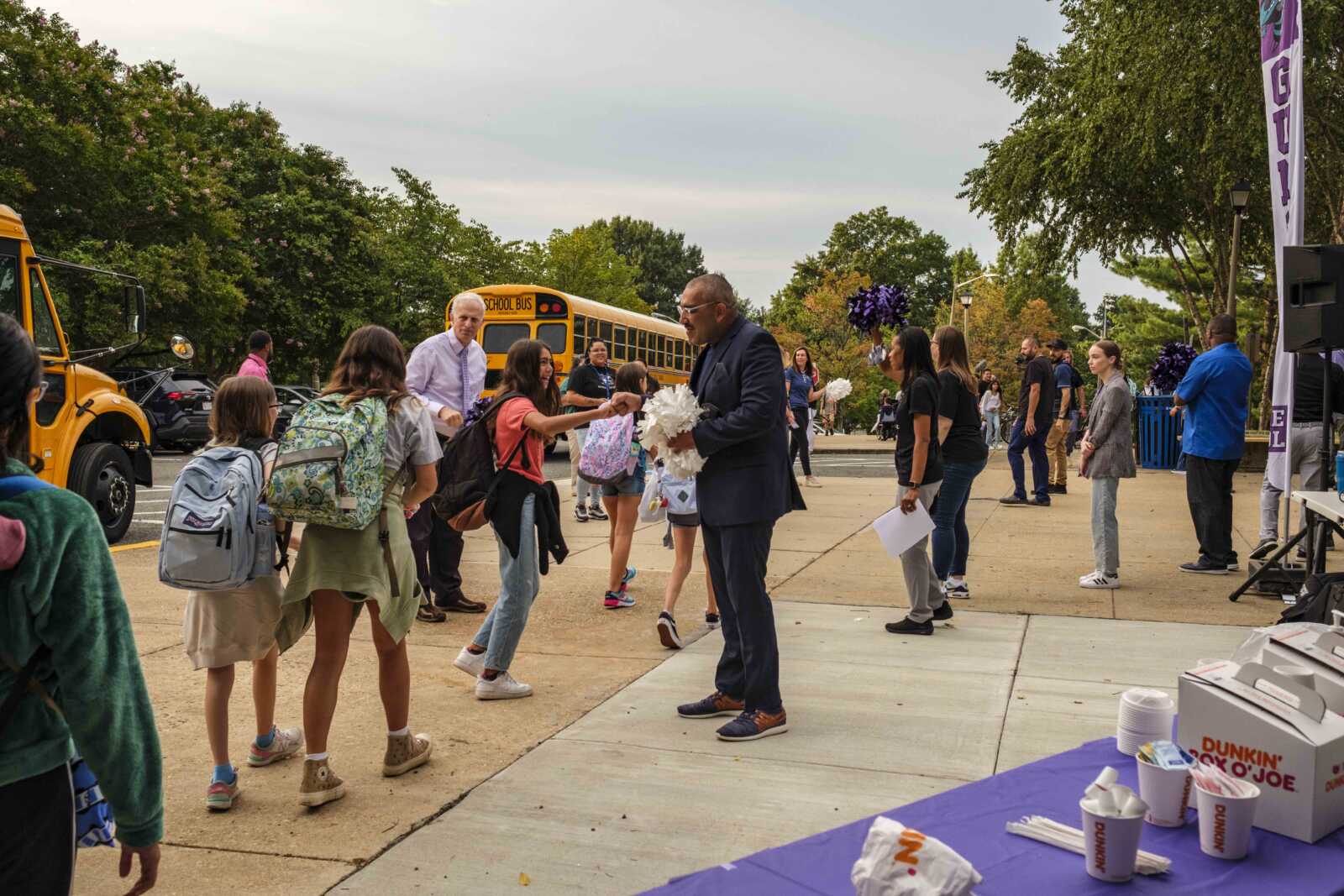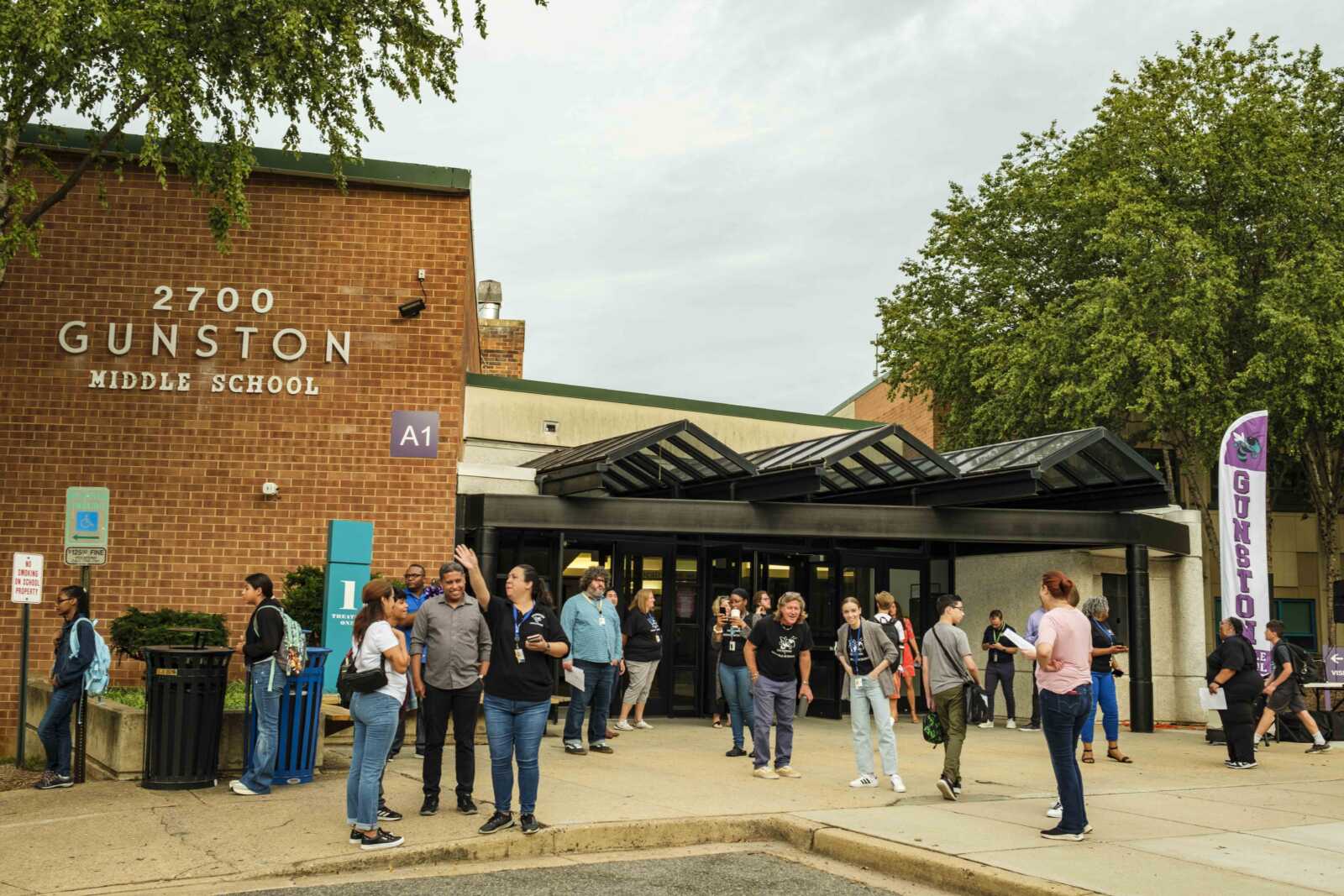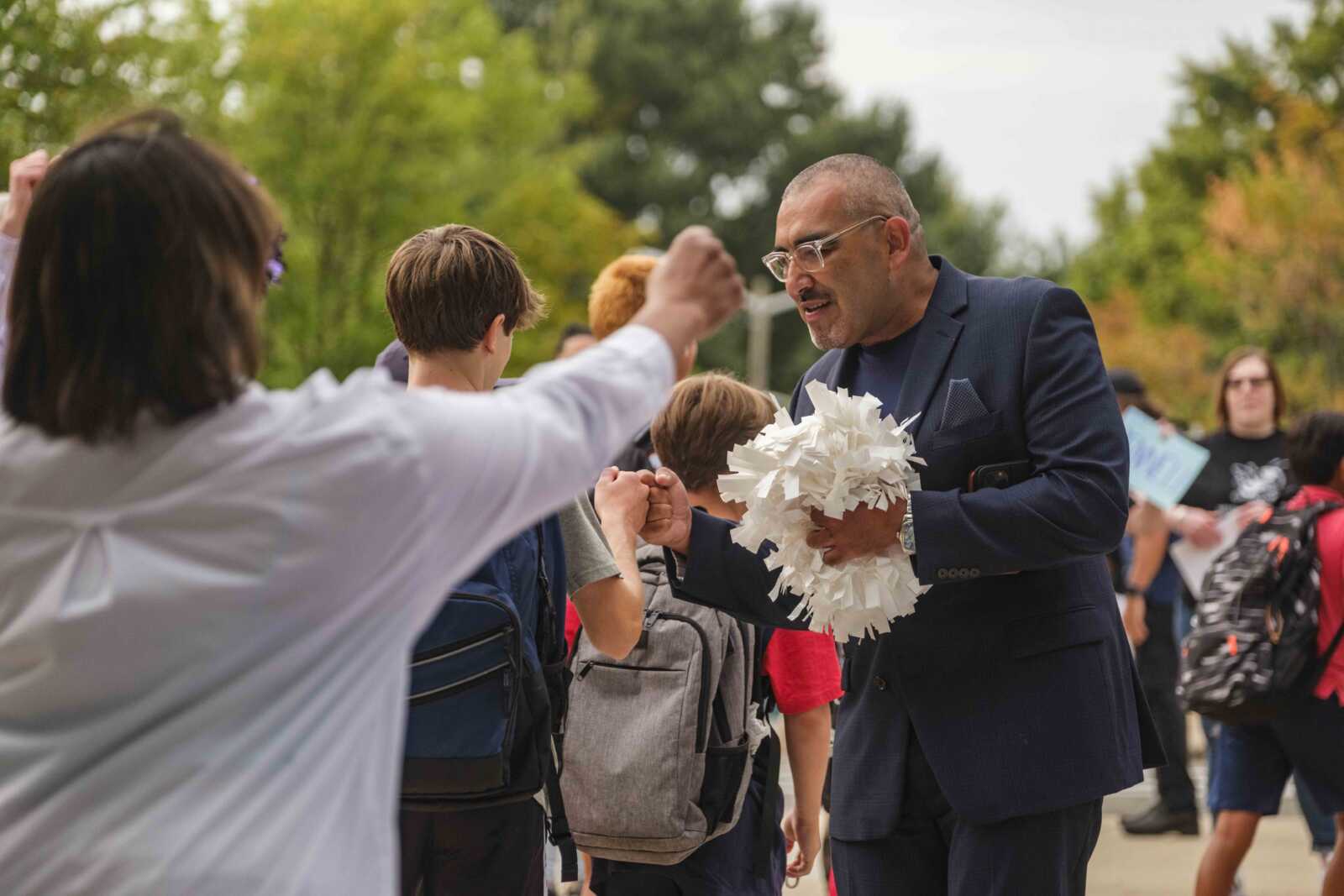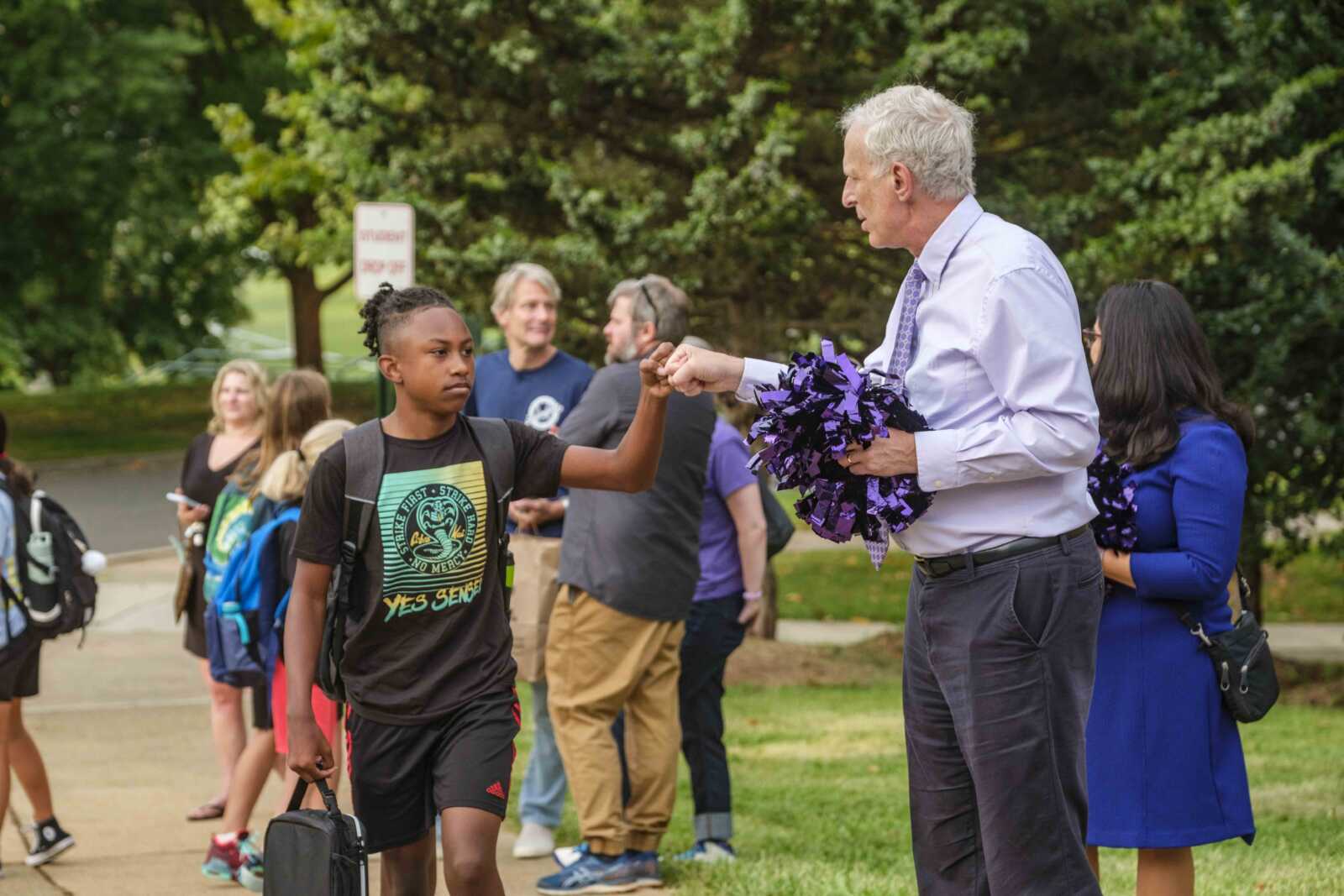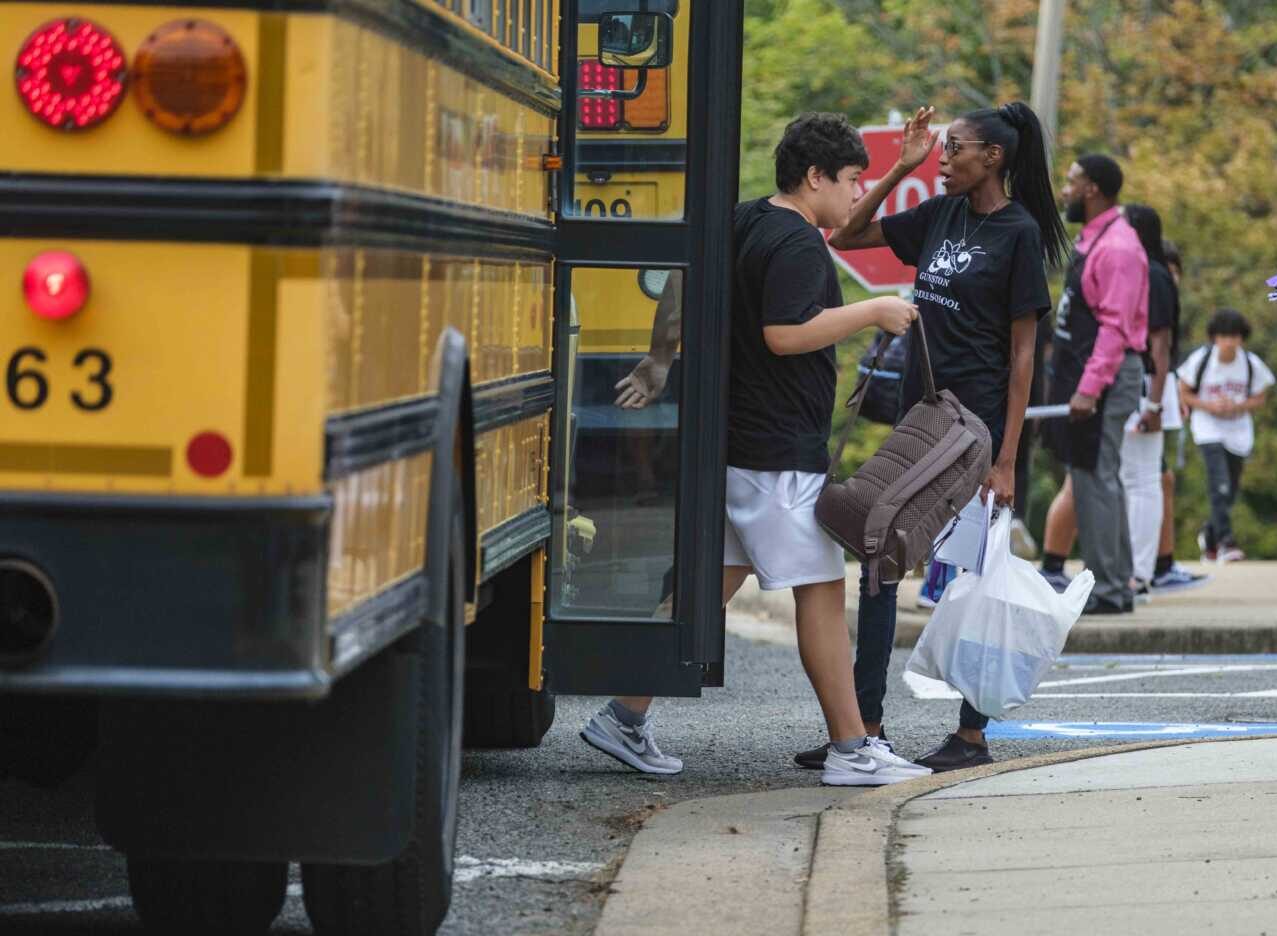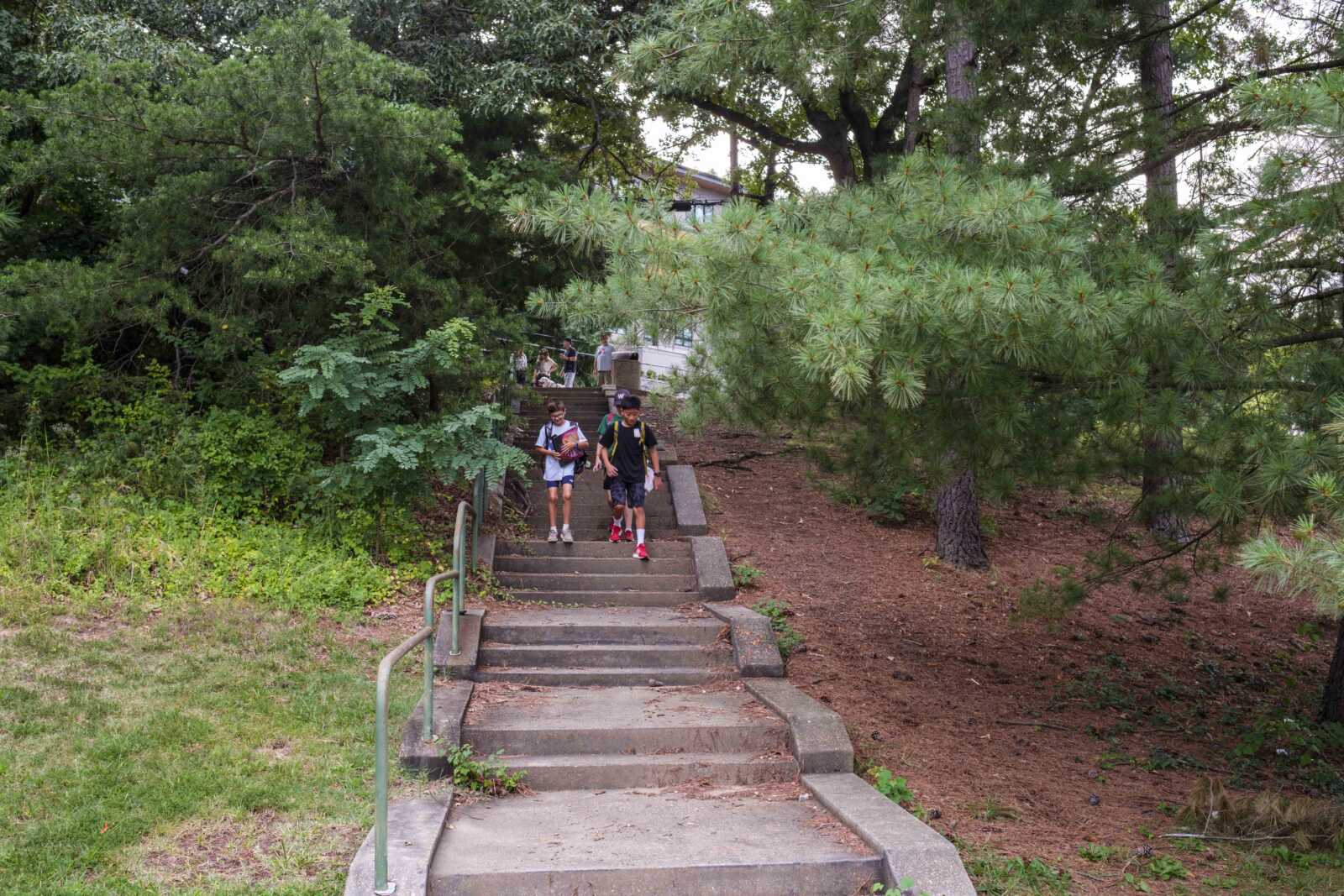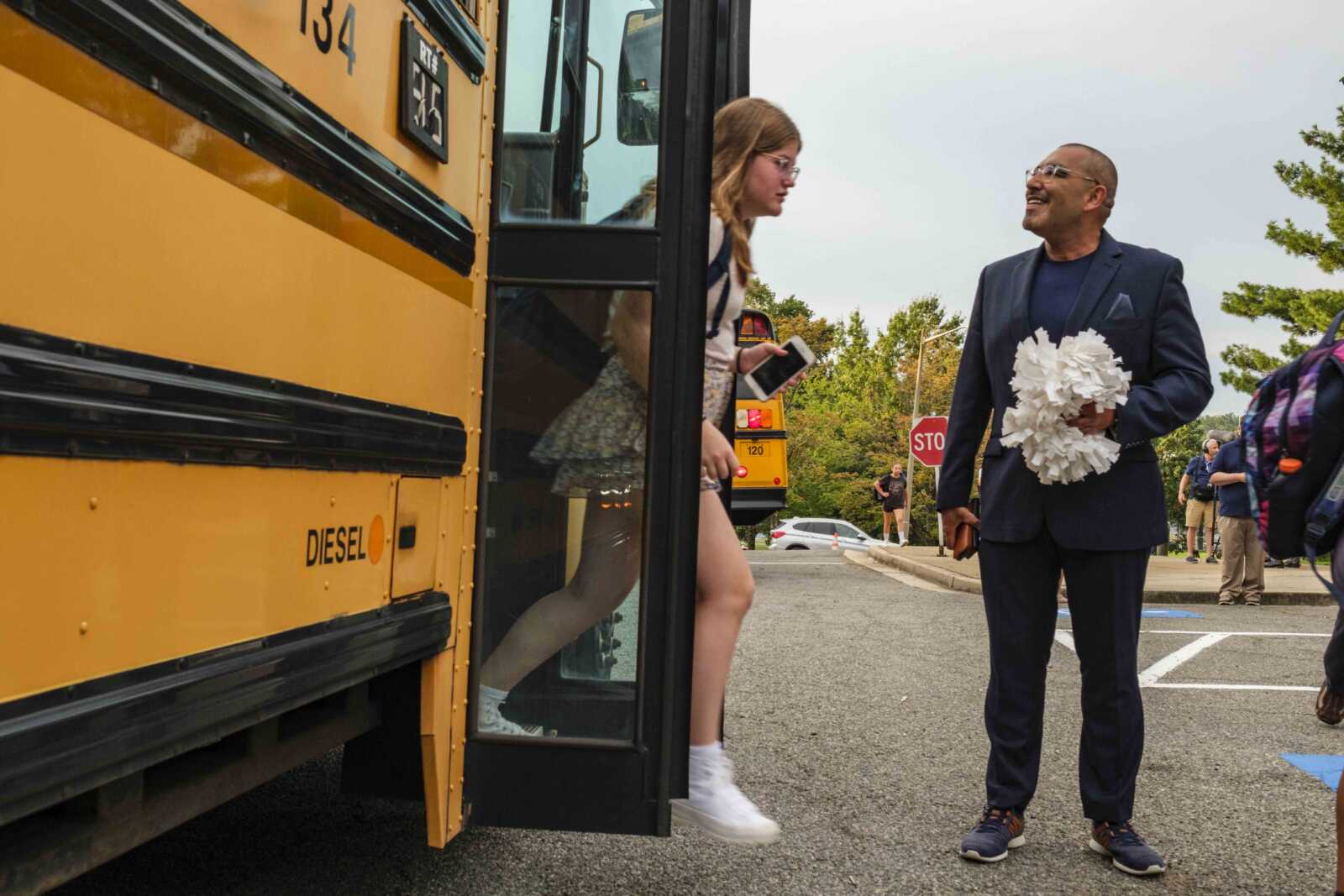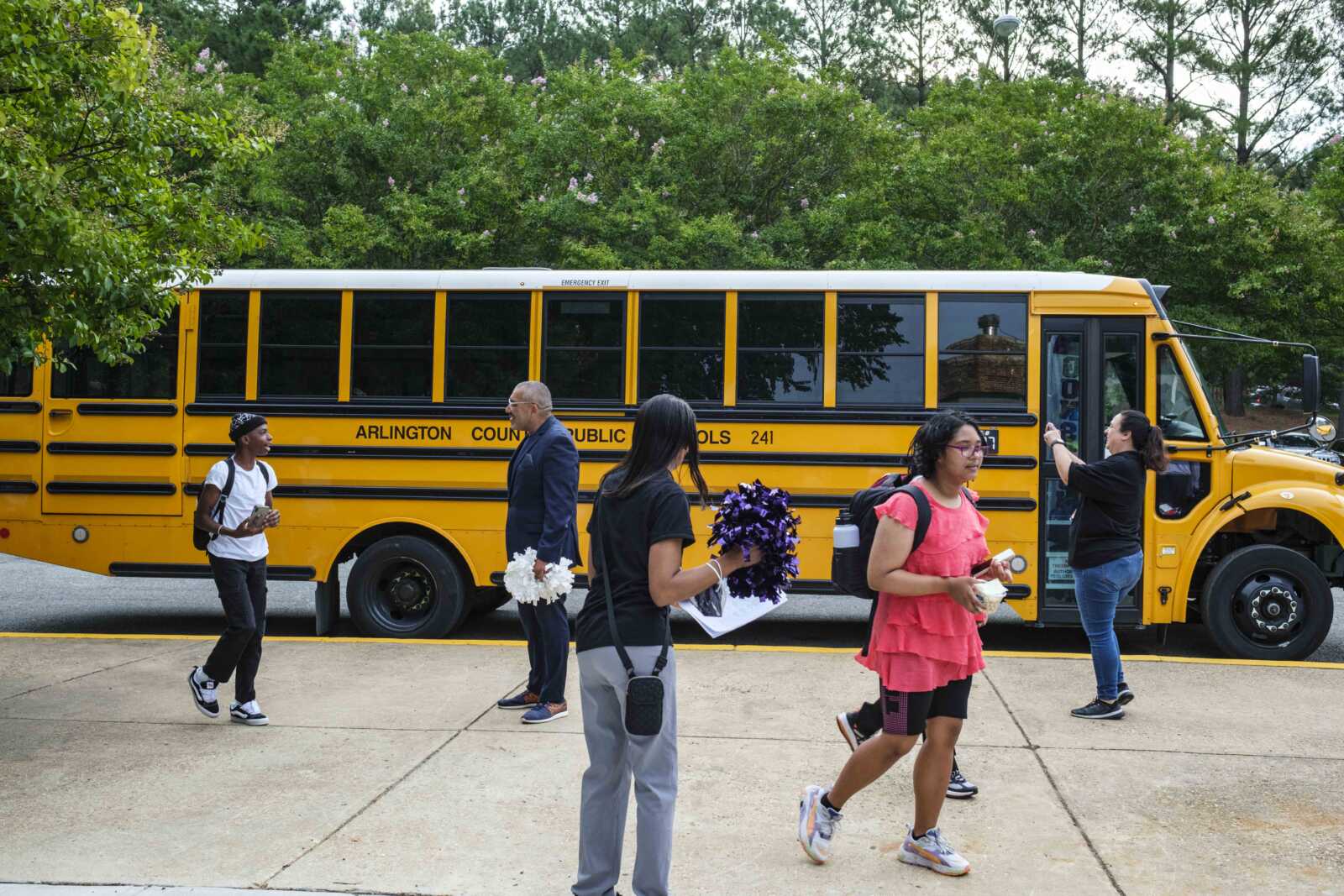
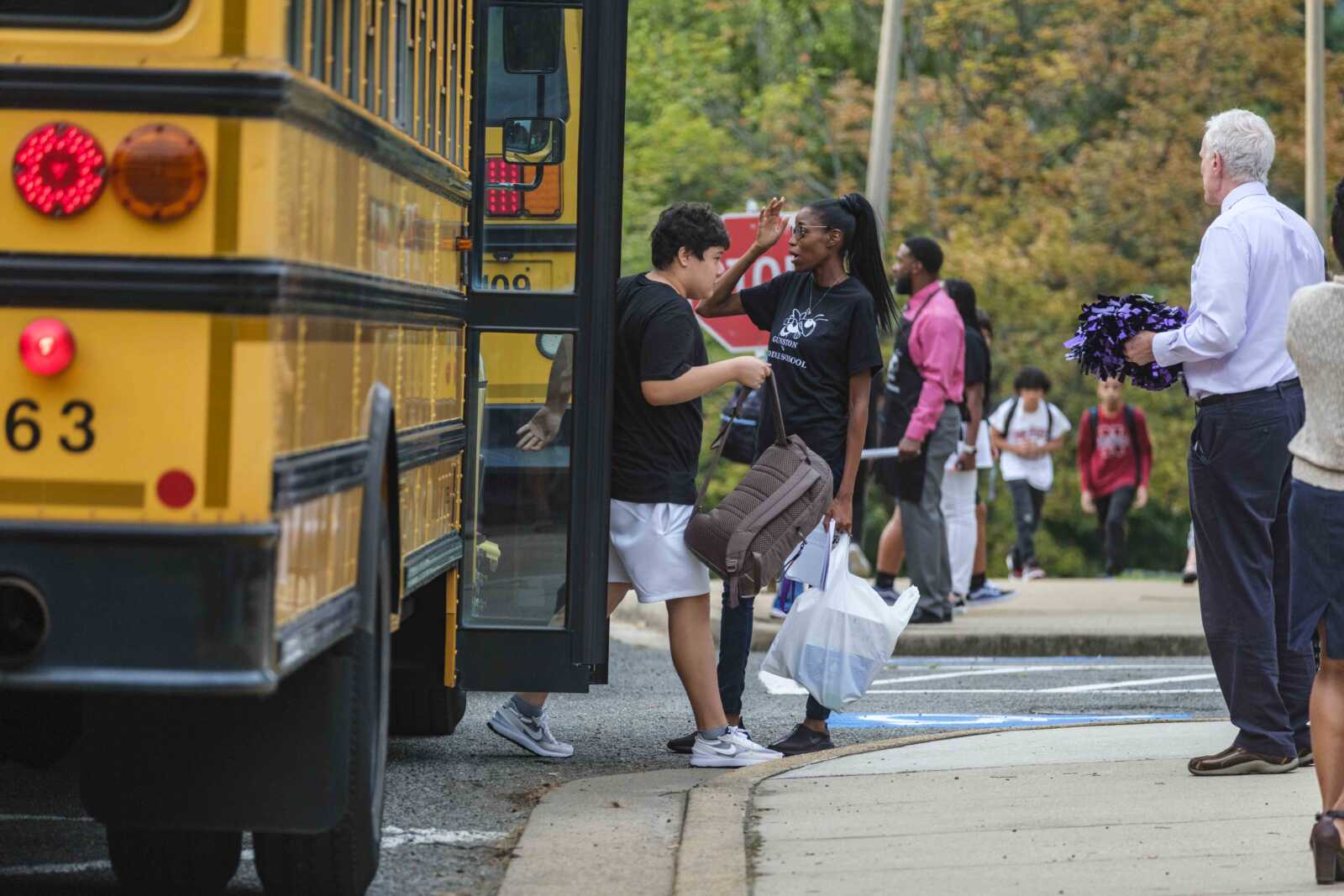
Students arrive to Gunston Middle School on the first day of school (staff photo by Jay Westcott)

Arlington Public Schools is kicking off the new school year with a bit of good news related to academic performance.

Last school year, students as a whole made gains in math, social studies and science, and in almost all areas, generally exceeded statewide scores, per new testing data.

Between the 2022 and 2023 school years, the percentage of students passing state tests increased by 4 points for math, 7 points for social studies and 1 point for science, according to a presentation to the School Board on Thursday. Reading remained flat and writing dropped 2 percentage points.

Black and Hispanic students, students with disabilities and those learning English, in particular, demonstrated progress. APS highlighted math pass rates that increased by 8 and 11 percentage points for Hispanic and English-language learning students, respectively.

Administrators says the data demonstrates that students are gaining ground after pandemic-era learning loss. It may also indicate long standing achievement gaps based on race, English proficiency, ability and socioeconomic status are narrowing.

Crediting teachers and new academic tools for that progress, Chief Academic Officer Dr. Gerald Mann, Jr. told the School Board on Thursday APS has its work cut out for them.

“We are seeing the work that our team is doing starting to pay dividends and recover some of the loss from the pandemic,” he said. “We’ve come a long way but we’ve got more work to do.”

Future focus areas include reading — where pass rates remained flat over last year, at 80% — and writing, which fell 2 percentage points.

Facing what one committee described a “literacy crisis,” APS overhauled how it teaches reading to elementary school students. Like other schools nationwide, APS is working to reverse years of reading instruction that critics say glossed over the basics, such as phonics, and disadvantaged students for whom reading did not come naturally.

That effort is starting to bear fruit, according to Superintendent Francisco Durán, who noted that this fall, some 91% of kindergarteners could meet benchmarks such as recognizing rhymes, words and letter sounds, up from 81% last year.

“[That] is building them up for bigger success later,” Durán said.

But this leaves a group of students, fifth grade and up, who were taught to read before these changes were made, and might still be struggling today. This year, APS is turning its attention to them.

“Our hope is that the work that we’re doing for secondary literacy this year also pays dividends in the future,” Mann said.

When School Board members asked about falling writing scores, Durán emphasized that the state test measures one type of writing: responding to a social studies or science text.

“We want students to be writers across all different types, and genres and ways,” he said. “I just want to make sure we all are aware of that because, I think long term, it could be misunderstood if we’re just speaking about writing, generically.”

Writing, more broadly, may still be a concern.

A 2019 survey of APS graduates found many graduates wished they had been better prepared for collegiate writing. School Board watchdog group Arlington Parents for Education, which recapped last week’s meeting, previously highlighted the survey, saying students were “practically begging for more… ‘writing assignments.’”

Even as the number of assigned essays increased, Mann said teachers already feel they cannot give adequate feedback on assignments.

“The biggest barrier that I’ve also heard is that ‘I just don’t have the time. I will assign it, but then I can’t give [them] appropriate feedback,'” he said.
(more…)


CCPTA President Claire Noakes speaks at the School Board meeting on Thursday, Sept. 7, 2023 (via Arlington Public Schools)

(Updated at 2:30 p.m.) The Arlington County Council of PTAs is criticizing plans to close Nottingham Elementary School and make it a “swing space” where students go when their school is being renovated.

In suggesting this change, the coalition of PTAs, or CCPTA, says Arlington Public Schools has not considered how little money it has in the next decade to spend on sorely needed renovations. It adds the move would disadvantage low-income, diverse neighborhoods that rely on schools for county and community-based services.

This spring, APS proposed closing Nottingham, in the Williamsburg neighborhood at 5900 Little Falls Road, and making it a swing space as early as 2026. It was part of a suite of proposed changes to solve for projected capacity imbalances: several schools below Langston Blvd are over-full while their counterparts north of the highway have many empty seats.

Nottingham was chosen because it would cost the least to retrofit — $5 million to expand its ability to receive buses — compared to other schools, county facilities or commercial buildings. APS also argued it would be more fiscally responsible to use the under-capacity buildings it currently has, rather than build a new school.

This proposal quickly rankled current and future Nottingham parents, some of whom argue APS made the decision on faulty projections of falling enrollment. The CCPTA joined their chorus during the School Board meeting last Thursday.

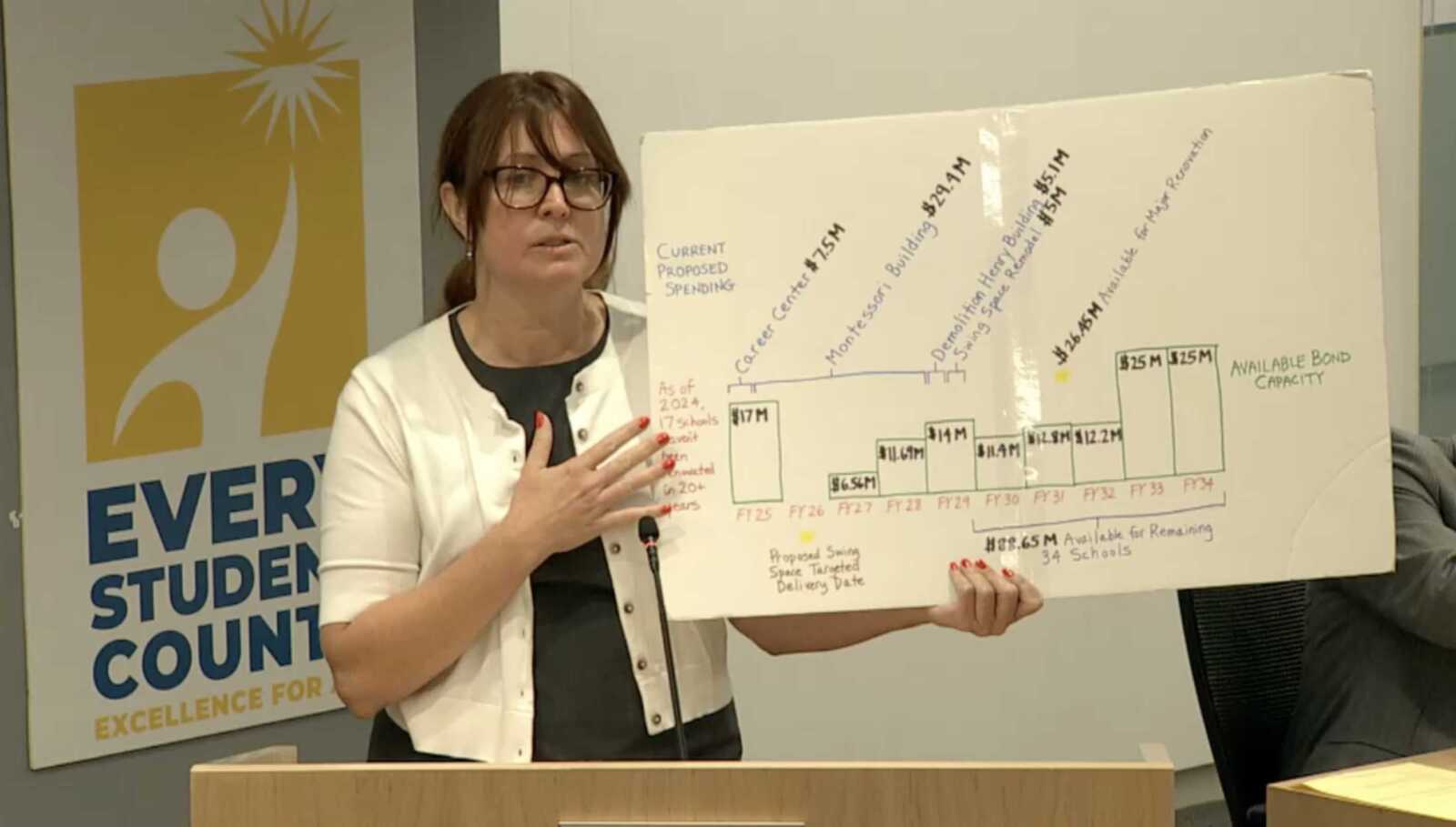
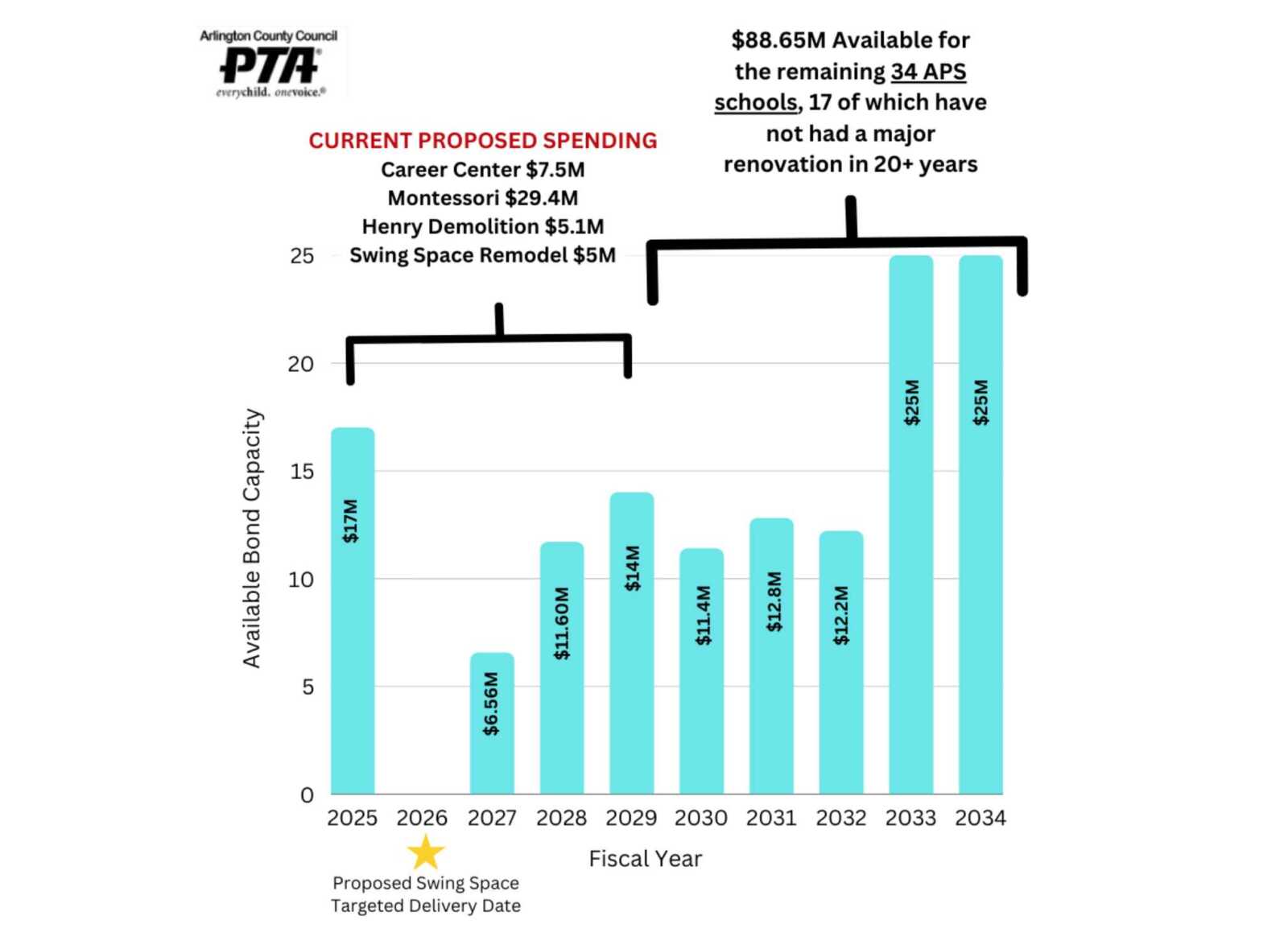
“Recent spending decisions and currently proposed spending projects have monopolized our bond issuance capacity until at least FY 2032, leaving insufficient funding for a major renovation,” CCPTA President Claire Noakes said in a statement released after the meeting.

She notes 17 of 37 school buildings have not had a major renovation in at least 20 years and are in need of upgrades, creating “a backlog of need.”

“The lack of available funds for a major renovation will cause the swing space to stay empty for six years, while other identified needs that could have been paid for with that $5 million will go unmet,” she continued.

The CCPTA illustrated its argument in a chart that shows how much money APS estimates it can issue in bonds for major renovations over the next decade.

It estimates a major renovation would exceed $25 million, based on estimates for one such project down the pike. The CCPTA say that APS would have to accumulate a few years of bond capacity, from Arlington County, to embark on a major renovation.

This squeeze is due to projects APS already has in the queue, including the new, forthcoming $180 million Arlington Career Center building and related plans to retrofit the current Career Center for the Montessori program now housed in the former Patrick Henry Elementary School. This building is set to be demolished and turned into a green space.

(Note: The chart below lists $7.5 million for the Career Center because this was tacked onto the project’s costs after APS approved the project via the previous Capital Improvement Plan.)

A chart from the CCPTA arguing APS will deliver a “swing space” at Nottingham at least six years before having the money to start a major renovation project (via CCPTA)

(more…)


It has been 10 years since Arlington County last put up speed humps to reduce speeding.

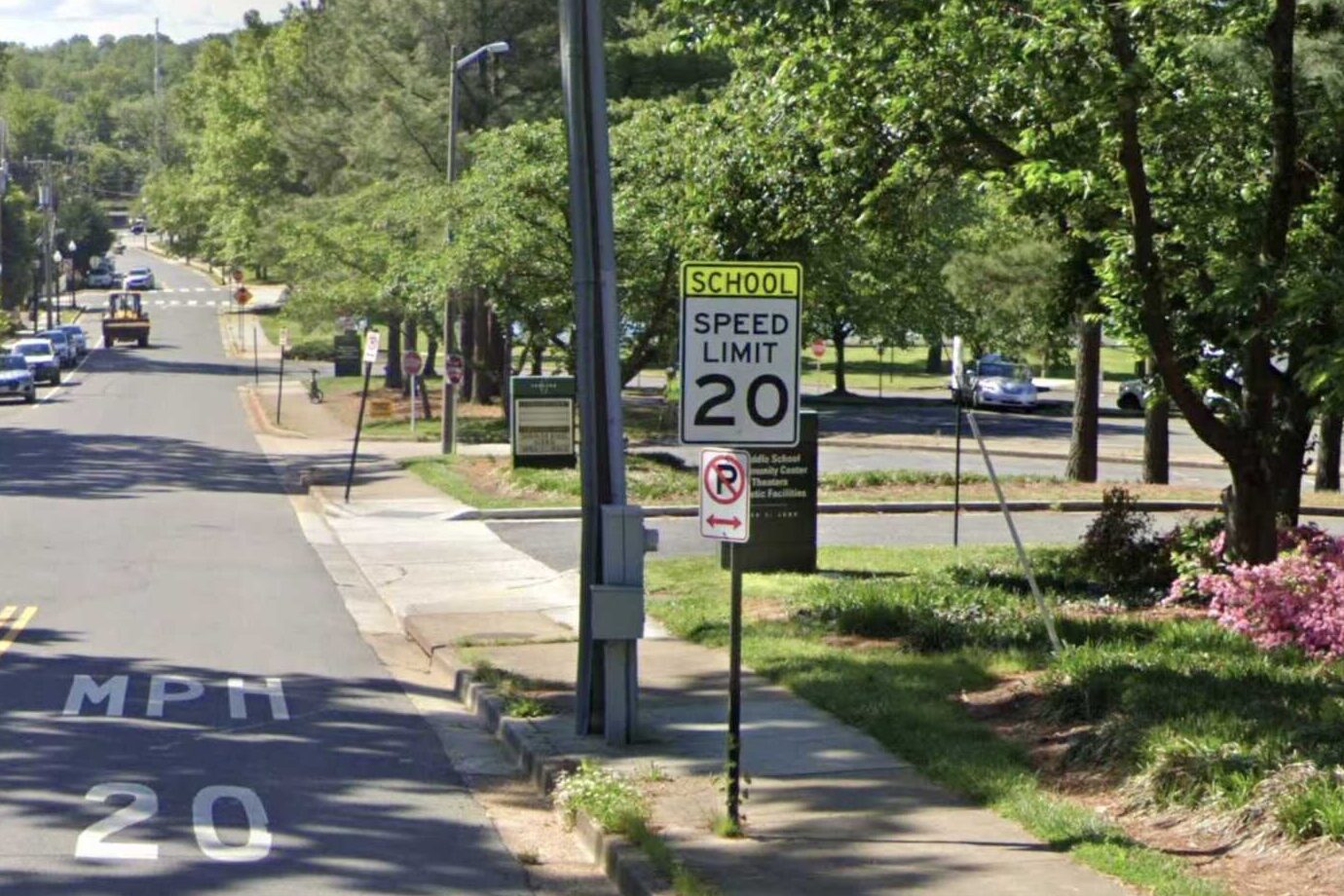
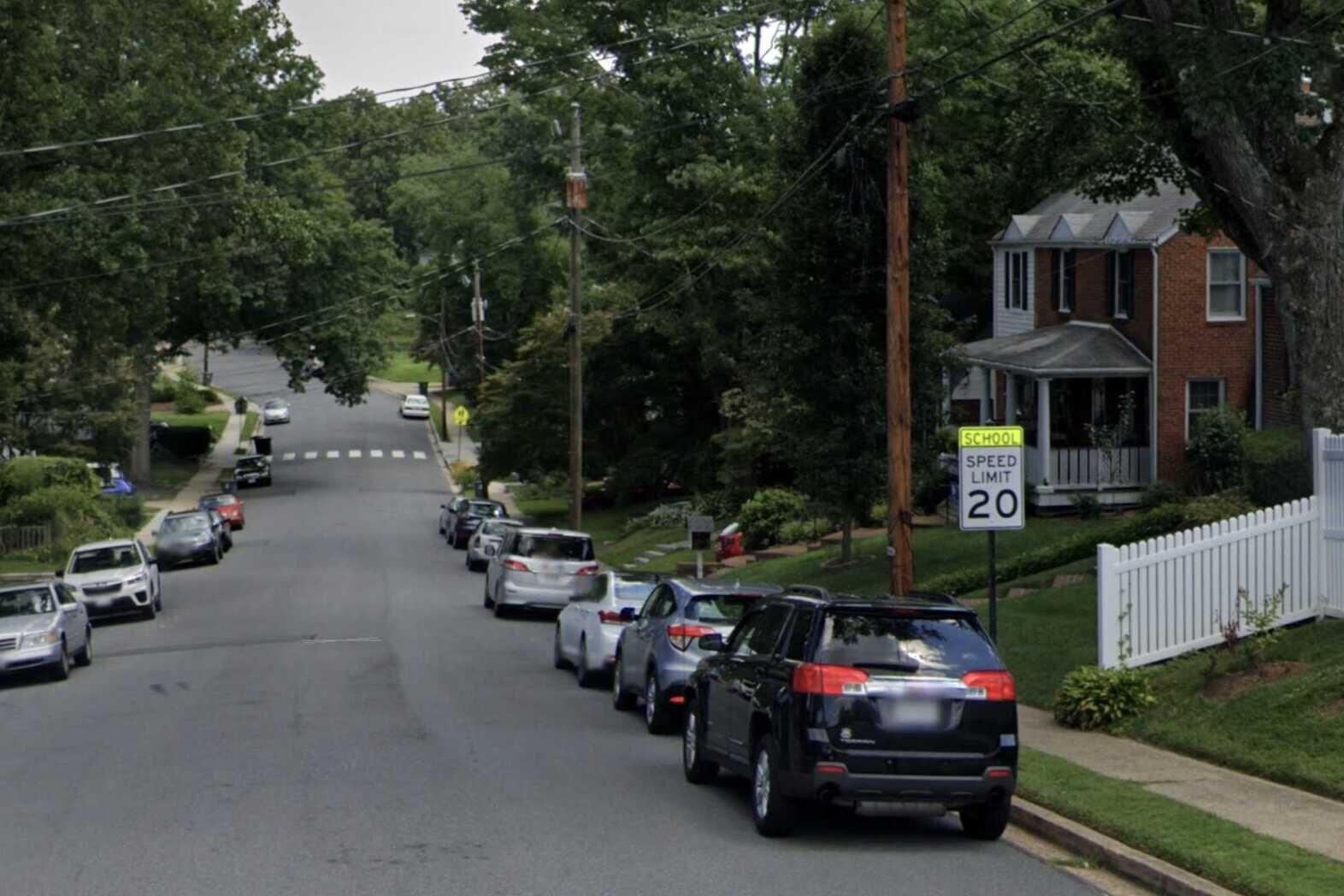
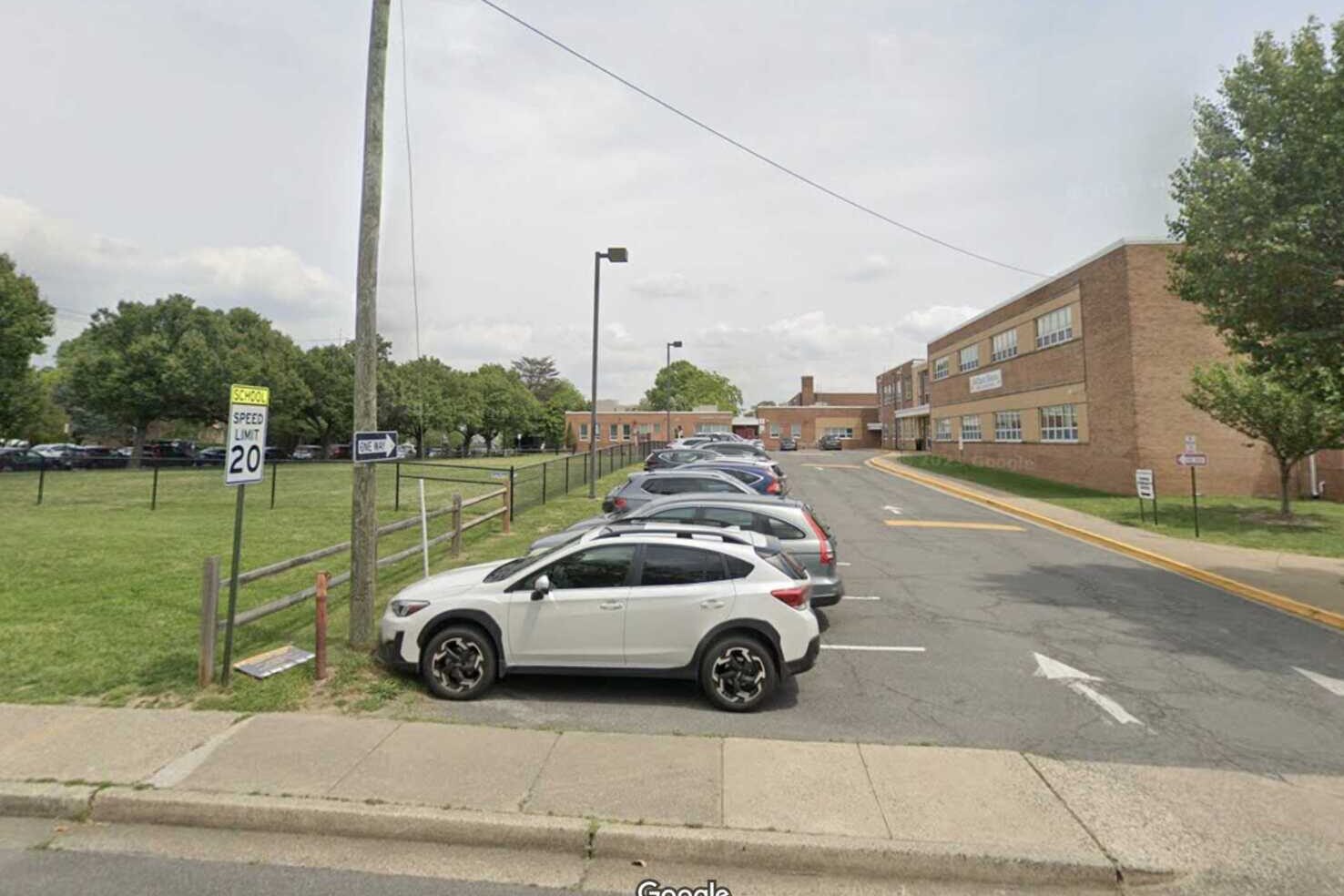
Now, they will be coming to streets around a trio of schools where lowering speeds to 20 mph has not stopped drivers from going well past the speed limit.

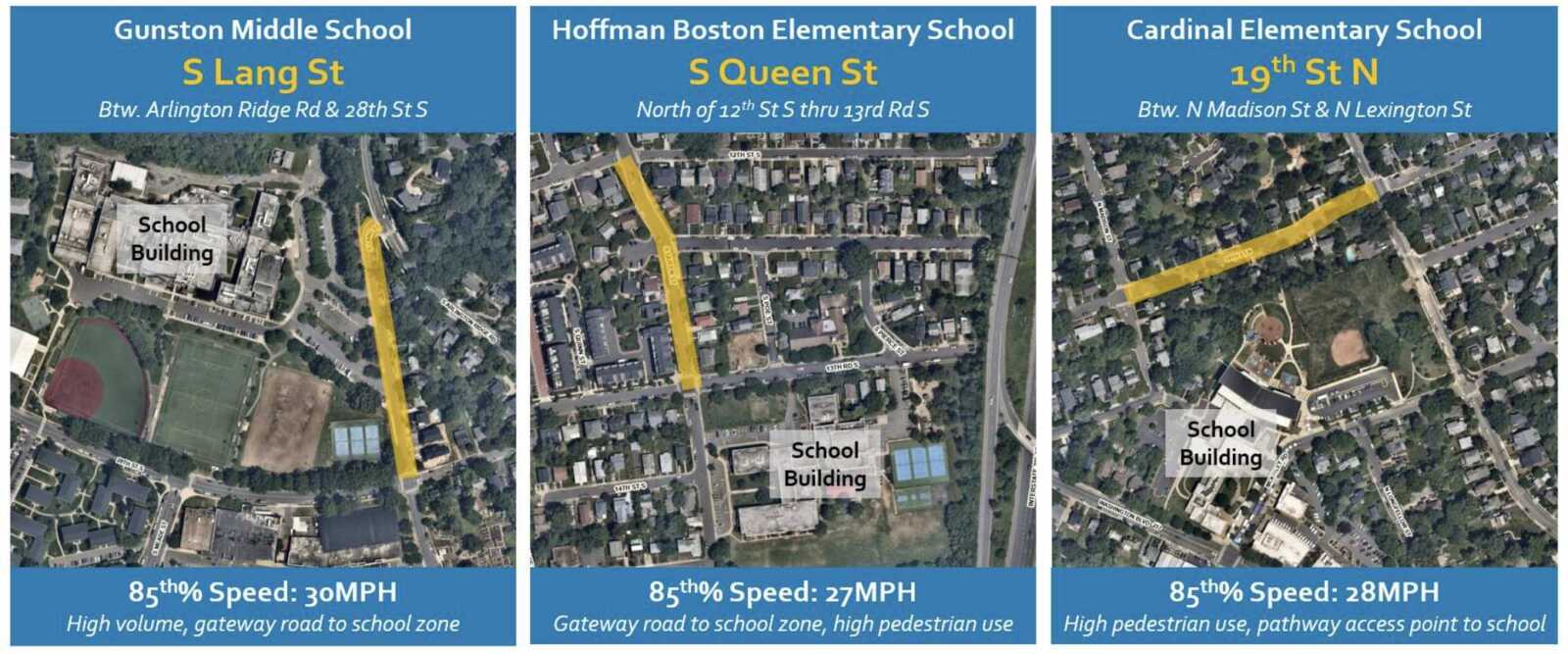
The humps will be installed this fall near Gunston Middle School and Cardinal and Hoffman-Boston elementary schools. The county will be piloting the humps as part of Vision Zero, the county’s resolution to eliminate traffic deaths and serious injuries by 2030.

“This initiative reintroduces speed humps through a limited pilot focused on reducing speeds in school slow zones where data shows the introduction of 20 mph speed limits has not lowered speeds,” says Dept. of Environmental Services spokeswoman Katie O’Brien.

Arlington County permanently dropped speeds on neighborhood streets within 600 feet of certain school access points to 20 mph. A vehicle going 20 mph has a much lower probability of seriously injuring or killing a pedestrian compared to one going 30 mph, according to government research and an investigative report.

Since the Arlington County Board approved the lower speed limits, signage alerting drivers to the changes has rolled out incrementally: 13 schools in 2022, 14 schools this year, and the remaining 19 school zones set for 2024.

At some of the 13 schools that have had lower speeds for a year, staff noticed the changes did not see slower speeds. They picked the three schools with the highest speeds for the pilot speed humps, O’Brien said.

Drivers can expect to see the humps pop up this fall on S. Lang Street, S. Queen Street and 19th Street N.

Where speed humps are coming to roads by three schools in Arlington (via Arlington County)

“The installation of a speed hump will likely take less than a day,” O’Brien said. “The pilot will use tactical speed humps because they are easy to both install and remove quickly, if needed. They are cost effective, tested for durability, and made from 100% recycled material.”

Staff will monitor the locations and collect data through the winter. O’Brien said they can easily remove them if new safety issues or concerns with the materials arise.

Next spring, there will be public engagement opportunities for people to share their thoughts on the addition of speed humps. Next summer, the county will identify next steps. That could include adding more speed hump sites in other school slow zones.

Speed humps were last installed through a Neighborhood Traffic Calming program, which ended in 2013.

Three years later, the County Board launched a new initiative to update roads: the Neighborhood Complete Streets program. When the program was adopted, “the Board included a moratorium on vertical traffic calming measures for three years,” O’Brien said.

Since then, DES has made use of other tools to manage speed and reduce accidents: speed feedback indicator signs, pavement markings, curb bump-outs, high visibility markings and protected bike lanes, among others.


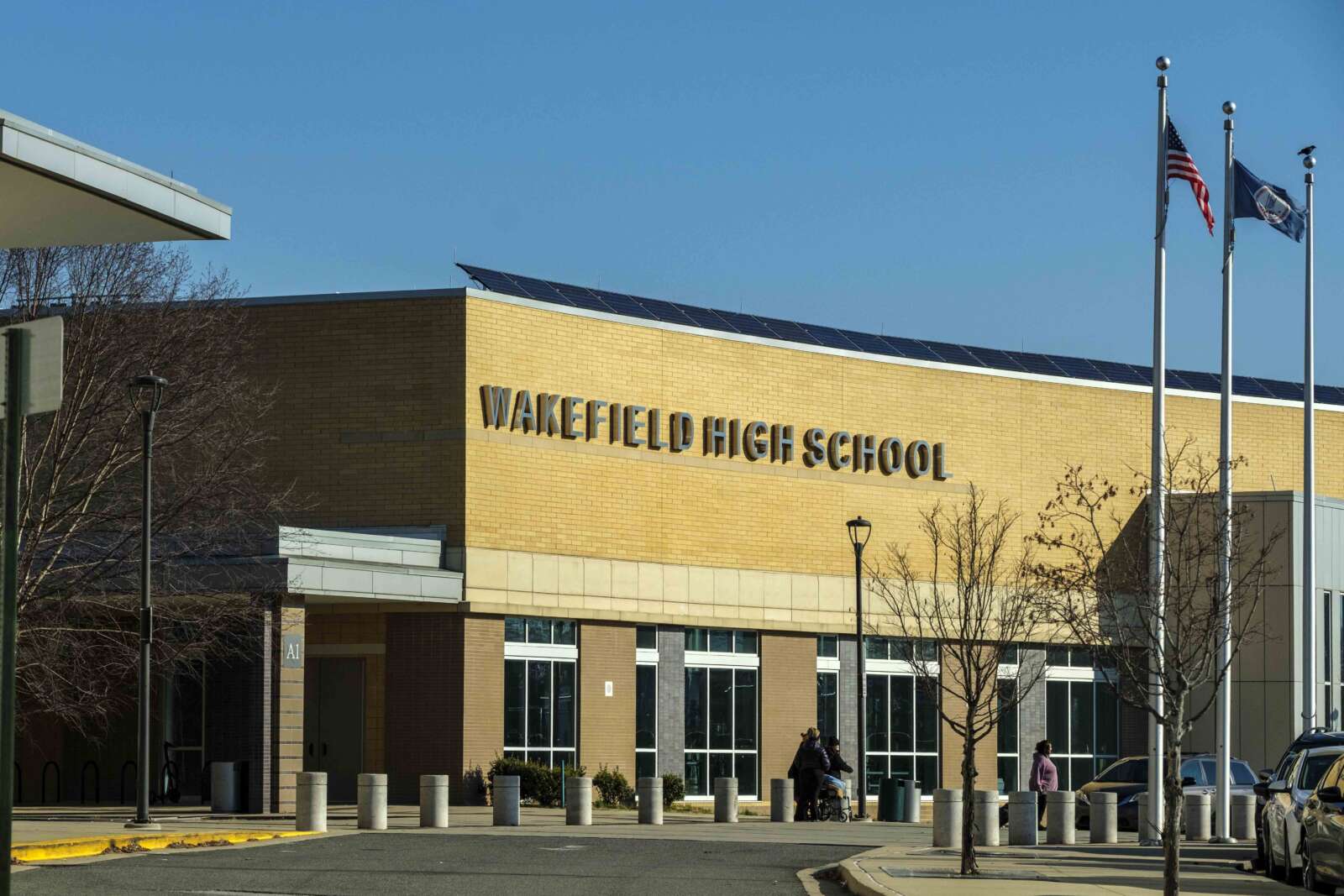
Wakefield High School (staff photo by Jay Westcott)

(Updated at 4:30 p.m.) Three days into the school year, Wakefield High School has logged a potential student overdose.

Medics were dispatched to the school at 11:30 a.m. and again about 45 minutes later for two students suffering possible drug overdoses — or, at least, the effects of suspected narcotics — according to scanner traffic.

Later this afternoon, ACPD spokeswoman Ashley Savage told ARLnow that a “juvenile male was transported to an area hospital in non-life threatening condition.”

Police also responded to the school to investigate and are looking into the incident “as an apparent overdose and the investigation,” she said.

In an email, Wakefield Principal Pete Balas assured families that students were safe during the ordeal, which he described as a “medical incident” involving a student.

The full email is as follows:

Dear Families,

Emergency personnel responded to Wakefield this morning to assist with a medical incident involving a student. Fortunately, everyone is safe, and they were able to work with our staff to address the situation. At no point was the safety of any students or staff compromised.

As some of our students observed the first responders in our building, I wanted to ensure you are aware that the incident was resolved, and everyone is safe.

Sincerely,
Pete Balas,
Principal

A student died earlier this year at Wakefield from an overdose, followed by more dispatches for substance-abuse related emergencies at the school and near Washington-Liberty High School.

The student’s death, followed by a parent march and outcry for more support from teachers, prompted the Arlington School Board and administrators to act.

The school system allowed students to bring the opioid-reversal drug Narcan to school and budgeted for new deans and more substance-abuse counselors. These and other measures are part of a system-wide focus on increasing student well-being, particularly at the secondary level, this year.

Wakefield’s former principal, Chris Willmore, was promoted this spring to be the director of secondary education for Arlington Public Schools. One month later, Balas, who previously led Alexandria City High School, emerged as his replacement.


Catholic students at St. Thomas More Cathedral School in Arlington (courtesy the Diocese of Arlington)

Arlington’s private schools say they are still riding a wave of enrollment increases that started early in the pandemic.

More than three years ago now, Covid lockdowns shut down schools, which reverted to distance learning. That fall, however, local private schools affiliated with a church or the Catholic Diocese of Arlington reopened their doors while Arlington Public Schools continued with virtual learning for most students for the better part of the 2020-21 school year.

While some APS families relied on virtual learning, even after the shutdowns, other parents urged for a faster return to in-person learning. Some in this camp enrolled their children in local private schools, confirmed by their rising figures and a steep drop among some public elementary schools, particularly in North Arlington.

Three years later, growth continues at some of these schools, albeit at a slower pace, with high retention rates among those who transferred during Covid.

“We’ve been holding pretty steady,” says Lori Bodling, the office administrator for Our Savior Lutheran Church and School in Barcroft. “We’ve kept most of the families — a few moved out or went back to public schools, but the majority who came to us during Covid times have stayed.”

This is not, however, the only enrollment story and families who made the switch due to Covid considerations do not wholly explain the changes. As the long-term effects of the pandemic on education reveal themselves, one school leader says a small — but growing — group of students with anxiety, school avoidance and academic struggles are opting for non-public options in Arlington.

APS, meanwhile, projects to recover from the Covid slump and continue seeing a steady growth in enrollment that began in 2006. It is preparing, however, for downward pressure on enrollment starting in 2025, due, in part, to falling birth rates.

Rising enrollment in private schools

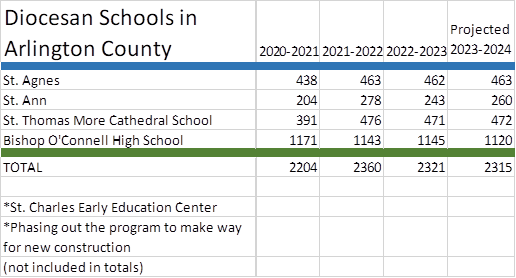
Both Our Savior Lutheran School and Arlington’s Catholic schools saw enrollment suddenly jump in the early years of Covid that has since slowed down.

Our Savior jumped more than 26% since 2020, while St. Ann and St. Thomas More Cathedral School, which both run from preschool through eighth grade, increased 27% and 21%, respectively.

“The uptick you saw at St. Thomas More Cathedral School and St. Ann [was] more pandemic-related,” says Renee Quiros White, the Assistant Superintendent of Catholic Identity, Enrollment & Marketing for the diocese. “In other words, they had the space to accommodate additional students.”

White adds that retention percentages have remained high, at 88% for both 2021 and 2022, suggesting families who changed schools have mostly stayed on.

Two remaining Catholic schools did not have these growth spurts. St. Agnes, another school for preschool through eighth grade, increased 6% at the start of the pandemic and has since remained steady while enrollment Bishop O’Connell High School has been in decline since 2020. Both were considered “full” prior to the pandemic, says White, noting “you wouldn’t necessarily see a big increase” as a result.

White says the growth in Arlington tracks with the predicted population growth tracked by the U.S. Census and population estimates from the University of Virginia. The diocese is seeing a third straight year of overall enrollment increases, with an average increase of 10% since 2020.

“Enrollment numbers can vary from year to year, due to a number of factors,” she wrote. “Regardless of the reason(s), we are very pleased that so many families have sought a Catholic education for their children and have become part of our communities.”

New needs among students

Meanwhile, a private school recognized as non-traditional option for middle- and high-school-aged students is also reporting an enrollment uptick.

(more…)


(Updated at 4:15 p.m) Arlington Public Schools students headed back to school today and the positive energy, according to Superintendent Francisco Durán, was palpable.

“It was so wonderful,” he told ARLnow on a phone call this afternoon, debriefing from his morning spent visiting the half-dozen schools with new principals, including Gunston Middle School. “People are excited to be back.”

Going into this year, Durán says APS has its work cut out for it.

The system spent two years focused on improving literacy among kindergarten through second-graders, and is starting to see more students who are proficient the basics of reading. Now, the system is developing an all-hands-on-deck approach to another area of concern: middle and high school students who cannot read or write on grade level, either.

“We haven’t done a systemwide approach to secondary literacy,” he said. “How do we shift and go intensely, and in a strategic way, to supporting… those who are really struggling?”
Already, APS has identified struggling readers who he says could benefit from a new reading curriculum and the extra attention. The school system also is looking into ways to assess and identify struggling students better. Families can expect more information coming online about this shift in the coming months.

Likewise, the school system says a big challenge ahead will be tackling mental health. Last year saw the death of a 14-year-old due to an overdose as well as a rash of reported deaths connected to worsening mental health.

“We’ve had challenges at secondary level with substance abuse and students feeling depressed, isolated or having anxiety,” Durán said.

Middle and high schools have new intervention counselors and APS is working with Arlington County Dept. of Human Services to bring therapists to the schools. Three middle schools and all high schools have new deans focused on providing supports to students and getting their families involved.

“When we see students who are experiencing behavioral challenges — being suspended or being sent out of class or experimenting with substance abuse — we have to take an approach that’s not just punitive,” he said.
Part of that work, for Washington-Liberty High School Principal Tony Hall, is holding students to the school’s policy to keep phones “away for the day.” This week on X, the platform formerly known as Twitter, he outlined the academic and social reasons for keeping phones off.

(more…)


Two months after Arlington Public Schools floated plans to turn Nottingham Elementary School into a “swing space,” parents returned to the School Board with a message.

The assumptions the school system relied on for this plan are flawed, they said.

Arlington Public Schools is planning how to use its buildings in the coming decade. The goal is to balance enrollment among schools with empty seats in North Arlington and over-capacity schools in South Arlington, while keeping costs down. It aims to do so by improving how it uses existing schools with a surplus of seats.

One solution could be closing Nottingham Elementary School, in the Williamsburg neighborhood at 5900 Little Falls Road, and turning it into a “swing space.” For $5 million, it could become home to any school community temporarily displaced by renovations. Reaction to this idea, proposed in June, was swift. Several parents mobilized, forming a Facebook group and circulating a petition, which had nearly 750 signatures as of publication.

After receiving a charge from the School Board in June to “poke holes” in the data, a group of Nottingham parents told ARLnow they did just that.

“We found, in a bunch of ways, the forecasts are critically flawed… The main issue is that APS used pandemic enrollment to project future enrollment,” one parent, Aaron Beytin, said. “At the beginning, I was upset about Nottingham. Now, I’m worried about the direction of the overall county. We’re looking at a probable capacity crisis.”

Enrollment had been increasing by 3% on average in the decade prior to the pandemic, statistician and parent Paul Winters said last night (Thursday) during a School Board meeting. Rather than assume this trend would continue, he says APS assumes Covid-induced falling enrollment would continue.

“Ignoring these concerns will lead to overcrowded schools and a worse educational experience for our children,” he said. “A more reasonable approach would be to discard the Covid data and use the pre-pandemic years, or even APS’s own projections from 2019.”
The school system maintains that its staff are in lockstep with county counterparts on these projections.

“APS and Arlington County demographers collaborate to ensure the longer-term projections are using the same factors,” it said.

APS says it used the three most recent school years — which the parents consider pandemic years — to project enrollment for grades 1-12. The school system projected kindergarten rates with actual births going back to 2018-2019, using addresses associated with births to map where new students are located.

The parents say the strongest sign that projections relied on pandemic years is how APS weighted the ratio of births to kindergarten enrollments.

The school system says it placed more weight on birth-to-kindergarten ratios for 2016-21 and 2017-22 than 2015-20 because “of the impacts of the pandemic on that cohort that year.”

The birth-to-kindergarten ratio in these years had fallen as a result of the pandemic, the parents say. They argue APS gives 2020, 2021 and 2022 outsized influence compared to the 2015-2019 school years, when the birth-to-kindergarten ratio was higher.

APS counters that birth rates are in fact declining in Arlington, like the region and nationwide.

(more…)


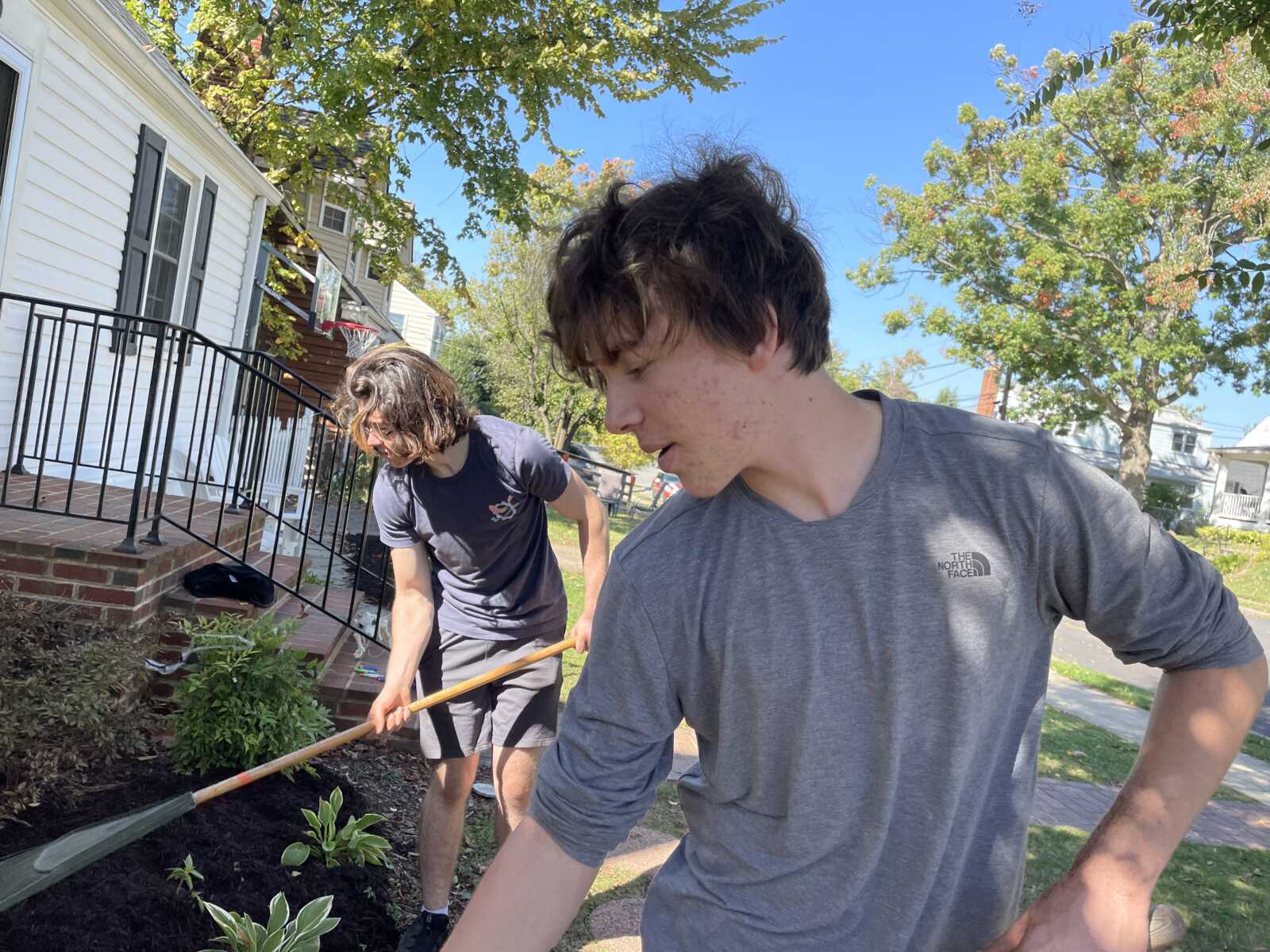
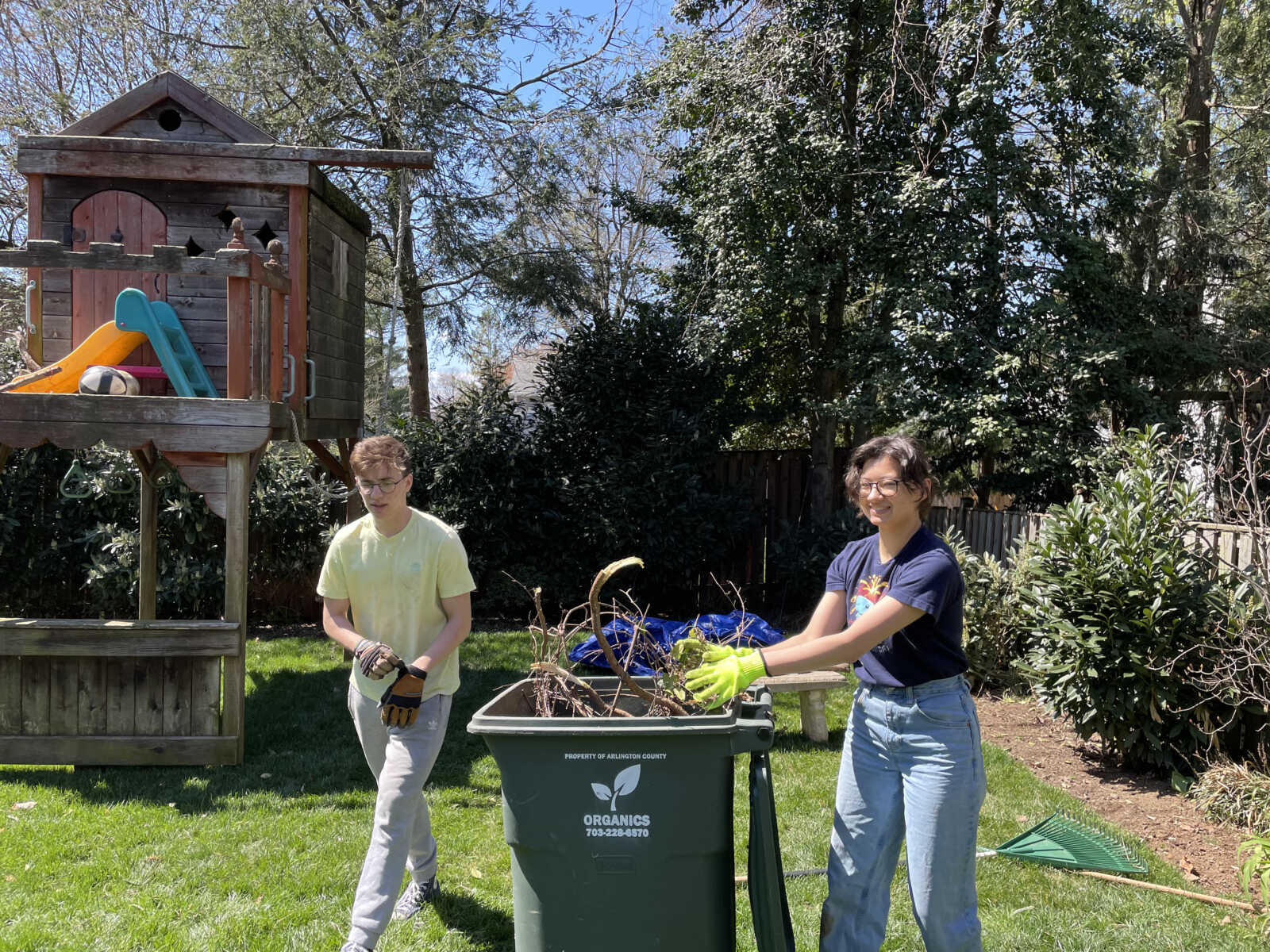
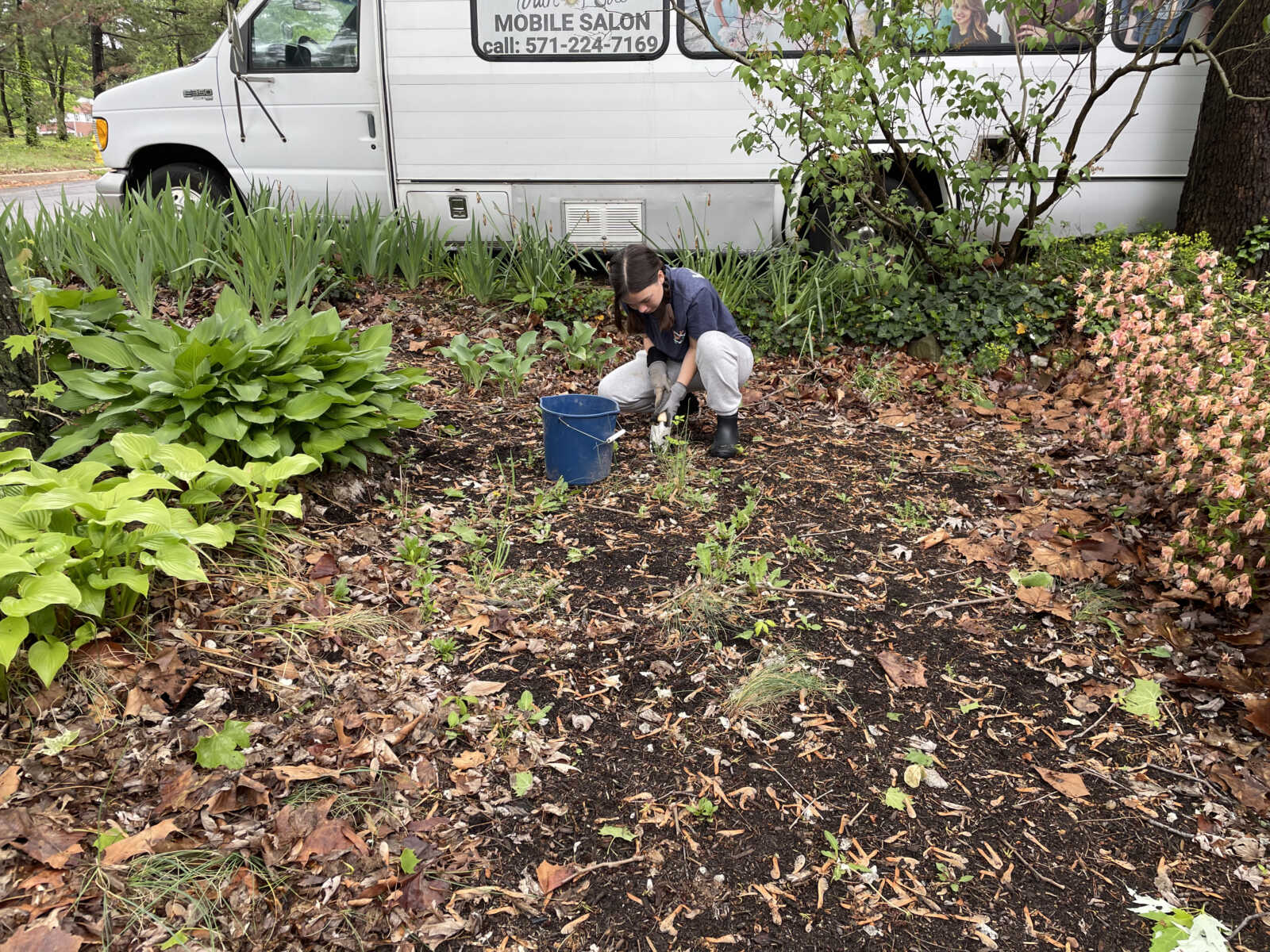
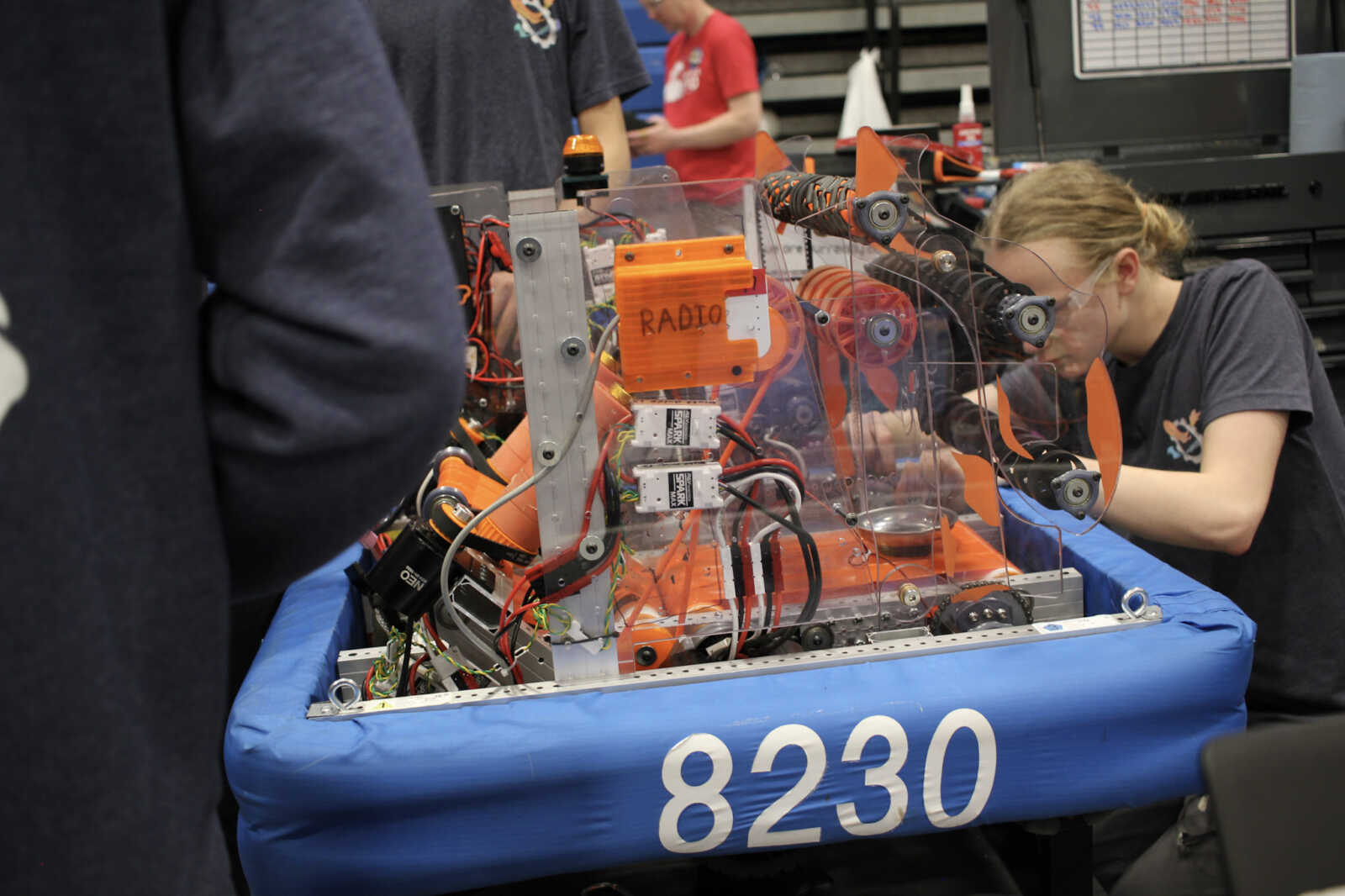
An Arlington Tech robotics team has an unusual strategy for building camaraderie and raising money ahead of competition season: yard work.

Every fall, members of the Koibots weed, rake and landscape around 40 yards in Arlington. Money funds the cost to pay for robot parts and travel and lodging when competitions start in March.

“We’re kids, we all we have the ability to go out and break our backs for four hours on a weekend, shoveling, raking leaves and whatnot,” says rising senior Madeline Florio. “It is a service that people do need and we are able to provide it. Our customers are pretty loyal.”

The team’s coach, engineering teacher Steve Nystrom, says yard work hones their ability to communicate and work together, which comes in handy during the building phase.

“So when you start making the robot, you need to know, who can I depend on? Who can I count on? Who has the skill sets?” he said. “Ironically, you can build a lot of that and know a lot of those answers by going out on yard jobs.”
This kind of fundraising makes the Koibots an anomaly, says rising junior Anna Litwiller. Most teams get large sums of money from Boeing, Lockheed Martin and sometimes the Dept. of Defense.

The yard work might provide the team a competitive advantage, especially considering how well they’ve performed in their short existence.

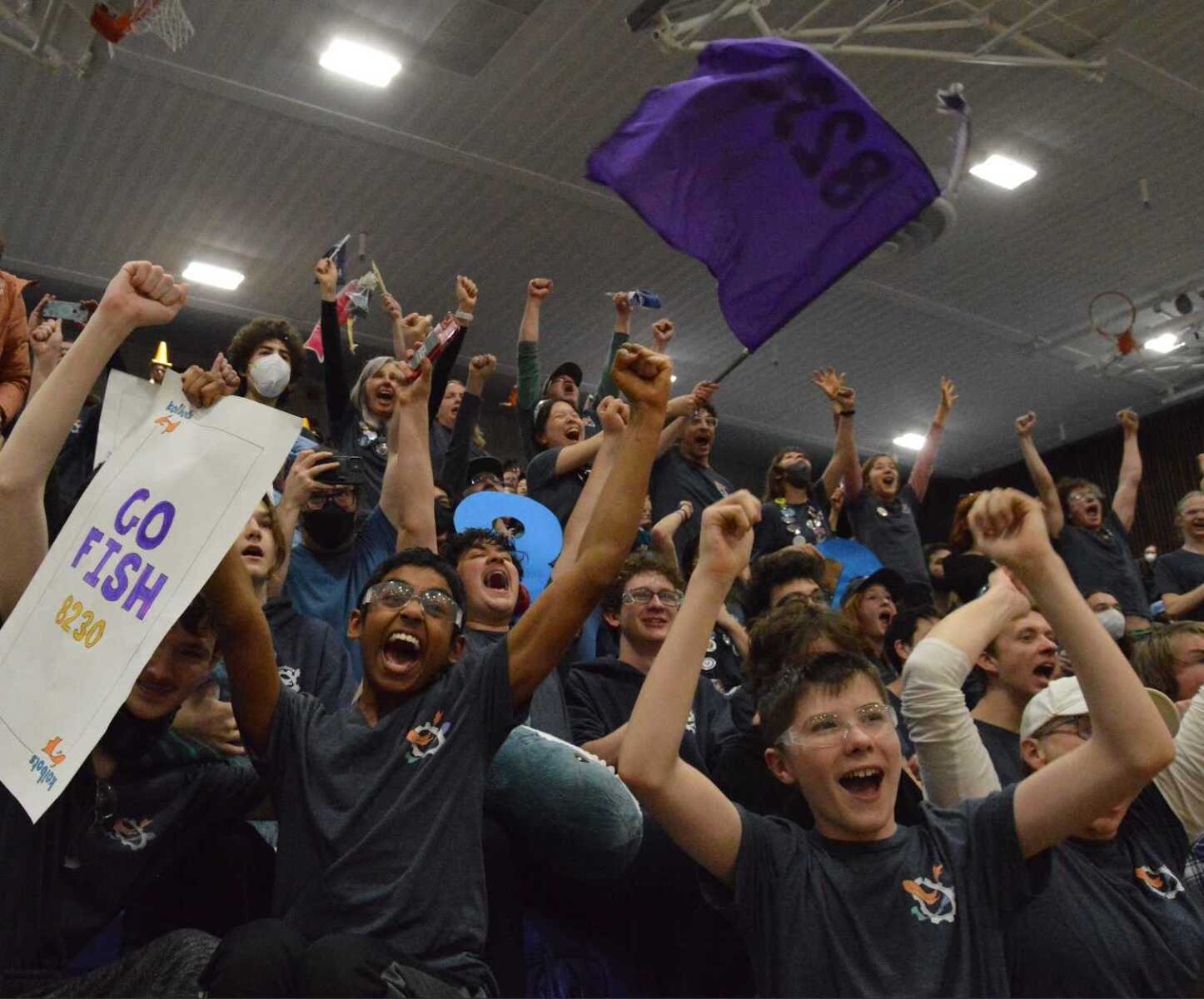
Despite being in existence for just five years and having constructed only three robots, the team has twice made the cut-offs for districts — where the top 50% of teams in D.C., Virginia and Maryland compete in the spring.

This year, the Koibots came in 36th out 0f 60 and won an award for its design and branding, which leans heavily into its quirky culture influenced by marine life.

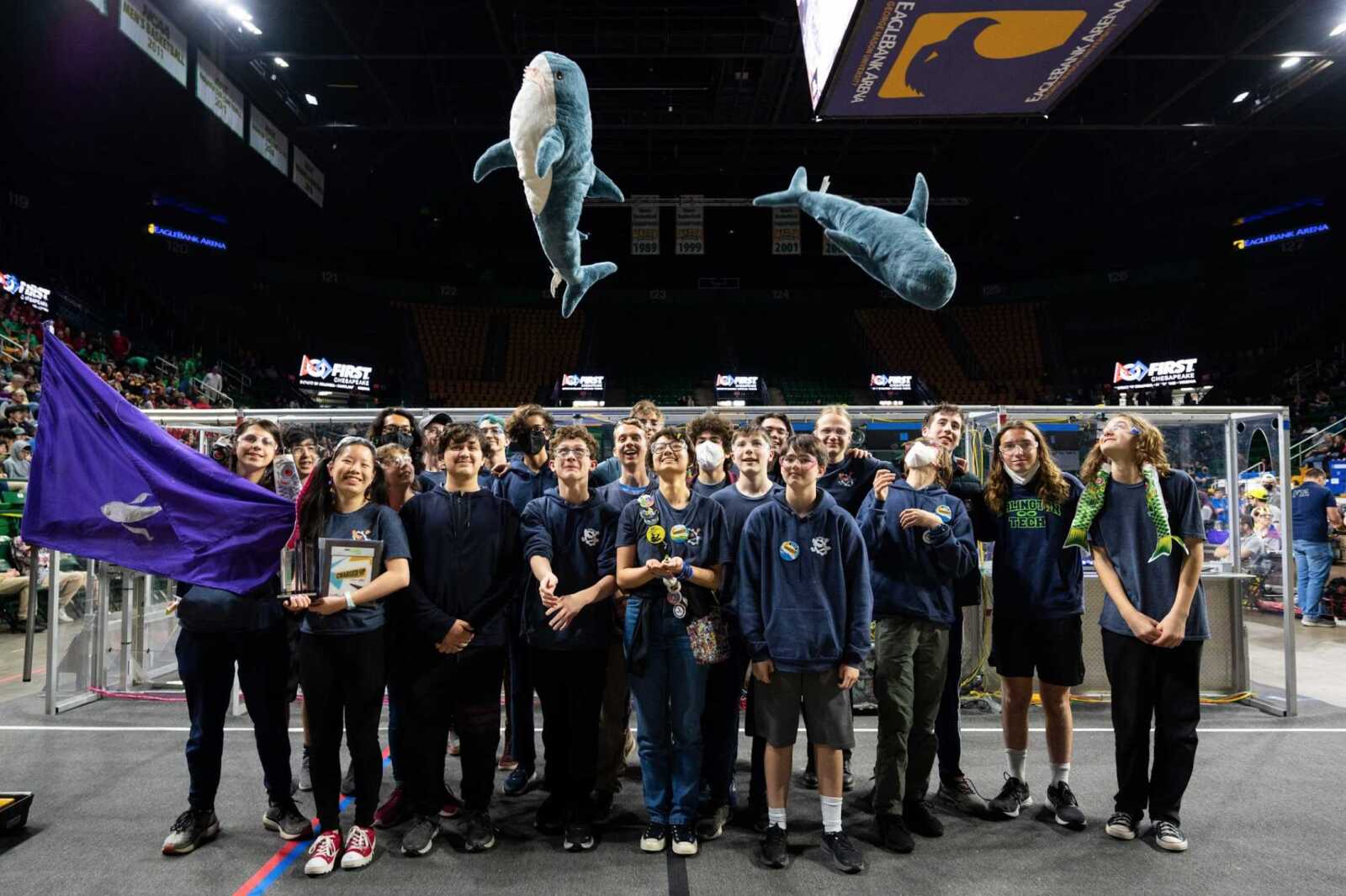
Nystrom said he chose the name “Koibots” because Arlington Tech’s Frisbee team is called “The Kois.” After naming their second robot “Sharkbait,” the aquatic theme stuck.

“We try to do as much as we can send her around the fish, and the IKEA shark, and all sorts of aquatic things,” says rising junior Shangwen Cheng. “We highly encourage our team members to get a shark because they’re wonderful but it really brings together our team in a way that you really can’t from the engineering alone.”

“Obviously, we’re here to encourage a love of STEM and building things and learning all things technical, but it’s also a lot of fun and you get to throw sharks around at people,” she continued.

(more…)


Plans from Arlington Public Schools to redraw middle school boundaries have already prompted opposition from some families.

A new petition is circulating that calls on the Arlington School Board to reject the proposal and keep Dorothy Hamm Middle School, one of the affected schools, walkable.

“This proposal is being rushed through an approval process in the summer/early fall without the benefit of proper input from those who will be most impacted by the change,” reads the petition, which had 148 signatories before publication. “Middle schoolers from a great many households located within a few short blocks of Hamm will now be forced to take a bus to a school 3 miles away.”

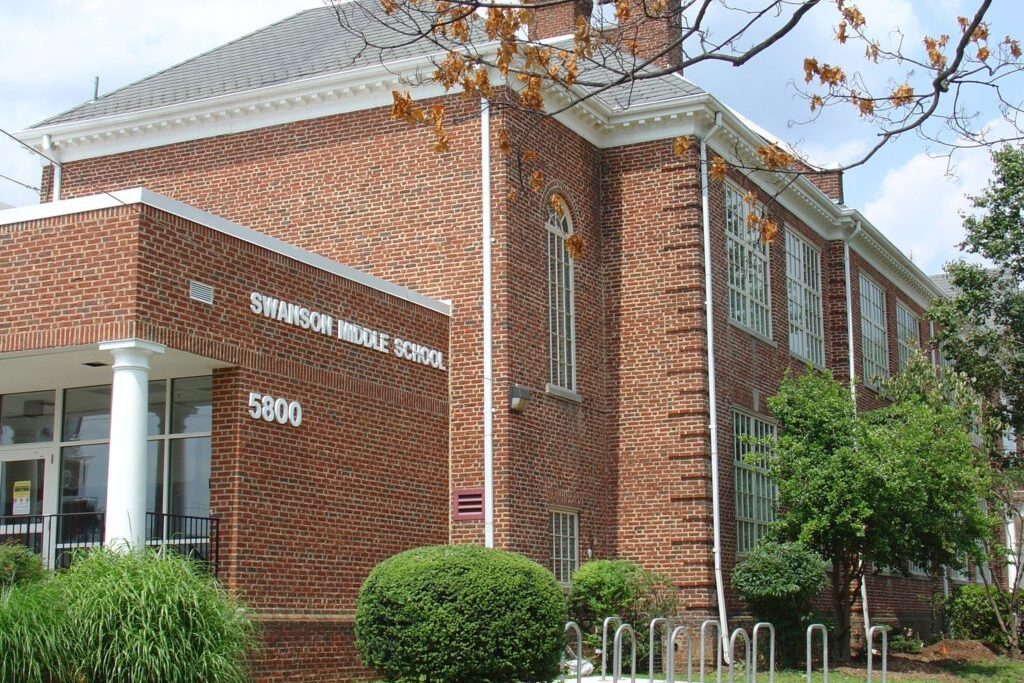
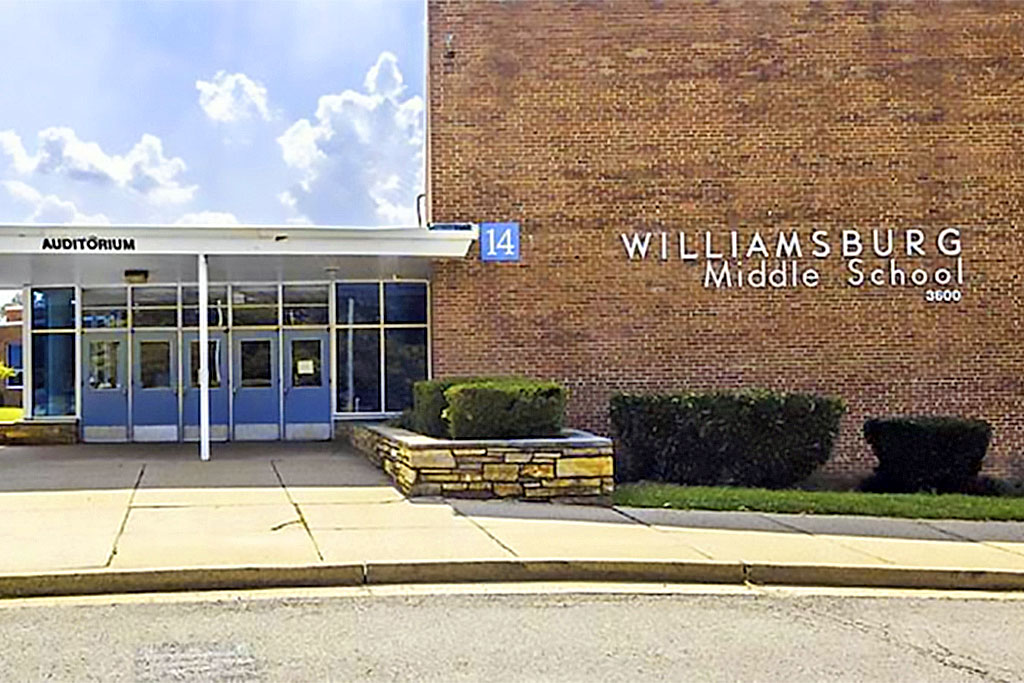
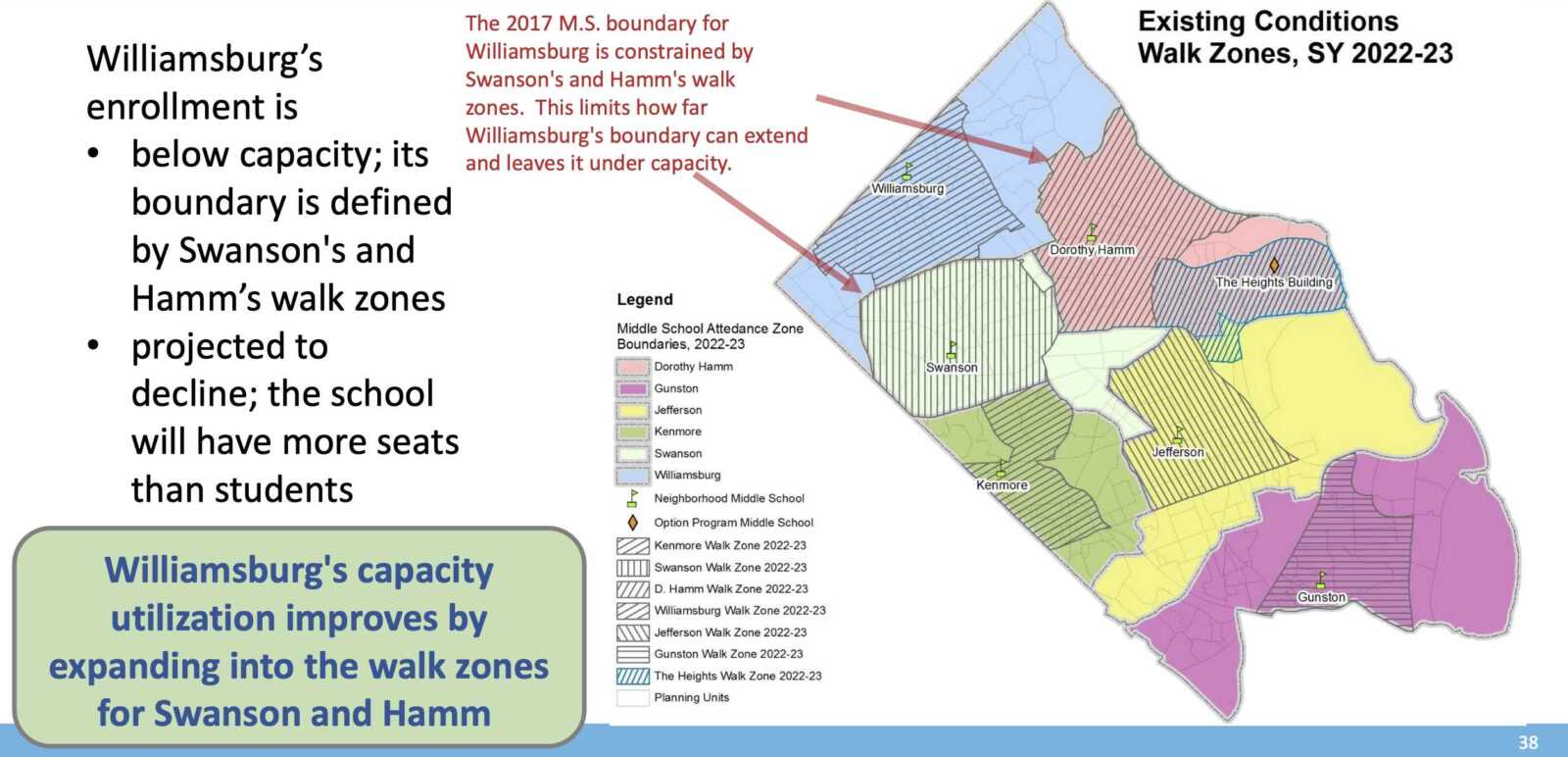
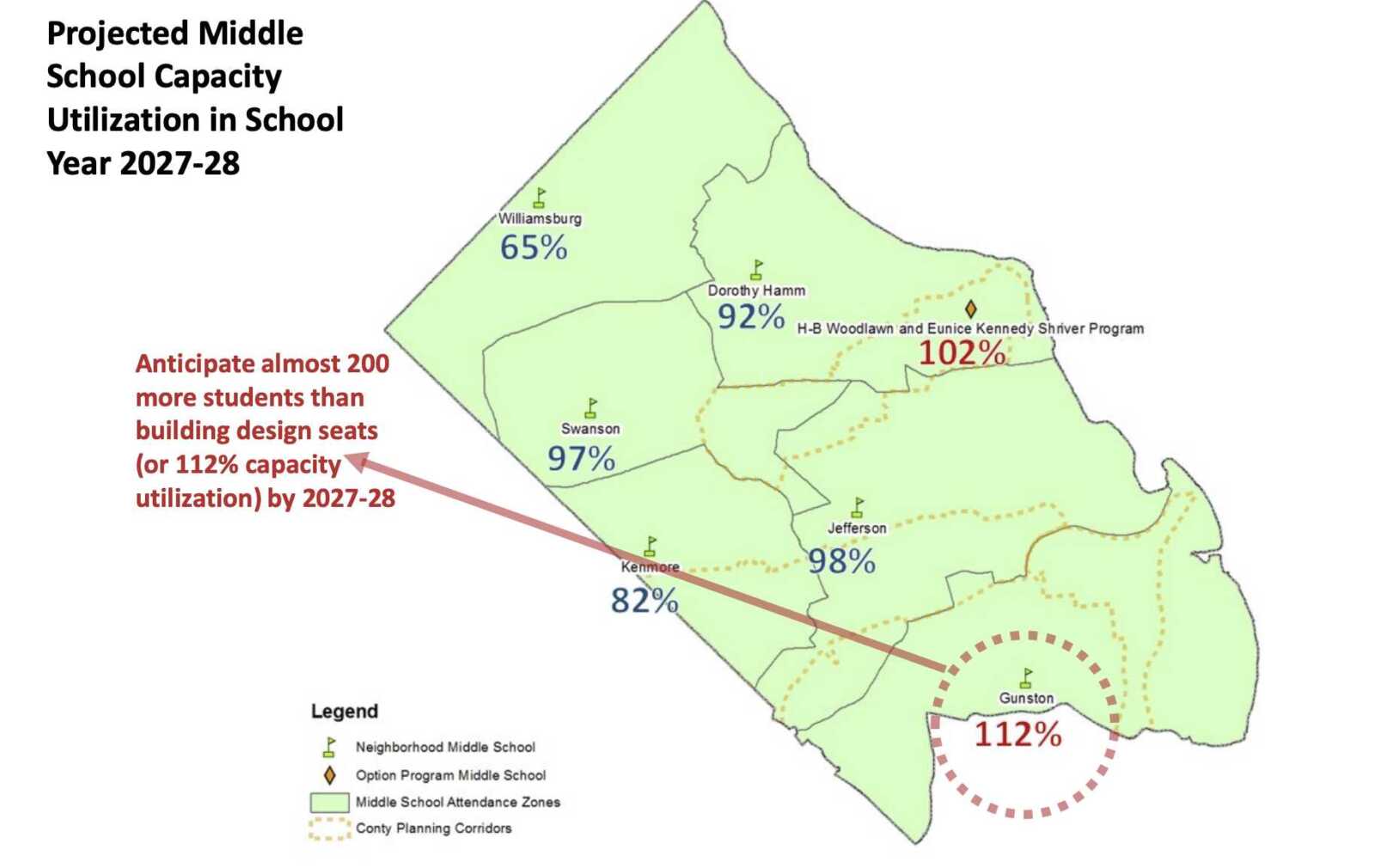
APS is developing plans to address declining enrollment at Williamsburg Middle School and over-capacity problems at Gunston and Swanson middle schools. It proposes bussing several students from Dorothy Hamm and Swanson to Williamsburg, even though many live within walking distance of their current schools. Additionally, to reduce enrollment at Gunston, APS is considering relocating the Spanish language immersion program to Kenmore Middle School.

The proposal has elicited negative reactions from some parents of both current and former Dorothy Hamm students.

The Parent-Teacher Association of Taylor Elementary School, which feeds into Dorothy Hamm, also sent an email to families expressing its opposition to the changes and shared its plans to advocate against them.

For its part, APS says it is aware that fewer students would be able to walk to school if the proposed changes go through. Per a presentation from the school system, about 55% and 70% of students live within walk zones for Hamm and Swanson. These numbers would drop to 40% and 60%, respectively.

“We know that, in order to fill capacity at the building, we’re going to move probably quite a few walkers from Swanson and Dorothy Hamm to Williamsburg in order to even out capacity across schools,” APS Planning and Evaluation Dept. Executive Director Lisa Stengle said during a June work session on the proposal.

Current conditions for middle schools in Arlington (via APS)

The proposed changes would reverse a decision APS made in 2017 boundary process to prioritize sending students to schools within walking distance. Stengle said staff at the time knew the tradeoff would be overcapacity at Swanson and vacant seats at Williamsburg.

Swanson is currently projected to reach 105% capacity by 2025, while Williamsburg is expected to drop to 71% capacity in the same timeframe, per the APS presentation. Although Swanson’s overcapacity issue is predicted to lessen by 2027, Williamsburg’s enrollment is forecasted to continue declining.

“This recommendation possibly fills middle schools closer to capacity, increases the number of students who require transportation based on current policy and practices and requires more information to determine transportation costs,” Stengle said.
Projected school utilization rates in Arlington in 2027 (via APS)

(more…)


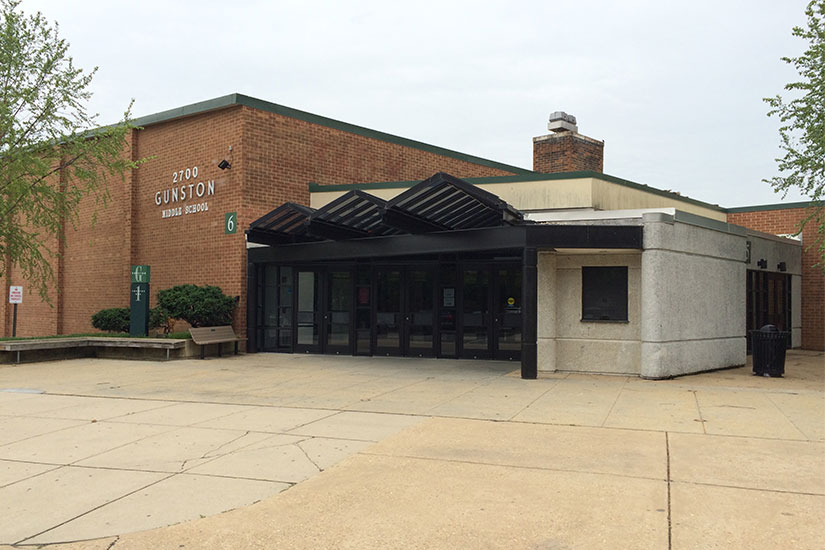
Gunston Middle School (file photo)

Arlington Public Schools is mulling moving the Spanish Immersion Program at Gunston Middle School to Kenmore starting two years from now.

The move would be part of a planned middle school boundary process also set to go into effect the same school year. APS is looking to balance middle school populations, as, without boundary changes, Gunston and Swanson are projected to become overcapacity and Williamsburg and Kenmore are projected to have seats available.

The school system says relocating the immersion program would also bring it to an easier-to-access school. In the Glencarlyn neighborhood, off of Route 50, Kenmore is more centrally located than Gunston, which is near the border with the City of Alexandria.

“We believe that by moving the program to a centrally located school, we will be able to enhance the program’s offerings and create new opportunities for our students to flourish,” staff said in a letter to parents, posted on the DC Urban Moms and Dads forum. “The decision to relocate this program was driven by our commitment to provide the best possible educational experience for our students.”

The change would apply to incoming sixth grade students. APS administrators say they will be spending the summer studying how this would impact students and whether those in grades 7 and 8 can finish their time in the immersion program at Gunston.

“Students who are enrolled in the program at that time will remain in the program and will be transferred to Kenmore when the program relocates to Kenmore,” reads the letter to parents.

Two-thirds of immersion students at Gunston are projected to fall within the new boundaries for Kenmore after a potential boundary process, per a presentation during a recent work session.

“I understand the rationale for wanting to move immersion out of Gunston for a variety of reasons, but what caught my attention is talking about transportation impact and congestion,” School Board member Mary Kadera said during the work session. “This is not meant to throw a total wet blanket over the idea of immersion at Kenmore but I would be interested… to understand congestion on Carlin Springs Road and the Kenmore site specifically.”

As a parent of students who went to Kenmore, she says she can appreciate the congestion on Carlin Springs Road and difficulties getting in and out of the Kenmore parking lot.

“We already have a bit of a knot there,” she said. “I’m concerned about moving an immersion program to that school when we know that a healthy number of immersion students end up being driven by a parent.”

Assistant Superintendent of Facilities and Operations Renee Harber agreed that transportation is top-of-mind for staff with this potential change. She projects the total number of buses going to Kenmore would increase from 11 to 19, without any decrease to Gunston, which needs buses for the Montessori program also located there.

“[Transportation] is a concern of ours,” she said during the work session. “We have to really review and study additional transportation demand options for this.”

Cristina Diaz-Torres, who is now the School Board Chair, encouraged families to “poke holes” in the handful of programmatic changes on the table so they can be improved.

“Our doors are open and are going to be open for the entirety of the summer and we really want to hear your thoughts and perspectives now and also in the fall,” she said. “This is not a decision that any of us are going to be taking lightly.”


Independent School Board candidate James ‘Vell’ Rives IV (courtesy photo)

An independent candidate for the Arlington School Board is bowing out of the race.

On Monday, four months ahead of the general election in November, James “Vell” Rives announced in an email that he was suspending his campaign. His announcement hinted that he may run again for School Board in a later election cycle.

“For various reasons, I am suspending my 2023 campaign and am instead working on a future run for Arlington County School Board,” he said in the email. “Thank you for your encouragement and support this year! For now, please stay involved in our schools, and help out where you can.”

Rives was running for the second time as an independent after a failed challenge to Democratic-endorsed candidate Bethany Zecher Sutton last year.

The psychiatrist and a member of the School Health Advisory Board — a citizen committee advising Arlington Public Schools — has campaigned on student health, improving academic performance and reducing technology use.

His opponent, Miranda Turner, who has the endorsement of the Arlington County Democratic Committee after its May caucus, will be running unopposed.

This is also Turner’s second School Board bid, losing two years ago in the Democratic endorsement caucus to now-School Board member Mary Kadera.

This year, Turner bested political newcomer Angelo Cocchiaro, who had the endorsement of outgoing School Board Chair Reid Goldstein and that of the local teachers union, the Arlington Education Association.

Ahead of the Nov. 7 general election, the first day of in-person early voting will begin on Sept. 22. The last day to apply for a mail ballot is Oct. 27.


View More Stories