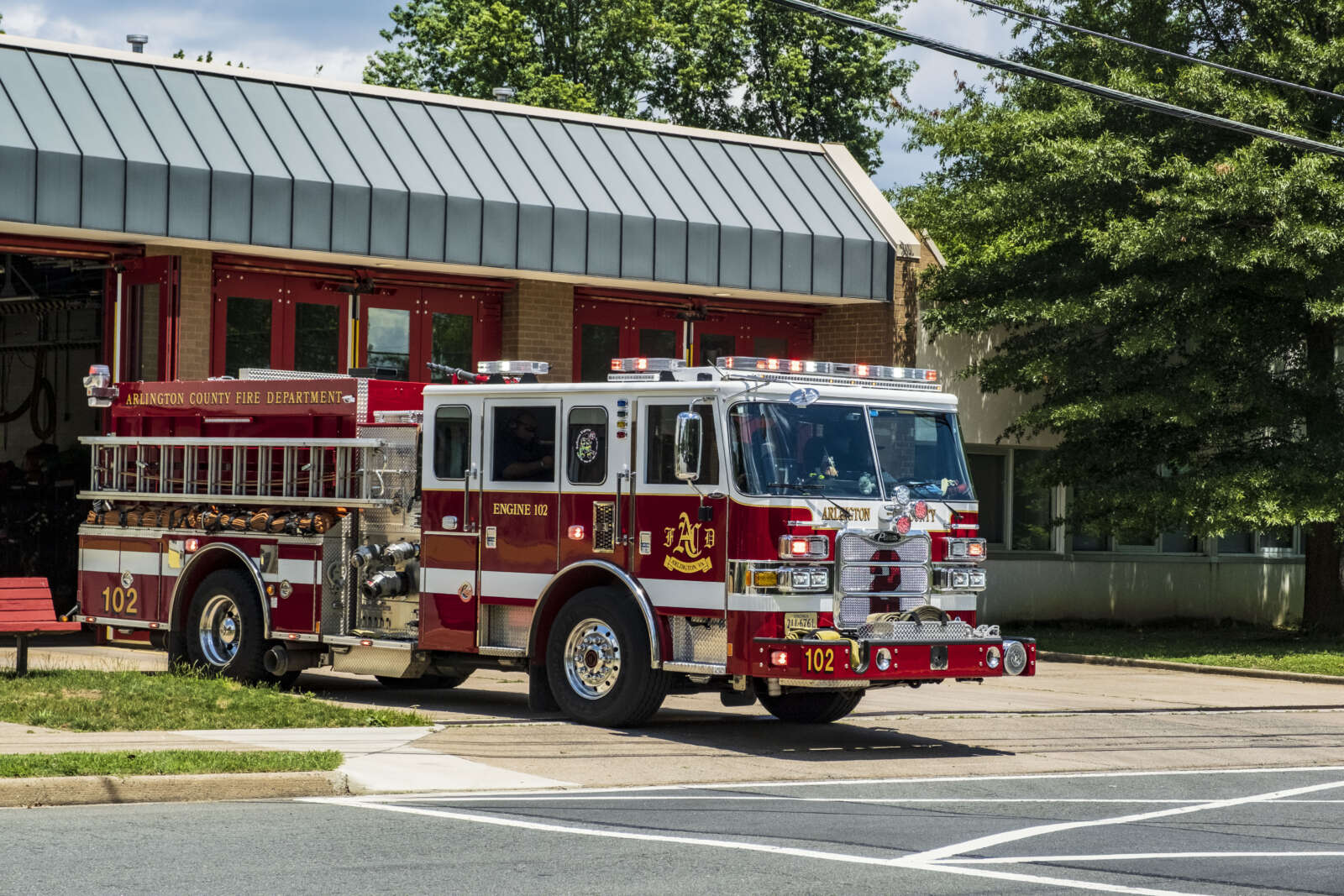
Wearing a clock as a necklace for turning papers in late. Carrying a hose stuffed with sand and rocks for losing a flag.

These were two “alternative learning opportunities” or ALOs that one instructor in Arlington County Fire Department’s Training Academy allegedly prescribed to former firefighter EMT recruit Brett Ahern in one week for mistakes that he made.

Two months ago, Ahern cited these ALOs as examples of how he was unfairly targeted by the instructor and set up to fail, according to an exclusive report by Hagerstown TV station WDVM. He told the news outlet that the way he was treated during the academy last year made him anxious and unfocused. Even after an investigation, he said the hazing continued until he failed two tests and was dismissed.

A 54-page Human Resources report, shared with ARLnow, indicates that the fire department investigated Ahern’s claims last summer. The heavily redacted report identified firefighters and recruits who observed that Ahern specifically was yelled at, taunted and tasked with ALOs that no other recruit was given. It also found that five other recruits were occasional targets of the same instructor.

ACFD told WDVM and repeated to ARLnow that it is committed to making changes to each subsequent class recruit class. At least one change has been made since Ahern — part of the 78th class — failed out of the academy. Recruit Class 79, which graduated in May, did not have alternative learning opportunities, according to Lt. Nate Hiner, the spokesman for the department.

“The Arlington County Fire Department makes improvements each Recruit Class, building off lessons learned from previous classes,” Hiner said. “The ACFD has discontinued the use of ALO’s, ensuring that any supplemental training focuses solely on refinement and reinforcement of proper skills, techniques, and procedures that recruits will utilize as firefighter/EMT’s protecting the community.”

Previously, Fire Chief David Povlitz told WDVM that if a recruit made a mistake during training, an instructor would make time for these so-called ALOs, which are “meant to reinforce learning and they have to be approved by high-ranking officers.”

But according to the newly-shared HR report, multiple witnesses who were interviewed during the investigation said that the two ALOs that Ahern was given during his “Hell Week” — wearing the clock and carrying the heavy hose — were beyond the pale.

One recruit said the hose in particular — punishment for losing a flag, or guidon — was “straight up bullying.”

“When [recruits] lost the guidon before, they were given the ‘ghetto guidon,'” one interviewee said, “but when Recruit Ahern lost the guidon, he was given” this heavy hose, which the speaker called “an impossible guidon.”

The report said other interviewees “opined that this ALO, although warranted, was orchestrated by [the instructor] to ‘break’ Recruit Ahern.” They added that “the ALO would have been handled differently had it been assigned to another recruit.”

Aside from these ALOs, multiple independent witnesses said the instructor was vocal about his belief that Ahern did not deserve to be in the academy, and that he would yell — or at least would raise his voice — at Ahern in front of his peers.

Five witnesses confirmed that the instructor had Ahern accompany another recruit who asked to retrieve his sunglasses. On their return, the instructor said the recruits were two minutes late and the class had covered “a lot of material.” He told the recruits that he hoped their next test would cover this missed information, adding, “I hope you f— fail it!”

(more…)


Preservation Battle Brewing — “The historic-preservation advocate who launched a community-driven, albeit ultimately unsuccessful, effort to save the Rouse estate on Wilson Boulevard, is on a new quest. Tom Dickinson has filed paperwork with county officials seeking historic-district status for an East Falls Church home, despite the likelihood that the current property owner aims to raze the home and redevelop the 0.29-acre parcel.” [Sun Gazette]

Arlington Ranks No. 39 Healthiest in U.S.Updated at 9:20 a.m. — “U.S. News and World Report, in its annual assessment of the ‘healthiest communities in the U.S.,’ has given a staggering third place finish to the City of Falls Church in its latest edition. That’s ahead of all other entities in the entire nation, except for Los Alamos, New Mexico, and Douglas County, Colorado. The magazine listed the top 500 entities in the U.S., and others in this area to finish near the top were Loudoun County at No. 4, Fairfax County at No. 14 and Arlington County at No. 39, the City of Alexandria at No. 124 and Fauquier County at No. 195.” [Falls Church News-Press]

Tattoo Shop Opening New Clarendon Location — “Regency’s The Crossing Clarendon is excited to welcome Lady Octopus Tattoos to its second local storefront in the Arlington, VA area later this year. Run by artist Gilda Acosta and co-owner Jonathan Reed, the custom tattoo shop offers high-quality tattoo artistry in addition to selling brand merchandise including t-shirts, enamel pins and more.” [Regency Centers]


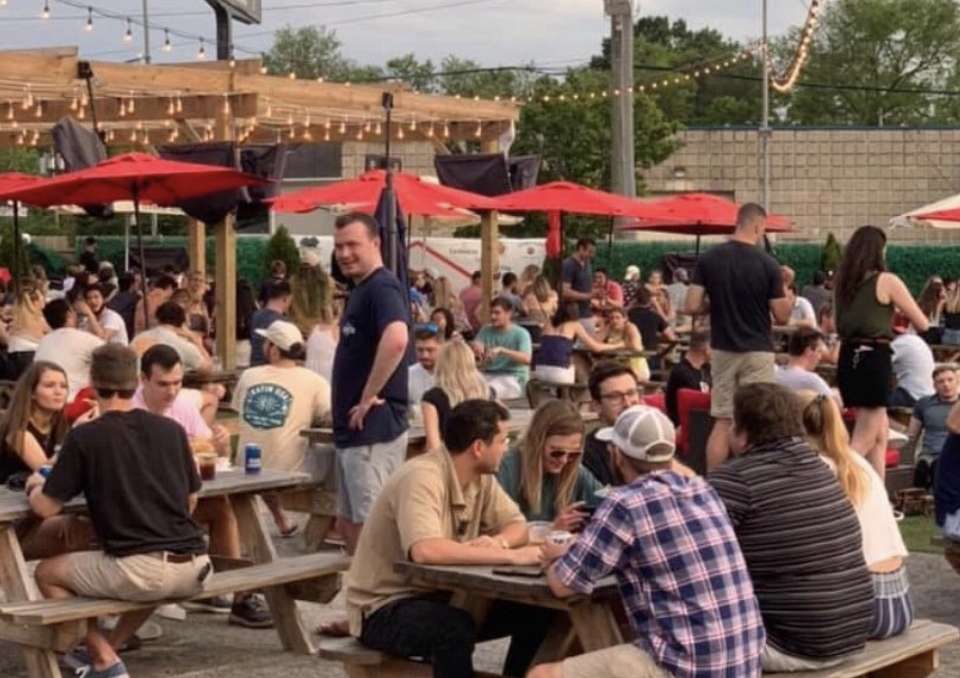
Crowd at The Lot beer garden on May 29, 2020 (via Twitter)

From Clarendon bars to crowded gyms, unmasked store clerks to house parties, Arlingtonians asked the county to investigate more than 1,000 reported cases of COVID-19 non-compliance.

The reports came in through a form that Arlington County launched last year to report lax social distancing and masking.

ARLnow obtained the full list of reported instances from a resident who acquired the list with a Freedom of Information request. After removing incomplete or abusive requests, about 1,175 remained. Of those, around 200 were filed in 2021, with the rest — just shy of 1,000 — filed in 2020.

The entries provide a snapshot into the kinds of activities that worried Arlingtonians the most during the height of the pandemic. People reported facilities operating without authorization, restaurants allegedly exceeding 50% capacity and large religious gatherings, as well as crowded non-essential businesses, parks and county facilities. A final category, “other,” included home gatherings and complaints about little masking enforcement in apartment buildings.

Referencing a rowdy house party, one reporter asked the tip line, “can we lock everyone under 30 in a closet until this is over?”

Of the nearly 1,200 submissions, about 370 referenced restaurants exceeding 50% capacity.

Far and away, the most frequently reported establishment was The Lot beer garden near Clarendon, which racked up at least 100 reports. Many of these came the Friday (May 29, 2020) that The Lot reopened along with other non-essential businesses permitted to reopen with additional precautions.

The word cloud shows Arlington businesses that have been reported at least four times for not complying with COVID-19 guidelines. The size of each name depends on how frequently they were reported (via WordItOut.com)

The opening day went viral when Democratic strategist Adam Parkhomenko posted a photo showing a large crowd outdoors, with none wearing masks. The bulk of the tips came that weekend.

“People packed in like sardines. Minimal masking. Shut it down,” wrote one.

Board member Katie Cristol retweeted the photo, suggesting The Lot was out of compliance and included a link to the hot line. She later apologized for the suggestion in a tweet. Outdoor settings were later found to be much safer than indoor settings in terms of virus spread, though not without risks.

Some complaints about Clarendon’s day-drinking and nightlife continued into the fall and winter. In October a tipster said the crowding happens “every night.”

“Surely someone should be policing this — for years you have had extra police in Clarendon for the bars, so why not assign someone here?” the tipster wrote. “The line at the farmers market is better policed by volunteers than this one.”

Behind restaurants were “other” violations (about 330) and reports of public outdoor facilities not following guidelines (nearly 300). Of these, the most common were reports of social gatherings and complaints about enforcement in apartment buildings and gyms.

One tipster said their management company took four months to post signs saying masks were recommended and was not doing any enforcement: “I would estimate fewer than 50% of residents wear face covering in halls and elevators.”

A gym-goer said the building’s fitness center was “full of people” and “no one was wearing a mask except me.”

(more…)


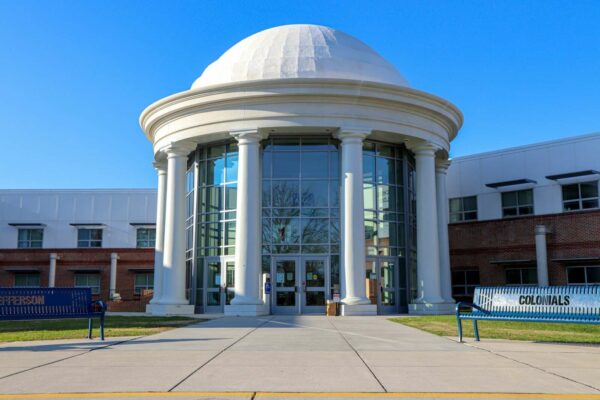
Thomas Jefferson High School for Science and Technology (courtesy of Sean Nguyen)

Months after parents and students wondered if rising freshmen in Arlington could attend Thomas Jefferson High School for Science and Technology, the results are in.

The Class of 2025 will include Arlington kids, although the exact number is not known.

The results, released Wednesday, cap a turbulent admissions cycle. Fairfax County Public Schools made significant changes to the school admissions criteria — among them scrapping a standardized test and written teacher recommendation — which parents protested and challenged with two lawsuits.

The changes resulted in the school’s “most diverse class in recent history.”

Thomas Jefferson, nicknamed “TJ,” is a STEM-focused magnet school open to students from Arlington, Fairfax, Loudoun and Prince William counties who meet certain academic requirements to get in. US News ranks it as the number one public high school in the United States.

While Arlington annually sends students to the school, the relationship is not a steady one. When facing a budget deficit, Arlington Public Schools sometimes suggests cutting funding. That happened earlier this year, when Superintendent Francisco Durán’s proposed budget for the 2021-22 school year, which had a $42 million gap, put TJ funding on the chopping block.

In response, some Arlington parents and students mobilized to advocate for funding tuition. Then-sophomore Lauren Fisher was among four parents and students to speak at a School Board hearing on March 23.

“If I were to sum up TJ in a few words, it would be an animated community of nerds,” Fisher said. “The students there are incredibly enthusiastic and encouraging, and this energy is contagious. I’ve never felt more encouraged to try or learn new things regardless of how nerdy they might be.”

When the School Board released its amended budget in early April, TJ was no longer among the next school year’s cuts, though the reason for the reversal was not clear.

Still, Arlington students’ access to the magnet school could end in a future budget cycle. Director of Secondary Education Tyrone Byrd tells ARLnow that in difficult budget situations, funding for the magnet school would be among the first of proposed cuts.

“Our commitment is to APS kids and APS buildings, that’s our first priority,” Byrd said. “As far as I know, there’s no purposeful movement toward removing TJ from our options to kids, but when it gets tight, we have to start looking for avenues to correct that.”

Former TJ parent Jennifer Atkin, who remains involved in the Arlington-TJ community, recalled a similar effort two years ago when then-Superintendent Patrick Murphy suggested cutting transportation funding.

“I believe one of the values that Arlington and the School Board profess is equity and access, and I think there’s a feeling amongst parents that in order for them to make good on that they really need to continue the relationship that they have with TJ,” Atkin said. “If you cut off access to this public education opportunity, what you’re really doing is cutting off access to [specialized] programs to the people who are middle and lower-income within Arlington, which runs counter to this idea that you’re promoting equity and access.”

Atkin suggests that the magnet school remains a target for budget cuts because the Arlington-TJ community is relatively small, and tuition cuts would anger fewer people than cuts to other programs. Byrd disputes that theory, saying that the county considers these cuts because the APS prioritizes its own resources first and foremost.

Should access to her school be in danger next year, senior Alexandra Fall said she is prepared to pick up where she left off in April, writing to board members and motivating peers to take action.

“I would try to get people involved,” Fall said. “I know that the community of Arlington kids at TJ is very strong because they ride the buses together and they’ve all come from a similar place.”

Fall and Atkin said they doubt the struggle to keep Arlington students at TJ will ever reach a resolution.

The problem is with every election cycle, the composition of the school board changes,” Atkin said. “Even if this school board were to say, ‘We’re going to stop proposing cuts to TJ,’ it doesn’t mean that the next school board will operate the same way. That’s the nature of politics.”

Photo courtesy of Sean Nguyen


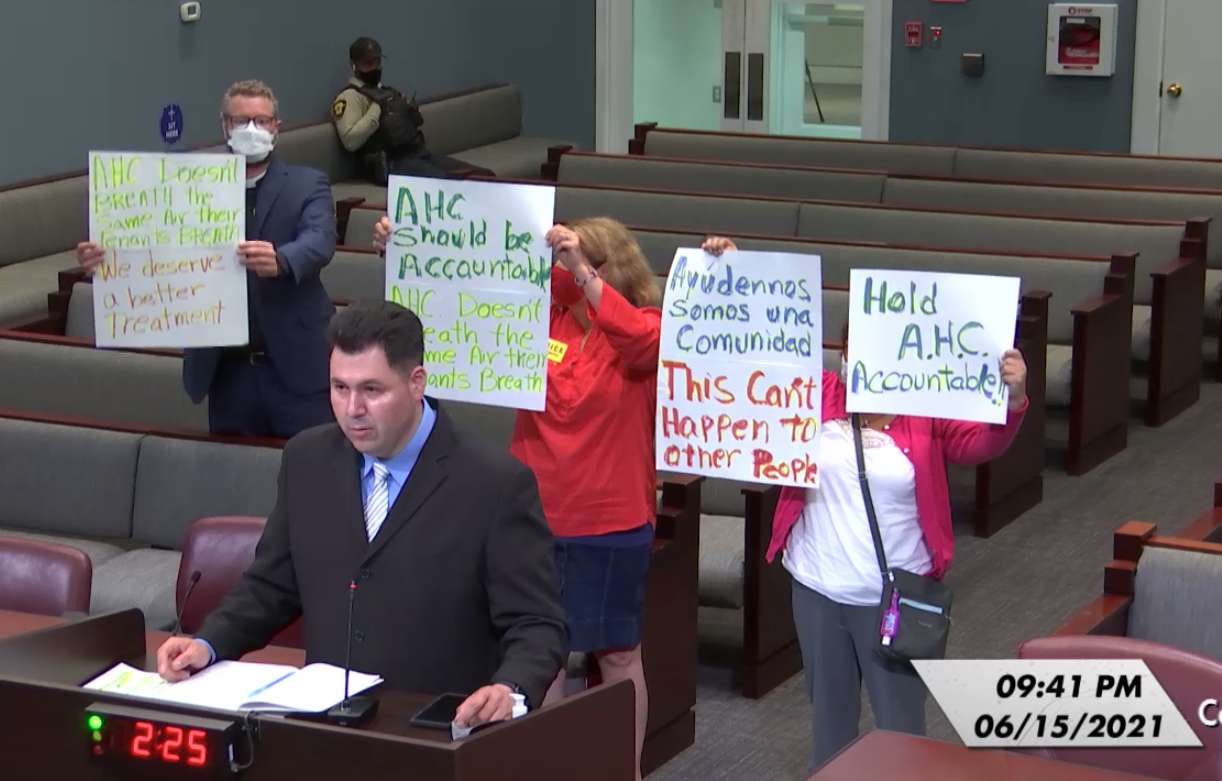
County Board members demanded AHC Inc. answer for the deteriorating conditions at the Serrano Apartments and to convince them it will actually fix things during their meeting on Tuesday.

The discussion happened as county staff outlined the flurry of work at the property. Separately, the Board voted 5-0 to enter into an agreement allowing AHC to refinance its loan for the apartments through a new lender before its current loan expires in less than two months.

This loan agreement is urgently needed, according to a staff presentation. If in two months lenders foreclosed on the property, the bank would repossess the Serrano, lifting the affordability restrictions and displacing residents. But some people are worried that preventing AHC from defaulting runs counter to the need to hold the organization accountable.

Elder Julio Basurto, a member of the Arlington Schools Hispanic Parents Association, said he has watched the building at 5535 Columbia Pike crumble under AHC. He urged the county “to stop feeding the monster that AHC has become,” a monster that “sucks the life out of the ones they vowed to help.”

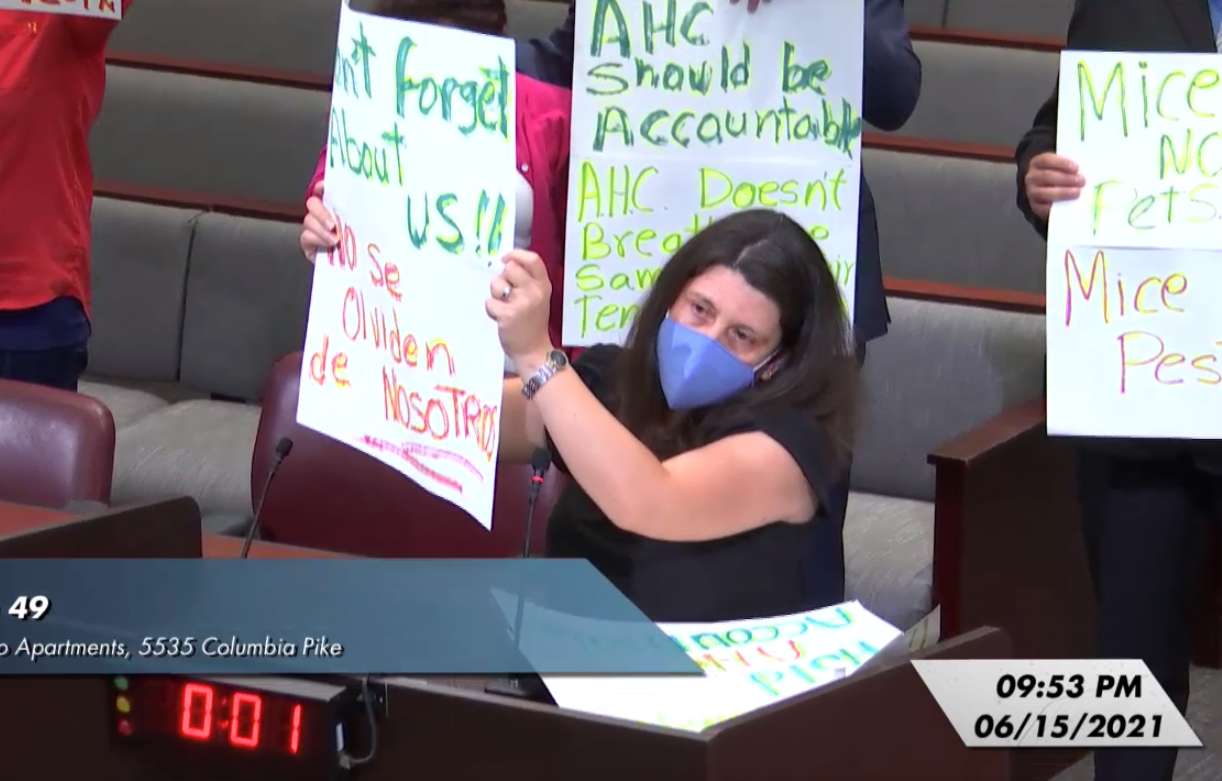
Former school board member Tannia Talento read the signs residents brought — pleas to be heard and protected.

“Don’t forget about us,” she said, saying it again in Spanish. “No se olviden de nosotros.”

Board members explained that allowing AHC to refinance will lock it into a new agreement and force it to make improvements.

“The easy way out for AHC would be to be in a position where they defaulted on a loan and ended up with a foreclosure,” Board member Christian Dorsey said. “They could wipe their hands of it and move on, they could walk away leaving in their wake devastation and despair, leaving people in limbo. Accountability is being engaged with the long-term process to return the Serrano to the level of quality the residents expect.”

AHC has two loans to pay off: a primary loan to a private lender and a subordinate loan to the county through the Affordable Housing Investment Fund. The new lender requires AHC to agree to prioritize repaying the private loan before the county loan, something that required a county vote.

This loan acts like a bridge until 2024, when AHC intends to use Low-Income Housing Tax Credits to finance a full renovation of the property. The county says it will work with AHC to develop a renovation plan.

In recent weeks the county has conducted 150 code violation apartment walkthroughs, put up people in hotels and shared information about various resources they can use, said Housing Director Anne Venezia.

AHC is also keeping busy and finding ways to repay tenants, according to a letter from the Board of Directors.

It is waiving certain fees and returning security deposits for those who relocate and, for those who have been displaced, providing $200 gift cards and waiving utility payments. It reduced July rent by $200 for all tenants.

Board Chair Matt de Ferranti reiterated the responsibility he feels for the conditions of the Serrano and apologized to the residents who were signed up to speak but had to go home due to the late hour — caused in part by an hour-long discussion about a new farmers market’s start time.

De Ferranti called for another update next month and told AHC it, not the county, should bear the brunt of the hotel stays and relocation costs.

“I would submit that we would not be in this situation if care had been taken over the past two years,” he said.  “The right thing to do is that the large majority of relocation costs should be covered by AHC and not by the county.”

Some Board members expressed frustration that this conversation mirrors similar discussions over the past two years with AHC. Dorsey said he met with AHC in 2019 about the same problems at the Serrano and, at the time, heard similar remedies.

(more…)


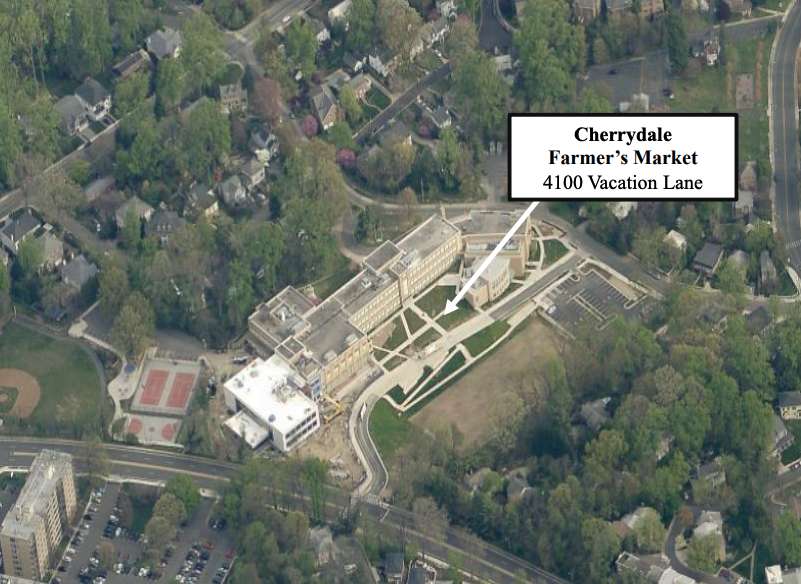
A new farmers market in Cherrydale will open in a few weeks following a vote by the County Board last night (Tuesday).

Ahead of the vote, some residents — chiefly worried about noise early in the morning — told Board members the market will be a rotten deal for their neighborhood. The issue drew 14 speakers for and against the proposal and the discussion lasted one hour, prompting some Board members to hasten to a vote and move on.

The new market will attract up to 20 vendors to its location at Dorothy Hamm Middle School (4100 Vacation Lane). Its first day is expected to be Saturday, July 3; starting next year, the market will operate from April through November. Field to Table, an Arlington-based nonprofit that facilitates the markets at Lubber Run, Fairlington and Westover, will manage the market.

Sales will start at 8 a.m. and end at noon. The School Board is set to approve an agreement during its Thursday, June 24 meeting.

Concerned residents asked for a 9 a.m. start time to allow for more quiet time in the morning. While the County Board ultimately sided with an 8 a.m. start time, proposed by staff and requested by Field to Table, they did extend an olive branch to residents in the form of a County Board review of the market in six months.

“Having lived through this with my Fairlington community, there was a lot of concerns about noise, and I would hear about it on walks,” Board member Libby Garvey said. “I have not been hearing about complaints since, and I’m fairly confident that this will work out fine.”

Local resident Joan Perry predicted that with this level of concern over the impact on the neighborhood, the market will not succeed, just like a community-supported agriculture program in the neighborhood failed.

“The farmers market is supposed to serve the immediate community surrounding the school, the very people opposed to the market who did not support the CSA,” she said.

Neighbor Simone Acha asked for a later start time so her Saturday mornings would not be unduly disturbed.

“We know from having lived through almost four years of construction at Dorothy Hamm Middle School that noise is very disruptive,” she said.

Others were excited at the prospect of a walkable market.

“I can’t think of a better place to hold the farmers market,” said Marcy Gessel.

Neighboring civic associations advocated for starting at 9 a.m. and ending at 1 p.m. The Donaldson Run Civic Association conditioned its support on — among other requests — this start time.

“A farmers market located in this kind of neighborhood setting, such substantial disruption of nearby DRCA residents on a weekend morning is unreasonable,” wrote Bill Richardson, the president of the Donaldson Run Civic Association. “For those living near Hamm Middle School, who have already had to endure many years of construction activity, this burden is particularly distressing.”

In response to the concerns, ahead of the Tuesday Board meeting, staff added language governing noise levels, limiting vendor parking to one road, and suggested both a staff and County Board review.

Attempting to wrap up the discussion and propose a resolution that would work for everyone, Board member Katie Cristol nodded to some mothers and children in the audience of the County Board meeting. They were waiting to speak about a later agenda item: county attempts to improve conditions at the Serrano Apartments, an affordable housing complex in Columbia Pike.

“I’m cognizant that we have some really important items, as I know our chair feels acutely — and it’s bedtime in some cases — so I think we should try to be moving forward,” Cristol said.

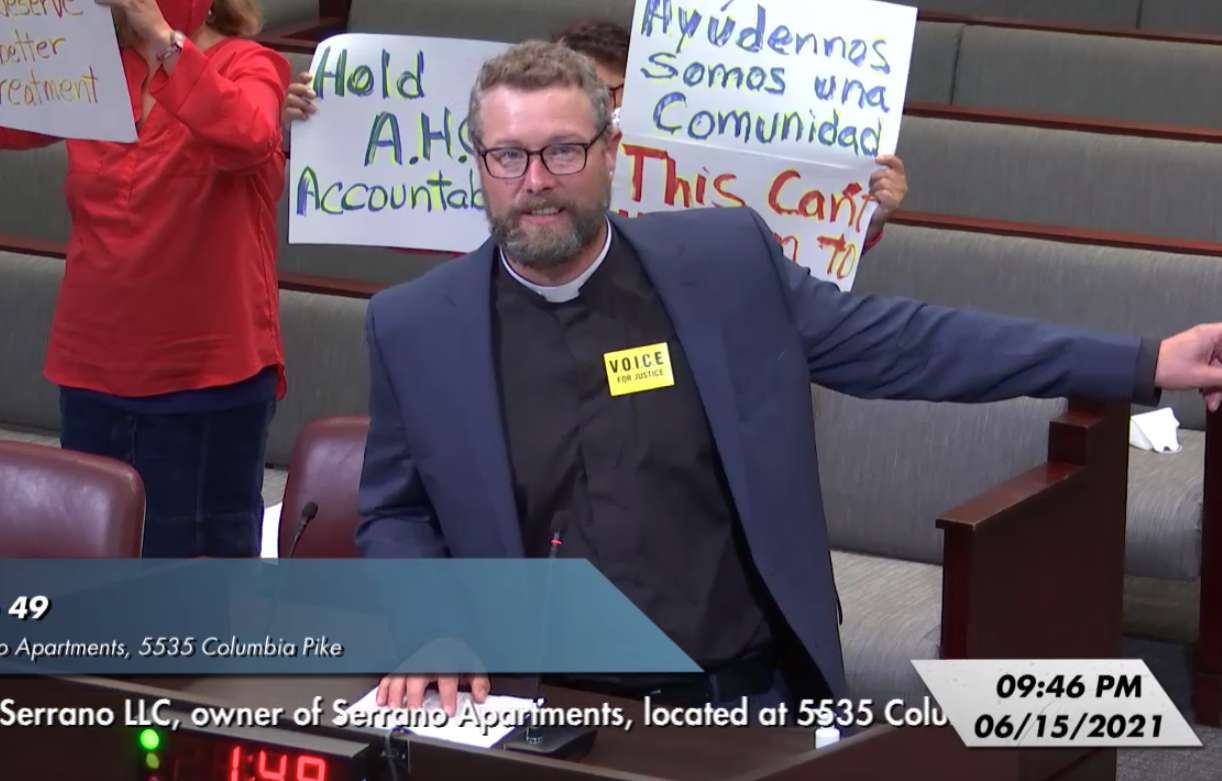
By the time the Serrano discussion started, however, those families had to leave, according to Rev. Pete Nunnally, the assistant rector at St. Mary’s Episcopal Church.

“I wonder what the conversation was between the mothers who brought their kids here but had to wait so long, so long that they had to go home, while white people argued about a farmers market,” he said.


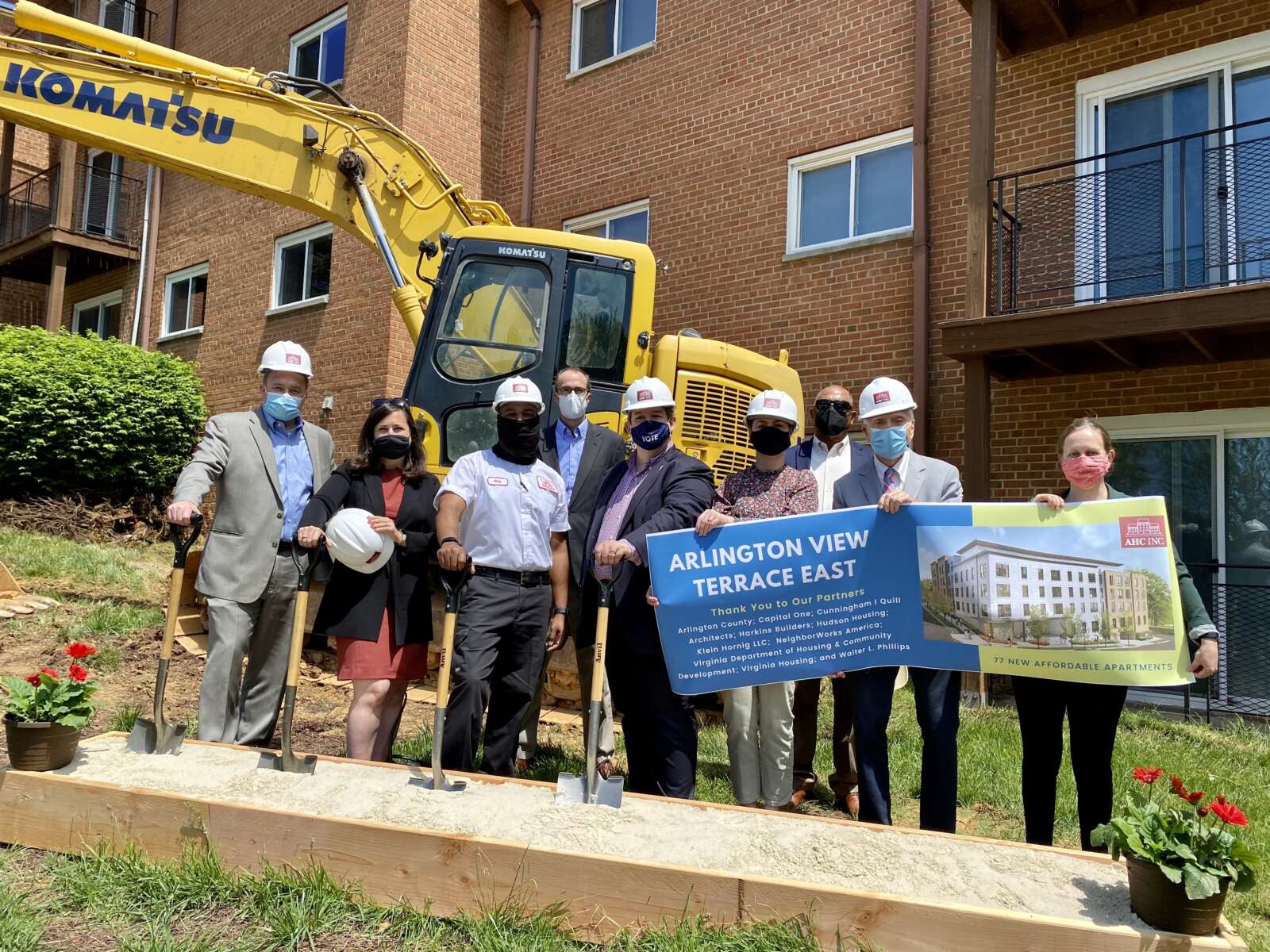
Groundbreaking for AHC’s Arlington View Terrace East project earlier this month (Photo courtesy of AHC, Inc.)

(Updated at noon) Walter Webdale, the CEO of local affordable housing developer AHC, is retiring.

Webdale’s retirement announcement comes as the nonprofit faces fallout from reports of poor conditions and maintenance at its Serrano Apartments complex on Columbia Pike. Outrage over apartments infested with rodents, filthy air conditioning units and walls covered in mold has led to condemnations from local elected officials and a flurry of actions to fix the problems, as ARLnow first reported.

Among the actions taken: replacing AHC’s own for-profit management company with another firm to manage the Serrano Apartments.

Webdale, in an email this morning to AHC supporters, announced that he will be retiring as of this coming Monday. He touted AHC’s growth and good works over the course of his more than two decades of leadership. He said the organization will be announcing plans for new leadership soon.

Webdale received more than $400,000 in compensation by the nonprofit in 2018, according to federal filings. AHC and its affiliates and subsidiaries reported around $92 million in revenue that year, mostly from apartment rents.

Answering an ARLnow inquiry about Webdale’s compensation, AHC spokeswoman Celia Slater noted that “he does not receive compensation from AHC’s other affiliated entities.”

Webdale’s letter about his retirement is below.

Dear AHC family,

I am writing to you all today to announce my retirement, effective May 31, 2021. It has been my honor to lead our organization for the past 22 years, and I’m immensely proud of the growth and good work we have accomplished together.

You will hear more about specific plans for AHC’s new leadership soon, but I want to personally assure you that the organization is committed to continuing our mission of providing affordable, stable homes for those in need and serving our residents.

The AHC Board, led by Board Chair Bob Bushkoff, in conjunction with senior staff, will provide oversight while we undertake a search for a new CEO. A special committee has been set up to ensure a seamless transition. I have full confidence in the Board’s ability to find a successor that will lead AHC into the next chapter.

I wish you well and want to thank each and every one of you for your support of AHC’s mission of providing affordable housing and educational opportunities for our residents.

All my best,
Walter D. Webdale
President & CEO


Thursday night was not a typical Arlington School Board meeting.

A contentious public comment period, during which Board Chair Monique O’Grady called for order multiple times, preceded news that Arlington Public Schools has launched school-based COVID-19 testing and preschoolers will gain access to four days of in-person instruction.

Six times, O’Grady addressed violations of the comment period, which included clapping, direct appeals to school board members, and an unseen man shouting down a speaker. She even threatened to “take other measures” if people kept disrupting the proceedings.

“We do appreciate hearing from all families, whether you’re happy or not, but we ask you that when you come into our board room that you please respect our rules and one another,” she said later in the meeting, which was preceded by a rally pushing for schools to add more in-person learning days this spring.

Tensions came to a head last night among parents who are asking APS to open schools fully, school board members and administrators, and other parents and advocates who want the school system to retain a virtual option.

Last night, administrators announced some new developments.

APS is rolling out on-site COVID-19 testing, which could allow some students exposed to COVID-19 in class to return sooner, said Zachary Pope, the director of emergency planning for APS. This new approach will be tested in the summer and could be implemented this fall.

Additionally, Superintendent Francisco Durán said preschool students can be in-person four days a week starting Monday, May 3 due to the federal guidance shortening social distancing from six feet to three feet. Students in certain special education programs are the only ones currently in person four days a week.

But many parents want to see four-day schedules for all students, not just those enrolled in specialized programs. They call for APS to follow the lead of Fairfax County Public Schools.

In Northern Virginia, the superintendents of Arlington Public Schools and Alexandria City Public Schools are sticking with two days a week of in-person students for the remainder of the semester, while Fairfax and Loudoun County public schools have allowed some students to access in-person education four days a week.

A spokeswoman for FCPS tells ARLnow the first students to get four days of in-person learning were those in most need of it, who may or may not have been in-person before. After they returned on April 6, wherever additional spots remained, school personnel reached out to students attending school in person twice a week and gave them the option of four-day, in-person schedules, depending on the number of staff and the size of each classroom.

APS is taking a different approach, Durán said. Rather than expand schedules to four days of in-person school for a limited number of students, he decided to expand access to two days of in-person education. Over the last month, nearly 1,800 students who were virtual started attending school two days a week where space allows.

Last night, parents calling for fully in-person schedules picked up where they left off earlier this month, calling for more days as well as the resignation of APS leaders.

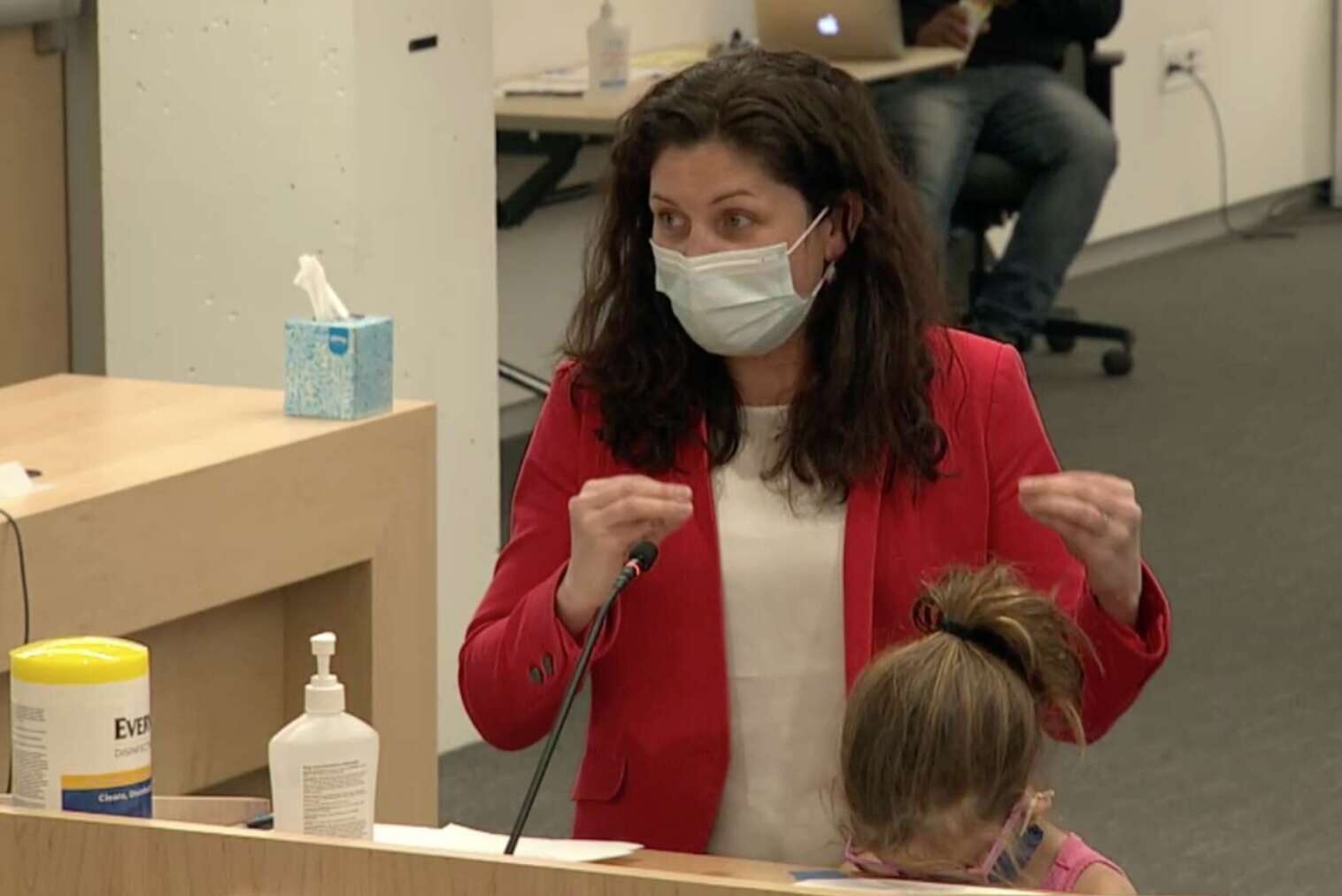
Standing with her daughter, Sheila Leonard pleaded with the school board to allow hands-on arts, music and physical education experiences on in-person school days, and to open schools fully.

“Since July, Gov. Ralph Northam and the American College of Pediatrics have prioritized [special-education, English-language learners and K-2 students] but not APS. When will you stand up for our neediest children?” she said.

Next, Brittany Kitchen wondered whom the school board members are protecting in avoiding a full return.

“It’s not for the kids. It’s not for the teachers — they’re vaccinated. Who is it for, then? You, so you can sleep at night knowing you didn’t make a decision, so if something goes wrong, it’s not on you?” Kitchen said. “That’s not leadership, it’s cowardice.”

People clapped. O’Grady instructed attendees to wave their hands silently. Two more parents’ speeches are met with applause and O’Grady reiterated the rules.

Next, Aaron Asimakopoulos called for the removal of school board members and administrators.

“Who among you can honestly say you have fought to get our children back in school?” he said. “Your departure from APS would have absolutely zero effect on the outcome of a student’s outcome, except to remove a barrier.”

After O’Grady rebuked him for addressing her specifically, he told other board members to “show some spine.”

Eventually, Latina advocates Gabriela Uro and former school board member Tannia Talento came forward. They said the immigrant and Latino families they work with are more cautious about school since they have experienced disproportionate rates of financial burden, sickness and death during the pandemic.

(more…)


View More Stories