 Arlington residents will be able to weigh in on the county’s proposal for more affordable housing before the County Board votes on the ambitious plan.
Arlington County will hold the hearings on Sept. 8 with the Planning Commission and Sept. 19 with the County Board.
“Ensuring that Arlington has housing affordable to folks at all incomes in all stages of life is one of the most important challenges facing our community,” County Board Chair Mary Hynes said. “Whether we are seeking to attract businesses, helping Arlingtonians age in place or ensuring that residents who rent have the opportunity to grow roots, the preservation and creation of affordable housing is a necessary component of our long-term sustainability and vibrancy.”
The county’s plan includes the creation of 15,800 additional affordable housing units by 2040, bringing the total to 22,800 units or 17.7 percent of the total housing stock in Arlington.
The county currently has 7,000 committed affordable units (CAFs), which are bound to keep rents lower thanks in part to federal and/or local government subsidies. Affordable housing programs account for about 5 percent of Arlington County’s overall budget, excluding school funds.
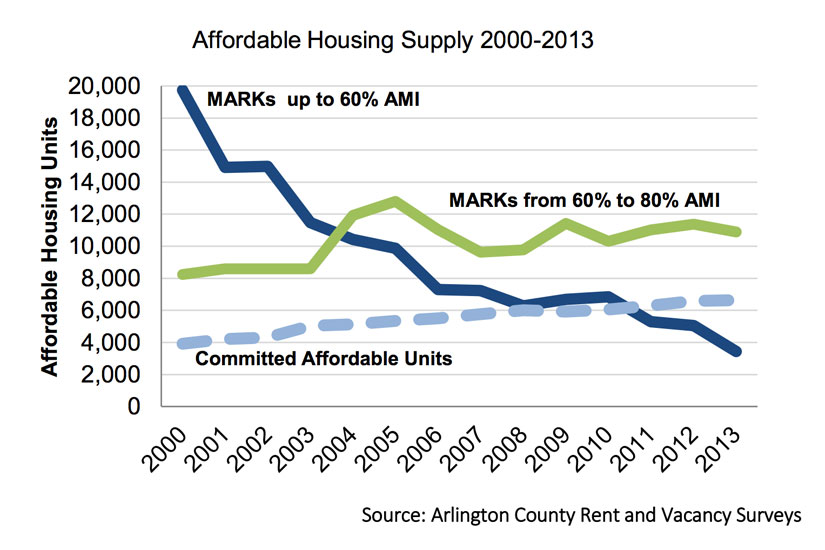 In Arlington, housing is typically considered “affordable” for households that make less than 60 percent of the area’s median income (AMI), or $64,480. According to a press release from the county, only 9 percent of housing in Arlington is currently affordable to that group of residents.
“There is insufficient affordable housing to meet the demand of renters” with incomes below 60 percent of AMI, the county says.
As part of its Affordable Housing Master Plan, the county also plans to incentivize the creation of 2,700 moderately-priced homes that would be affordable to buy for those to those who make between 80 to 120 percent of the area median income.
Moderate income renters will not, however, see an increase in housing opportunities under the plan.
“The County’s current rental stock sufficiently serves both families, and single-person households, who have incomes above 80 percent of AMI,” the plan concludes. It thus envisions trying to preserve existing 60-80 percent AMI committed units while focusing on creating new committed units for sub-60 percent AMI residents.
While the additional housing would help low-income households in Arlington, the county also identified renters over 65 years old, families and racial and ethnic minorities as the target population for these affordable units.
The need for committed units to replace disappearing market-rate affordable units is particularly acute. A county study found that market rate units affordable for those under 60 percent AMI in Arlington may all but disappear by 2020.
Support for affordable housing among county policymakers is strong. Arlington’s housing efforts are generally supported by all five County Board members and each of the four candidates for County Board have expressed support for affordable housing programs to varying degrees at one point or another.
Some critics, however, contend that the county’s new plan is unrealistically expensive and will require considerable additional housing density and school capacity.