Rain in Ballston (Flickr pool photo by Kevin Wolf)

APS Graduation Rate Rises to 92 Percent — Arlington Public Schools’ graduation rate rose to 92 percent for the Class of 2014, up from 85.2 percent in 2010. The dropout rate declined to 3.8 percent this year and the graduation rate for Arlington’s three comprehensive high schools reached 98.7 percent. “This steady improvement is a reflection of the teamwork of everyone working together to ensure that our students succeed,” said Superintendent Dr. Patrick Murphy, in a statement. [Arlington Public Schools]

Company Promises In-N-Out Delivery — As a publicity stunt, food delivery service OrderAhead is offering to deliver frozen In-N-Out Double Double burgers from California today to addresses Arlington and D.C. Even though In-N-Out is famous for food that’s never frozen or pre-packaged, the offer is apparently proving popular for those with a craving for the west coast chain. Currently, a website set up to provide more information about the promotion is down. [Eater]

County Board Supports Nonpartisan Redistricting — The Arlington County Board voted unanimously on Tuesday to support nonpartisan redistricting of state legislative boundaries. Democratic Board Chairman Jay Fisette said partisan redistricting leads to “stagnation and gridlock,” while independent Board member John Vihstadt said it produces “toxic partisanship in Washington and Richmond.” [InsideNova]

Flickr pool photo by Kevin Wolf


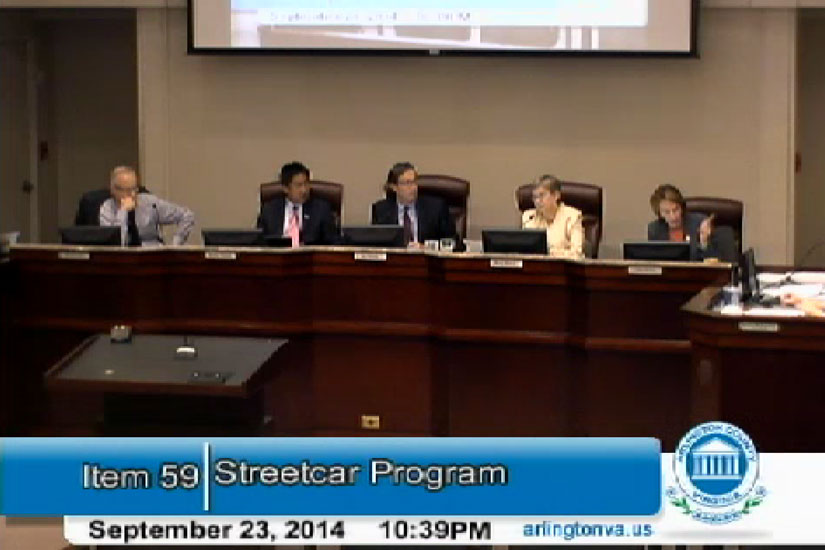
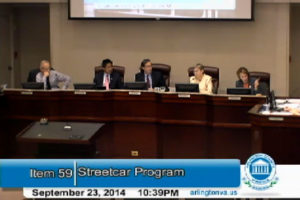
Arlington County Board Streetcar discussionA significant milestone has been reached for the Columbia Pike and Crystal City streetcar — the county has approved an engineering and design contract for the 7.4-mile system.

Last night, after a two-hour discussion, the Arlington County Board voted 3-2 to approve a contract with HDR Engineering for $26 million for preliminary design and engineering work on the project. Fairfax County has committed to paying $3.2 million of the contract for their segment of the streetcar, from Bailey’s Crossroads to the Skyline neighborhood. The $26 million is 5.4 percent of the projected $481 million streetcar project.

The contract is the first step to Arlington’s goal of the system becoming operational in 2020. While the county has spent millions funding studies and surveys to prove the streetcar is the best transit system for the Pike’s future, this contract is the first going to actually laying the groundwork for the system itself.

“I believe that this decision is a major milestone to keeping us on track to start streetcar service in 2020,” County Board Chair Jay Fisette said at the meeting. “We think long-term. We make long-term decisions, we don’t think just about the next month or next election. We created a Columbia Pike plan over many years. Think about the Clarendon Sector Plan or the Rosslyn Sector Plan. How would you feel if you went through those years and years of meetings and then have someone change that plan? I think we need to have some integrity and recognize the engagement that we’ve had.”

HDR is the firm that designed the streetcar in the District’s H Street NE corridor, but has also designed streetcar or lightrail systems in New OrleansPhoenix and is designing a 122-mile rail system in Denver, Colo. As part of the contract, there’s a $5 million clause for “optional work,” which includes helping the county with deciding how to actually construct the streetcar. The preliminary engineering and design is expected to take 18 months.

According to the staff presentation, the contract stipulated HDR provide:

  • Studies of area surveys, traffic, utilities, soils, structures, environmental conditions and mitigation
  • Achieving 30 percent design status for roadway work, track alignment, power, signals, stations and facilities
  • Vehicle specifications
  • Plans for property acquisition
  • Updated construction cost estimates
  • Technical support for outreach and coordination

Thirteen speakers addressed the County Board on the issue — 11 in favor, and two opposed — a somewhat muted turnout considering the divide the streetcar has generated in the Arlington community.

“We have waited for a very long time for this project,” said Juliet Hiznay, an Arlington Heights resident. “It occurs to me that sometimes one of the worst things government can do is delay decisions. I think we’ve seen that play out on the school side with the lack of comprehensive planning, and we’re really paying for it now.”

David DeCamp, a real estate developer and former Arlington Chamber of Commerce chairman, spoke in favor of the streetcar, saying it will fund future investments in schools and will be “great for all of Arlington.”

“Frankly,” he said, “it’s something that’s been promised to the developers who have built three or four beautiful properties on the Pike so far.”

Penrose resident Stefanie Pryor opposes the streetcar, but in acknowledging that it was likely to pass, said she hoped for an auditor to be included in the contract and direct stipulations to ensure the materials and cars used for the project are appropriate and functional.

“You get some nasty surprises with commercial off-the-shelf [vehicles] unless you put it explicitly in the contract,” she said.

Board members John Vihstadt and Libby Garvey, elected largely on platforms opposing the streetcar, both railed against the contract and the streetcar in general, with Garvey positing that the streetcar system would move fewer people and deliver a worse return on investment than an enhanced bus system.

“I would maintain that we are plunging ahead on something we are not really ready for that I don’t think is really justified,” she said. “We are spending all this time and effort and money on seven and a half miles of tracks and wires that can take us to where we can go now, but slower.” (more…)



Cameras will be installed on school bus stop sign Drivers who speed past school buses when their flashing red stop signs are extended will soon be caught on camera and fined $250.

The Arlington County board approved a policy on Tuesday night to install high-resolution cameras on the “stop arms” of school buses to catch drivers who don’t stop to protect children.

“Any car passing a stopped school bus, throw the book at them,” County Board Chair Jay Fisette said.

The cameras will automatically capture photos and video of any vehicle that passes a school bus from behind or the front when it is stopped with its driver’s side stop sign extended.

The images will be reviewed by a vendor selected by Arlington Public Schools through a competitive bidding process and then sent to the Arlington County Police Department. Police will then send citations to the vehicles’ registered owners.

The cameras will be installed and operated at no cost to APS, which will share ticket funds with the vendor and reimburse ACPD for reviewing the footage. According to County Board documents, in Falls Church a school bus camera vendor receives 75 percent of revenue in the first year of a contract, 60 percent in the second year and 50 percent in subsequent years.

The $250 fines will be payable to Arlington Public Schools, which may earmark the money for school bus and pedestrian safety programs.

“This is not about money, it’s about safety — and the red light cameras aren’t either. It’s about saving lives and reducing injury,” Fisette said.

County Board members opted to push back the effective date of the ordinance to Feb. 1 to put in place policies on storing, accessing and sharing the recordings.

Board Vice-Chair Mary Hughes Hynes said she wanted to balance children’s safety with privacy concerns.

“I’m very concerned about wandering in here without some conversation about what the limits and our expectations are,” she said.

Lt. Mike Watson said the images caught on camera will be held for 60 days if an infraction is recorded, and then deleted.

“If there are no violations issued, that information will be purged 10 days after use,” he said.

If the cameras were to record another crime, the footage could be released only by court order, Watson said.

Violators will receive warnings, not tickets, for the first month the cameras are used. ACPD has issued an estimated 700 citations in the past five years to drivers who pass stopped school buses.

Photo via Flickr/madame_furie


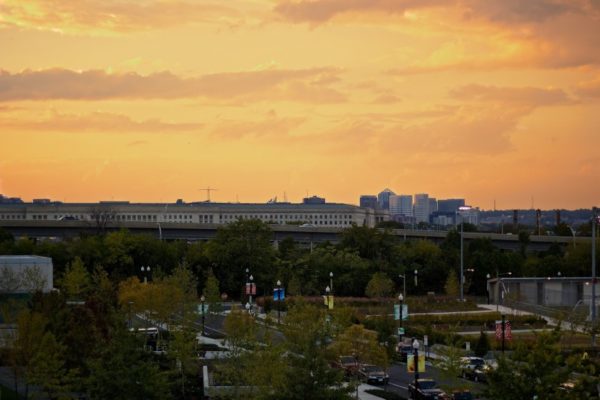
Sunset over Long Bridge Park, the Pentagon and Rosslyn (Flickr pool photo by Joseph Gruber)

County Can’t Stop In-Home Gun Sales — Concern was raised during the public comment period of Saturday’s Arlington County Board meeting about a resident of Fairlington who’s selling weapons out of his home. The Board responded to the complaint about the weapons sales, saying it can’t stop the business from operating as long as it has all the proper permits. The resident has been trying to find a retail location to open a gun shop. [InsideNova]

Cyclists Encourage Cycling Etiquette — A sidewalk stencil appeared in Rosslyn earlier this year, encouraging those on the Custis Trail to “make us bicyclists look good.” One local blogger has four tips for conscientious cycling. [Ode Street Tribune]

Prescription Drug Take-Back Day in Arlington — The Arlington County Police Department will participate in National Prescription Drug Take-Back Day on Saturday, Sept. 27. Police personnel will be on hand at three Arlington fire stations to accept “potentially dangerous expired, unused, and unwanted prescription drugs,” no questions asked. [Arlington County]

Flickr pool photo by Joseph Gruber


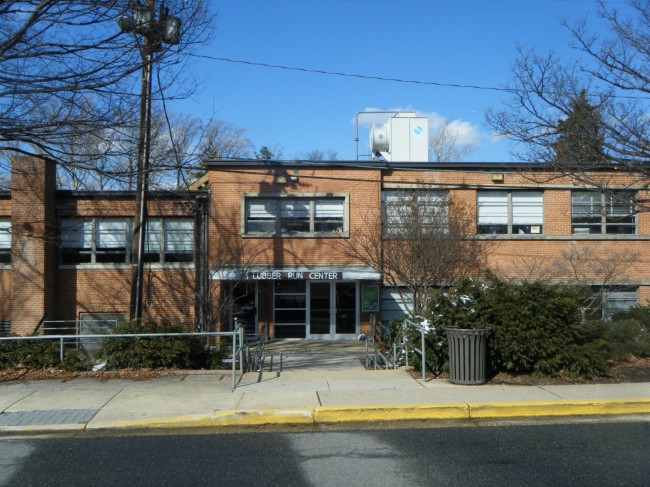
Lubber Run Community Center (photo via Arlington County)Arlington County is receiving some pushback over its “Public Land for Public Good” affordable housing and school capacity initiative.

Specifically, the identification of the Lubber Run Community Center (300 N. Park Drive) as a site for potential affordable housing has drawn the ire of the 76-unit townhouse community Cathcart Springs, across N. George Mason Drive from Lubber Run.

Arlington is expected to begin studying Lubber Run, the “salt dome” along Old Dominion Drive and land adjacent to Jennie Dean Park in Shirlington as county-owned land that could be developed or redeveloped into affordable housing. The community planning portions for those sites, if approved by the Arlington County Board, would begin next spring.

The county is already accepting online comments on the proposed sites, and recently extended its deadline to receive those comments by a month, until Oct. 31.  The association is passing out flyers to its residents, encouraging them to send this comment to the county:

“Using park and recreation facilities should be preserved for future generations and should NOT be considered for conversion to alternative uses. Once beautiful parkland is gone, it is gone forever. Preserve LRCC as a recreation/community center only.”

So far, the county has received about 70 comments, according to the county’s Department of Community Planning, Housing and Development.

“Many of the comments suggest revisions to improve the proposed site evaluation guidelines,” CPHD spokeswoman Jessica Margarit told ARLnow.com today. “Other comments range from concerns about preserving parkland to ensuring that affordable housing locations are balanced across the entire county.”

Cathcart Springs Homeowners Association President Sandy First told ARLnow.com that she’s not opposed to affordable housing — far from it — but that site should not be considered. She also said Cathcart Springs has teamed up with the Arlington Forest Civic Association to rally against the proposal.

“I’m not against affordable housing at all, it’s just that most of it is [in the 22203 ZIP code],” she said. “Across the street at Lubber Run you’ve got an opportunity over there. With the community center, playground and amphitheater, it could play into an incredible array of programs.”

The opposition to Lubber Run’s redevelopment joins opposition from the Old Dominion Civic Association to plans to redevelop the “salt dome” site, for which adjacent green space had originally been slated for a new fire station and emergency management headquarters. That plan has been scaled back since as the county mulls its options, but the County Board approved $28 million to redevelop Lubber Run.

Photo via Arlington County


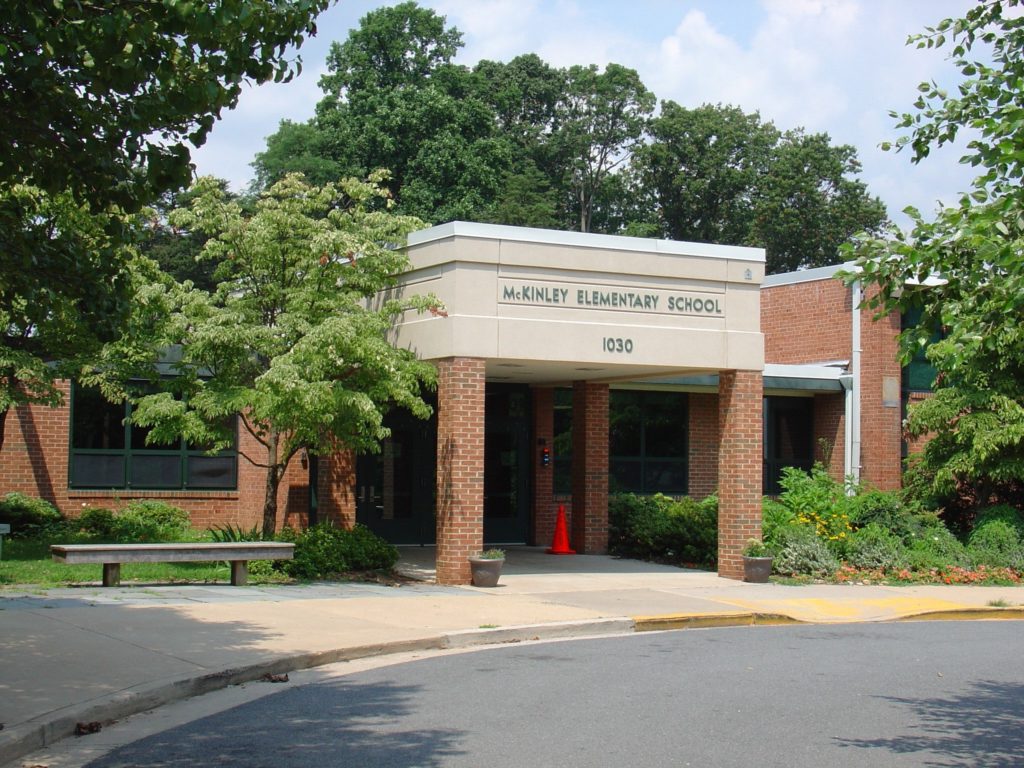
McKinley Elementary School (photo via Arlington Public Schools)McKinley Elementary School will grow by about 241 seats thanks to a $20.5 million expansion approved by the Arlington County Board at its meeting on Saturday.

The expansion will add a 33,040-square-foot addition in the northeast corner of the school, at 1030 N. McKinley Road, and smaller additions in the southwest corner and at the main entrance to the school. The project is expected to be complete by the beginning of the 2016-2017 school year.

An expansion of this size would, according to the county’s Zoning Ordinance, necessitate that Arlington Public Schools add 108 parking spaces. But because open space and a number of mature trees surround McKinley, the County Board approved plans to add just 20 spaces to the existing 36 spaces. Even those 20 spaces were the source of controversy; the county’s Planning Commission and Transportation Commission recommended adding no spaces and instead using street parking to accommodate the additional staff and parent vehicles.

Advocates from the school and community who were a part of the planning process, including McKinley Principal Colin Brown, spoke in favor of adding the 20 spaces.

“I’ve said from the start that we enjoy a fantastic day-to-day relationship with the neighbors and the community,” Brown told the Board. “At this point, the neighborhood is able to handle the volume of staff and parents parking on the street given the current capacity of the parking lot. We’re at a tipping point. We need to maintain a fine and delicate balance.”

Ultimately, County Manager Barbara Donnellan recommended keeping the 20 spaces in the plan, and the County Board approved it unanimously. Only three members of the general public spoke, two of whom, School Board candidate Audrey Clement and Jim Hurysz, decried APS’ inability to expand schools “up, not out,” which would save green space. Despite that opposition, County Board Chair Jay Fisette marveled at the lack of animosity toward the plan, which marked the expansion of Ashlawn Elementary School.

“I think it is quite a testament to this process that we had three speakers,” he said. “This is one of the easiest things I’ve seen to come before the Board.”

To make way for the school expansion, 78 trees will be removed — 12 of which are gingko trees that will be transplanted elsewhere in the county. Nearly 150 trees will be planted once construction is complete, according to APS Director of Design and Construction Scott Prisco.

“We feel strongly this is a sensitive approach to the neighbors, and it will meet our needs as a school system,” Prisco said.

In total, the expansion will mean a net increase of 32,250 square feet and include 10 new classrooms, two art rooms, two music rooms and expand the gymnasium to have enough space for the entire, expanded school. The expansion will also add a stage. Construction will include pedestrian improvements on N. McKinley Road and 11th Street N.

Photo via APS


County Board 2014 budget hearingArlington is investing in its water management systems to replace aging pipes — some of which are 87 years old — and keep pace with development.

The Board unanimously approved master plans on stormwater and water distribution on Saturday, which aim to maintain a clean water supply and reduce the risk of flooding.

“Arlington is committed to providing safe and reliable drinking water to our residents and ensuring that our community complies with environmental law and remains sustainable,” Arlington County Board Chair Jay Fisette said in a statement. “These plans will allow us to meet the demands of projected population growth and help restore the health of the Chesapeake Bay.”

About a third of the storm sewer system in the county needs additional capacity to reduce flooding risks, according to the county’s assessment. And a total of 11 miles of aging steel and terra cotta storm sewer pipes — some 87 years old — need to be replaced.

The average age of the county’s water mains is 55 years, Water, Sewer and Street Bureau Chief Harry Wang said earlier this year. Between Jan. 8 and Feb. 20 alone, the county had to perform 89 repairs on water mains — and average of 2.1 breaks per day, Wang said.

The approved plan estimates the capital cost per year for stormwater-related projects to increase from $2 million per year to $3.3 million per year, depending on what external regulations require.

Home construction is responsible for a spike in the amount of surfaces like streets, rooftops and sidewalks that can’t absorb runoff, the report said. “Single-family home projects accounted for the majority of pollutant load increases from development activity in the county during the time period studied [from July 2009 to July 2013],” the document said.


Squirrel in a water fountain (Flickr pool photo by Wolfkann)

Wilson Blvd Sidewalk Improvements Delayed — Arlington County Board members were apologetic on Saturday after a resident complained about the state of sidewalks along Wilson Blvd in the Bluemont area. The first phase of an improvement project, which will only consist of repaving and restriping the road, is now not slated to take place until the spring. County leaders promised to try to implement the second phase, which will actually improve the sidewalks, sooner rather than later. [InsideNova]

Bar to the Rescue in Crystal City? — Crystal City property owner Vornado hopes Highline, a new bar coming to the neighborhood, will help its growing tech community there after work. Vornado is trying to restyle Crystal City — which has lost government tenants for millions of square feet of office space, as a result of BRAC — as a tech hub. [Washington Post]

Neighborhood Conservation Projects Approved — A $2.5 million slate of four neighborhood improvement projects was approved by the County Board on Saturday. The projects include three in north Arlington and one in south Arlington. [Arlington County]

Bank Robber Sentenced — A D.C. man who robbed two Wells Fargo banks in Arlington has been sentenced to 35 years in prison, federal prosecutors announced. James Link, 57, was accused of robbing a Wells Fargo branch on Nov. 25, 2013, injuring an elderly woman in the process, and a branch on Dec. 31, after which he and an alleged accomplice were arrested by FBI agents who were waiting outside. [U.S. Dept. of Justice]

Flickr pool photo by Wolfkann


Arlington police carThe Arlington County Police Department will likely have 141 new gas masks at its disposal soon, courtesy of the federal government.

The gas masks come from a $81,958 “urban area security” grant, courtesy of the U.S. Department of Homeland Security. DHS’ grant program came into focus in the wake of the protests in Ferguson, Mo., during which local police used military-grade equipment to try to disperse crowds of people.

The grant for the masks is part of $51.8 million that was allocated by DHS for the D.C. metro region in 2012. The gas masks were purchased from a subset of grant money allocated to the Alexandria Police Department, according to Arlington County staff, “to increase response capabilities of tactical teams” in the region. The County Board is scheduled to vote on the grant at its regular meeting this Saturday.

Alexandria has already purchased the masks and “related equipment,” the report says, and ACPD is simply waiting for Board approval before it can receive the masks. The masks are required for the ACPD to be considered a Type 1 tactical response team for responding to disasters, “including terrorism.”

The ACPD says there’s no known cost for maintaining the masks, which have a lifespan of 20 years. After 20 years, the county may have to pay for new masks from its own budget if it hopes for ACPD to maintain Type 1 status, according to the staff report.


A-Town Bar and GrillA-Town Bar & Grill could have its permit for live entertainment and dancing renewed this week, the next chapter in its tenuous relationship with the Arlington County Board and staff.

Thanks to a reduction in noise complaints, County Manager Barbara Donnellan has recommended the Board approve renewal of A-Town’s permit, with another county staff review in three months and another Board review in six months.

“Residents in the community have stated to staff that the site plan condition, which restrict the permitted hours the outdoor cafe can be in use, has significantly cut down on noise-related disturbances,” the county staff’s board report states. “However, disturbances related to overcrowding and over-serving of alcohol still have a negative impact on adjacent properties.”

County staff specifically mentioned an incident during the World Cup final on the afternoon of July 13, when the restaurant was found to be over capacity by “at least 100 people” and Virginia Alcoholic Beverage Control agents “found a truck, parked on the patio, dispensing champagne to the crowd without the proper licenses to do so.”

The County Board last approved the permit’s renewal three months ago, with conditions on limiting the times at which patrons can be on the outdoor patio. The restaurant also planned to install “theater-style curtains” on the patio to reduce noise after the Board’s December use permit review, which saw several residents of the surrounding area complain about the noise the bar was generating. However, A-Town opted to simply close the patio area early instead of putting in the curtains.

A-Town is still waiting for the results of a Virginia ABC Board hearing for a February incident in which, at an employee-only party, police say one man slashed another with a broken beer bottle in the face and neck.

County staff said A-Town gets more police calls than any other “liquor-serving establishment,” with or without live entertainment, in the Ballston area. It also “continues to have issues with compliance with local and state laws and regulations.” The situation has improved since the June decision to close the outdoor café at midnight on Fridays and Saturdays and even earlier during the week, but the County Board could still revoke the live entertainment permit at its meeting this Saturday.


Four projects aimed at improving pedestrian safety, removing invasive plants and more are likely to be approved at this Saturday’s regular Arlington County Board meeting.

The final four projects funded by the 2012 Neighborhood Conservation bond, approved in June by the Neighborhood Conservation Advisory Committee, will receive a total of $2,540,175 if the Board approves them. About $1.3 million of those funds would come from the 2012 bond, while about $1.2 million is expected come from the bond referendum on the ballot on Nov. 4.

The four projects up for approval:

  • Pedestrian safety and street improvements for the intersections of N. Vacation Lane with N. Stuart and N. Utah Streets in Donaldson Run. Improvements include replacing a yield sign with a stop sign at the northeast corner of N. Stuart Street, replacing sidewalks on N. Utah Street and curb extensions at both intersections. Total cost: $608,749.
  • Street improvements for N. Quintana Street between Washington Boulevard and 19th Street N. in East Falls Church. This includes constructing curbs and gutters on both sides of the road and installing a 5-foot-wide sidewalk on the east side on the street. Total cost: $756,581.
  • Park improvements for Oakland Park at 3701 Wilson Blvd. in Ballston-Virginia Square. This project is meant to give the park a complete upgrade, bringing features up to Americans with Disabilities Act standards and adding new site furnishings, ornamental plantings and wood decking. Total cost: $798,845.
  • Removing invasive plants from Lucky Run Stream in Fairlington-Shirlington. The project calls for creating a “pollinator habitat between the stream bank and bike trail” and creating buffers with trees on either side of the stream. Total cost: $376,000.

The four projects were selected from a pool of 26 applications from neighborhoods around the county because they scored the highest on the NCAC’s points system, which is explained in the county staff’s report.

The county also has produced a five-minute video, embedded above, in honor of the Neighborhood Conservation Program’s 50th anniversary.

“When it was created in 1964, the goal was to empower residents by having them come together to discuss and share ideas for improving their neighborhoods,” the narrator says. The video includes interviews from NCAC Chair Bill Braswell and other committee members. “Over the years, the program has moved from beautification efforts to focus more on infrastructure needs… The program enables residents to identify and plan projects in their own neighborhoods.”


View More Stories