
Arlington’s quest to opt out of the Secure Communities immigration enforcement program has hit a brick wall. U.S. Immigration and Customs Enforcement Director John Morton tells the Associated Press that local governments cannot withdraw from Secure Communities, because the program is between states and the federal government.

Secure Communities checks the immigration status of those booked into local jails by comparing fingerprints sent to the FBI’s criminal database to an ICE immigration database. Because the fingerprints are first sent to the state, which then sends them to the FBI, local communities can’t opt out, Morton said.

He also dispelled the notion that Secure Communities forces local police departments to enforce immigration laws.

“No one in the Department of Corrections, no one in Arlington County, no one in the other jurisdictions of Virginia is being asked to enforce federal immigration law,” Morton told the AP. (That, despite this press release announcing the successful conclusion of a joint local, state and federal immigration enforcement operation in Virginia last week. Morton himself traveled to Richmond to join Gov. Bob McDonnell and Attorney General Ken Cuccinelli in announcing deportation proceedings against 13 immigrants convicted of sex crimes in Virgina.)

On Thursday, Arlington County Manager Barbara Donnellan sent a letter to Morton asking for clarification on whether Arlington can withdraw from Secure Communities. Morton says he’ll meet with individual localities to discuss the issue.

So far, federal authorities say Secure Communities has helped facilitate the removal of 40,000 criminal illegal immigrants.

At the board’s behest, Arlington County Manager Barbara Donnellan sent a letter to U.S. Immigrations and Customs Enforcement Director John Morton yesterday, seeking clarification on whether Arlington can withdraw from the Secure Communities program, and, if it can, how it may do so.

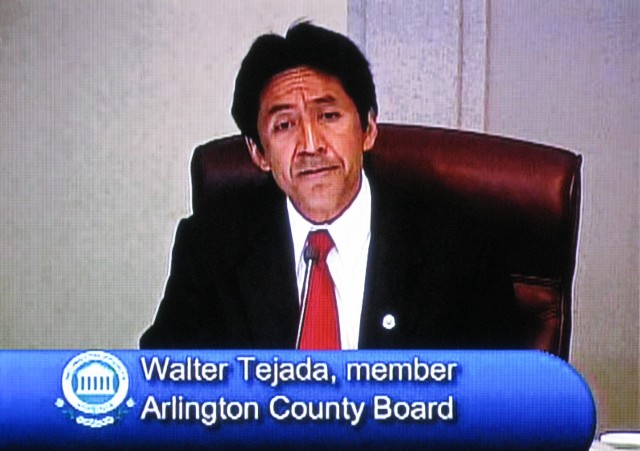
“We need to ask him to clarify this conflicting information we’ve been getting,” county board member Walter Tejada said in a telephone interview last night. He was referring to a recent Washington Post article that suggested communities will not be able to opt-out of the immigration enforcement initiative, as the county board had been led to believe.

“Once we have that clarification, and we better understand what else we need to be asking, we’re going to go from there,” Tejada said.

The board’s effort to opt-out of Secure Communities received a public endorsement this week when the New York Times ran an editorial calling on the Obama administration to accomodate the request. San Francisco, Santa Clara, Ca. and the District have also expressed interest in opting out of the program.

“Washington needs to find a way to allow cities like San Francisco and Washington to enforce the law without turning into a branch of ICE,” the Times said.

(more…)


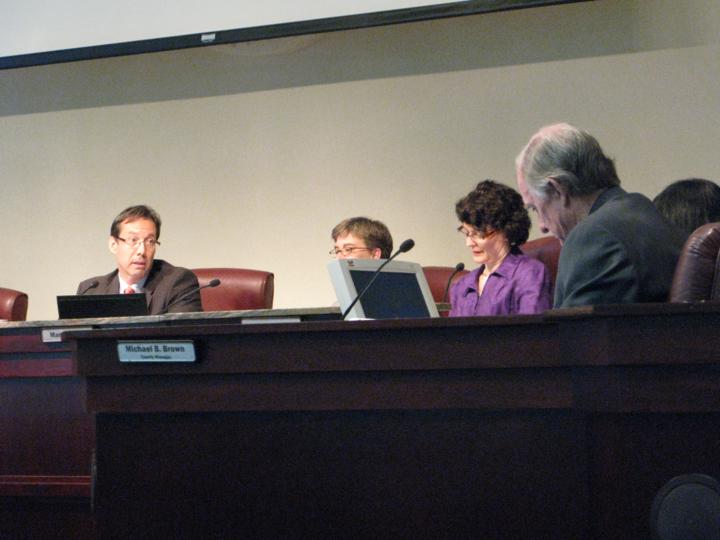
Former Arlington County Manager Michael Brown was asked to step down by the county board after it was decided he wasn’t a good fit for the county, Jay Fisette revealed for the first time Wednesday night.

Fisette, speaking at the Arlington County Democratic Committee’s monthly meeting, acknowledged that Brown’s sudden resignation and his $110,000 severance payout left more questions than answers last week. Video of the speech was posted on YouTube by the Blue Virginia blog.

“I understand some clarity is maybe required regarding the severance payment,” the county board chairman said. “I know there’s been some conversation in the community.”

The severance “was fully consistent with the terms of his contract, and was not discretionary,” Fisette continued, contradicting the official line that Brown resigned due to his wife’s health. (His contract included a clause that required a severance payment of half his $220,000 salary in the event of termination without cause.)

As for why the board dumped the executive it hired after a seven-month, nationwide search just four and a half months into his tenure, Fisette didn’t get into much detail.

“When the board determined that Mr. Brown’s fit with our organization was not what we had hoped for, Mr. Brown was given the opportunity to submit an official resignation letter to the county board,” he said.

As for Brown’s replacement, Fisette heaped praise on long-time county employee and former interim county manager Barbara Donnellan, who was sworn in as the county’s first permanent female county manager on Friday.

“We are very fortunate to have her at the helm, and she will do us all proud,” he said.


At times, the preliminary budget recommendations from Arlington’s Fiscal Affairs Advisory Commission sound more like something you’d hear on CNBC than at a county board meeting. While recommending that next year’s estimated $25-$35 million budget shortfall be made up by a 50-50 combination of spending cuts and tax increases, the commission says that longer-term changes might be necessary.

“The County may have to make structural changes to accommodate continued significant financial challenges,” the commission said in a three-page report to the county board. “Those changes may include improved efficiencies, outsourcing (to realize improved efficiencies and reduced labor costs) and changes in service levels.”

FAAC recommends that the board “require departments to identify and implement operational efficiency improvements,” and “reduce or eliminate funding for programs that are no longer needed, are not effective, or are no longer affordable.”

The recommendations come at a time when the county will be taking on new operating expenses as a result of several major capital projects. Those projects include the Mary Marshall Assisted Living Residence, Artisphere (which opens this week) and the Columbia Pike revitalization project (which includes the assumption of road maintenance costs from the state).

The commission praised the board for balancing priorities during recent budget cycles, calling the past three budgets “fiscally prudent and responsive to pressing human service needs.”

“Arlington has been fiscally fortunate in comparison to many jurisdictions, in part because of a legacy of strong planning and prudent investments,” the report concludes. “However, the fiscal picture remains uncertain, and we believe that the recommendations contained in this report may provide additional options for the Board to consider in the development of the FY 2012 budget.”


Arlington’s effort to withdraw from the federal Secure Communities immigration enforcement program has hit a big snag. Turns out withdrawing is harder than the county board originally thought.

The program checks the immigration status of individuals arrested by local police agencies by using fingerprints submitted to the FBI. If an offender is a known illegal immigrant, U.S. Immigration and Customs Enforcement asks the local agency to hold the prisoner until immigration officers can take appropriate action.

The Washington Post reports that since local police need to check prisoners’ wanted status via the FBI database, withholding fingerprints from the Feds is not feasible.

“It is most frustrating,” said county board member Walter Tejada, upon learning of the revelation from a Washington Post reporter. Tejada, who championed the resolution that instructed the county manager to take steps to withdraw from Secure Communities, said lawyers and officials spent the summer researching how to opt out of the program.


It was a long night for the county board, which didn’t adjourn its recessed meeting until a few minutes after midnight. In addition to a controversial resolution regarding the Secure Communities program, a briefing on next year’s budget projections and the passage of the Crystal City Sector Plan, the board took a number of other significant actions.

The board heard a presentation by County Manager Michael Brown regarding staff research into the proposed development plan for East Falls Church. Details are available on the county’s web site.

Funds for the design of a better Ballston beaver pond were approved unanimously. The $471,842 contract calls for a new design that will allow the pond to do a better job of treating stormwater while still providing a habitat for wildlife.

A plan to renovate 162 apartments in Colonial Village was approved unanimously. The board looked into concerns about parking and trash expressed by neighboring residents, but otherwise made no alterations.

After another somewhat lengthy discussion about outdoor patios, the board voted unanimously to renew Hard Times Cafe’s outdoor seating permit. The board specified an allowance of four tables and eight chairs on the North Highland Street sidewalk during dinner time.

The board voted 4-1 to advertise a steep fee increase for restaurant and food vendor licenses. The board was careful to emphasize that the fee hike, from $100 to $285, was mandated by the state and already in place in neighboring jurisdictions. The fee would apply evenly to brick and mortar restaurants and mobile food vendors.

At the very end, the board approved some sort of settlement with the owner of the long-delayed Bromptons development in Cherrydale. Update at 11:15 a.m. — The settlement deals with a dispute between the owner and the county over utility undergrounding. Under terms of the settlement, Bromptons owner R15, LLC will pay $255,000 to a utility fund.


Just before the unanimous vote that would approve a sweeping plan to redevelop Crystal City, county board chairman Jay Fisette paused for reflection. Looking back at the four and a half year process of crafting the plan, Fisette remarked that it “an amazing moment and a startling success.”

Then, with five “ayes,” the board set in motion a 40-year development process that will transform the dated, hodgepodge apartments and office buildings in Crystal City into a gleaming, high-density, pedestrian-friendly urban district.

Initially conceived as a response to Crystal City’s impending loss of thousands of jobs as a result of BRAC, the Crystal City Sector Plan is meant to ensure a bright future for the oft-maligned but economically-crucial neighborhood. On numerous occasions last night, speakers pointed out that Crystal City currently produces the lion’s share of commercial tax revenues for Arlington County.

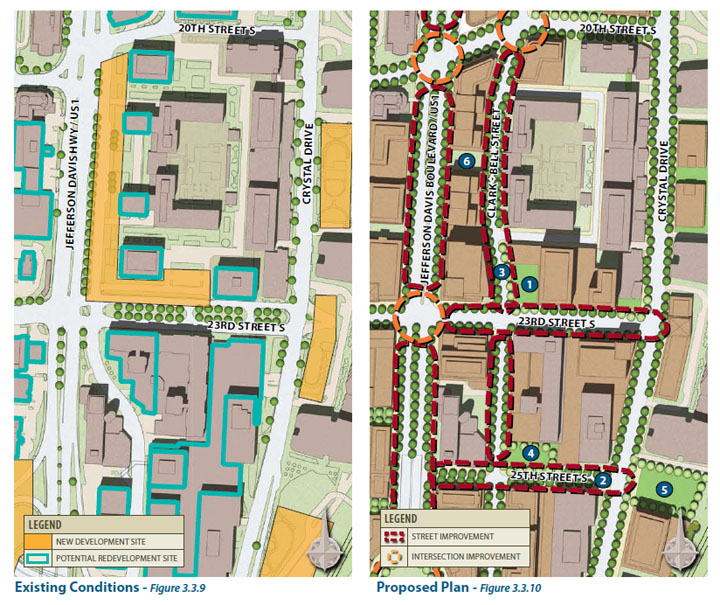
Among other alterations, the plan calls for the creation of a streetcar line, significant changes to the street grid, and an additional 15 million square feet of mixed use development through 2050.

Although some speakers compared last night’s vote to the 1970s-era growth plan that laid the groundwork for the now-vibrant Rosslyn-Ballston Metro corridor, others spoke of the hardships the Crystal City plan might inflict on surrounding neighborhoods.

Too much density, not enough open space and an increase in traffic through neighborhood streets were the most-repeated charges. Others complained that the plan did not provide enough of a transition from high-rise development to the single-family neighborhood.

Largely, those complaints were addressed by the final version of the plan, which included a traffic monitoring mechanism, a citizen advisory board, and a mandate to study ways to smooth the transition at the edge of development. The Aurora Highlands Civic Association unsuccessfully argued for a delay in the vote so those last-minute changes could be further reviewed by residents.

(more…)


Despite an improving real estate market, Arlington could face up to a $35 million budget gap next year, according to a presentation by County Manager Michael Brown this afternoon.

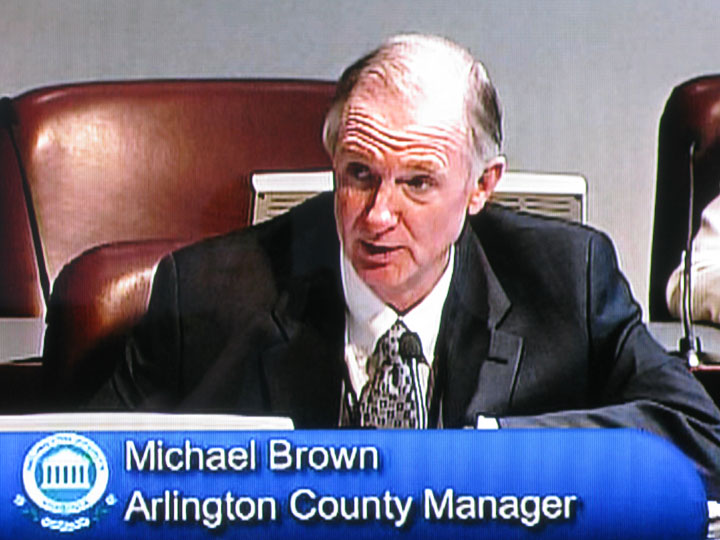
Brown told the county board that his preliminary forecast anticipates a combined $25-35 million shortfall for the county government and the school system. Brown projects a slight increases in real estate assessments and in tax and fee collections. However, he says expenses are rising due to increasing student enrollment, new school facilities and high county personnel costs.

“Current revenue projections could require program cuts and revenue increases,” Brown said. That’s in addition to the past two years of budget cuts and tax hikes.

“We must continue to be extremely cautious fiscally,” Brown said. He will present his recommended FY 2012 budget to the board in February.


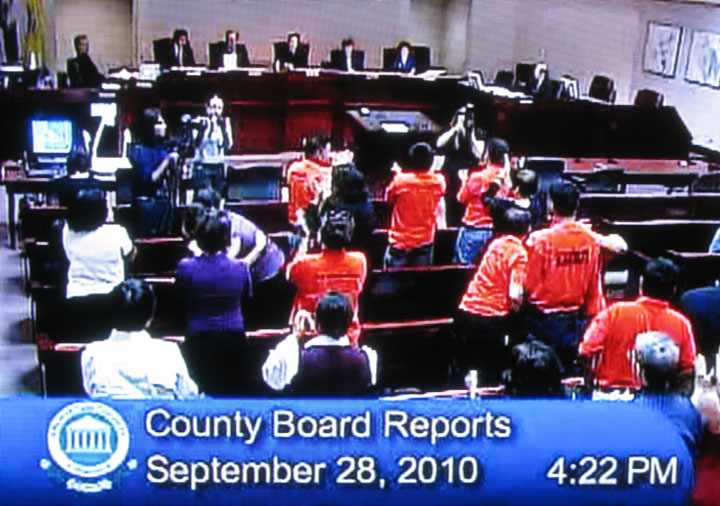
The Arlington County board voted Tuesday afternoon to become the first community in Virginia — and one of the only communities in the country — to withdraw from the federal Secure Communities immigration enforcement program.

Following an impassioned presentation by board member Walter Tejada, and without further discussion, the board voted 5-0 to direct County Manager Michael Brown to formally notify Virginia State Police and U.S. Immigration and Customs Enforcement of Arlington’s intention to withdraw from the program, which Virginia implemented statewide earlier this year.

“This is something that was imposed on Arlington County and other jurisdictions,” Tejada said. “They didn’t ask our opinion, there was no public process.”

“Arlington county remains firmly committed to the protection of civil rights and civil liberties for all people,” Tejada added, saying actions by the state government have created “an anti-immigrant sentiment, regretfully.”

“We’ve had a pattern of measures that seek to score cheap political points on the backs of working immigrants,” he said.

Tejada said Arlington County law enforcement would maintain its current policy of only reporting undocumented immigrants directly to federal authorities in the event of serious crimes. He argued that the Secure Communities program is actually a hinderance to police.

“There are concerns among Arlington County law enforcement and our residents that the Secure Communities initiative will create divisions in our community, and promote a cultural fear and distrust of law enforcement that threatens communities and makes communities less safe,” Tejada said, reading from the text of the resolution.

The resolution also calls on the U.S. Congress to “enact meaningful and comprehensive immigration reform that provides a path to citizenship” for undocumented immigrants.

A crowd that included at least a dozen immigration rights advocates rose to their feet and cheered after the vote. Many hugged and some whistled and threw their hands in the air.

In a joint statement following the vote, Arlington Sheriff Beth Arthur and Police Chief Douglas Scott said that the resolution will not change the way their respective departments enforce the law.

“Our goal remains unchanged – we are here to keep this community safe,” the statement reads. “And to do so, we must rely on strong partnerships and relationships with everyone in our community. We want to make sure that all people – regardless of their country of origin – continue to report crimes and do not fear interacting with Arlington County law enforcement.”

Update at 10:25 p.m. — The county has posted a text of the resolution here.


The Aurora Highlands Civic Association is asking the Arlington County board to delay a scheduled vote on a sweeping, 40-year development plan for Crystal City, to allow more time for resident review.

The board is scheduled to vote on the Crystal City Sector Plan at its 6:30 p.m. meeting tonight. But Aurora Highlands urban planning committee chairman Ted Saks says the county was unable to deliver an updated version of the plan to the association’s emergency meeting last night, prompting the call for a delay.

Saks says a meeting with County Manager Michael Brown two weeks ago has produced positive changes, including pledges of a traffic monitoring plan, a citizen advisory board, and a study of ways to smooth the transition from the high-density development that will surround Route 1 and the single-family home neighborhood to the west.

However, since the county could not deliver a final version of the plan that includes those changes, the association is requesting more time for resident review.

It’s unclear whether the board will grant the request.

The Crystal City Sector Plan has been in the works for years, and includes such changes as a new entrance to the Crystal City Metro station, a streetcar line to run along Crystal Drive, dense mixed-use development with ground-floor retail, and changes to the street grid that could result in existing apartment buildings being torn down or significantly modified.


It’s not listed on the official agenda, but this afternoon the county board is expected to take up a resolution that could affect the way immigration laws are enforced in Arlington.

According to a group that supports the “controversial” resolution, its passage would “limit participation” by Arlington police in the federal Secure Communities program and would make Arlington the first Virginia county to “take measures protecting the sanctity of local law enforcement.”

“We support the Board’s efforts to distinguish Arlington law officers from federal immigration agents,” Tenants and Workers United spokesperson Esteban Garces said in a statement. “This resolution in an important step in the right direction. We fully expect continued leadership from local officials on this important issue.”

Tenants and Workers United is one of about a dozen immigrant advocacy groups that are expected to attend the board meeting at 3:30 this afternoon. The resolution will likely be taken up at the beginning of the meeting, during board reports. Board member Walter Tejada will introduce the resolution, but his assistant and county communications staff were unable to provide a text of the resolution.

Currently, Arlington Police only report undocumented immigrants directly to federal authorities in the event of serious crimes. By Virginia law, however, anyone booked at the Arlington County jail has their fingerprints taken and sent to the state, which in turn checks the fingerprints with FBI and U.S. Immigration and Customs Enforcement databases.

On its web site, Arlington County says it “complies with all federal and state laws related to immigration” but adds that “it is not the role of Arlington County law enforcement to enforce federal immigration laws.”

It’s unclear at this time what effect, if any, the resolution will have on current policy.

See our update on the county board’s vote here.


View More Stories