The Arlington County Board unanimously approved a $959.9 million FY 2011 budget on Saturday. The budget includes a 8.3 cent property tax rate hike, 24 percent higher than the recommended 6.7 cent increase in the county manager’s proposed budget.

Together with fee increases totaling about $71 a year, the tax burden on the average household will increase by about $346 per year.

Arlington’s residential property tax burden will now total $0.958 cents per $100 of assessed value, which is still lower than most neighboring jurisdictions.

The board said it was responding to public concern over some of the spending cuts outlined in the county manager’s budget. Dozens of people spoke out against many of the cuts at public budget hearings, although the majority of speakers at a separate tax rate hearing spoke out against raising taxes.

Among the line items rescued from the chopping block as a result of the tax hike:

  • Community policing
  • The second of the fire department’s two heavy rescue units
  • Emergency management personnel
  • Merit pay raises for county staff
  • Metro funding increase
  • The Aurora Hills and Lee senior centers
  • Sunday hours at the Central Library
  • Funding for library materials, such as periodicals
  • Park maintenance and nature centers
  • Partial funding of non-profit organizations, arts grants

“This budget reflects the values of our community,” County Board Chairman Jay Fisette said in a statement. “We listened to residents and acted to preserve core services and our quality of life. We have also been fiscally prudent, making deep and sometimes painful cuts that affected services and reduced staff. This budget ensures Arlington’s fiscal sustainability while protecting the most vulnerable among us.”

Read more about the budget from the Washington Post or the county’s website.


A group of civic activists has formed the “Coalition for Arlington Good Government” (CAGG) to push back against an effort to change Arlington’s form of government.

The group’s goal is “to inform Arlington residents about the negative impacts of the proposal behind the petition drive.”

CAGG has set up a Facebook page with the slogan “Decline to Sign” and is in the process of launching a website.

The coalition’s co-chairs are Bill Bozman, Judy Connally, Alan Howze and Kris McLaughlin.

More from CAGG’s press release, after the jump.

(more…)


The Committee for a Better Arlington is firing back at a memo released by the County Attorney’s office yesterday. The memo concluded that the change-of-government plan promoted by the committee would be “a step backwards for the County.”

The committee just issued a strongly-worded statement (below) and pointed us to a memo from Ron Carlee, the previous county manager, which talks about the limitations of the County Manager Plan of government currently in place in Arlington.

Here’s the full statement:

It is disappointing that taxpayer dollars spent on the County Attorney’s salary were used for the overtly political memo disguised as a legal opinion on this ballot initiative.

The Committee for a Better Arlington was established in order to improve the current form of government in Arlington County so that it is more accountable and responsive to its citizens. It was established to improve the transparency between elected officials and Arlingtonians. More importantly, it was established to curtail the power an unelected bureaucrat has over the services and citizens of Arlington.

Prior to embarking on this initiative, the Committee for a Better Arlington deliberately reviewed the various forms of government provided for in the Virginia Code. The Committee felt the County Board form of government was the least disruptive yet responsive form of government that would remedy the faults in the current system – mainly communication and transparency with the County Board.

To date, thousands of Arlington registered voters have signed the petition expressing the same desire to improve Arlington County. This is not simply a matter pushed by Arlington’s police and fire unions to increase their pay.

If the County Attorney believes those who are pushing this change are naive then he believes the thousands of Arlington voters we meet each weekend at grocery stores, metro stops and farmers’ markets are also naive. Perhaps these voters will be equally naive come November and vote to improve the current system – one that places political expediency over better government practices.


A proposed change to Arlington’s form of government would “significantly impair” the county board’s effectiveness, and would invite “certain mischief” among elected officials, according to County Attorney Stephen MacIsaac.

In a memo to county board members, MacIsaac says the change would transfer some of the county government’s current powers to the state and would “compromise and even eliminate the County’s ability to achieve long established goals.”

The change-of-government proposal is sponsored by the Committee For a Better Arlington, which is endorsed by the Arlington Green Party, the Arlington County Republican Committee and the police and fire unions. The committee is currently trying to collect the 14,350 signatures necessary to put the proposal to a voter referendum.

If approved, the proposal would change Arlington’s government from the current “County Manager Plan” to the “County Board Form,” as outlined by state law.

The County Board Form calls for board members to be elected by districts, rather than at-large, and it would result in the board being elected all at one time, instead of holding separate, staggered elections.

MacIsaac said such a change could cause the “balkanizing” of county politics. Instead of promoting the interests of the county as a whole, there could be “competition among board members for funding and staff time for the betterment of one district over others.”

The change would also apply to the school board, “creating the possibility that schools in some districts would fare better than those in districts of less influential, powerful, or persuasive members.”

The County Board Form would give the board some of the executive powers currently entrusted to Arlington’s unelected county manager. Control over personnel matters, including appointments and compensation, would be transferred to the county board, “potentially introducing a form of political patronage not possible under the County Manager Plan.”

The county’s purchasing agent would report directly to the county board under the plan, presenting “the opportunity for undue influence in the award of contracts, and favoritism generally in the competitive procurement process.”

The change would also prevent the board from enforcing a human rights ordinance that prohibits all forms of discrimination, MacIsaac says. The board’s authority would be limited to the classes proscribed under state law, which does not include sexual orientation.

MacIsaac argues that the County Board Form was designed for a more rural county and is not suited to a large, wealthy, urban county like Arlington. As an example, he cites a state requirement that County Board Form governments establish a department devoted to agricultural and practical continuing education.

“It is naive to believe it is possible to change the form of Arlington’s government and expect the many powers Arlington now enjoys to neatly transfer into the comparatively small box afforded by the County Board Form,” MacIsaac concludes. “Adoption of the County Board Form would be a step backwards for the County.”


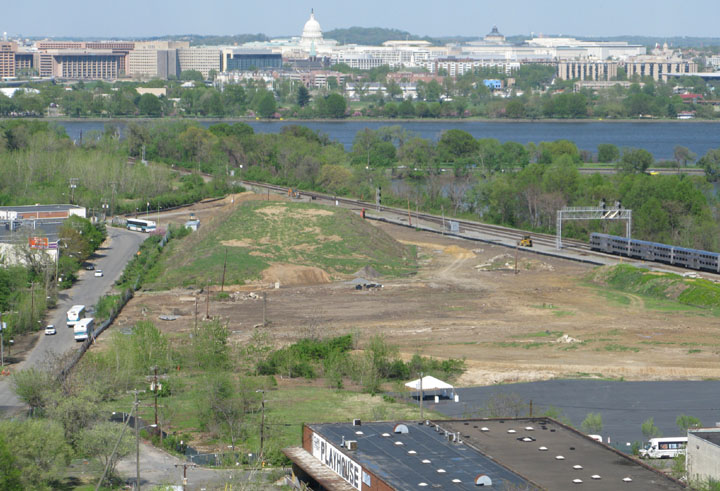
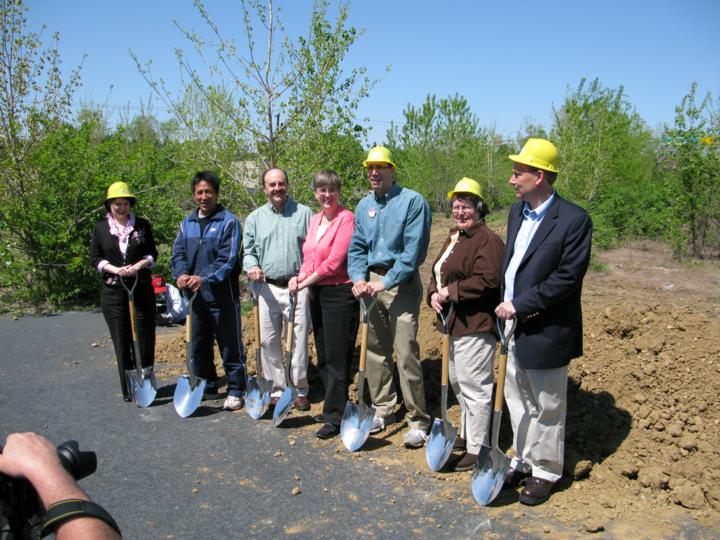
Arlington County leaders officially kicked off the $50 million Long Bridge Park construction project Saturday afternoon.

The park is being built just north of Crystal City, adjacent to Old Jefferson Davis Highway, on perhaps the largest open, undeveloped parcel of land left in Arlington County.

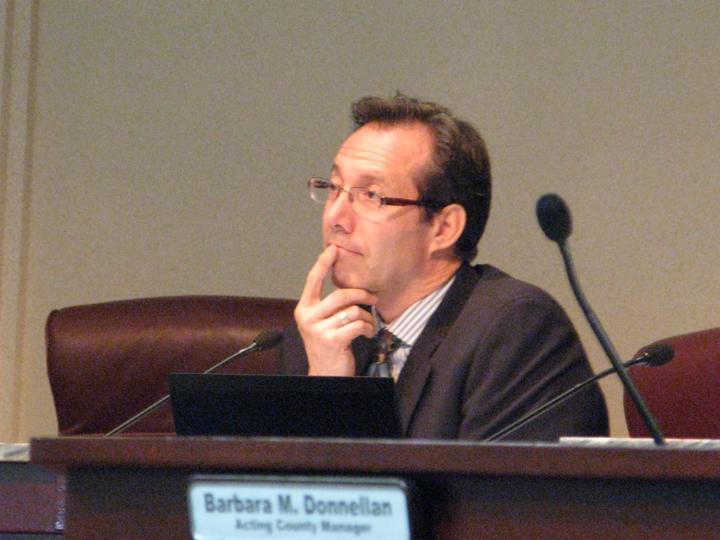
Speaking before the ceremonial shoveling were Arlington County board chairman Jay Fisette, park Design Advisory Committee chairman Toby Smith, and acting county manager Barbara Donnellan. State delegates Bob Brink, Patrick Hope and Adam Ebbin were in attendance, along with Arlington board members, county staffers, and park planners.

“This has been a long time in coming, and some of us thought it would never come,” joked Smith (see his speech here). The project has faced delays due lead and PCB contamination found on the former industrial site, as well as complications caused by the fact that the site is on a Reagan National Airport flight path.

Just over five years ago, through a bond referendum, Arlington voters approved funding for first phase of the 46-acre park, which includes three lighted turf athletic fields with synthetic turf, a half-mile long raised walkway, a rain garden and a large public event area.

The funding will also pay for the reconstruction of Old Jefferson Davis Highway, a pothole-ridden, flood-prone stretch of back road that’s perhaps the most poorly-maintained road in the county — and the only way to reach the park. The construction will include bike lanes, on-street parking, landscaped medians and street-side tree plantings.

If all goes according to plan, the park will open as early as the summer of 2011.

A second phase of the park, for which the county is seeking private funding, will include a state-of-the-art aquatics and fitness center with a 50 meter pool, a 10 meter diving platform, a therapy pool, exercise rooms, and a child care center.

(more…)


A group of German students from Arlington’s sister city of Aachen, Germany has managed to fluster members of two Arlington governing bodies nearly simultaneously.

The group of nearly two dozen students attended last night’s county board tax rate hearing. They were acknowledged by board chairman Jay Fisette at the beginning of the session. Fisette assumed they were going to stick around to watch American democracy in action. Instead, seven minutes into the hearing, they all suddenly got up and left en masse, which caused some board members fits of laughter (see video below).

Meanwhile, at the school board meeting (which, for some reason, was held at the same time as the county board hearing), board members were told at length about the exchange students and the host parents and the sister city program. But when the puzzled-looking presenter asked if there were any Aachen students in the audience, apparently expecting at least a few to be there, the Germans were nowhere to be found.


The following represents the views of the author, not of ARLnow.com.

Yesterday the Arlington Bicycle Advisory Committee asked the County Board to recognize the importance of cycling in Arlington as it considers next year’s budget allocations. As any look at our streets will tell you, cycling in Arlington is at an all-time high. Bike lanes are put to good use, the trails are filled with commuters, and bike racks at Metro stations are full.

We are pleased that Arlington County actively promotes cycling, and that County Board Chair Jay Fisette has made it a central part of his agenda this year. In fact, the County Manager’s proposed budget does not specifically target any bike-related funding for cuts (to the best of our knowledge). But we do worry that some may mistake such funding for simple recreational funding. This is not the case and the County Board should resist any such suggestion as it finalizes the budget, perhaps being tempted to cut already-low funding further.

Cycling for transportation and health is — for individuals —  a relatively low-cost choice. However, creating a safe and encouraging environment in which to make that choice does require help from the County. To that end, we respectfully suggested that:

  • Bike Arlington’s ongoing efforts — such as coordination of Bike to Work Day, the Arlington/DC Community Bike Ride, and many other outreach efforts — be fully supported in the budget.
  • The county take seriously the goals and commitments it made in adopting the bicycle element of the Master Transportation Plan.
  • The county provide funding to adequately maintain its existing facilities. Prime transportation arteries like the Custis Trail — which gets thousands of users a day — are in such a state of disrepair that some cyclists even find it dangerous to ride in certain places.

We also reminded the County Board that adequate street paving isn’t just important to those who drive cars. It is also important to cyclists, who often find themselves unable to safely negotiate potholes in traffic – especially the kind that now exists after this winter’s snows. One possible source of improved efficiency (and thus cost-savings) could be found in directing the Department of Environmental Services to take responsibility (from the Department of Parks, Recreation and Cultural Services) for funding the paving and maintenance not just of on-road bike lanes, but also for the Custis and other trails that serve as major transportation corridors.

The Arlington Bicycle Advisory Committee and other local cyclists believe that during difficult economic times, the County should remain committed to making our streets and trails safe for bikes. Cycling provides a low-cost and healthy transportation option, reduces roadway congestion, and is something all Arlington citizens can enjoy.

Mark Blacknell is Chair of the Arlington Bicycle Advisory Committee. Mark also provided the photo.


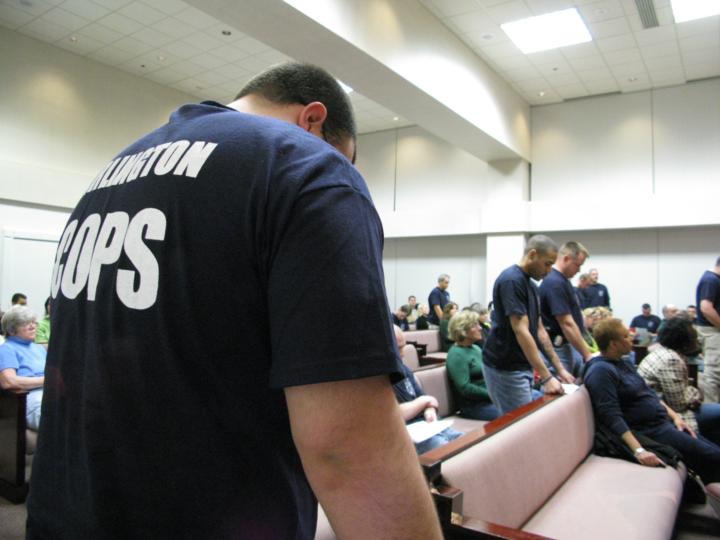
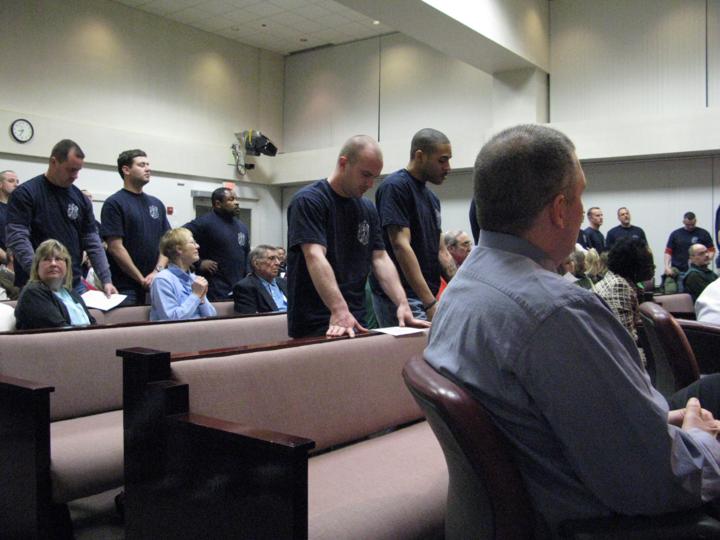
Twenty-three Arlington police officers attended Tuesday night’s board meeting to speak out against a proposed four percent decrease in police department funding. The cuts would result in the reduction of 11 officers from the department’s community policing force and four positions from other parts of the department.

In addition, certain regularly-scheduled pay increases would be frozen and health care costs would increase. Officers say despite promises and words of praise from Arlington leaders, compensation is lower than many comparable local jurisdictions.

“We’re falling behind,” said Ken Dennis, president of the Arlington Coalition of Police union. “We need to keep up with the Joneses.”

Dennis had all the police officers in the room stand up in order to represent the number of officers that will have been lost to budget cuts since 2009 if the proposed budget is approved.

“We make them work harder for less, we do more with less money, [and] we expect them to be happy because they have a job,” Dennis said. “Don’t cut any cops, we shouldn’t have cut them last year.”

David Green, president of the Arlington Police Beneficiary Association, said pay increases haven’t kept up with inflation since 2001.

Brynn Bennett, a six-year veteran of the force, said officers will begin leaving the department if nothing is done to improve conditions.

“We will hemmorrige skilled officers to those agencies that can better help us provide for our families,” Bennett said.

“When you turn your back on the employees, morale hits an all-time low and the ripple effect will be seen in the services provided,” police officer Mike Rowling told the board.”The message is loud and clear: employees are not a priority.”

Rowling suggested the county raise taxes to the advertised rate, which is two cents higher than the county manager’s proposed rate, in order to properly fund the department. The suggestion drew loud applause.


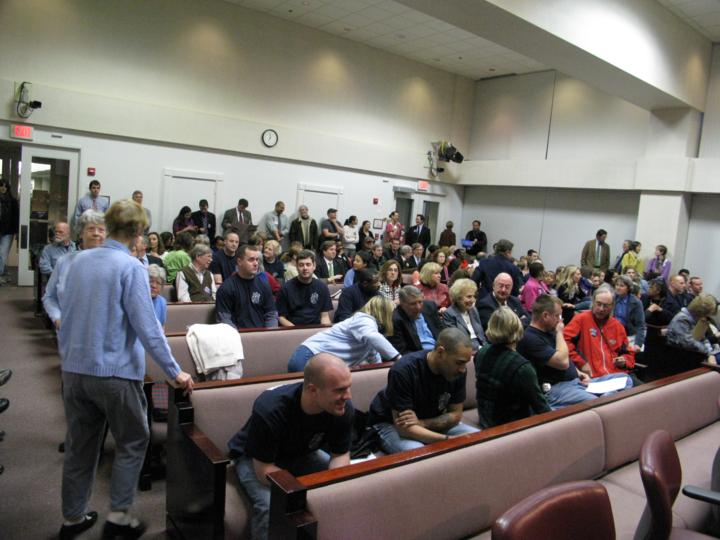
About 150 people packed the Arlington County board room in Courthouse Tuesday night to voice concerns about the county’s proposed budget cuts.

Nearly 80 speakers came to the podium during the three hour public hearing. County residents and employees spoke out against proposed cuts to public safety agencies, substance abuse programs, senior centers, and libraries, as well as environmental, educational and recreational programs and facilities.

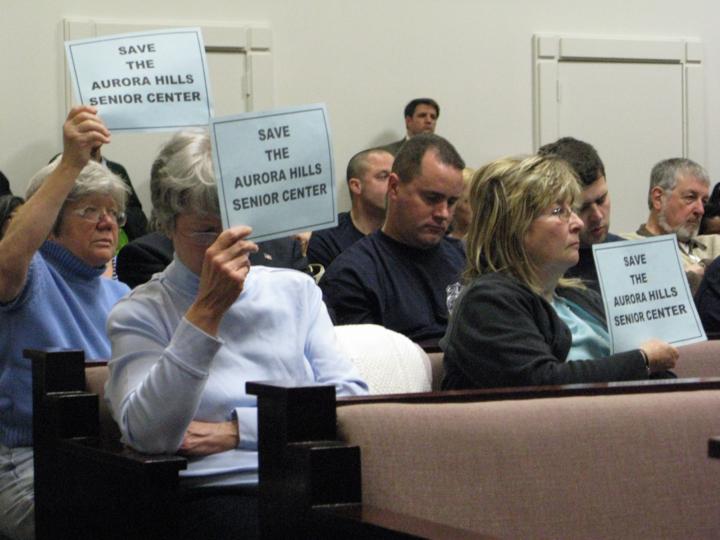
Resident Andrea Walker started the night off on a humorous note, saying board members should consider “self-preservation” before cutting funding to the Aurora Hills Senior Center, which regularly serves about 100 “cranky seniors.”
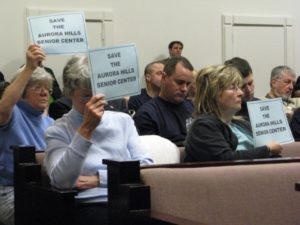
Walker was among eight people who spoke out against the plan to cut funding for Aurora Hills’ part-time senior coordinator. The senior programs “are keeping me alive,” said Frank Minichello, 92. Several others spoke in favor of restoring funding to the Lee and Madison senior centers.

Four police officers – including the presidents of the Arlington Police Beneficiary Association and the Arlington Coalition of Police union – received loud applause for their arguments against cutting police funding. More on that here.

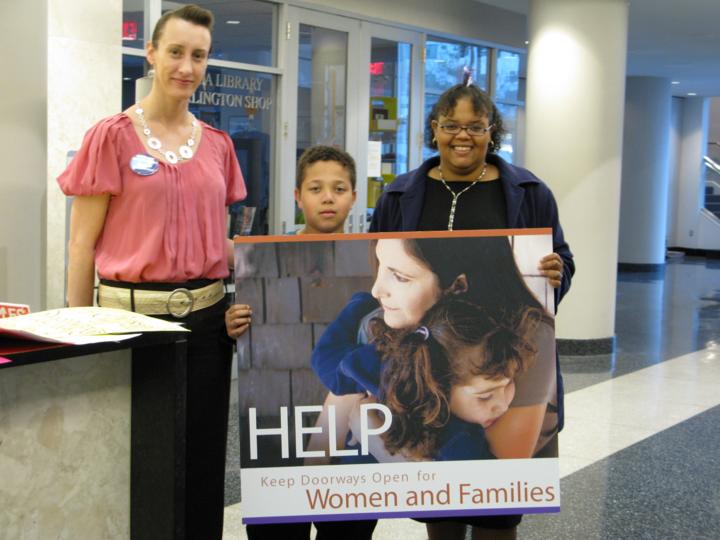
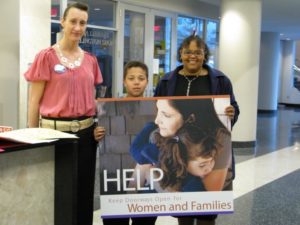
Four people, backed by a larger contingent of supporters armed with signs, fliers and buttons, pleaded for the county to increase funding to Arlington’s Doorways for Women and Families crisis shelter, which has seen a significant reduction in private donations.

A number of residents, speaking on behalf of the Arlington Street People’s Assistance Network (A-SPAN), asked the board to fund a year-round homeless shelter. Among the speakers was Rev. Richard Cobb, of the Central United Methodist Church, who said homelessness will become an even greater problem in the community after the emergency winter shelter closes on April 1.

Half a dozen people, some speaking with the help of an interpreter, asked the county to continue funding Project Family, which provides free early childhood education and parenting programs in English and in Spanish.
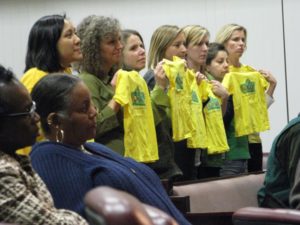
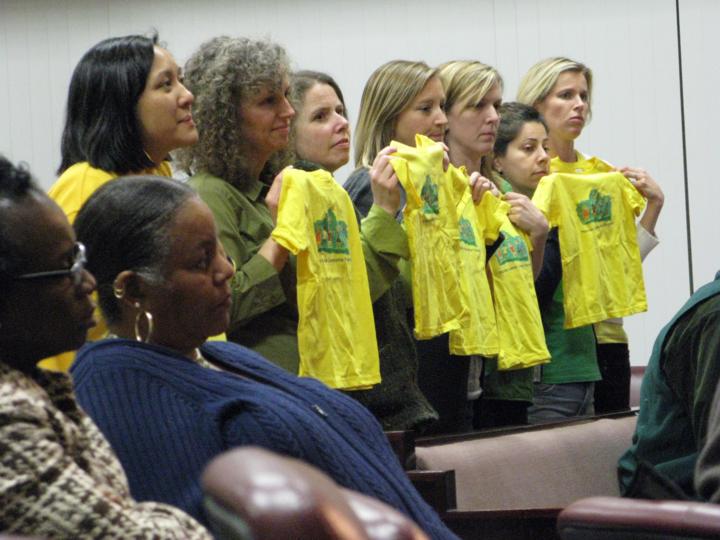
A group of mothers spoke and held up kid-sized t-shirts in support of pre-school and early childhood programs at the Madison Community Center. Shireen Dodini, who participates in a play group at the center, said she knows of seventy families that would be affected if funding is cut.

Three people spoke out against cuts to Gulf Branch Nature Center, which some fear could ultimately lead to its closure. Robert Atkins said cuts to the nature center are untenable, even to a self-described “taxpayer and fiscal conservative.”

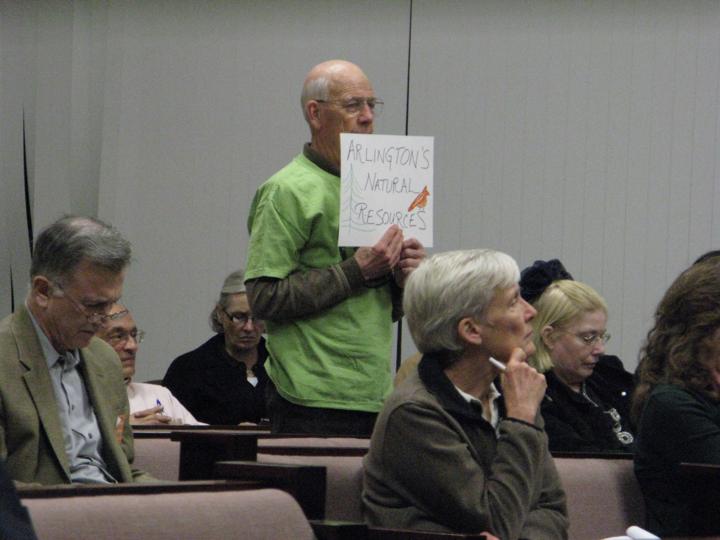
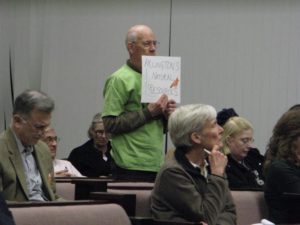
Michael Nardolilli, president of the Northern Virginia Conservation Trust, lamented the “Draconian chop” to funding for natural resources, while a half dozen people in green shirts held homemade signs.
Tricia Freeman, of the Arlington Forest Community Association, asked the county to restore funds to the outdoor amphitheatre at Lubber Run Park. Another speaker, Janet Irwin, said the 1,200 seat facility is being severely neglected.

“It would be a travesty to allow the Lubber Run amphitheatre to deteriorate to a point where it would need to be rebuilt,” Irwin said.

HB Woodlawn senior Benjamin Hubbert presented the board with a student petition against cutting Sunday hours at libraries, saying Sunday is one of the only free days available for busy students. Hubbert also spoke out against cutting periodicals from the libraries.

Other presenters spoke on behalf of Bike Arlington, Encore Stage and Studio, Northern Virginia Community College, and the Clarendon House rehabilitation program, among others.

Sixty-five speakers are already registered for a second budget hearing, scheduled for 7:00 tonight (Wednesday). A public hearing on the proposed tax rate increase will be held Thursday night.
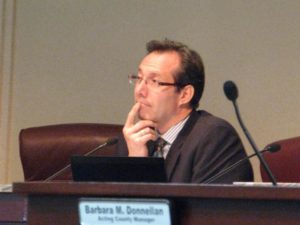

Arlington leaders will now get to hear what the public has to say about the county’s proposed 2011 budget, which includes a tax increase as well as significant cuts to parks, libraries and community policing.

The Arlington County Board is holding a public budget hearing at 7:00 tonight in the board room at 2100 Clarendon Blvd. Another public budget hearing will be held at the same time on Wednesday.

A public tax rate hearing with more restrictive rules on public comment will be held at 7:00 Thursday night.


Arlington will spend more than $2 million for street, sidewalk, streetlight and other community improvements in various locations around the county. The board approved the projects at its meeting last night.

Neighborhoods where projects will take place include Boulevard Manor, Arlington Heights, Bluemont, Alcova Heights, Madison Manor, Arlington-East Falls Church and Waycroft Woodlawn.

More from the Sun-Gazette.


View More Stories