The local NAACP is calling on the Arlington County Board to do more to encourage affordable homeownership opportunities for residents of color.

Although segregation officially ended last century, the Arlington branch of the NAACP says non-white residents are still effectively excluded from some neighborhoods due to county zoning codes, compounded by rising housing costs.

“The widespread single-family zoning scheme that prevents the construction of new housing in affluent, mostly white neighborhoods also worsens racial segregation by confining the construction of new affordable housing units to the Columbia Pike corridor and other parts of Arlington with large non-white populations,” the NAACP wrote in a letter to the county.

“People of color wishing to live in Arlington deserve meaningful opportunities to choose from a wide variety of housing types, in many parts of the county, at a reasonable cost,” the letter continues.

The NAACP says the county needs to adopt a comprehensive strategy to reform the county’s zoning laws and housing policies. It suggests reforms that go beyond those being considered in the Missing Middle Housing Study.

“We support the County’s many studies and other initiatives to promote affordable housing,” it concludes. “The best way to ensure the success of these initiatives is for the County Board and County Manager to show decisive leadership now and commit to supporting comprehensive zoning reform.”

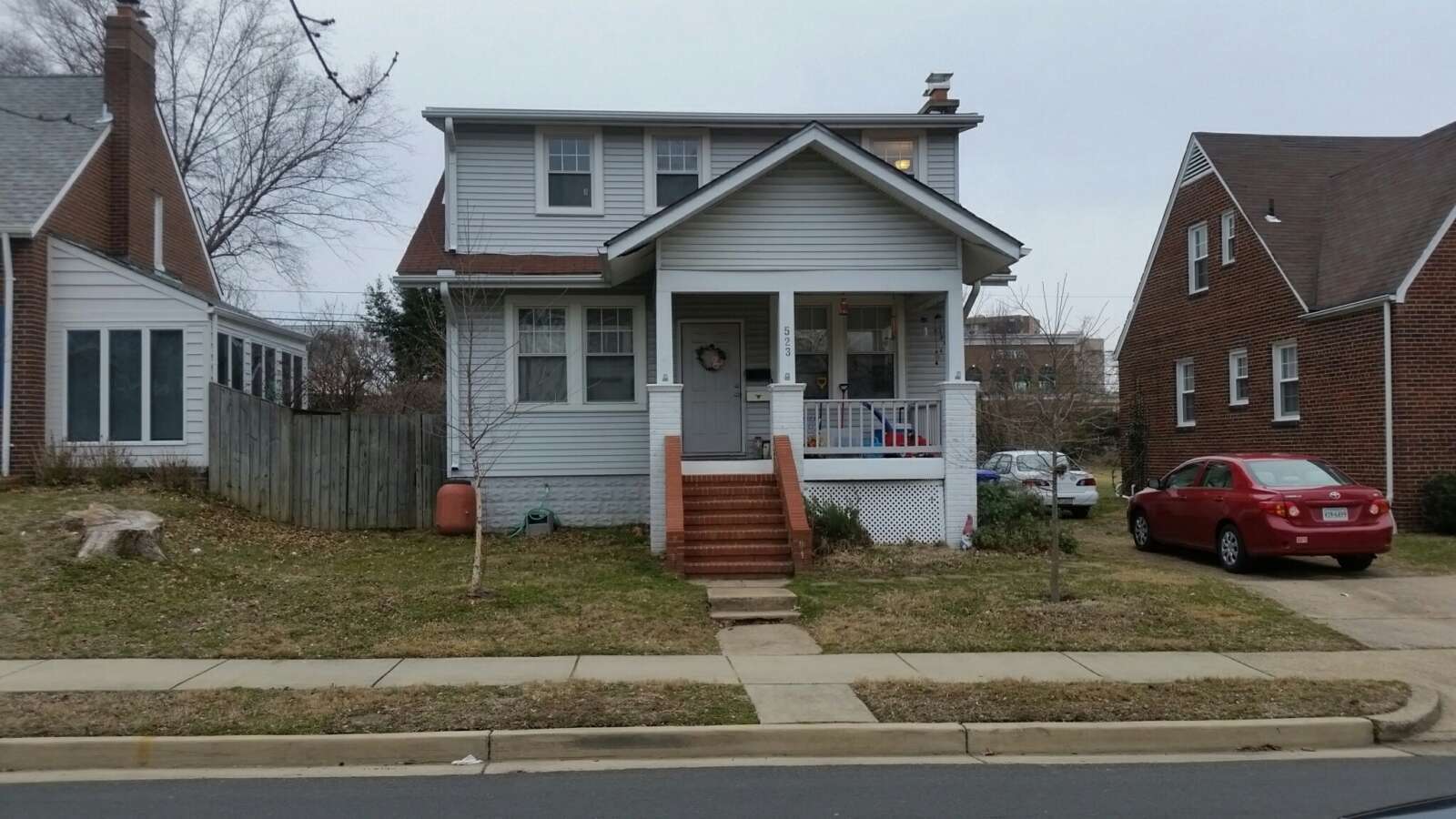
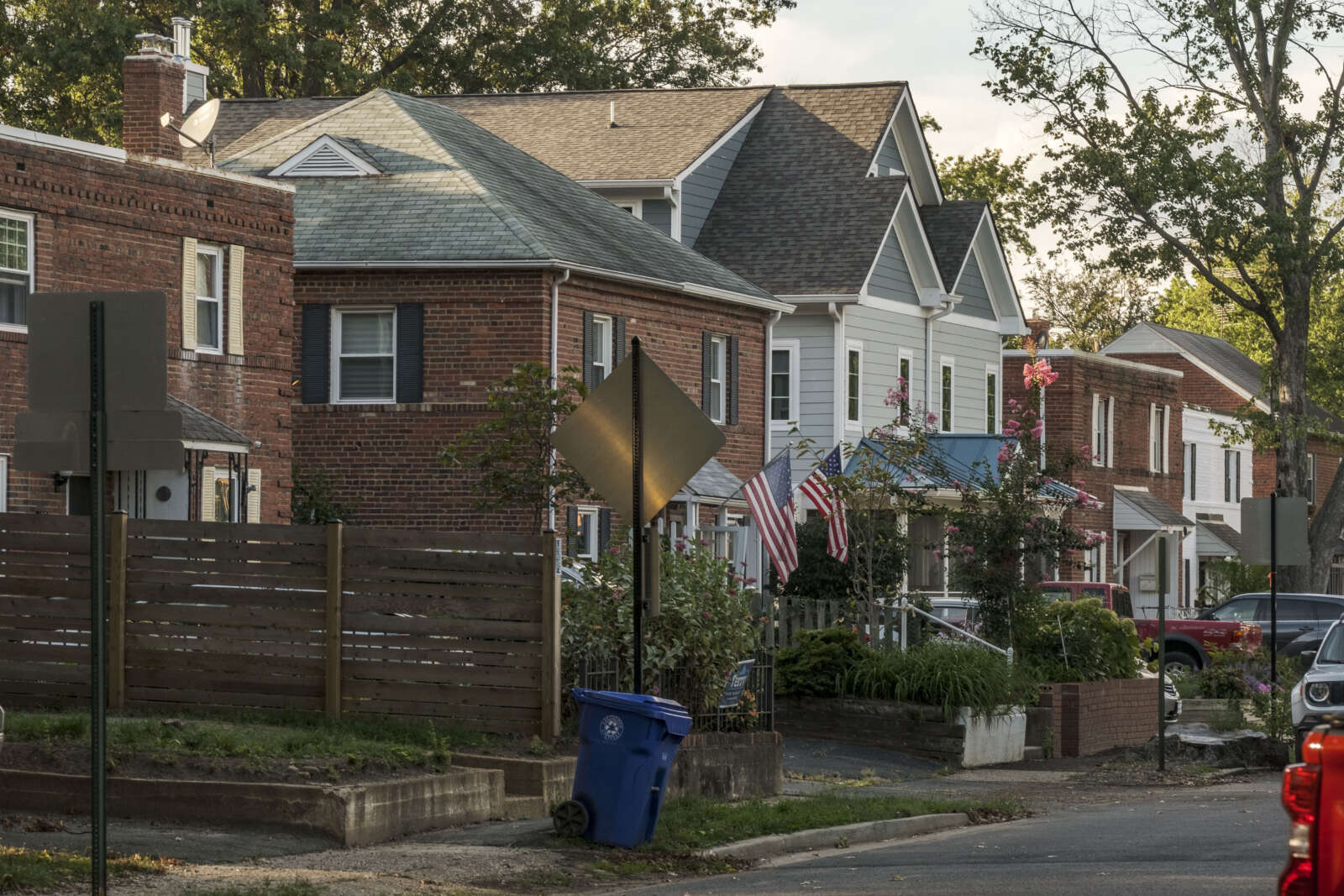
Through Missing Middle, the county is considering whether and what kind of low-density multifamily housing could fit into single-family home neighborhoods. The county says allowing more housing types in these neighborhoods can reverse the lingering impacts of yesteryear’s racist zoning policies.

“The Missing Middle Housing Study has documented the role that Arlington’s land use and zoning policies have played in contributing to racial disparities in housing and access to opportunity,” says Erika Moore, a spokeswoman for the Department of Community Planning, Housing and Development. “Conducting the Missing Middle Housing Study is one of many deliberate choices the County is making to address the mistakes of the past and pave a new path for Arlington’s future.”

While supportive of the study, the NAACP suggests solutions beyond its parameters.

It recommends every redevelopment be assessed for whether it would perpetuate historical exclusion or displace the existing community. If so, developers would have to use a “displacement prevention and mitigation toolkit” to reverse those impacts.

This toolkit could include:

  • property tax deferrals for lower-income homeowners
  • funding for Community Land Trust acquisitions
  • preferences for first-generation homebuyers
  • stabilization funds for residents at risk of displacement

The toolkit would “address the unique needs of and the displacement risk experienced by the community in and around site-plan and by-right developments while also helping to address patterns of historical exclusion experienced by members of protected classes,” the letter says.

These and other tools should also receive county and state funding, like a quick-strike land acquisition account, which would be used to quickly purchase properties for affordable housing development, and targeted homeownership assistance programs, the NAACP says.

(more…)


This regularly scheduled sponsored Q&A column is written by Eli Tucker, Arlington-based Realtor and Arlington resident. Please submit your questions to him via email for response in future columns. Video summaries of some articles can be found on YouTube on the Ask Eli, Live With Jean playlist. Enjoy!

Question: Can you summarize the type of housing inventory one can expect to find in Arlington?

Answer: One of the most beneficial things you can do when starting your home search is to understand if the type of property you want exists in the market you’re looking and, if so, how likely it is you’ll find it. The best way to do that is looking at sales over the past year or so to identify how many properties have the specifications you want, and what type of budget it’ll take to secure it.

For example, if you have your heart set on a lot with at least ½ acre in Arlington, you should know going into your search that just 1% of single-family homes that sold last year sat on ½ acre or more, so you need both patience and a substantial budget.

Condos Nearly Half of All Sales

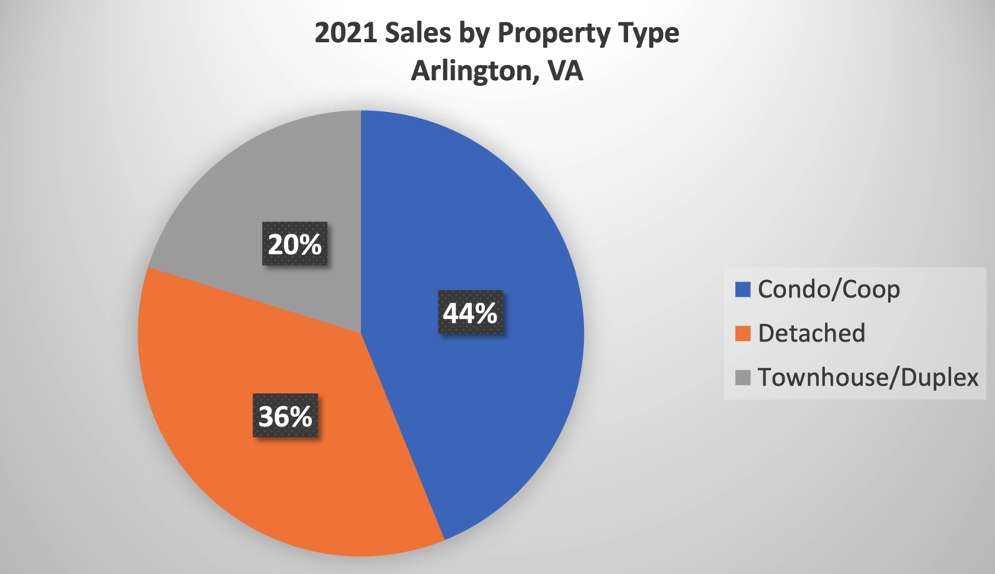
Properties in multi-family buildings represented nearly half of all sales in Arlington last year, followed by single-family homes, and then townhouse/duplex properties. I broke down the data a bit further by bedroom count and pulled out some interesting details about each property type:

  • 5% of condos sold had one or two bedrooms, 4% had three bedrooms (none had more than three)
  • 84% of single-family homes had 3-5 bedrooms, 29% with 3 BR, 34% with 4 BR, and 22% with 5 BR
  • The median price for a home with at least four bedrooms and at least three full bathrooms in North Arlington was $1,455,000 and $1,030,000 in South Arlington
  • 40% of townhouse/duplex properties had just two bedrooms and only 14% had four or more bedrooms

Arlington by Decades

Arlington’s single-family home problem is very much a decade problem. 66% of single-family homes last year were built prior to 1960 (mostly small and expensive to expand) and 14% were built since 2010 (large and expensive). Only 7% of homes sold last year were built from 1970-1999.

Why is this relevant? Because those decades (70s-90s) offer a middle-ground for many buyers — floor plans and square footage that meet the functional priorities of many of today’s buyers but old enough to sell at a steep discount from newer homes. So, we are faced with single-family inventory in Arlington that is either too small or too expensive for many buyers (this is not a comment on Arlington’s Missing Middle Study!).

The age of Arlington’s condo and townhouse/duplex properties is much more evenly distributed by decade, which is generally a good thing for a marketplace.

(more…)


The Garrison residence (courtesy of Les Garrison)

The owner of a two-family home near Crystal City says he may cancel his redevelopment plans because county approval processes have delayed construction and run up costs.

“As of right now, the project is on hold, possibly dead, because the County delayed it so long that the prices of construction (up 40%) not to mention the $150,000 in costs so far to get it approved, have made it unaffordable,” owner Les Garrison tells ARLnow. “The payback time is now unreasonable.”

It’s an outcome that Planning Commission members have said would be avoided if homes like his — duplexes on nonconforming lots — enjoyed the simpler, cheaper reviews that allow owners and developers to replace aging single-family dwellings with larger, luxury homes, sometimes referred to derisively as “McMansions.”

The main difference, they say, comes down to the fact that it’s a multi-family building.

Garrison’s proposal requires community review as well as Planning Commission and County Board approvals because he plans to increase the square footage of his house, which sits on a smaller-than-average lot. But commissioners argue more renovations on nonconforming lots will come forward and the county should preempt them with a faster approval track.

Since these hypothetical projects would update existing low-rise multi-family buildings — which are not permitted in many neighborhoods under current zoning — commissioners suggest considering these changes via the Missing Middle Housing Study. The study’s primary goal is to evaluate whether county codes should allow housing types like as duplexes and townhouses in districts zoned exclusively for single-family homes.

“As much as it’s important to end legacies of exclusionary zoning practices, we also have to be certain there are administrative options for improving and expanding existing multi-unit housing,” Planning Commission Chair Daniel Weir said during a meeting with the County Board and the planning division earlier this month.

Such projects go through Site Plan Review, which major development projects use, but as a potential alternative they could go through the Board of Zoning Appeals, which hears special exception requests from single-family homeowners, James Lantelme, Weir’s predecessor, previously said.

Multi-family homes like Garrison’s and oversized single-family homes are linked in another way: both often result in greater lot coverage, which often means fewer trees and plantings. The relative ease with which “McMansions” are built, compared to similar-sized multi-family units, has led some County Board members to ask the question: if both are permitted, just how big is too big?

Building up to tear down

Opposition to adding density falls into a few buckets, such as impact on existing infrastructure and loss of natural resources.

On environmental degradation, the county says keeping out duplexes won’t preserve neighborhoods from the tree loss and stormwater runoff associated with development, given the teardown-rebuild trend. Adding multi-family homes would, however, open up neighborhoods to people who can’t afford the average sale price for a rebuild in Arlington, which currently stands at $1.7 million.

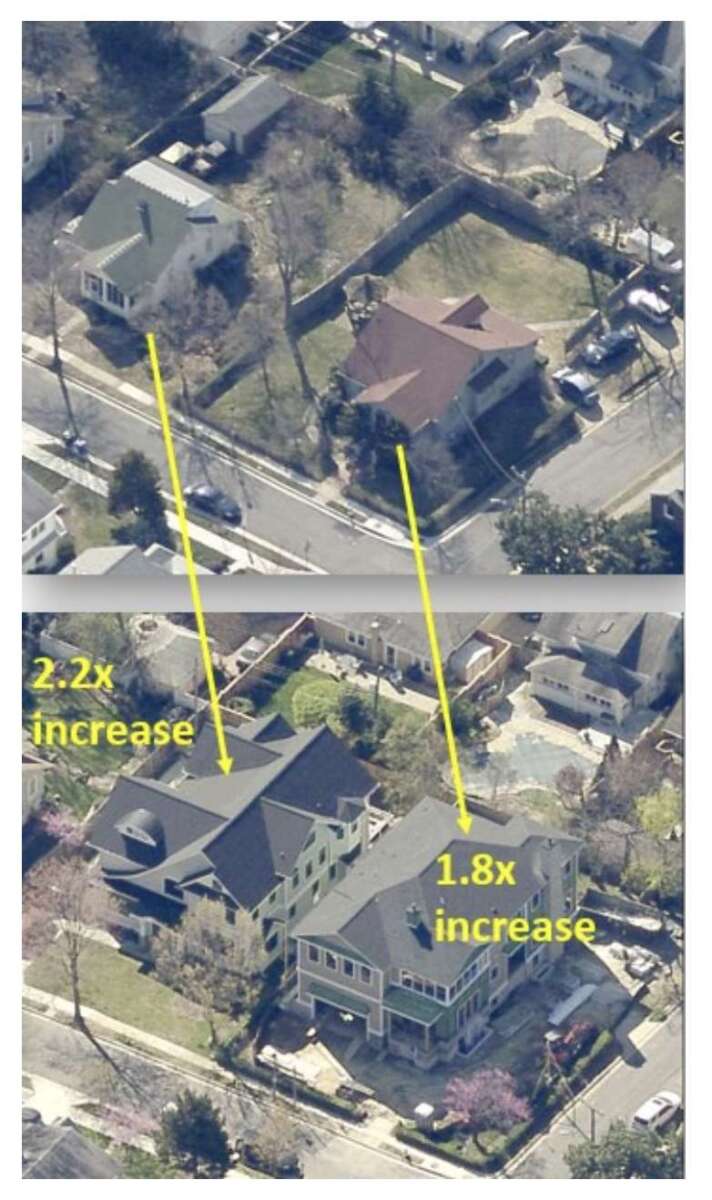
Over the last decade, 1,245 homes came down and were rebuilt, for an average of 125 homes per year, according to a county report. Typically, the tear-downs are 1,515 square feet and the new construction is 4,750 square feet. This contributed to the drop in tree canopy coverage from 43% in 2008 to 41% in 2016, another county report says.

“This is a rather fast-moving problem,” County Board member Takis Karantonis said during the February meeting.

It’s one member Libby Garvey said “we should dip our toes into” through the Missing Middle study.

That’s the plan, says Anthony Fusarelli, Jr., planning director for the Department of Community Planning, Housing and Development.

“Between now and October, we might have a better handle on some emerging recommendations — but I do expect that will be considered in some way,” he told County Board members.

(more…)


Independent County Board candidate Adam Theo (courtesy photo)

(Updated at 3:45 p.m.) The race is on for incumbent Matt de Ferranti’s County Board seat.

Independent Adam Theo announced Thursday morning he’s running for County Board, and another familiar independent candidate, Audrey Clement, intends to run. But de Ferranti doesn’t plan to let go of his seat.

This is Theo’s second time running for the County Board in as many years. Last year, he joined Clement and another independent candidates in what became a crowded County Board race for the spot that Democrat Takis Karantonis occupies. Although his bid was unsuccessful, Theo previously told ARLnow that his campaign would set the groundwork for a full run in 2022 or 2023.

In his second run, his announcement has come out strong against the current board.

“The COVID crisis exposed a disastrous lack of leadership on the board that’s been hiding in plain sight for years,” he said. “They are rubber-stamping each other’s bad ideas, spending big on band-aids instead of investing in smarter long-term solutions, and merely copy-catting ideas from neighboring cities and counties instead of making Arlington the regional leader it should be.”

He’s running on a platform of expanding government accountability, prioritizing public safety and making housing affordable.

Incumbent Matt de Ferranti, who was elected as a Democrat in 2018 to the seat, has not officially announced his run for re-election — yet. He tells ARLnow an announcement is coming.

“I’ve focused on COVID response, racial equity and the priorities I identified when I ran in 2018–affordable housing, hunger, funding our schools to support educational opportunity for all students, fighting climate change, and inclusive economic growth,” he said. “Next week, I will officially announce my intention to seek re-election. I take nothing for granted and look forward to listening to our residents’ concerns and working to earn each and every vote.”

Theo describes himself as “a fierce non-partisan free-thinking ‘progressive libertarian.'” He said he was in the Air Force Reserves as a civil engineer and deployed to eastern Afghanistan. He has also worked as a consultant within the Department of Homeland Security.

https://twitter.com/TheoForARL/status/1486730387162157062

He’s the vice president of the Ballston-Virginia Square Civic Association, a voting delegate to the Arlington County Civic Federation and co-founder of a regional housing advocacy group.

His campaign website says he is opposed to deals the Arlington County Board has given to Amazon, steep increases in property taxes and the “county’s slow progress on housing affordability.”

The experiences he could bring to the county board are unique, he said. He was incarcerated for four months as a young adult in his home state of Florida, has experienced homelessness and has been a longtime renter in search of a home in Arlington County.

“It is these formative life experiences that make me uniquely suited to empathize with and serve all Arlingtonians, and why I will work so hard to be your next independent member on the Arlington County Board,” his website reads.

In his announcement, Theo invited people to attend a virtual open house at 7:30 p.m. tonight (Thursday).

Audrey Clement tells ARLnow she plans to run for County Board this year as well but will announce later. She wants to reduce taxes, stop up-zoning, and preserve parks, trees and historic places. The Westover resident has been a perennial candidate over the last decade and says she believes once people realize the missing middle housing push will rezone some neighborhoods, they will support a candidate like her.

The primary election will be held June 21 and general election on Nov. 8.


What’s Next with Nicole is a biweekly opinion column. The views expressed are solely the author’s.

One of Arlington’s greatest assets is our highly educated population and range of knowledge in various policy topics. With my last column on ARLnow, I want to encourage you to pick something that you are passionate about in our community, and participate in our local government process. As a society, we would be better off with fewer keyboard warriors and more doers.

Commissions & Advisory Groups

Arlington has 50 commissions and advisory groups that are tasked with advising the County Board in their areas of interest. These groups also contribute to planning documents that shape how we operate. When people say things about how “the decision was already made” before it gets to the County Board for a vote, it is because dozens of commission and advisory group members have already given extensive public feedback prior to getting to the County Board for a vote. Meetings are typically once a month for 1-2 hours and you will have staff support for the logistics of getting things done.

Examples of commissions at work in the community: Phase 1 of the Draft Missing Middle Housing Study involved feedback from the Long Range Planning Committee, Commission on Aging, Climate Change, Energy and Environment Commission, Joint Facilities Advisory Commission, Forestry and Natural Resources Commission, Housing Commission and Transportation Commission.

Civic associations

Every neighborhood of Arlington is broken down into geographic areas that are represented by a civic association. Civic associations are your neighborhood advocates and organizers for everything from future development to dog parks to social gatherings. 

Examples of civic associations at work in the community: A group of civic associations around National Landing created a coalition called “Livability 22202” to proactively propose land use ideas. This has been used as the foundational ethos for Pentagon City Planning.

Public comment on planning documents

Engage Arlington is a site with ongoing planning documents that are open for public comment. Check this website regularly to ensure you don’t miss an opportunity to have your voice heard in the future of Arlington County. Currently, comment is open for the Fiscal Year 2023 Operating Budget.

Additionally, sign up for Arlington’s newsletter that will regularly deliver updates about ongoing projects.

Volunteer with your local political party

To get policy done, you need to have elected officials that believe in your values. Local political parties make targeted investments in local, statewide and federal elections to enhance political candidates’ ability to win. After Trump’s 2016 win, I got extremely involved in Arlington Democrats, where I was sent to knock doors as conveniently as my neighborhood for local elections, and as far as Georgia to support Sen. Raphael Warnock or Norfolk, Virginia to support Rep. Elaine Luria in order to flip key districts blue as part of the Beyond Arlington program.

If there is a local candidate that you like, reach out to them on their website and sign up to volunteer, donate, or host a meet and greet. Local politics is a small world and the more you help candidates with the groundwork of getting elected, the more influence you are likely to have in the future.

Conclusion

Get involved early and often. Make your voice heard. With so many forums for involvement now being virtual, it is easier than ever to make a difference. If not you, then who? If not now, then when?

Nicole Merlene is an Arlington native and former candidate for Virginia State Senate. She has served as a leader in the community on the boards of the Arlington County Civic Federation and North Rosslyn Civic Association, as an Arlington Economic Development commissioner, in neighborhood transportation planning groups, and as a civic liaison to the Rosslyn Business Improvement District.


If it’s shocking to you that it’s December already, you’re not alone.

Maybe it’s because fall seemed to be a mere extension of summer that then quickly transitioned to winter. Or maybe it’s continued remote work that makes the days blend together. Or maybe we’re all working harder than usual given the nationwide labor shortage.

Whatever it is, Christmas lights are proliferating, the first tiny snowflake have fallen, another bout of snow is in the forecast for this coming Wednesday. Bottom line: winter is here, believe it or not.

With that, here’s a look back at the most-read local stories of the past week.

  1. CarPool to open new Ballston location tomorrow
  2. Gunshots fired in Westover yesterday morning, police say
  3. Driver flees after striking and seriously injuring pedestrian near W&OD Trail crossing
  4. APS targets two overcrowded schools in latest boundary change proposal
  5. Peter’s Take: Arlington’s ‘Missing Middle’ housing morass
  6. Morning Poll: Should gas-powered leaf blowers be banned?
  7. Arlington resident dies in house fire in Augusta County
  8. ACPD: Officers assaulted by drunk men in Rosslyn, Crystal City and Pentagon City
  9. New pizza place moving in after former Clarendon late night spot Goody’s closes
  10. Seven years since debut, how’s the region’s first rapid bus transit system faring?
  11. An “Uncommon” restaurant is set to open in Clarendon early next year
  12. Ask Eli: Cost of new construction homes in Northern Virginia

Feel free to discuss those stories or anything else of local interest in the comments. Have a nice weekend!


What’s Next with Nicole is a biweekly opinion column. The views expressed are solely the author’s.

Infrastructure needs should be built into Arlington’s Sector plans and the Missing Middle study as part of the long-range planning process.

Currently, our long-range planning documents largely center around building heights and setbacks, building and greenery aesthetics, as well as road and public transportation configuration, design and demand management. Missing from this are other significant aspects of infrastructure including schools, public facilities, parks, public spaces and stormwater. I am defining infrastructure as anything that Arlington has used bonds to fund.

Arlington has five planning studies currently in progress — the Clarendon Sector Plan update, Crystal City Building Heights Study, Missing Middle Housing Study, Plan Langston Boulevard and Pentagon City Planning Study — that will all have significant impacts on infrastructure needs over the next several decades.

To give an example of why this is important: I was a part of the Pentagon City Planning Group and strongly advocated for including a potential range of additional housing units expected in future development. This was so that Arlington Public Schools (APS) could provide student projections and in turn, Planning would be able to include potential sites for a school that we know is needed in the area.

Staff were accommodating to that request, which was appreciated, but it was obvious that this was not a part of the usual planning process. Even with APS and Planning in the working group together, there was no “normal” procedure for the type of request that was made. That lack of coordination can be said for other aspects of infrastructure as well.

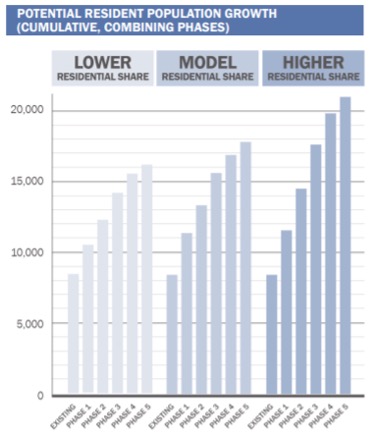
Population projections included in the Draft Pentagon City Plan (courtesy of Nicole Merlene)

The following infrastructure planning areas are needed:

Schools: It is obvious that there is a disconnect between Arlington County and APS in school site planning. APS staff has indicated that estimates on the range of new housing units and types are needed to properly use their multiplier equation and estimate future school sizes. Typically, this information isn’t provided in a study, but was for the first time in the Pentagon City Planning. This allowed APS to communicate a potential new school footprint size, and thus, in the last draft we were able to see potential sites for a new school. This was a big win, but is not what is or will be included in all of the other planning studies.

Transportation: Current planning processes do a good job of planning transportation impacts of future development. A “Travel Demand Forecasting Model” produced by the Washington Area Council of Government’s is the basis for demand management, and plans will also prescribe extensive details on street dimensions, medians, bike lanes, public transit specs and traffic calming measures.

This type of planning should continue in the other areas of infrastructure listed, with the same type of specificity and modeling. One item for improvement in this area is that there is not always a marrying of the Comprehensive Transportation Plan to long-range planning. This lack of continuity between infrastructure planning and long-range planning will be a theme among my recommendations.

(more…)


Peter’s Take is a biweekly opinion column. The views expressed are solely the author’s.

On Nov. 16, County planning staff briefed the County Board on Phase I of the Missing Middle Housing Study.

Prior to the pandemic, County planners asserted that up-zoning to enable new Missing Middle (“MM”) housing would be a major contributor to ease Arlington’s affordable housing crisis.

But by the time Phase I was launched, the County had been forced by cascades of data to abandon this false claim.

Misappropriating the language of civil rights advocates, County planners’ latest rationale is that up-zoning to enable MM housing is necessary to provide diversity of building types in certain neighborhoods, noting for example that each of two new $900,000 duplexes is more “affordable” than a $1.6M single-family house that might otherwise occupy the same lot.

As a leader of Arlingtonians for Our Sustainable Future (ASF), I reject the notion that County planners’ preferences for more luxury buildings in certain neighborhoods deserves much weight compared to the preferences of the residents who live there now.

Prominent Arlington activist Suzanne Smith Sundburg points out that if more density were the key to affordable housing, more densely populated places like New York City would be more affordable than Arlington.

Arlington lacks adequate infrastructure and environmental plans for its current zoning

Arlington forecasts a total population of 301,200 in 2045 compared to 234,200 residents in 2021. These additional 67,000 residents are coming to Arlington under current zoning. Can Arlington’s infrastructure and environment sustain them?

For starters, where, exactly, are we going to put the new school facilities that will be required? In November 2019, the County Manager sent a letter to the acting APS superintendent offering County properties — including parks — to be turned into school properties. But those same parks are needed to support the park and recreational needs of these new residents. The Manager’s awkward overture reveals that the County has not planned adequately for either additional school capacity or additional parks.

Moreover, we regularly see water and sewage pipeline breaks in our old systems. Infrastructure problems are acute in many other areas, including flooding, power failures, building integrity, tree maintenance and protection, bridges and competition for parking spaces as population increases.

The County and APS have failed to adopt an internally consistent plan for all major public facilities, i.e., a Public Facilities Master Plan, despite the fact that six years have passed since the 2015 recommendation of the Community Facilities Study Group that such a Master Plan was critical to Arlington’s future. Many potential sites for important public facilities have been lost permanently to private development during those six years of dithering.

Generational transformation

Arlington County has not quantified the full costs of critical capital expenses that will have to be incurred as our population increases. In fact, the Manager told the County Board in his message of Nov. 12, 2020: “[G]iven that we are undergoing a generational transformation in how we provide services and use facilities, this is the wrong time” to support a proposal from the Joint Facilities Advisory Commission for long-range planning.

How then can this be the right time for an action like major MM up-zoning that could have a huge, irreversible, net-negative impact on Arlington’s future?

(more…)


What’s Next with Nicole is a biweekly opinion column. The views expressed are solely the author’s.

Homeownership is one of the fundamental pillars of building wealth in the American economy.

In Arlington about 60% of our housing stock is renter occupied and new housing stock is almost all in rental housing development, with almost no new development of ownership housing stock.

The Missing Middle housing initiative has the opportunity to provide expanded home ownership stock. The current Missing Middle draft lacks intentionality around homeownership and even pushes back against the concept. My hope is that this changes in future drafts.

Arlington has the highest median home sale price in the D.C. metro region from 2020:

  1. Arlington: $670,000
  2. D.C.: $630,000
  3. Alexandria: $600,000
  4. Fairfax: $575,000
  5. Montgomery County: $483,000
  6. Prince George’s County: $345,000

When the topic of homeownership was requested during multiple public meetings, it was largely shutdown as illegal based on “discrimination by tenure.” This is a term I have been unable to find in any fair housing laws and contrary to the fact that Arlington County is currently discussing dedicated home ownership exclusive units on Columbia Pike right now.

Homeownership is important for millennials, people aged 25-40, who are in their prime home-buying years and dominate the U.S. workforce. Millennials hold just 4.6% of U.S. wealth and have 56 million in the workforce, whereas Boomers are 10 times wealthier and hold 53% of U.S. wealth and have 41 million in the workforce.

When Boomers were in the current age-range for millennials, they held 21% of U.S. wealth or four times what millennials hold today. Since homeownership is a key to wealth building, this gap in purchasing opportunities is fundamental for the economic outlook of future generations.

We know that Missing Middle-type housing, when available for purchase, is lower-cost than single-family homes, while this rental type is not necessarily more affordable. For example, in 2021 average assessed value of homes were:

  1. Single-family detached: $1,000,300
  2. Attached townhouse: $846,800
  3. Condo townhouse: $686,800
  4. Multi-unit condos: $447,700
  5. Cooperatives: $158,400

Additionally, if we are planning to reduce ownership housing stock in single-family houses, we should have a plan to replace it with ownership housing. We have plans to produce thousands of additional rental units throughout the county and no plan for additional ownership opportunities, and the Missing Middle Housing initiative should be exactly where we seek to do so.

Nicole Merlene is an Arlington native and former candidate for Virginia State Senate. She has served as a leader in the community on the boards of the Arlington County Civic Federation and North Rosslyn Civic Association, as an Arlington Economic Development commissioner, in neighborhood transportation planning groups, and as a civic liaison to the Rosslyn Business Improvement District.


Progressive Voice is a biweekly opinion column. The views expressed are solely the author’s.

By William Mark Habeeb

The new Arlington County logo seems to announce that we are nothing but an appendage of D.C. Is that a sad admission of the truth, or the declaration of a rather uninspiring ambition? Either way, it’s a gross underestimation of what our county of nearly 240,000 could be.

Arlington enjoys a solid tax base, a geographic and population size conducive to the creation of community, and a diverse, well-educated — and generally liberal-minded — population. So, why are we so timid in exploring ways to use these assets to create a model progressive community, a place where new ideas are tested and refined, where we do more than wring our hands over problems like systemic inequality? In short, why aren’t we more bold?

Arlington has been bold in the past: Over 50 years ago, Arlington’s elected leaders insisted that the Metro be built underground, not above ground as originally planned. While this decision cost billions more, it allowed Arlington’s Rosslyn – Ballston corridor to develop as a compact urban community; the increased tax base must certainly have more than made up for the higher construction costs.

Contrast that decision with the issue of mass transit along Columbia Pike. The best solution would be bus rapid transit (BRT). But to be truly rapid, BRT needs dedicated bus-only lanes. That, however, would require removing street parking along Columbia Pike, which some would oppose. But being bold sometimes requires making decisions that meet resistance. Being bold requires a vision — in this case, the vision of a community dedicated to the reduction of vehicular traffic.

Addressing the “missing middle” housing crisis also requires boldness. Revised zoning laws to allow more small multi-family buildings and duplexes would make it possible for more people and families to live in Arlington’s neighborhoods while maintaining a neighborhood feel. Cities like Somerville, Massachusetts, maintain a neighborhood feel even though much of the housing stock is multi-family. Would this make everyone happy? Of course not. Being bold seldom makes everyone happy, especially when the bold actions are aimed at addressing inequalities or better sharing a community’s resources.

Bold ideas can be borrowed. For example, a way to provide lower-income Arlingtonians with more educational opportunities could be based on the “Birmingham Promise,” a public-private partnership in Birmingham, Alabama — which has a far lower tax-base than Arlington — that provides tuition assistance for graduates of Birmingham City Schools who attend public colleges in Alabama, and offers an internship and apprenticeship program where high school seniors gain work experience while earning money and academic credit.

Other ideas — such as community land trusts (CLTs) and participatory budgeting — have been successfully implemented in a number of communities. CLTs are publicly funded non-profits that purchase and hold property in trust in order to guarantee affordable rental rates. Participatory budgeting (PB), an idea that originated in Porto Alegre, Brazil — allows community members to decide how to spend a designated portion of the public budget. PB goes beyond Arlington’s Neighborhood Conservation Program by allowing community members to identify a wide range of community needs and allocating public budget funds to address them.

Not all bold ideas are realistic or cost-effective. But to find the ones that turn out to be real gems, we must be nimble-minded and willing to take a few calculated chances. If Arlington’s leaders — both elected officials and unelected community leaders — become so risk-averse, so afraid to arouse opposition, so scared of pushing the idea envelope, then we will be in danger of becoming what our new logo portrays: The missing corner of DC, a metro-area afterthought living in our just-good-enough community.

I would like to see Arlington become an urban “beta community,” where we test bold ideas even if they’re in the start-up phase.  Let’s take advantage of our citizens’ innovative ideas and other resources — to see how successful we can become in creating a model 21st century urban community.

William Mark Habeeb first moved to Arlington in 1977 as a graduate student, and he and his wife bought their Arlington home in 1991. Their son attended Arlington Public Schools. Mark teaches in Georgetown University’s School of Foreign Service.


Raindrops and leaves in Rosslyn (Staff photo by Jay Westcott)

Biden Visits Arlington for Vets Day — “President Joe Biden saluted the nation’s military veterans as ‘the spine of America’ on Thursday as he marked his first Veterans Day as president in a wreath-laying ceremony at Arlington National Cemetery.” [WTOP]

Wet Roads Leading to Crashes — From the Washington Weather Geeks: “Please be careful out there this morning! Multiple crashes have been reported in and around the region. Wet [leaves] on the roads will help cause more hazards this morning. Slow down!” [Twitter]

Jury Duty Reminder — “Juror questionnaires were mailed in the form of a postcard with a website link in early August to 35,000 randomly selected residents of Arlington County and Falls Church City. Not everyone was chosen to receive the questionnaire. If you did not receive a postcard, there is nothing you need to do. These Questionnaires are used to qualify residents for jury duty which begins January 1, 2022, and ends December 31, 2022.” [Arlington County]

‘Missing Middle’ Study Update — “The most recent update revealed community support for the housing affordability, diversity, and supply that missing middle housing would bring. Competing concerns from homeowners have arisen regarding flooding, tree loss, and strain on infrastructure; though ultimately, existing patterns of development mean these issues already exist under the status quo.” [GGWash]

‘Spirit of Community’ Honorees — “As Arlington Community Foundation marks three decades of service this fall, this year’s Spirit of Community will honor three extraordinary people who embody Arlington’s Spirit of Community, Advocacy, and Volunteerism. In addition to recognizing these three extraordinary individuals, the program will feature Arlington youth and business leaders who have stepped up to meet the historic challenges of the last two years in inspiring and innovative ways.” [Arlington Community Foundation]

Lots of Ladybugs Around Area — “Multicolored Asian lady beetles are swarming in large numbers across the Mid-Atlantic because of late fall warmth. Also called ladybird beetles, this type of ladybug smells bad, can bite you and, if you squish it, produces a messy, yellow stain. This is another invasive insect that has found a home in our area.” [Capital Weather Gang]

WaPo’s Winter Forecast — “Overall, temperatures should work out close to average. Snow lovers are unlikely to be pleased as we’re projecting below-average amounts for the fifth time in the past six winters. We do, however, think we’ll top last winter’s snow totals… Alexandria, Arlington and Prince George’s counties and the District: 8 to 14 inches.” [Capital Weather Gang]

It’s Friday — Today there will be rain and storms until about 10 a.m., then gradually clearing through this evening. Sunrise at 6:48 a.m. and sunset at 4:56 p.m. Tomorrow there will be a chance of showers between 10 a.m. and 4 p.m., otherwise it will be mostly sunny and breezy, with gusts up to 23 mph. Sunday will be mostly sunny, with a high near 51.


View More Stories