Mary RouleauBy Mary Rouleau

Progressive Voice is a weekly opinion column. The views and opinions expressed in the column are those of the individual authors and do not necessarily reflect the views of their organizations or ARLnow.com.

A recent posting on the Governing website noted:

There is a wave of new innovation at the local level of government, and much of it is coming not from government but from citizens. This is happening through a rapidly proliferating ecosystem of civic innovation labs — platforms that connect citizens with each other and with government to share ideas, define community problems and find solutions.

For the past two years, I have been a part of one such citizen-created platform: Arlington Women Educating & Empowering, also known as AWE2 (“AWE Squared”).

The AWE2 organizing group brought together women with a variety of job-related and volunteer expertise. Our forming the group was motivated by what we saw as challenges facing Arlington, including such issues as a growing school enrollment, a higher-than-normal commercial vacancy rate, transportation options, and an affordability crisis.

A guiding question for the group was “Wouldn’t it be great for a group of women who already take an active interest in Arlington to come together to ask questions and educate themselves on issues?” We also viewed the effort as a great way for women to socialize and network with one another.

As a group, we wanted to:

  • Connect the dots among our issues: affordable housing, schools, neighborhoods, jobs, and more
  • Break down silos
  • Look at the big picture
  • Be nonpartisan and avoid taking group positions on particular projects or policies
  • Help spread information, and
  • Have fun!

About 50 women first met at the beginning of February 2014. We identified issues of common concern and made lots of introductions and connections. Since then, we have covered a lot of ground, figuratively and literally.

We have explored County and Arlington Public School planning processes and followed that up with a letter to the School Board, signed by 109 Arlingtonians, calling for greater transparency and other changes in the APS Capital Improvement Plan (CIP).

We have also explored how pieces of Arlington’s transportation network link up (or can be linked up) and how those in attendance use the network.

In a session hosted by the Crystal City BID, we gained a better understanding of the role of Business Improvement Districts and followed that up with a tour of Tech Shop.

We took a walking tour of the Clarendon area to examine how well “smart growth” has aged.

And we learned about the importance of community flexibility in enhancing Arlington’s economic growth.

We also run a list serve and regularly circulate notices of important meetings, informative websites, and good summary documents. We steer folks to County and APS information portals.

Along the way we have encountered some challenges, with the most significant being picking dates and times for events that fit into the busy schedules that most of us keep.

We also have to work to find venues that can accommodate our interaction without breaking the bank.

Innovative and informal groups need to provide value to survive. Based on attendance at our events and feedback we’ve received, the AWE2 organizers believe we are providing value.

Personally, through AWE2 I have had the opportunity to get to know women I would likely have not had a chance to interact with while attending larger County-sponsored meetings.

My experiences with AWE2 have given me new perspectives and created fresh energy on issues, and allowed me to help inform others on issues where I have particular expertise or knowledge.

We also have developed something very important to Arlington’s ability to move forward. As we get to know each other, we are able to build trust and find ways to make progress even if we don’t always agree.

In this way, we see AWE2 as a supplement to The Arlington Way. The County and APS can make such efforts by AWE2 and other groups easier by:

  • Keeping Arlingtonians informed of dates of events well in advance;
  • Providing good information and educational tools that can be shared across list serves;
  • Attending informal group events to gather perspectives and help inform attendees; and
  • Hosting occasional informal feedback sessions with AWE2 and similar groups.

To join our list serve, please contact us via: [email protected].

Mary Rouleau is a 25-year resident of Arlington. She is the Executive Director of The Alliance for Housing Solutions. This column reflects her personal views.

Greg Greeley (Progressive Voice)By Greg Greeley

Progressive Voice is a weekly opinion column. The views and opinions expressed in the column are those of the individual authors and do not necessarily reflect the views of their organizations or ARLnow.com.

The Arlington Way has been much discussed over the last few years amid concerns that the “Way” has been lost. Our experience on the South Arlington Working Group (SAWG) planning for a new school suggests that we can still achieve consensus while doing so in an inclusive and prompt manner.

We do still need a way of ensuring that our elected leaders’ decisions about Arlington’s future have broad community support, especially with the number of decisions needed to address school capacity concerns.

As we consider how to update the Arlington Way the SAWG process — swift and inclusive — may point to what we need to meet the demands of our changing community and growing school population.

In June of 2014, Arlington Public Schools (APS) identified the Thomas Jefferson site as its preferred location for a new elementary. The County Board, in response, formed the Thomas Jefferson Working Group to consider the feasibility of building a new school on the site. The TJ Working Group was able to establish a number of thoughtful considerations for the use of the site, but could not build a consensus that the Jefferson site should be for a new elementary school.

There were many community questions about alternative sites and how a school on the Jefferson site would be used. Ultimately, the County Board deferred on approving the site and asked the School Board to help develop a consensus regarding location of a new elementary school.

In response, the School Board set up SAWG and invited a broad cross-section of community participants. This included every Civic Association in south Arlington, PTAs from every south Arlington school, and a number of community-based organizations. These stakeholders brought different views to the table — and different ideas about how to address school capacity.

One challenge was that capacity needs in south Arlington were not evenly distributed. The three schools projected as most overcapacity in 2019 were Barcroft, Henry and Oakridge. Barcroft and Henry are on the western side of south Arlington and Oakridge is on the eastern side. Thus, it would be challenging to find a single school site that could relieve capacity issues for all three schools.

The SAWG members wanted new options. They considered every APS property and every County property in south Arlington. The members also reviewed potential privately-owned sites. This interest and outreach ultimately led to not one, but two private property owners coming forward. Both had serious proposals for providing the County with land in return for building more densely on their remaining property.

With a large, diverse group, some thought SAWG would not reach a conclusion. But, we pushed for open discussions and stepped outside of narrow, parochial viewpoints. We also sustained a healthy dialog with APS and County staff. Ultimately, we came up with three, interlocking recommendations.

First, we recommended that APS build a new home for Henry Elementary at the Jefferson site. These new seats are well-located to relieve crowding at Henry and Barcroft. Also, knowing that this new building would be a neighborhood school was an important consideration for many stakeholders.

Second, we paired the Jefferson/Henry recommendation with a plan to move the Montessori Program from Drew Model School to the current Henry building, opening approximately 400 seats at Drew. This pairing was important because it provides needed capacity for schools on the eastern side of south Arlington. And, by separating two programs now housed at Drew, it helps ensure the success of both programs.

Third, we concluded that a second elementary school would be needed in the Pentagon City area. Oakridge is our only elementary school east of Interstate 395. We expect that population growth will require another school. By starting planning now, we can thoughtfully consider such options as the potential joint use of the Aurora Hills Community Center and the offer of land for a school at the River House property.

SAWG members did get new options on the table that had not been considered before. We also moved quickly and came up with recommendations that met our charge — and more. Consensus was broad. Our site recommendation received unanimous support from both boards.

Most importantly, our recommendations quickly received support from our communities. This shows that what Arlington needs today in finding our “Way” forward can be achieved.

Greg Greeley was a member of the Thomas Jefferson Working Group and the Chair of the South Arlington Elementary Working Group. He is a long-time resident of Arlington and has been an active parent in Arlington schools.


Alfonso LopezBy: Del. Alfonso Lopez

Progressive Voice is a weekly opinion column. The views and opinions expressed in the column are those of the individual authors and do not necessarily reflect the views of their organizations or ARLnow.com.

The Virginia General Assembly kicked off what is sure to be a challenging and fast-paced 2016 legislative session this week. In just two short months, we will make judicial appointments and consider approximately 2,000 bills.

During the session, you can expect the Virginia Democratic Caucus to work on key issues affecting the lives of Virginians:

  • Increased investments in K-12 education and higher education
  • Strengthening economic and workforce development efforts
  • Improving transportation and transit options in the region
  • Securing the expansion of Medicaid and enhanced health care options for all
  • Preserving the natural environment and investing in renewable energy
  • Passing sensible gun violence prevention measures
  • Defending against attacks on civil rights, voting rights, and immigrant communities

Serving as Whip for the Democratic House Caucus, I will be working on floor advocacy, bill tracking, and messaging efforts to move Caucus legislation and our agenda forward.

You can find the Virginia House Democratic Caucus’ list of priorities here.

In addition, a major focal point of the session will be the adoption of Virginia’s budget for the next two years.

In December, Gov. McAuliffe introduced a budget that includes key investments in health care, K-12 and higher education, economic development, environmental protection, and veterans’ services.

The budget proposal may present opportunities for bipartisan agreement. There appears to be support for significant — and long overdue — investments in K-12 and higher education this year. We should expect to see agreement on important improvements to workforce development programs.

I believe we will see some victories for and a renewed focus on economic development and diversification of Virginia’s economy.

There will also be considerable challenges, including a Republican plan to remove an eminently qualified Supreme Court Justice from Northern Virginia for purely partisan reasons.

Other Republican bills threaten to demonize immigrants and refugees, block same sex marriage, roll back sensible gun violence prevention laws, and block compliance with the Clean Power Plan, to name just a few areas where the General Assembly majority is working against Arlington’s priorities.

My own bills this session include:

Small Business Definition Reform — Changing the definition of small business in Virginia to be fairer for women and minority-owned businesses by incorporating federal small business standards.

Affordable Housing — Creating a dedicated source of revenue for the Virginia Affordable Housing Trust Fund so that it can be implemented more effectively across the region and Commonwealth.

School Environmental Protection Act — Banning the use of federally “Restricted Use Pesticides” within a quarter of a mile of a public or private elementary or secondary school in Virginia.

Zero Tolerance for Repeat Polluters Act — Significantly increasing the civil penalty that the Virginia Department of Environmental Quality can impose on repeat offenders.

Default Sales of Firearms — Banning default sales for gun purchases if the background check takes longer than 72 hours.

Concealed Carry Training — Ensuring that in order to be qualified for a concealed carry permit in Virginia, an individual must do more than just take online and video courses.

Restrictions on Firearms Use by Children — Update child firearm restrictions to prohibit children four and under from using a firearm regardless of adult supervision.

Renewable Energy — Fixing Virginia’s definition of renewable energy to promote efficient biomass energy generation.

Child Labor in Tobacco Farms — Placing significant restrictions on the use of child labor in tobacco farming operations in Virginia.

In addition, as founder and Chair of the bipartisan Virginia Environment and Renewable Energy (VERE) Caucus, I’ll be promoting legislation to increase renewable energy production and improve energy efficiency. The General Assembly must not let the opportunity to create a sustainable energy future and mitigate the impacts of climate change slip away.

We will also be working to defend against attacks on sensible efforts to address climate change through the Clean Power Plan. The Plan presents Virginia with a tremendous opportunity to grow and diversify its economy through investments in clean, sustainable energy — solar, wind, etc. — and green technology.

Rest assured that I will continue to fight for our community’s values and priorities in Richmond so that we can keep Virginia moving forward and improve the quality of life for all Virginians.

Alfonso Lopez represents the 49th District (South Arlington and Eastern Fairfax) in the Virginia House of Delegates.  He and his family are long-time residents of Arlington.


Larry RobertsBy Larry Roberts

Progressive Voice is a weekly opinion column. The views and opinions expressed in the column are those of the individual authors and do not necessarily reflect the views of their organizations or ARLnow.com.

If you are an Arlington County Board member, you get up early on New Year’s Day for the annual County Board organizational meeting. It’s what you do.

This longstanding tradition reflects the importance of government in Arlington, the County’s history of civic engagement, a desire to “hit the ground running” by identifying early the priorities that Board members plan to pursue during the year.

One of the first acts by the Board every new year is to elect a Chair and Vice Chair.

In recent decades, the choices have been fairly obvious. Not so in 2016. The new Board includes two newly-elected Democratic members casting their first votes, two incumbent Democrats who have not always seen eye to eye, and a Republican-endorsed independent who won his seat with the support of Democratic Board member Libby Garvey and a fusion coalition.

In the end, Libby Garvey won the Chair position by a unanimous vote. Jay Fisette, the longest serving Board member was elected Vice Chair on a unanimous vote.

Following those and some other organizational votes, Chair Garvey set forth her priorities for 2016 followed by the other Board members.

While the unanimous Chair and Vice Chair votes suggested a cohesiveness among the Board members, the individual remarks about priorities suggested an interesting dynamic in the year ahead.

There were many positives expressed about Arlington, as well as areas of agreement about transparency, efficiency, rebuilding public trust, keeping Arlington a welcoming community, and new ways to involve residents in County decision-making.

Yet our five Board members bring independent perspectives with strong and engaging personalities, are able to articulate those perspectives clearly and with conviction, have constituencies that are not identical, and were each elected in years where the mood of the electorate differed from the years when other colleagues were elected.

Most observers would acknowledge that Arlington is in a time of transition. The historically important role of the federal government is changing, and Arlington’s share of federal dollars is less secure. We have changing demographics. Our unemployment rate remains very low, but we have higher than normal commercial vacancy rates. We have outstanding schools, but those schools are a magnet for more families and require greater resources. We have increasing demands on our facilities because Arlington remains a very attractive place to live and work. And housing prices continue to rise even though the incomes of many long-time Arlingtonians are not keeping pace.

The Board reflects that transition and — like Arlington’s residents — they have differing perspectives on how to respond to the changes in the County.

Observing the Jan. 1 meeting brought some questions to mind:

  • Will the Board develop a consensus approach that results in 5-0 votes on key issues and priorities?
  • If not, will a reliable bloc of three — or four — votes develop that sets the agenda? Which Board members would make up that bloc? Or will there be shifting majorities depending on the issue?
  • Will the Board be able to develop strong consensus views in order to maximize the County’s effectiveness in influencing federal, state and regional government decisions?
  • The Washington Post suggested that on Jan. 1 the Board “signaled that its priorities in the famously progressive community may turn toward the right.” Is that a fair characterization of the Board’s intentions? If so, does that accurately reflect the wishes of County residents?
  • Will we continue to see a level of cooperation and coordination between the County Board and the School Board that maximizes the effectiveness of our public schools, yet does so in cost-effective ways?
  • How will “core services” be defined? Is there a community consensus in that regard? In the past, Arlington has defined core services to include a range of values and services that have made Arlington an attractive place to live and contributed to economic and revenue growth. Many of those values and services enjoy broad support in the community. Will those values be considered “core services”?
  • Will Arlington’s economic development efforts keep pace with other jurisdictions? Will sufficient resources be available?
  • How will the Board’s common desire to keep Arlington affordable for people of all income levels — including fixed incomes — mesh with market forces that move the County in the opposite direction?

During a time of transition, there are many questions. These are a few. I welcome other questions by commenters.

Larry Roberts is a 30-year resident of Arlington and an attorney in private practice. He chaired two successful statewide campaigns and is a former Chair of the Arlington County Democratic Committee.


Karen DarnerBy Karen Darner

Progressive Voice is a weekly opinion column. The views and opinions expressed in the column are those of the individual authors and do not necessarily reflect the views of their organizations or ARLnow.com.

The following is an adaptation of remarks delivered by Karen Darner at the swearing-in ceremony for incoming County Board members Katie Cristol and Christian Dorsey.

Good afternoon, Arlington! I have the honor of sharing with all of you an event that is the culmination of almost a whole year of campaigning by many people to serve on the Arlington County Board.

This year was historic to a certain degree — two first-time members join the County Board on Jan. 1, 2016 — the first time this has happened since 1978.

Here in Arlington, which has been my home for almost 45 years, I have seen come to life almost daily Margaret Mead’s words: “Never believe a few caring people can’t change the world because that’s all who ever have.”

I’ve seen that spirit of caring and community in our neighborhoods, classrooms, community centers, and parks; in our public and private workforces and our volunteers; and in our elected and appointed leaders.

The Arlington Community Foundation says we’re a community of “uncommon values” — and I believe that wholeheartedly.

We have had our difficult times in Arlington. On Jan. 11, almost 13 years ago in this very room, our new County Board Chair Charles “Mickey” Monroe had a mortal stroke as he was responding to a citizen comment. Mickey was stricken while giving back to a community where he was raised, wanting to make Arlington a better place for residents of all ages and for future generations.

Mickey’s favorite song was “Sailing” by Christopher Cross, and the chorus provides a little insight into Mickey’s thoughts about our community: “Sailing takes me away to where I’ve always heard it could be; just a dream and the wind to carry me.”

I believe Charles Monroe would be proud of these two new County Board members. He would hold a dream of all five County Board members working together in 2016 to serve the community they represent and wish for them a little figurative wind at their backs aided by the service of past County Board members. Though we face a changing world, those links between past and present are important to ensuring that Arlington is the kind of place we’ve always heard it could be.

In a few moments, we will hear from our new Board members, Katie Cristol and Christian Dorsey. They bring a youthful vigor to their new positions. What impresses me about both Christian and Katie is their fervent desire to work with our residents to identify strengths and weaknesses, joined together with a willingness to invest the time and study to ensure collaborative problem solving. They stand ready to work with their Board colleagues and with Arlington’s residents to move our community forward.

I am impressed that they have learned something that I learned through my Peace Corps work — there isn’t always a right way or a wrong way — it is often enough just to be willing to try things a different way.

It is good to see this room overflowing with people wishing Christian and Katie well.

I am glad that we are joined by so many community leaders and elected officials, from County Board members, to School Board members, to Constitutional officers, to General Assembly members, to senior County and Arlington Public Schools staff.

And we have a special mix of generations participating today. The Star Spangled Banner will be sung by 8th grade Thomas Jefferson student Maya-Ree Loza Munoz, a young woman who is an outstanding student, and is quite busy with theatre and music activities as well as volunteering with low-income family and homeless programs — giving back to her community. In addition to being an English and Spanish speaker, she is learning Chinese, French, and American Sign Language.

Immediately following the Star Spangled Banner, Jordan Dorsey, a second grader at Arlington Traditional School, will lead us in the Pledge of Allegiance to our flag. Keep in mind that not only is she a voracious reader, but Jordan was elected to her student council the week BEFORE her dad was elected to the Arlington County Board — the first elected Dorsey in Arlington!

Thank you to all of you for your participation in this special event today. May we all be blessed in the New Year and may we all wish our 2016 County Board a successful year ahead.

Karen Darner served in the Virginia House of Delegates from 1991 to 2004. In 2009, she received the Arlington Community Foundation’s William T. Newman Jr. Spirit of Community Award in recognition of over 30 years as an active member of numerous community organizations.


Mary Rouleau

By Mary Rouleau

Progressive Voice is a weekly opinion column. The views and opinions expressed in the column are those of the individual authors and do not necessarily reflect the views of their organizations or ARLnow.com.

Two weeks ago, in this space, I articulated what others in the community have been saying: it’s time to craft an Arlington Way 2.0. If nothing else, demographic shifts and the technology explosion support the view that a reboot is timely.

While there has been discussion about and some effort to bring more segments of the community into the dialogue by creating more opportunities for public input, it is not enough. The Arlington Way should also encompass a more effective rollout of studies and policies after they are adopted, including getting basic facts into the community in a timely way.

This is not to advocate for particular decisions or policy directions. The community and its elected representatives will ultimately set directions and make decisions. I am advocating for processes that include early opportunities for broader and more meaningful input together with more intense communication efforts at the back end of decision making processes.

In that way, Arlington can discern views of its residents more accurately and make decisions more promptly as well as more securely. The end goal is building community trust in an environment that differs markedly from the more homogenous Arlington that existed in past generations.

What follows are several thoughts about the overall process, with a particular focus on communications.

First, the Arlington Way for a particular process should include prompt decisions through a schedule, as well as clear and accurate information about where, what and how public input will be sought and used.

Second, we should review our system of charrettes and town halls to better promote inclusion and “community conversations.” We have not had adequate participation or room for deep dive discussions.

We should aggressively reach beyond the civic association structure. We especially need to more fully engage our large millennial population, including involvement on working groups and organizational boards. Leadership Arlington’s Young Professionals Program has grown a pool of candidates.

Third, we still need real-time, in-person give-and-take. While online tools can be helpful supplements, they can be too easily commandeered by those with a preset agenda.

I think the County has been doing a better job at gathering input, yet fuller information flow is still needed.

According to the 2015 County Resident Satisfaction Survey, 75 percent of those polled trust information provided by the County, but satisfaction regarding the effectiveness of County communications and transparency of decision-making declined.

The County has recently created informative and user-friendly portals for the Community Facilities Study, other studies and site plans. We need tools to promote use of those pages — perhaps a “Campaign to Connect” that emphasizes the importance of these portals to decision making.

A changed paradigm for information packaging is needed. Arlington produces thorough reports but few read them. Those reports should be accompanied by highly visual summaries — such as infographics — that are released simultaneously.

My suggestions for disseminating information more effectively include:

  • better use of The Citizen, including a format overhaul and well-designed center pullouts
  • electronic short pieces and infographics to distribute to the many community newsletters and Listservs
  • pop-ups and temporary signage that focuses attention
  • new methods to simplify complicated topics like community planning — such as the upcoming Cards Against Urbanity session
  • placing basic information on major initiatives — not advocacy — inside routine mailers that go to many residences and mailings to neighborhoods directly affected by upcoming decisions

The just-completed Community Facilities Study, like the recent housing study, produced a wealth of data about Arlington’s economy, schools and demographics. This data deserves broad public awareness and could be packaged into a series of “101s.”

An improvement of the County’s communications capacity should be a high priority for the newly constituted 2016 County Board and the County Manager.

Given the enormous successes achieved by Arlington and some issues that divided the community despite lengthy processes meant to avoid such divisions, it is important that the County not leave itself open to the impression that it is hiding something or that a particular process is not fair.

A fully informed and engaged public can improve County decisions and do so even with a streamlining of our processes. The County should leave few stones unturned in the effort.

Mary Rouleau is a 25-year resident of Arlington. She is the Executive Director of The Alliance for Housing Solutions. This column reflects her personal views.

Larry RobertsBy Larry Roberts

Progressive Voice is a weekly opinion column. The views and opinions expressed in the column are those of the individual authors and do not necessarily reflect the views of their organizations or ARLnow.com.

This week, progressive Democratic leaders from the three DMV jurisdictions appeared on stage together at a Capital Region Business Forum held in McLean. Virginia Governor Terry McAuliffe, D.C. Mayor Muriel Bowser, and Maryland State Senate President Mike Miller were at times both cooperative and competitive in discussing how the region and each jurisdiction can move forward successfully.

The topics discussed will have major ramifications for Arlington in the years ahead.

All three leaders are committed to growing the region’s economy and enhancing its competitiveness in a global economy.

They did not view business only through the lens of lower taxes and less regulation. They identified other issues key to our region’s economic future — transportation, K-12 education, research and entrepreneurship, higher education, affordable housing, environmental sustainability, green space, access to health care. They also view economic success being dependent on regional cooperation and coordination.

They see a continued influx of residents to the District of Columbia. Fairfax, Loudoun and Prince William Counties will continue to grow rapidly. Maryland will move more aggressively to match successes in Virginia and the District.

All spoke of diversifying an economy too heavily dependent on federal spending. They emphasized the importance of foreign investment in our region and a vibrant tourism sector.

These initiatives will have consequences — likely dramatic ones — for Arlington, whether we choose to engage them or not.

There will be increasing pressure for moving more cars through Arlington unless we are fully engaged regionally and with Richmond to develop multimodal solutions that work for outer jurisdictions and show a willingness to contribute resources.

Our top-tier schools will attract more families to Arlington for educational opportunities. In response, we can grow our commercial tax base to support increased school enrollment or pay higher residential taxes to fund education. Or we can be involved in regional efforts to promote educational excellence in other jurisdictions to ease some of the growth pressure on Arlington’s schools.

We can compete nationally and internationally for new and innovative business opportunities through investments in Arlington Economic Development, or we will see other jurisdictions strengthen their commercial tax base while ours remains stagnant or declines.

We can work aggressively on housing affordability and affordable housing issues, or we can see more people priced out of Arlington, as its location near the District and regional population growth pushes land values higher.

As we enter a new year in Arlington, we can expect to see renewed emphasis on scrubbing our budget to reduce spending, concerns about changes that have come to Arlington, and a desire to keep things the way they have been.

Yet as other jurisdictions grow in population and economic strength, we risk being without a seat at the table as decisions are made and priorities are set if we miss the larger picture.

There has been much talk about the need for strategic planning in Arlington. My hope is that such planning will include an intense focus on how we can most effectively play a key role in state government and the Capital Region.

A heavily internal focus will mean that changes all around us will not work to our advantage and we will have a harder time maintaining our level of success.

Historically, Arlington has “punched above its weight class” through its intelligent planning, creative use of resources, willingness to place resources behind priorities, care for others, an understanding of the economic power of diversity and inclusion, sound finances, a strong commercial sector, excellent schools, multimodal transportation investments, unity of purpose, and political will.

Remembering what has made us great, looking for ways to improve, and engaging more fully in state and regional issues will all be necessary to ensure a bright future for Arlington.

We can only retain the best and most important unique qualities and values that have defined Arlington if we are fully cognizant of, willing to engage in, and help shape the significant change ahead for our Commonwealth and our region.

Larry Roberts is a 30-year resident of Arlington and an attorney in private practice. He chaired two successful statewide campaigns and is a former Chair of the Arlington County Democratic Committee.


Mary Rouleau

By Mary Rouleau

Progressive Voice is a weekly opinion column. The views and opinions expressed in the column are those of the individual authors and do not necessarily reflect the views of their organizations or ARLnow.com.

Last year, I attended a workshop focused on crafting a conversation about and building public support for “the common good” in Arlington. In my view, the workshop helped counter the view that government was the problem — or at least a large part of it — in a climate of “no trust” and partisan gridlock.

While the “no trust” description readily applies to the other side of the Potomac, there have been threads of the “no trust” narrative in Arlington in recent years.

I believe Arlington has done many things right over the past 20 years, including balancing the tax base between commercial and residential sources, sustaining strong schools and crafting national best practice models of transit-oriented development, including affordable housing.

But we now face large, complex challenges, including sustained school growth, economic competition, a growing affordability gap and a large number of aging Boomers — and all must be placed in the context of limited available land.

A prior generation of Arlington leaders made tough but good decisions in leading the County. Among the best was siting the Metro underground instead of in the I-66 median. We now find ourselves with a set of “next era” decision points. Those decisions will determine where and how we go forward as a community.

Because we must make these decisions in an era of tight budgets and slower economic growth, it would not be surprising to hear sentiment along the lines of, “Why should I pay for things I don’t need?”

But Arlingtonians have, over the decades, been more sophisticated and progressive, showing a willingness to go where the facts lead, even if there is not a direct benefit to them. Perhaps the most important and consistent indicator of this is the continued support for our schools even though the vast majority of Arlington households have no direct ties to APS.

Pursuing progressive values does not require a blank check to government. And residents should be able to expect not only good outcomes, but also transparency and informed decision-making with public input of various kinds.

It is important that the County government provide the public with facts that support its decisions and a description of the public purposes served by the decisions. My experience with housing issues over the past several years has demonstrated again and again that there is a wide information gap on that set of issues alone.

Advocacy groups can play an important educational role, too, but the County has the resources to reach more households and should be a primary source of information for explaining the use of public assets and resources.

And what of the “Arlington Way” that has guided County decisions? No doubt it has been a key in the public’s support for most of those decisions.

But demographic shifts, the technology explosion, and increasing careers demands support the view that it’s time for an Arlington Way 2.0.

There was talk during the recent election cycle of the need to bring more segments of the community into the dialogue by creating more opportunities for feedback. While true, it’s not enough. We also need ways to get more information about the challenges we face into the community’s hands in a timely and a sustained way. For most issues, this will need to be an ongoing process and not a one-off exercise.

It strikes me that so much energy goes into a typical Arlington study process on the front end that little remains for the rollout. Yet for many people, the rollout is the first time they become aware that change is happening.

We can fairly expect that those who participated in the process understand the reasoning behind the recommendations and outcomes that follow. But to build and maintain a larger community consensus, it is probably even more important for good information — promoting understanding of the importance of the action and why the action serves the common good — to flow after a decision is made.

In a future column, I will discuss the importance of the just-completed Final Report of the Community Facilities Study Committee, both for its substantive recommendations and how it provides an opportunity for greater public awareness and consensus.

Mary Rouleau is a 25-year resident of Arlington. She is the Executive Director of The Alliance for Housing Solutions. This column reflects her personal views.

The Reverend Sharon K. CoreBy The Reverend Sharon K. Core

Progressive Voice is a weekly opinion column. The views and opinions expressed in the column are those of the individual authors and do not necessarily reflect the views of their organizations or ARLnow.com.

We live in a time when organizations constantly need to be aware of their structure, purpose and business plans. They need to innovate and tend to their reputations or risk the danger of disappearing.

Remember RCA, Eastern Airlines, Woolworth’s, and Enron? All of them are gone. By contrast, there are Apple, IBM, Netflix, and Samsung — all companies that have reinvented themselves successfully.

This reality of needing to attend to direction and purpose doesn’t just include businesses. The reality also applies to churches. The way churches engage this work is through a process called discernment.

Several years ago, the Arlington Presbyterian Church congregation began to wonder who God was calling us to be and what God was calling us to do. We spent much time in prayer, studying scripture, talking to one another, and talking to people in the community.

Whatever God wanted for our congregation, it would be discovered through deep and intentional listening.  As members engaged this time we were seeking to answer the question, “For whom are our hearts breaking?”

During the summer of 2012, the searching took on a new emphasis as a vision team was formed.  As we continued the discernment process, a threefold vision began to emerge:

  • create and nurture a community of disciples following Jesus Christ
  • be a people and place of crossroads for the diverse population along Columbia Pike
  • redevelop our property so that committed affordable housing can be built.

Not surprisingly, the third piece of our vision has garnered the most attention, as Arlington Presbyterian entered into a relationship with the Arlington Partnership for Affordable Housing (APAH), who will purchase our property and build a mixed-used development that will include affordable housing, amenities for the residents, street-level retail and structured parking.

However, as important and perhaps harder are the first two parts of our vision. Who we understand ourselves to be as a faith community is deeply rooted in the Christian faith and the commitment to be disciples of Jesus Christ.

The decision to sell the property is a business decision. But more than a business decision, it is also an act of faith. Likewise, the identification of APAH as our solid business partner is not just good due diligence. It is also good stewardship of the church’s resources.

For example, APAH offered our congregation the opportunity to name the development. We chose Gilliam Place, named for Ronda A. Gilliam (1906-1970). Mr. Gilliam was Arlington Presbyterian’s first African American member, an Elder and founder of a clothing assistance program, among other accomplishments in the community.

Naming Gilliam Place for this humble and dignified individual, who strived to make his neighborhood better, aptly represents our legacy. Remembering Mr. Gilliam through the name of the building will continue the story of Arlington Presbyterian — a story of visionary men and women carrying on the tradition of radical willingness to trust God — woven into the history of the development of community along Columbia Pike.

During the redevelopment process, Arlington Presbyterian will seek to strengthen its community of disciples through outreach in the community.  We have an interest in returning to the property after construction by leasing space on the ground floor of the building. Through continued prayer and discernment, we will use the next year to consider how God is calling us to new ministry and service in this community.

Every aspect of our congregation’s journey has started with prayer, been sustained by prayer, and been sealed with prayer. We continue to keep our minds and hearts open, listening for God’s continued guidance and following with trust and faith.

The Reverend Sharon K. Core is pastor at Arlington Presbyterian Church. She has had the great joy of being with this congregation since December 1998.


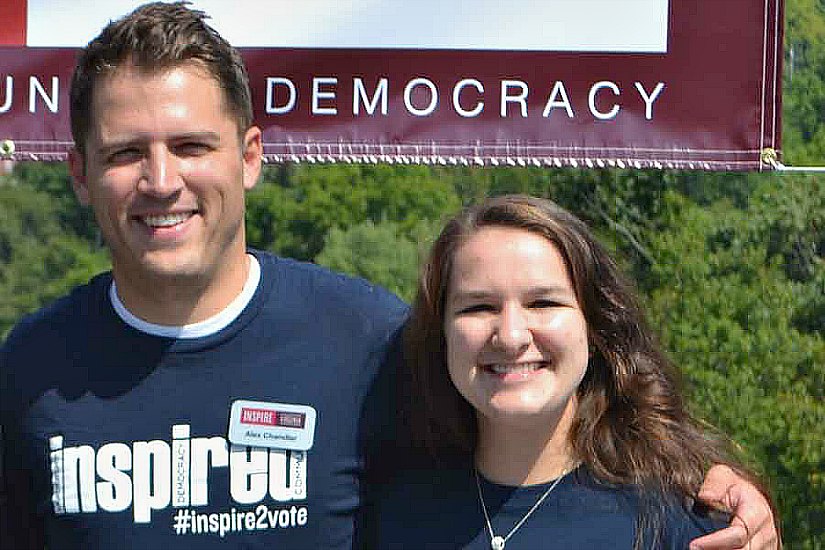
Isabel Alcalde and Alex ChandlerBy Isabel Alcalde and Alex Chandler

Progressive Voice is a weekly opinion column. The views and opinions expressed in the column are those of the individual authors and do not necessarily reflect the views of their organizations or ARLnow.com.

While some of the individual results may be important, proponents of a fair and representative democracy see little to celebrate overall in the 2015 Virginia general election results.

Only 26.5% of eligible voters turned out to vote on Nov. 3. Only 29 out of the 100 House races had a two-party contest. Of those, only six races were seen as truly competitive. Thus, the Washington Post lamented that 2015 was “a carnival of cakewalks” that left the average Virginia voter “powerless.”

Inspire Virginia is a civic engagement organization based in Arlington. We are supported by Project High Hopes, a nonprofit organization that was founded by Ira Lechner, who once represented Arlington in Virginia’s House of Delegates.

Through its work, Inspire Virginia has an understanding of the frustrations identified by the Washington Post and experienced by voters. We believe that hope lies in the youth vote and that is why we support and empower high school student leaders to mobilize the youth vote.

A healthy and representative democracy requires ideas, debate, and votes from every demographic. Young people offer unique attributes that could energize Virginia elections and the political process:

  • Young people are more likely than other age groups to be unaffiliated with a specific party and want candidate interaction beyond just party identification.
  • Surveys in 2000 and 2008 showed 18 to 29 year-olds cared about candidates’ positions on issues over leadership/personal qualities more than any other age group.
  • Studies show active young voters influence members of households to go and vote. It’s simple: young people bring others along with them to vote.

Inspire Virginia is working to transform the way the youth vote is viewed; we must empower every eligible high school student to vote as soon as they are eligible.

In August, Inspire Virginia brought together 60 students from 18 different high schools in six different counties, including Washington-Lee High School in Arlington. Together, these students formed Inspire Virginia’s inaugural class.

Inspire Virginia recruits three or four exceptional leaders in partner high schools across the state.  These juniors and seniors must be willing and committed to improving Virginia’s democracy, starting with their own schools.

We educate, train, and ultimately, inspire these student leaders to return to their schools and mobilize their peers to participate in the democratic process. Our mission is to inspire student leaders in each high school across the state to register every eligible student and empower those students to vote. Already, these “Inspired Leaders” are reaching out to community leaders and asking for greater inclusion of youth in the democratic process.

In the weeks since the summer conference, Inspired Leaders have worked to register 172 voters, and nearly 900 of their peers have pledged to register when they become eligible. These 1,072 youth votes are just the beginning.

As one of our student leaders, Jessica Edwards, a junior at Saint Stephens and Saint Agnes High School, wrote:

“It’s truly incredible to see all the amazing work that other schools are doing through Inspire so quickly. Additionally, it’s great to know that the stereotype that youths are apathetic and lazy is certainly false, as proven by the work of Inspire Leaders all over the nation. “

The coming year presents a unique opportunity for all of us to engage the youth vote. Virginia law allows 17 year-olds to register and vote in primary elections as long as they will turn 18 by the general election. For 2016, that means many seniors can register and vote in both the March presidential primary and the June primary for Congress and other offices. These are two opportunities for young people to become active voters — and get in the habit of voting — even before graduating high school.

Our state, by incorporating the collective youth demographic into Virginia civic life, will reinvigorate an elections process that has been criticized as stale and ineffective. This is why Inspire Virginia is working to register thousands of new, interactive voters across the state. We hope you will join us in welcoming and supporting these new additions to the electorate. For more information, visit our website.

Isabel Alcalde and Alex Chandler are Program Coordinators for Inspire Virginia. Inspire Virginia is the seventh state chapter of Inspire US, a unique program dedicated to supporting students in a year-long civic experience.


Gillian BurgessBy Gillian Burgess

Progressive Voice is a weekly opinion column. The views and opinions expressed in the column are those of the individual authors and do not necessarily reflect the views of their organizations or ARLnow.com.

Arlington Public Schools opened a new elementary school this year, is currently building additions to two other schools, and is building another entirely new school. And the Arlington community is studying where to put another new elementary school. And we need to look at options for the Career Center. And. And. And. There are lots of decisions to make, and these decisions will shape how we live in Arlington.

We need new, creative ideas on how to deal with the capacity crisis in Arlington Public Schools. However, as one wise Facebook commenter wrote, “I feel like these discussions constantly occur in a vacuum, completely ignoring the public processes and discussions that have gone on previously, some of which seriously looked at (and rejected) some of these ideas.”

To fill this vacuum, APS should organize a School Planning 101 session and publish an accompanying website that summarizes the public processes that have come before, explains those that are currently running, and collects relevant data into one easily accessible place. By doing so, APS would not only enable more people to engage in this important process, but also would improve the quality of its decisions.

Many Arlingtonians have already been involved in “More Seats for More Students” or a related process. There have been committees, advisory councils and working groups advising the School Board, the County Board and the Superintendent, all with relevant ideas and recommendations. Coming in fresh to this process is intimidating. When talking to those who have been following this process for years, seemingly every idea has already been considered and evaluated. The enthusiasm of new blood is often quickly tempered by “been there, thought of that, it doesn’t work because.” We need new people and new ideas in this process, and those new people need to understand what has come before. Organizing a School Planning 101 session would enable more people to engage productively.

The work of organizing this information would improve the quality of “More Seats for More Students.” These past committees have made important recommendations, which deserve serious consideration by the School Board and the Superintendent. School Planning 101 should summarize the recommendations of the working groups, providing links to their final reports and other resources. It should also gather the current data that is relevant to school planning — enrollment, projected populations, current capacity and available land – in a place that is easily accessible and up to date. The session should explain the fundamentals of how facilities are paid for, including the difference between capital and operating costs.

The end result would be not only an information session, but also a website so that this information would be available to the general public who could not attend the information session and going forward. This website would gather data and recommendations in one location. Most importantly, as more people become interested in helping out with this important planning process, this website will give them a place to start.

Yes, APS already has a website for “More Seats for More Students.” But it takes you deep into the weeds of the current planning processes. Information on past committees is there, but anyone interested has to dig through the unorganized archive. There is no roadmap, no “START HERE.” My suggestion would create just such a page.

“More Seats for More Students” is one of the most important planning programs of our generation. APS must add thousands of seats for new students over the upcoming years, and will likely build significant facilities to do so. These facilities and their locations will shape the look and livability of Arlington for everyone and will impact the quality of our public schools. Having great public schools is essential not only for our students but also for our property values. By organizing a School Planning 101 session and accompanying website, APS would enable more people to lend their voices and ideas to shaping the future of the public school system. A more informed process will lead to a better result and a more livable Arlington County.

Gillian Burgess is the current Chair of Arlington County’s Bicycle Advisory Committee, the founder of Kidical Mass Arlington, and the former Vice Chair of APS’s Multimodal Transportation and Student Safety Special Committee. She lives in Cherrydale with her husband and three children.


View More Stories