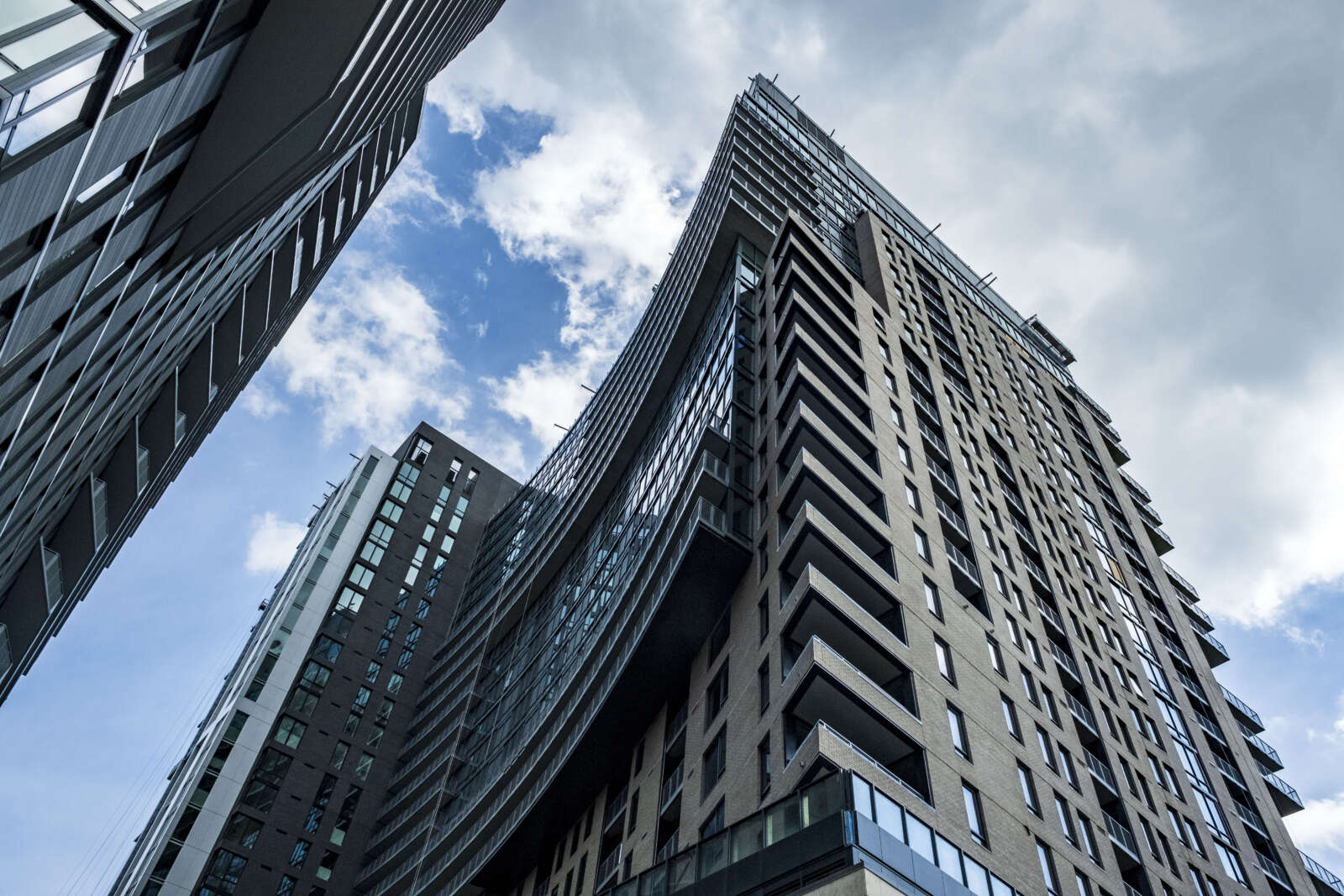
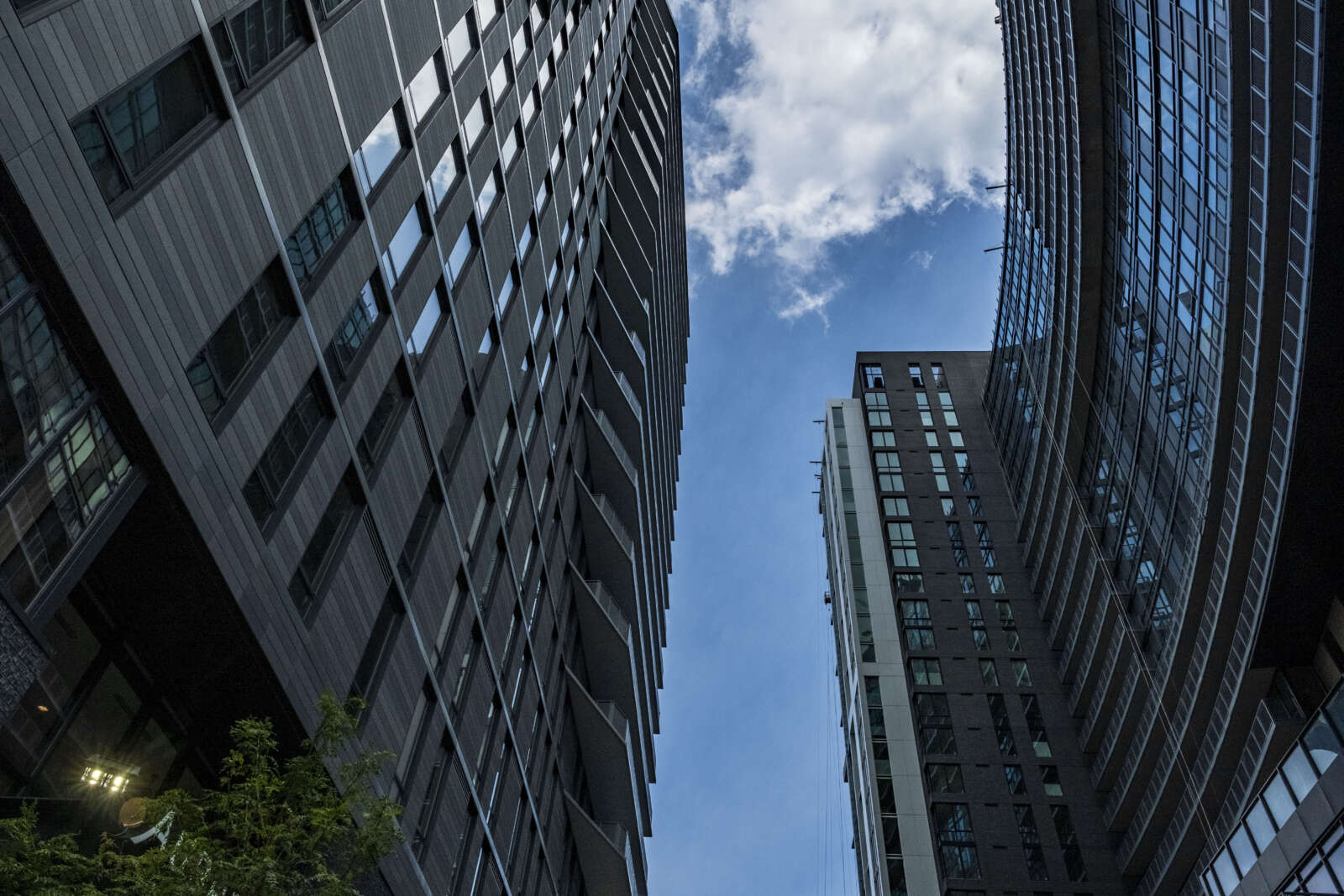
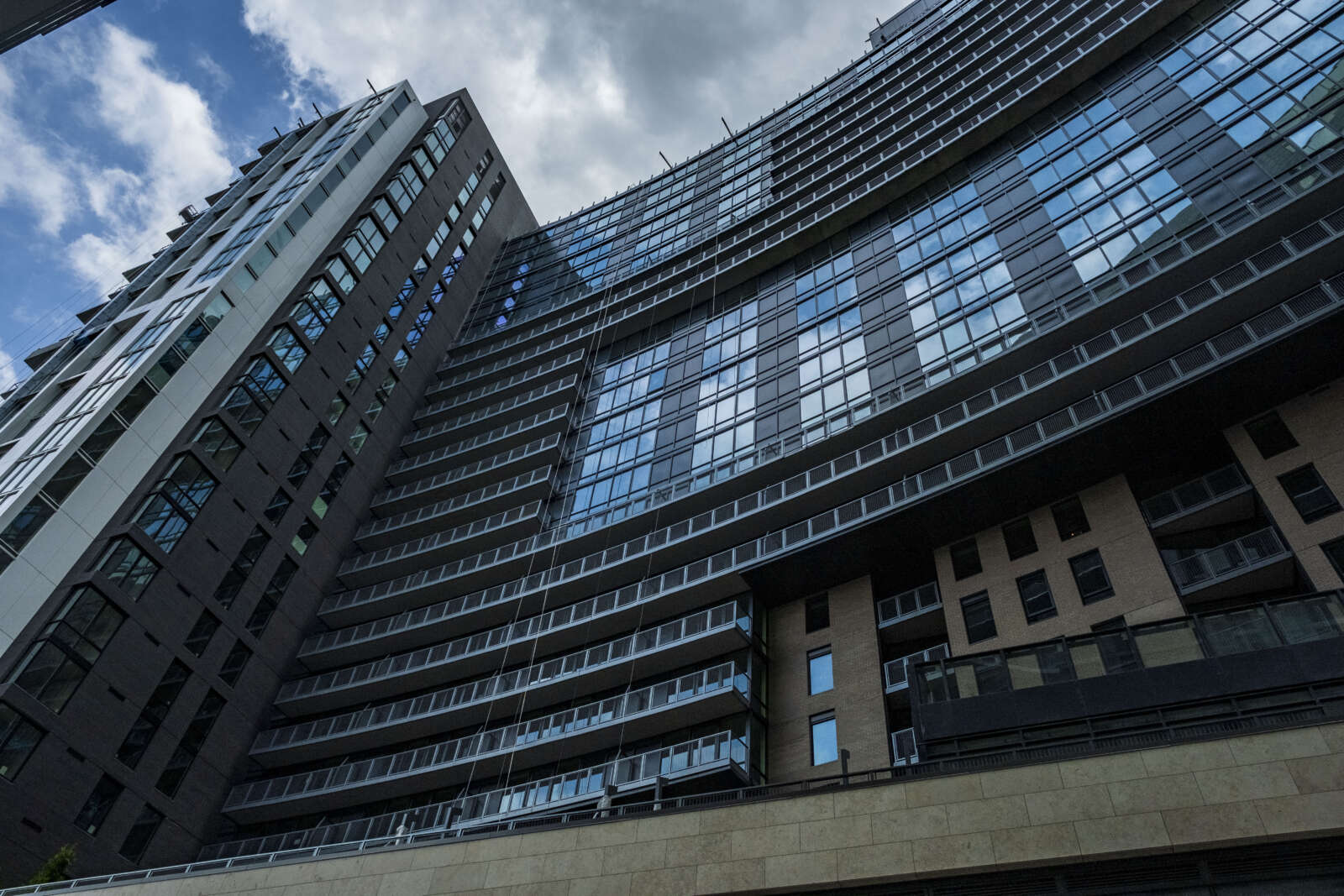
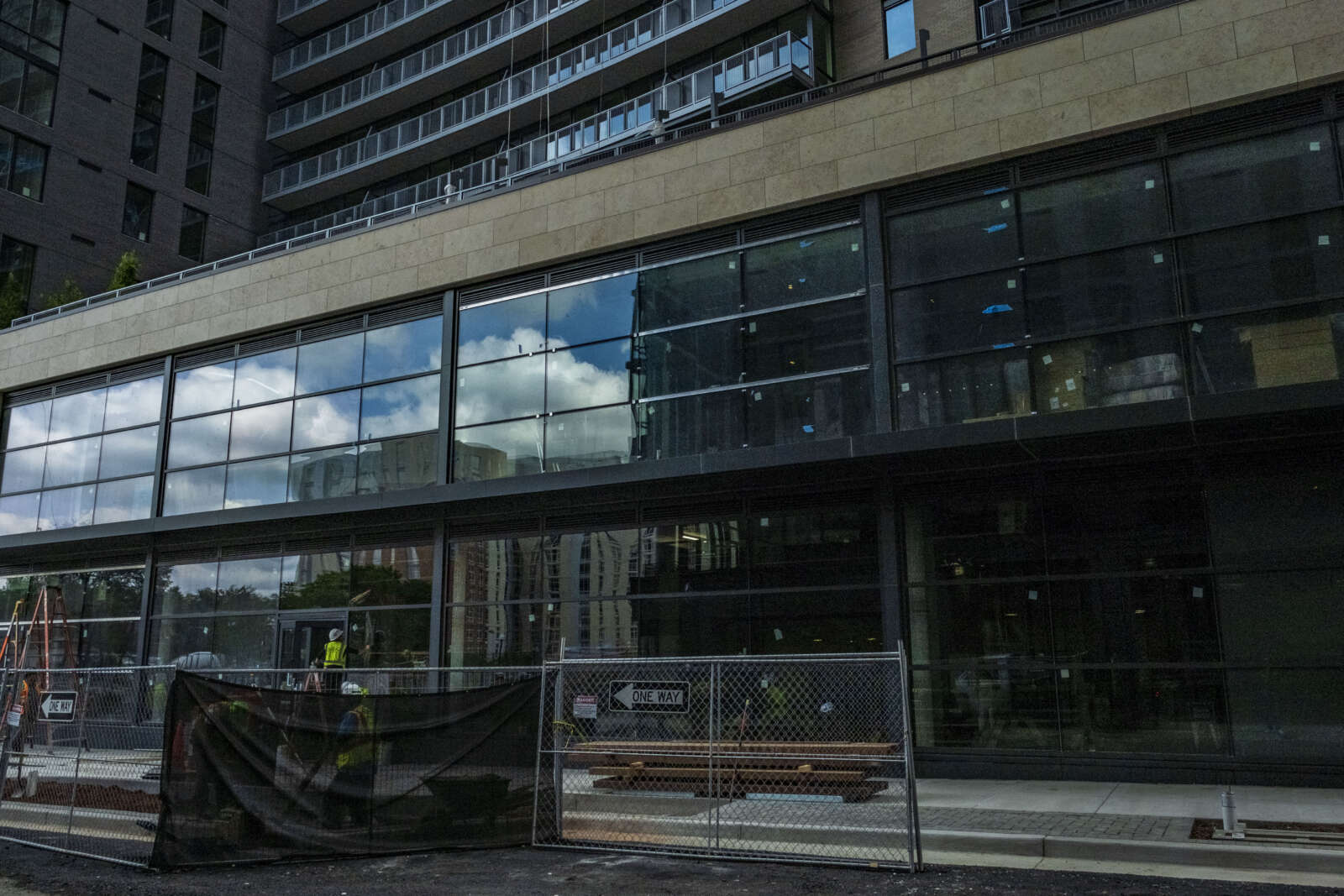
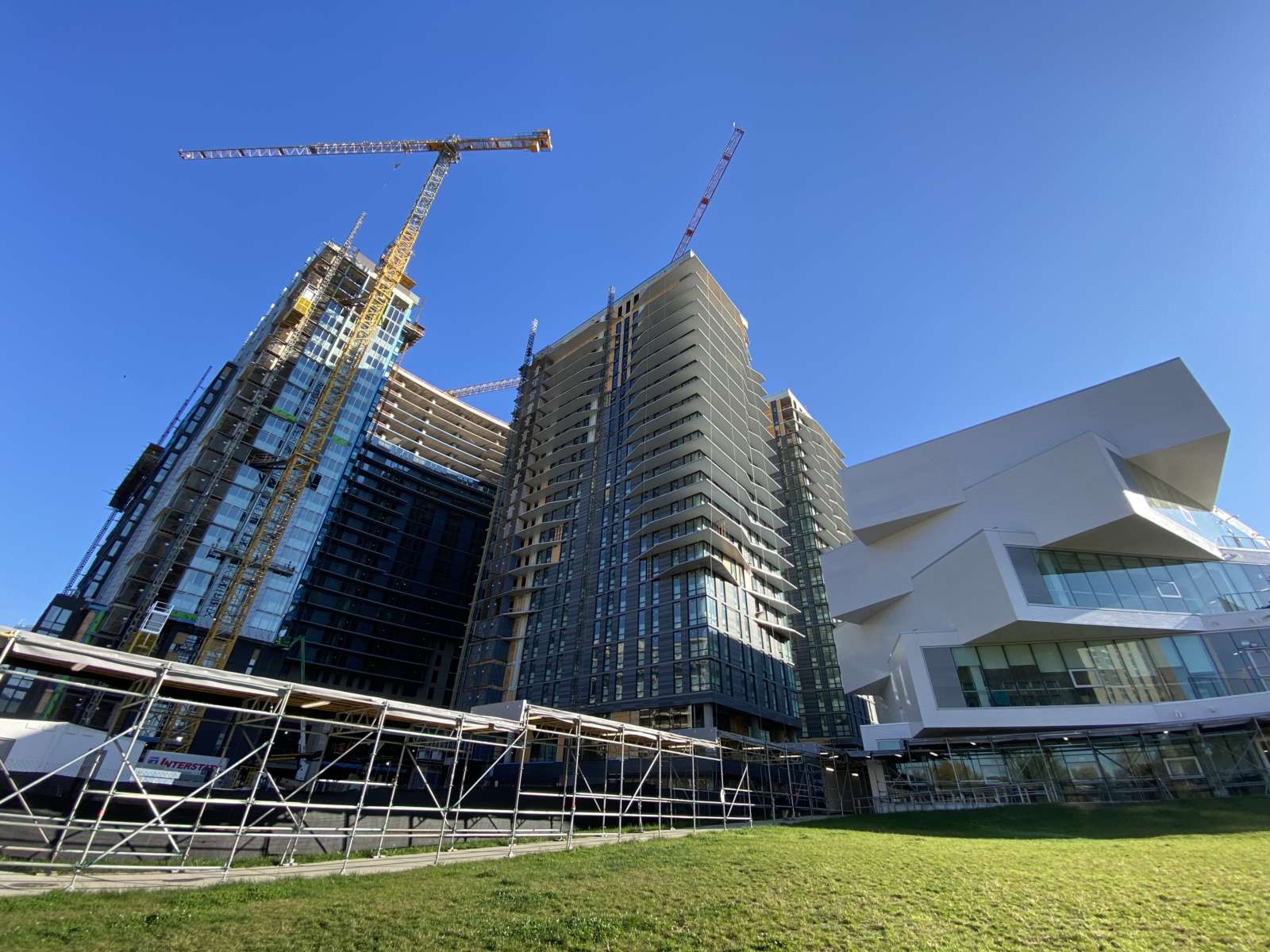
Apartment buildings that make up The Highlands development (staff photo by Jay Westcott)
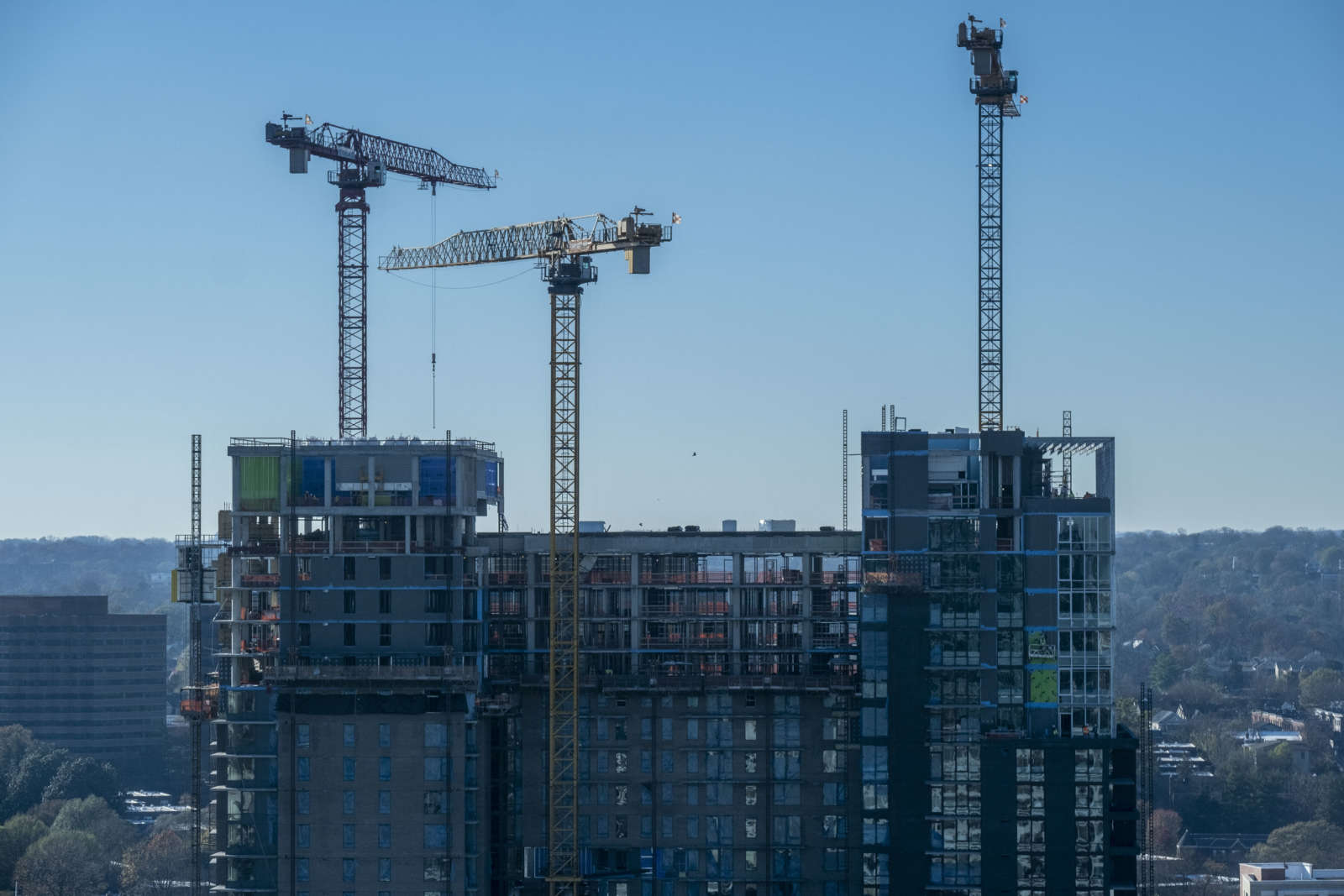
The trio of buildings that make up The Highlands development (staff photo by Jay Westcott)
A look at The Highlands development project (staff photo by Jay Westcott)
A look at The Highlands development project (staff photo by Jay Westcott)
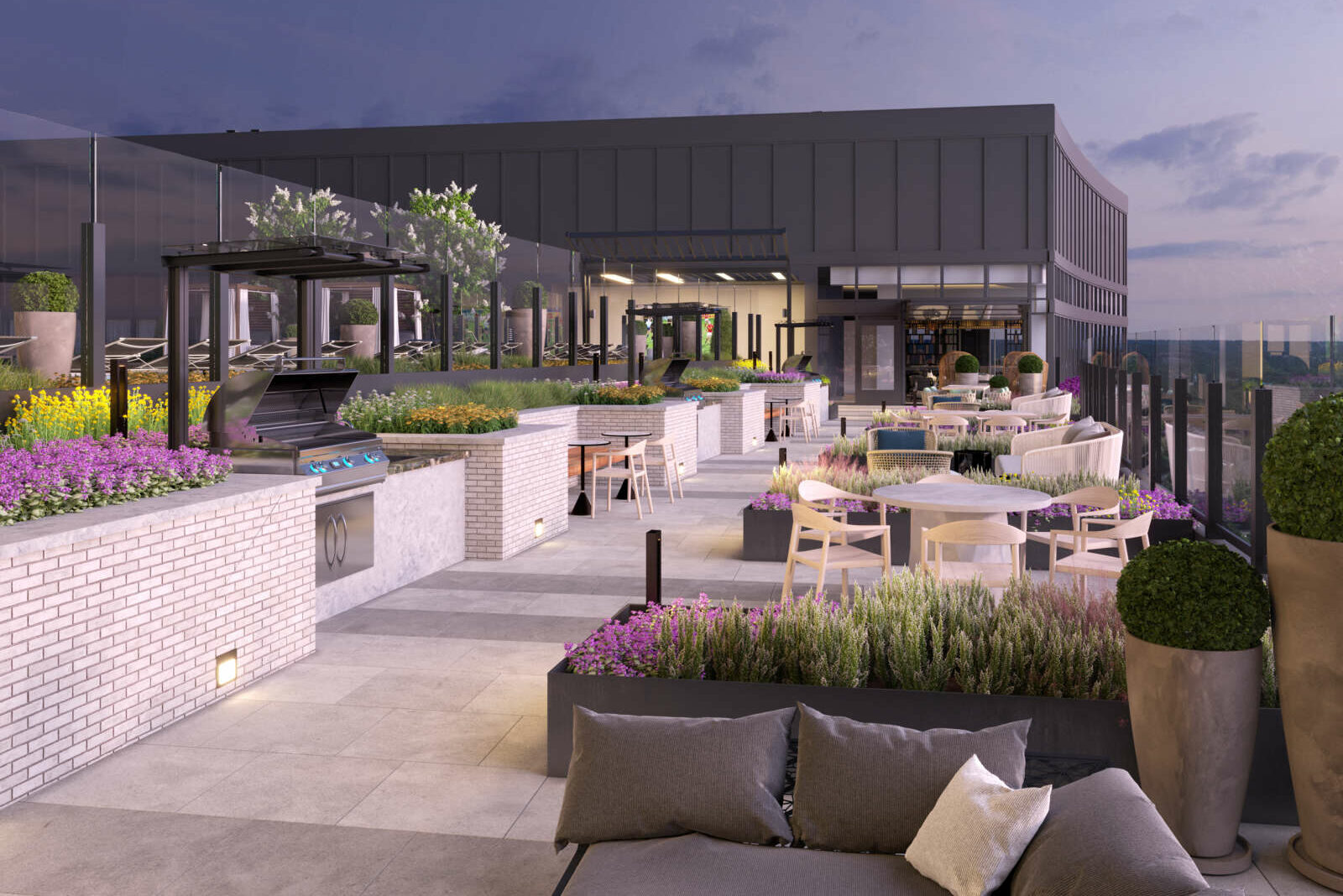
A rendering of the rooftop of Evo, part of The Highlands development in Rosslyn development (courtesy of The Highlands)
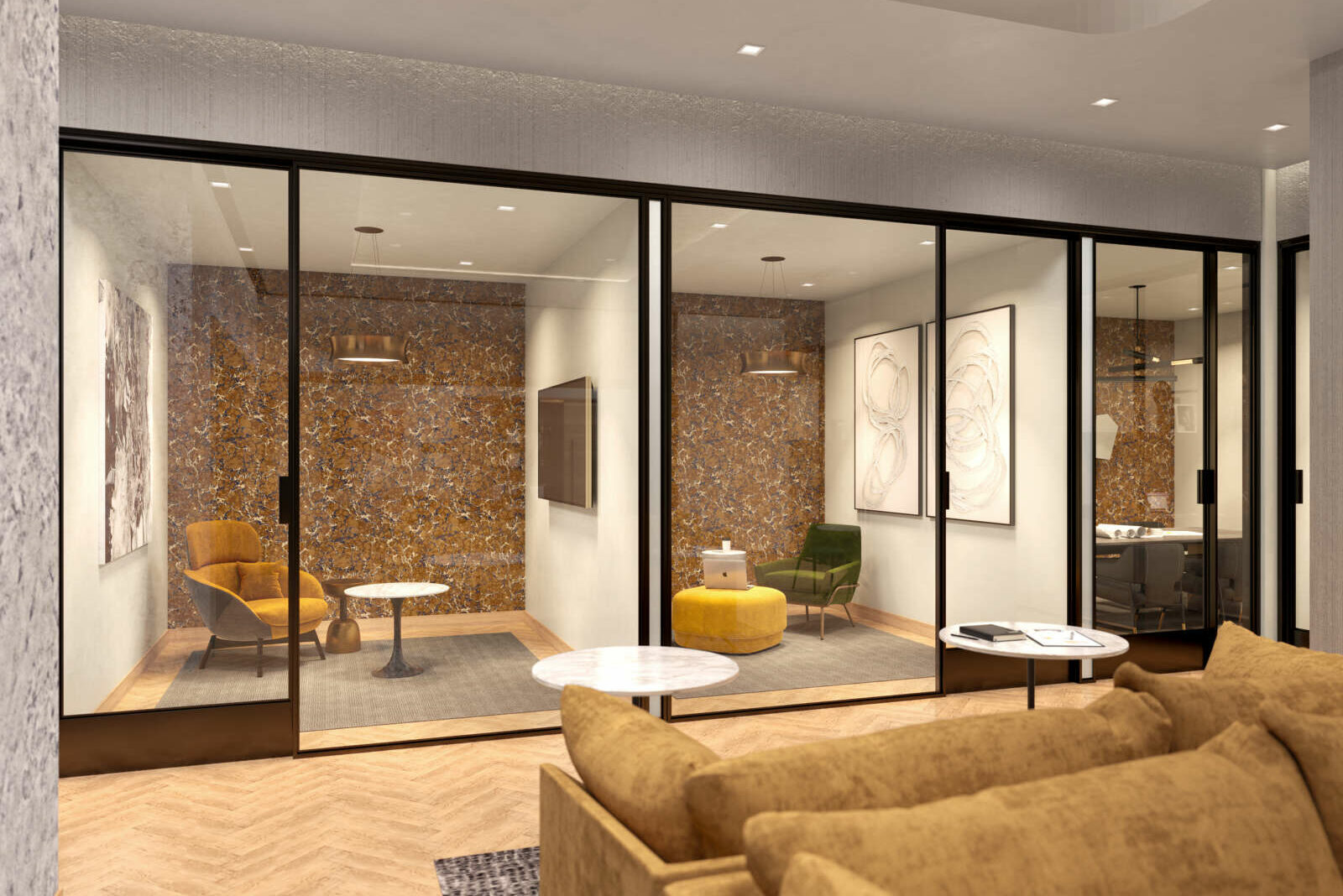
A rendering of the coworking lounge in Evo, part of The Highlands development in Rosslyn development (courtesy of The Highlands)
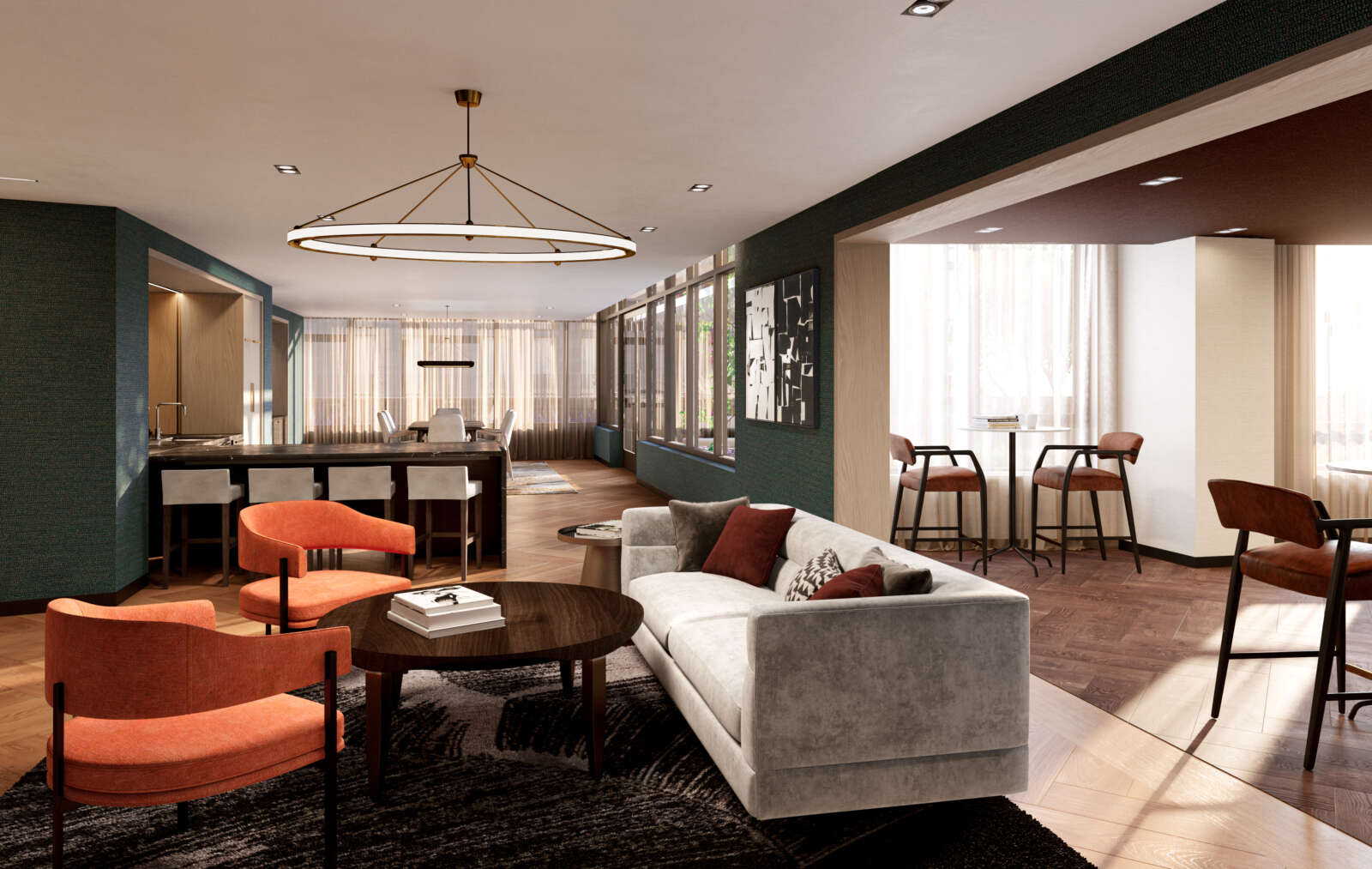
A rendering of Evo, part of The Highlands development in Rosslyn development (courtesy of The Highlands)
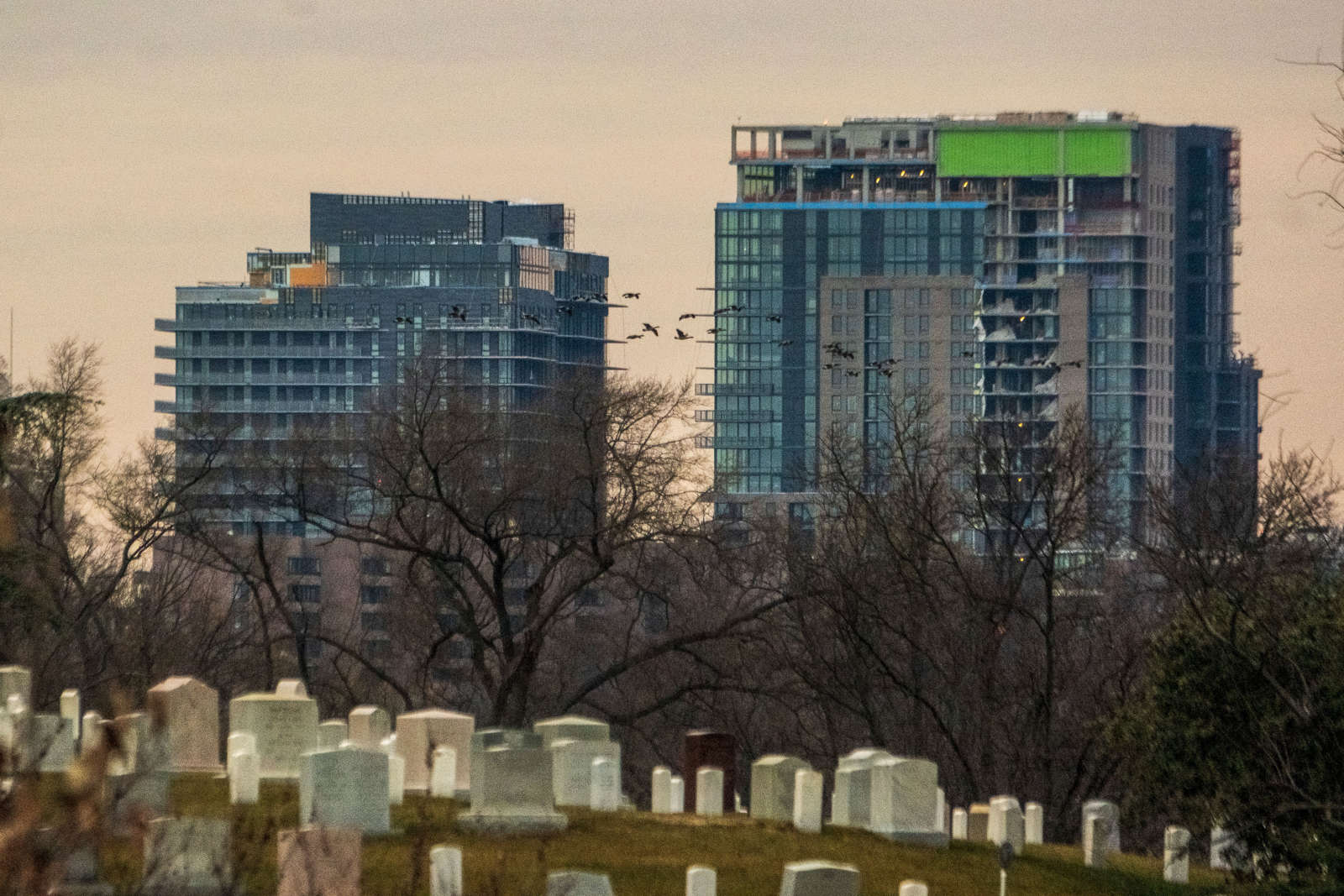
Flocks of geese fly by The Highlands development, as seen from the US Air Force Memorial in February 2021 (Staff Photo by Jay Westcott)
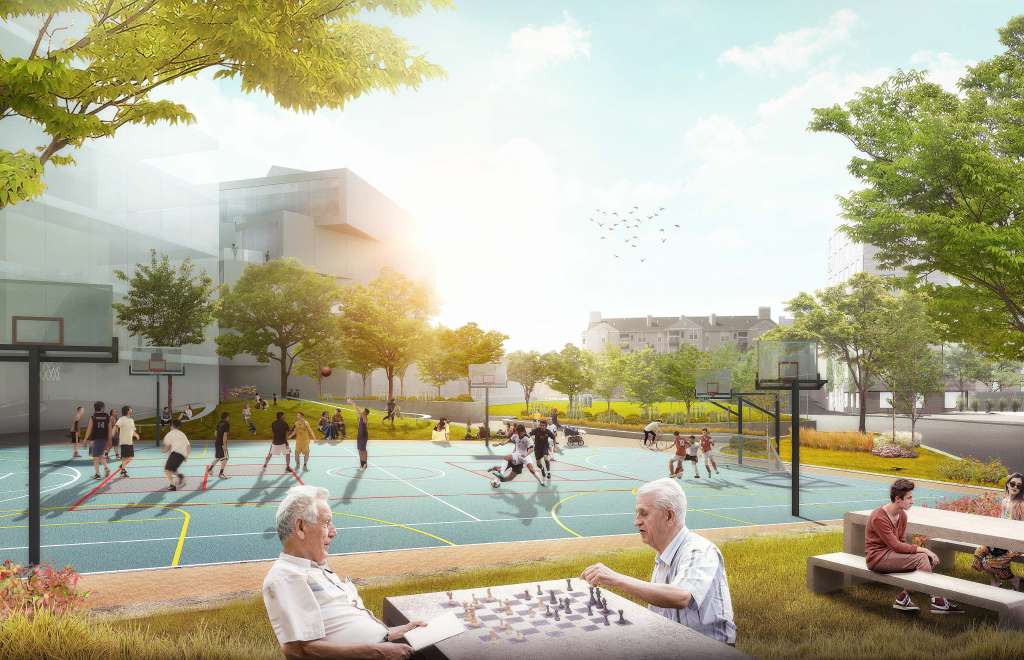
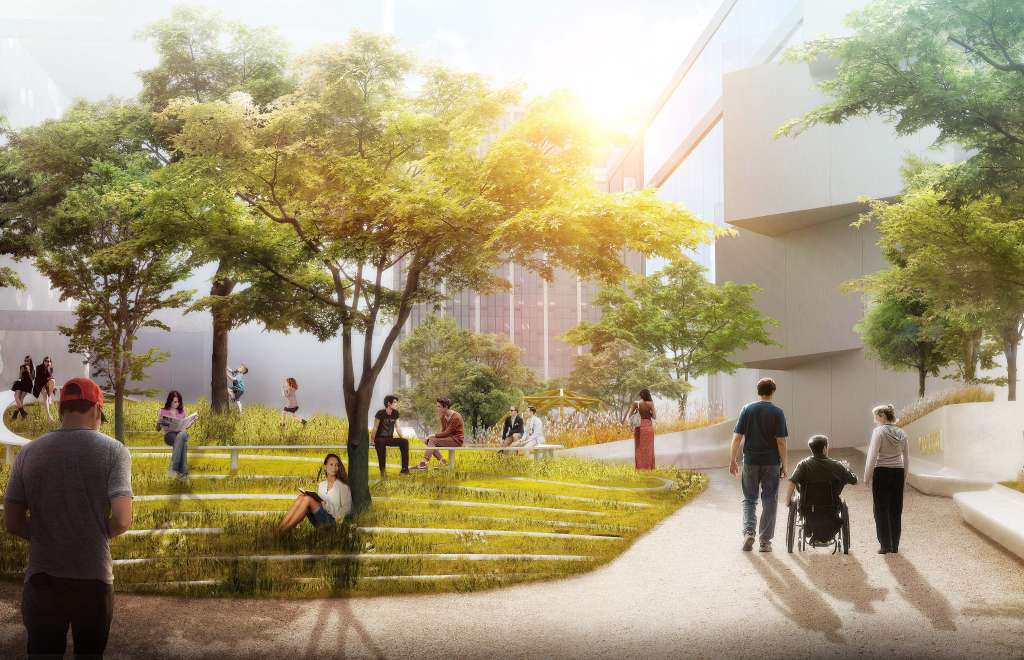
Rosslyn Highlands Park plan rendering
Rosslyn Highlands Park plan rendering
The Highlands development, seen from The View of DC in Rosslyn in November 2020 (Staff Photo by Jay Westcott)
H-B Woodlawn and the under-construction Highlands development in November 2020 (staff photo)
Developer Penzance is approaching the finish line for The Highlands development in Rosslyn, which includes a trio of residential towers, a fire station and a park.
One apartment building, named Aubrey, will be completed this summer, a spokeswoman said.
Early this fall, Penzance is set to deliver two residential buildings — apartment tower Evo and condo tower Pierce — as well as the new ACFD Fire Station 10, which is temporarily located at 1791 N. Quinn Street.
Construction on The Highlands started in October 2018. When finished, The Highlands will feature 780 luxury rental apartments, 104 condos and 40,000 square feet of retail space, in addition to the park and fire station.
Yesterday (Thursday), Penzance announced the start of leasing for apartments in Evo, a new milestone for the massive development. Leasing for Aubrey began March 1 and condo sales are ongoing for Pierce.
“We’re excited to begin leasing for Evo, the final residential tower coming to The Highlands,” said John Kusturiss, Penzance’s senior vice president of development and construction.
The 29-story building with more than 450 luxury apartments will feature a number of amenities, including a rock-climbing wall, a golf simulator, a dart alley and bar, a rooftop pool, grilling stations, and coworking lounges.
“Following The Highlands’ delivery, Rosslyn will also welcome the forthcoming Rosslyn Highlands Park that residents can enjoy,” a press release noted. The 26,000-square-foot park is set to be completed by the end of the calendar year, the spokeswoman said.
The Highlands is part of a flurry of construction in Rosslyn, including the recently completed Queens Court Residences affordable housing development (1801 N. Quinn Street), which will have its grand opening on Tuesday and which features a new playground on-site.
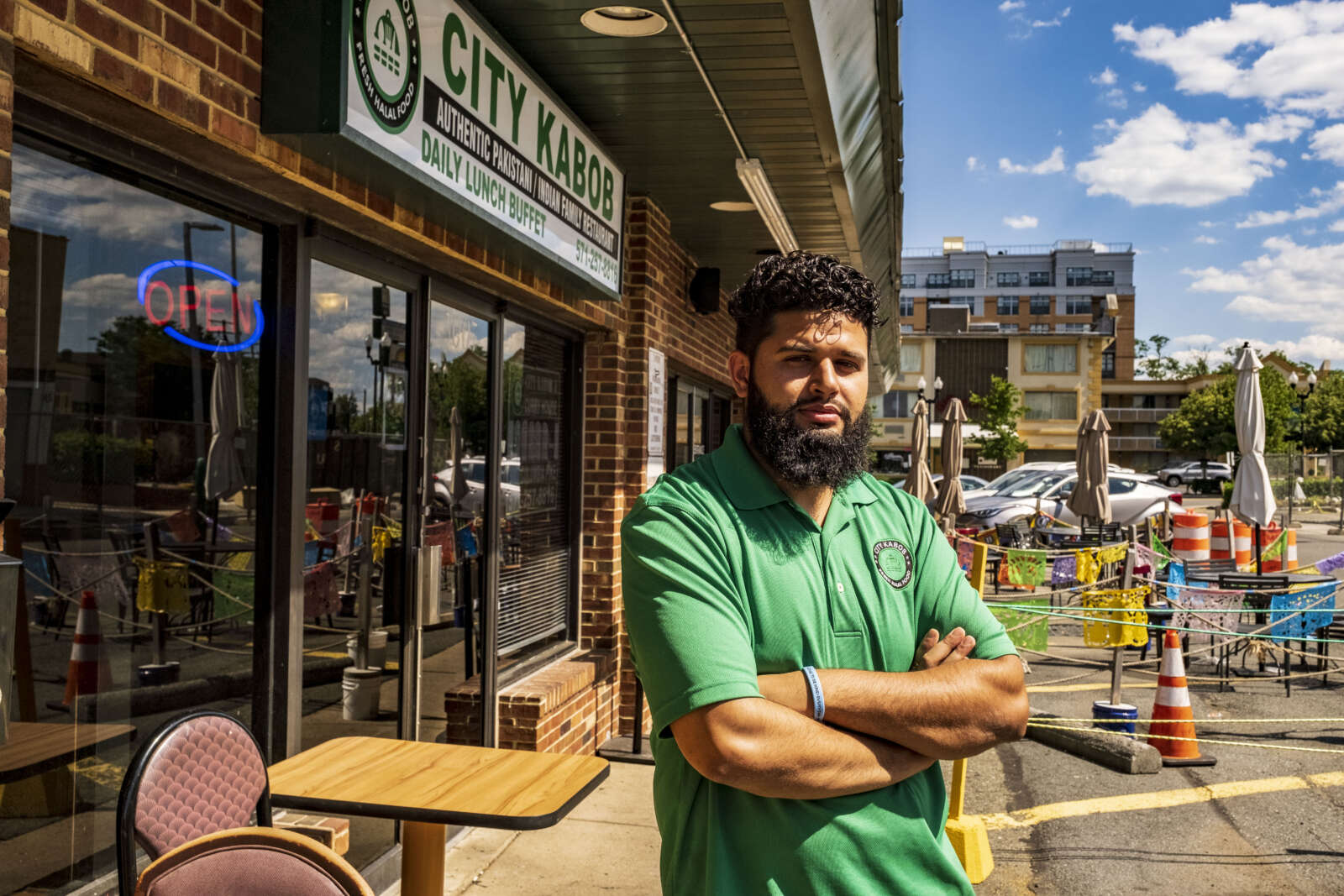
City Kabob & Curry House Manager Adnan Bashir (staff photo by Jay Westcott)
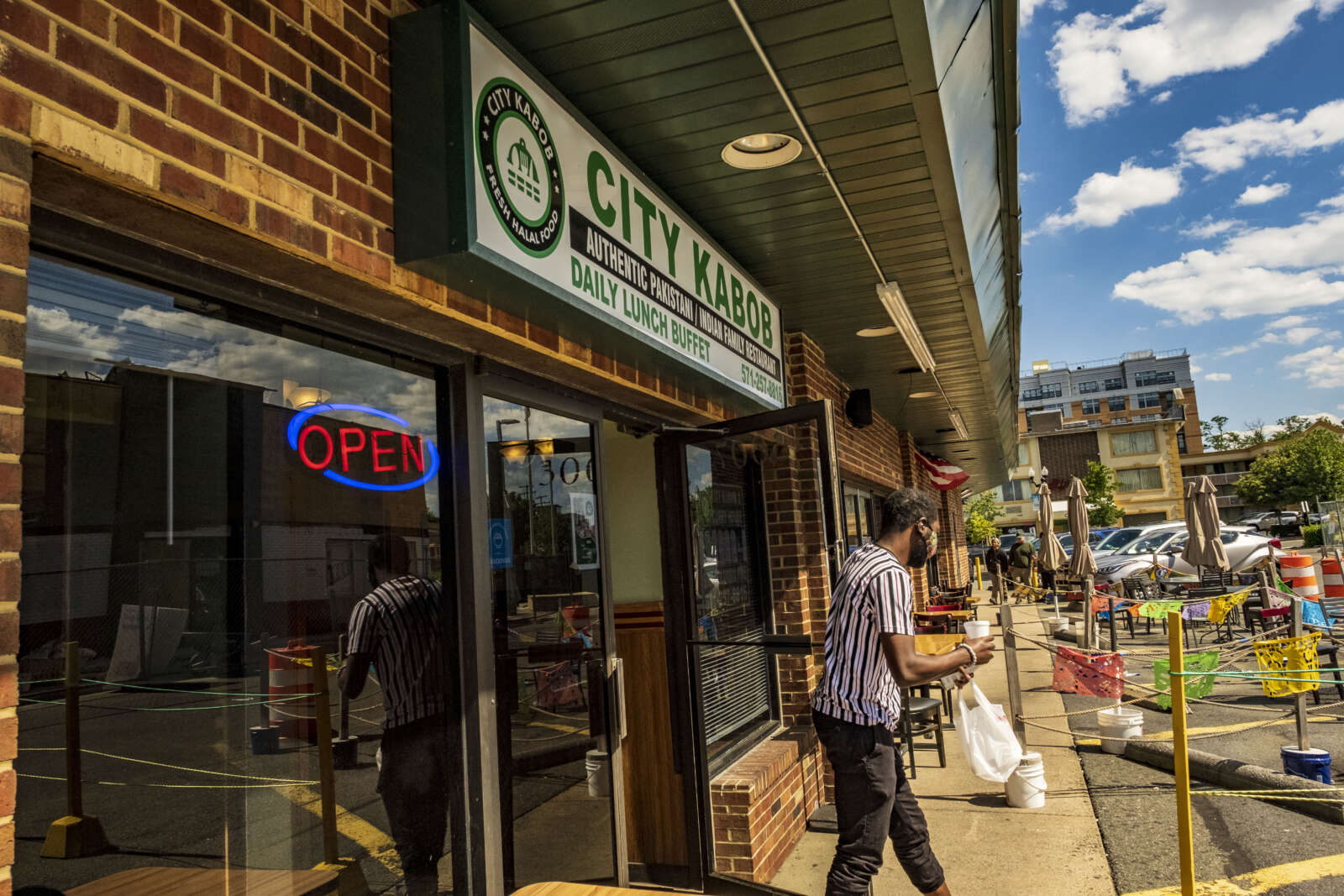
Someone with takeout from City Kabob & Curry House on Columbia Pike (staff photo by Jay Westcott)
City Kabob & Curry House on Columbia Pike (staff photo by Jay Westcott)
A few restaurants in Arlington are reducing their food waste through a new app called Too Good To Go.
And the restaurateurs say the platform not only helps them recover profits on food that would otherwise get tossed — it also makes their businesses more sustainable and helps them reach new clientele.
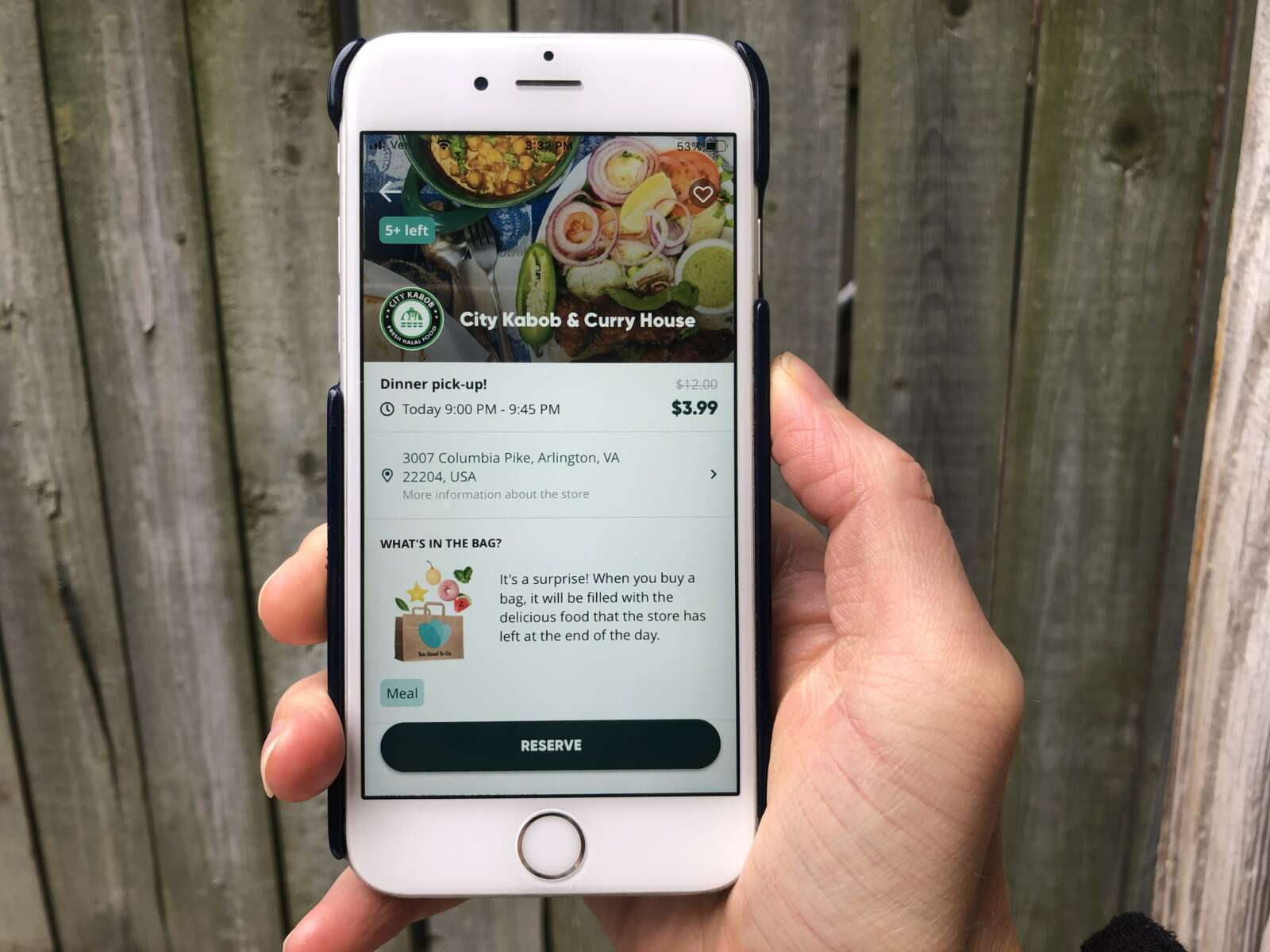
Too Good To Go was founded in Denmark 2015 and made its American debut in New York City last year. Over the last 10 months, it has spread to Boston, Philadelphia, the D.C. area, San Francisco, Seattle and Portland. On days when participating restaurants have leftovers, chefs assemble “surprise bags” with extra produce or a full meal, which are sold via the app for a fraction of the cost of a regular meal.
City Kabob & Curry House (3007 Columbia Pike) is a new buffet that opened two months ago along Columbia Pike. Adnan Bishir, the assistant manager, said the restaurant’s presence on the app for the last month has gotten new customers in the door.
“We’re getting 10-15 orders a day,” he said. “It’s all from the extra food that we have from the buffet. It’s still really good food — they just make too much of it. This way, it doesn’t go to waste.”
City Kabob sells main dishes for one with rice, protein — such as butter chicken or chickpeas — and veggies for $4 instead of the regular price of $12.
“It’s helping business,” Bishir said. “Customers like it.”
At Pentagon Row, since rebranded Westpost, the Asian fast-casual restaurant Bun’d Up (1201 S. Joyce Street) will sometimes sell bags with fresh food and buns or extra meals made but not distributed due to mix-ups involving delivery apps, co-owner Scott Chung said.
The app helps make up for slow days and is bringing out new customers who are happy to support the environmental cause, he said.
“It’s good for our customers to know we’re trying to be sustainable and helping reduce food waste,” said Chung.
Too Good To Go also repurposes leftover orders. While food pickup and delivery apps have been a lifeline during the pandemic, they come at a cost: no-shows, mixed-up orders or lost drivers, which would mean wasted food, he said.
“We’re expected to eat the costs, on top of the really high commissions for operating on those apps,” Chung said.
Over at South Block, the growing juice and açai bowl chain with multipleArlingtonlocations, Vice President of Product Adam Kramer said employees use the app to get extra cold-pressed, unpasteurized juice — which has five to 10 pounds of produce per bottle — to people before it expires, he said.
“So far the feedback has been awesome,” Kramer said. “We have people texting our text line asking when we’ll have stuff available on the app.”
“If we do have waste, it’s a cool way to eliminate it,” he added. “It’s also a way for people who may not ordinarily be able to afford South Block to try our product.”
Kramer said the concept is on brand for South Block, which also has a nonprofit cafe that offer fresh produce to people who are food insecure.
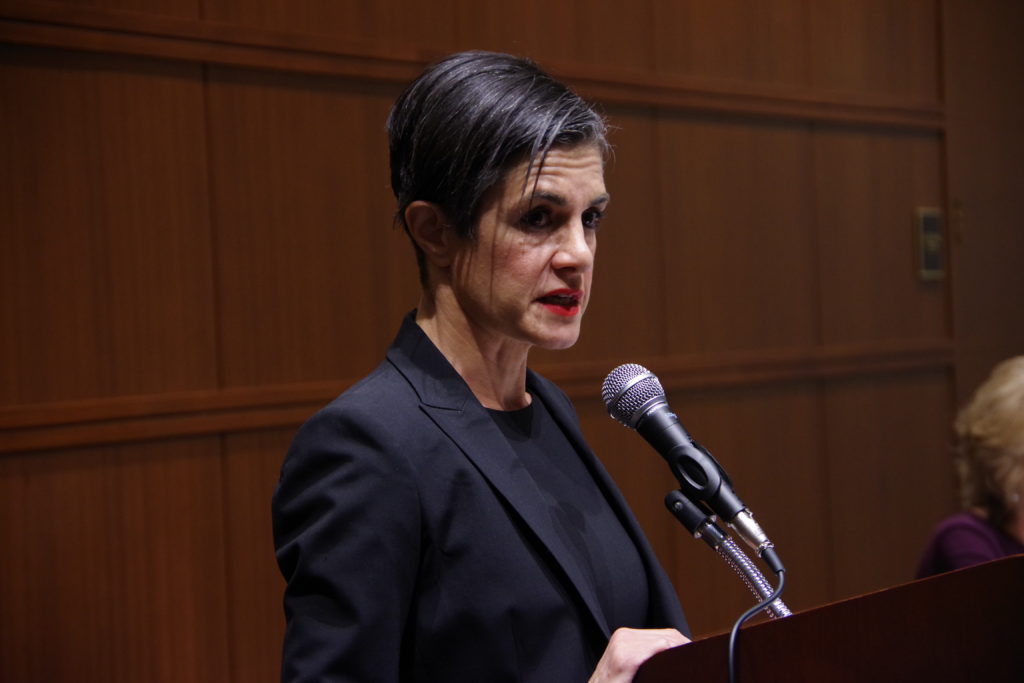
Arlington’s top prosecutor said she is working with Arlington County Police Department to establish a multi-agency cooperative effort to tackle the carjackings and vehicle tamperings here and in the D.C. area.
“My philosophy has always been to focus on crimes that are a public safety risk,” Commonwealth’s Attorney Parisa Dehghani-Tafti tells ARLnow. “Car tamperings and car thefts, I don’t look at those as simple ‘property crimes’ because those are things that make people feel vulnerable and set people up for dangerous situations.”
Dehghani-Tafti, who was elected in 2019 on a platform of criminal justice reform, said she has been following the theft and tampering trend and looking for patterns. She said she has also been encouraging early and constant communication between her office and ACPD, while the two are working with other Northern Virginia and Maryland jurisdictions and some federal agencies.
This coordination may turn into something like a task force. Talks about one began in February, and she said officials will soon be able to announce some kind of organized intra-jurisdiction response.
“ACPD has been working on the task force, and I’ve been promoting the task force,” the prosecutor said.
Dehghani-Tafti said that is playing out across the river in D.C., which saw five times more carjackings in the first quarter of 2021 than the same period in 2020. Similar sprees are occurring in Montgomery County, Prince George’s County and Howard County, she said.
“We’re seeing this across the country, whether or not a reformer is in office or the county government is progressive or not,” she said.
And Dehghani-Tafti said she has reason to believe the car thefts are organized. A few weeks ago, she drove around with ACPD detectives to see what they see and maintain the collaboration she said is needed to tackle more organized crime sprees.
“The carjackings started to look [organized] when a few people were arrested in February and March and the instances went down dramatically in all the jurisdictions in the D.C. area,” she said.
Her office has one person whose job is to provide early assistance to ACPD and other agencies as they build carjacking and tampering cases. The sooner law enforcement agencies reach out, the sooner her office can support officers as they ask for search warrants, gather evidence and build cases.
Such a collaboration “adds value and context of a case” to investigations “so that we don’t take things that are serious insufficiently seriously and we don’t overreact to cases that are not within the organized pattern we are seeing,” she said.
“The criminal-legal system is a blunt tool, and what we’re trying to do is make it more surgical,” she said.
That approach does not mean she is “soft on crime,” she argued, but that she is going after the right people.
As COVID-19 cases surged in Arlington County last year, so did carjackings, assaults, trespassings and opioid overdoses, according to a new annual report from Arlington County Police Department.
Meanwhile, alcohol-related crimes and vehicle crashes saw significant decreases.
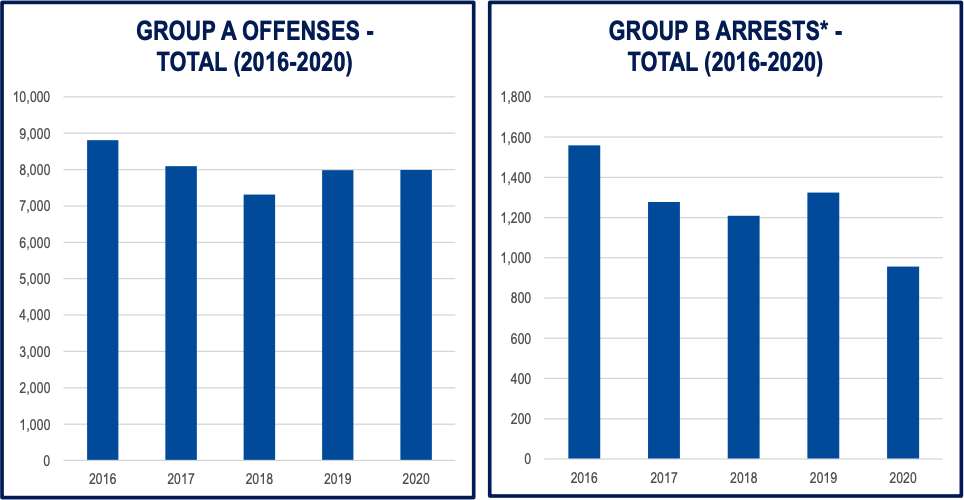
Overall, the report paints a mixed picture of a relatively flat crime rate for those against property and society, or “Group A Offenses,” compared to 2019. It also shows a drop in the number of arrests for less serious crimes such as trespassing, loitering and drunkenness, or “Group B Arrests.”
But the report highlights a few key crimes that rose or fell, partially due to the pandemic. It also addresses at length the rash of carjackings — which started ticking up in 2019 and have continued in 2021 — and ACPD’s response.
“Group A Offense Totals” and “Group B Arrests” rose to 7,990 and fell to 956, respectively, from 7,985 and 1,324 the year prior, according to the report.
Crime rates from 2016 to 2020 by “Group A” and “Group B” (via ACPD)
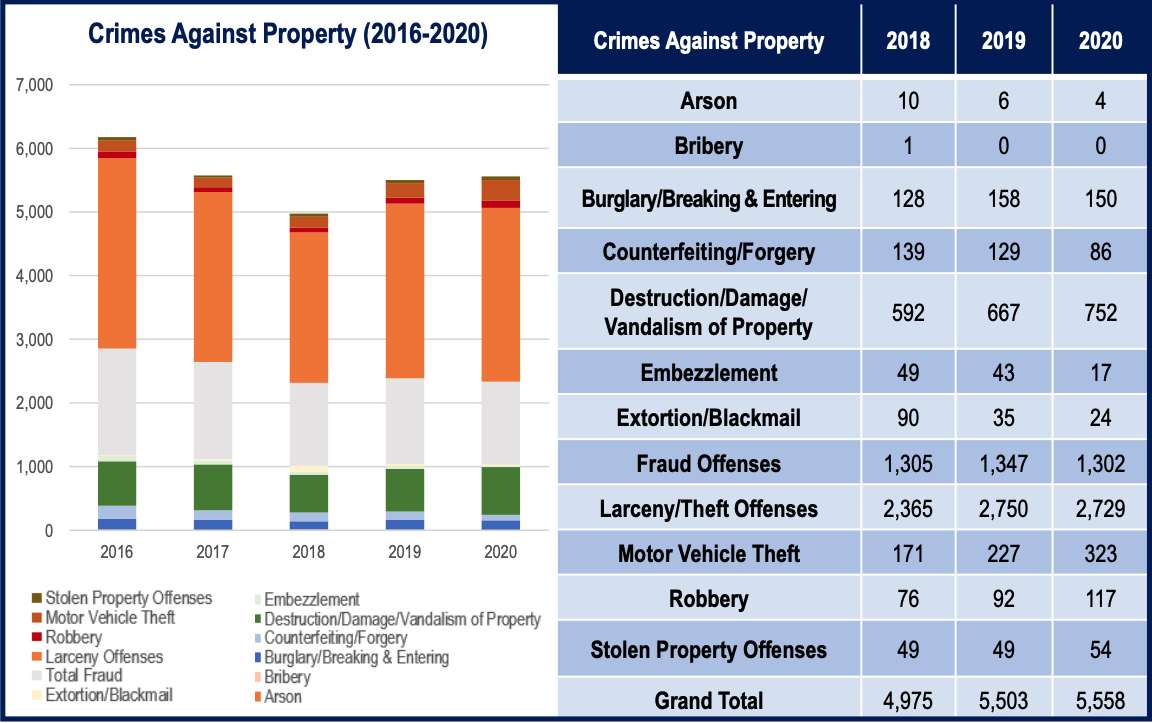
While the Group A total stayed largely flat, “2020 was marked particularly by increases in vehicle-related property crimes including carjacking offenses, motor vehicle thefts, larcenies from auto and tamperings,” newly-appointed Police Chief Andy Penn wrote in the report.
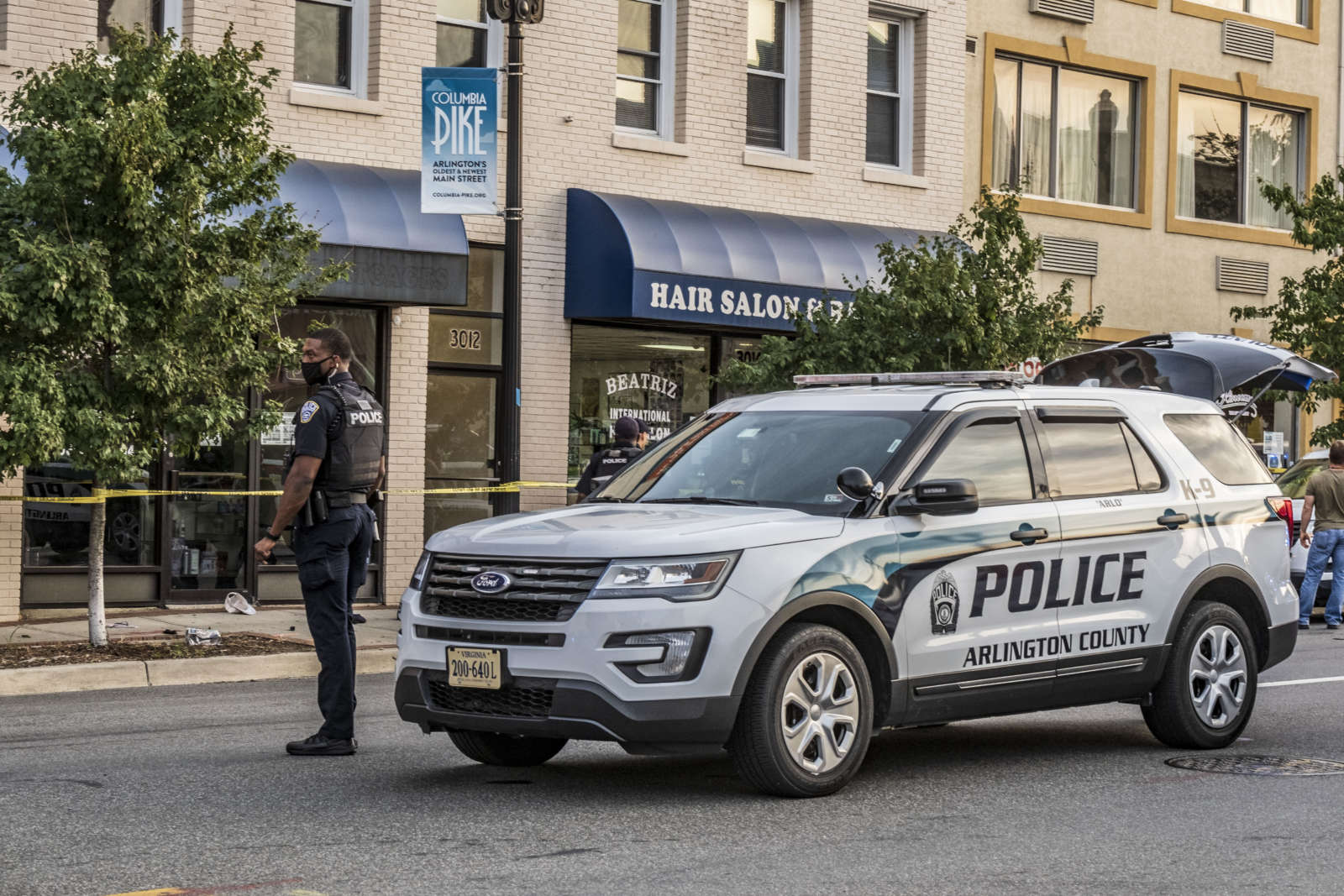
Penn said these car thefts and tamperings are playing out across the D.C. area and nationwide. ACPD investigated 16 carjacking reports in 2020: eight were solved with arrests or with the identified suspect being held in another jurisdiction.
“Arlington detectives worked collaboratively with our local, state and federal law enforcement partners to investigate cases, identify suspects and apprehend those responsible,” Penn said.
Most of the carjackings were concentrated in Crystal City and Pentagon City. In response, ACPD poured more resources into these neighborhoods last year and earlier this year, which the department said in March appears to be working.
Crimes against property from 2016 to 2020 (via ACPD)
Thieves tend to target unlocked vehicles in neighborhoods, Toyotas and Hondas (for their parts) in open-air parking lots and those left running unattended or parked with keys inside, according to the report.
Assaults, meanwhile, reached a sustained three-month high from July through September before declining. They were concentrated in populated areas and in transit corridors, the report said.
“This temporal pattern was similar to other offense types this year, likely related to COVID-19 closures,” according to the report. “Domestic assault and battery offenses against a family or household member increased by 38 cases (14.6%) compared to 2019 and were a significant contributor to the increase in simple assaults.”
Although ACPD’s report does not specifically link domestic assault to the pandemic, at least one study does.
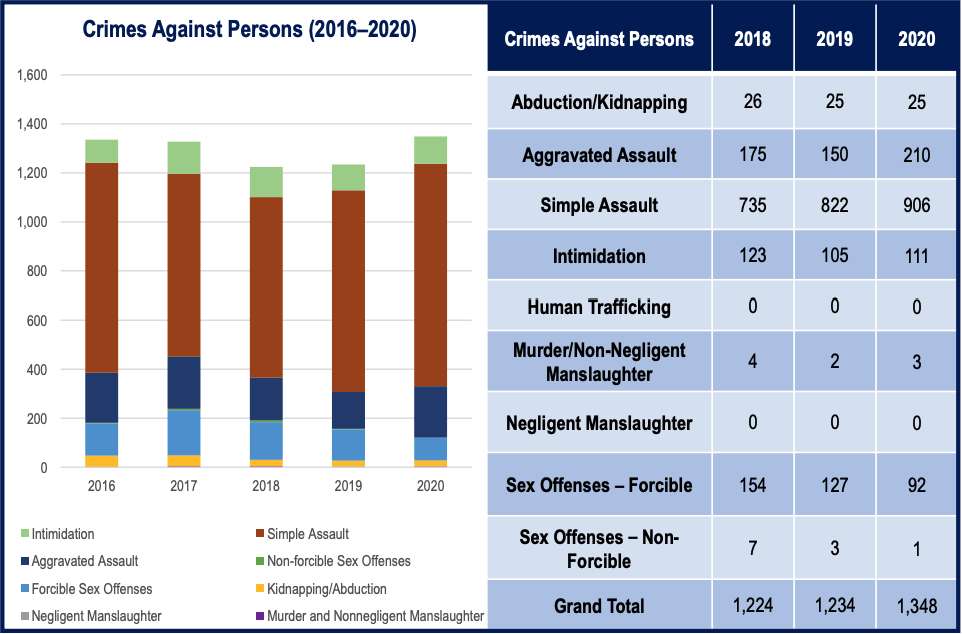
Crimes against persons from 2016 to 2020 (via ACPD)
While crimes against people have been increasing since 2018, Arlington’s violent crime rate continues to be less than half the statewide rate, the report said.
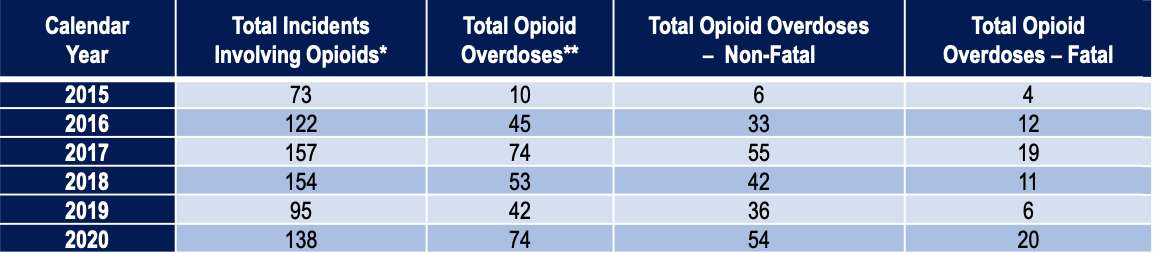
Lastly, ACPD investigated 20 fatal overdoses and 54 non-fatal overdoses in 2020 — more than any other year since it began actively tracking incidents involving opioids in 2014, the report said. The total, 74, matched the number reported at the peak of the opioid epidemic in 2017, and involved heroin and prescription painkillers mixed with fentanyl.
“While the investigation into these incidents revealed no direct evidence that the increases are fueled by the COVID-19 pandemic, it is likely a factor given the timing, the loss of income and jobs and the isolation of stay-at-home orders,” the report said.
Opioid overdoses in Arlington County (via ACPD)
COVID-19 may partially explain the increases in assaults and thefts, but it may also have contributed to a sharp decline by 27% in “Group B” arrests. Leading that drop were drunkenness (42%), driving under the influence (13%) and liquor law violations (68%).
“These declines are likely indicative of COVID-19 business closures and reduced hours of operation, decreased public consumption of alcohol, success of increased enforcement, advocacy and better utilization of taxis, ridesharing and other transportation options in reducing DUI behavior,” the report said. “Alcohol-involved traffic collisions were reduced in 2020 to the lowest levels in recent years.”
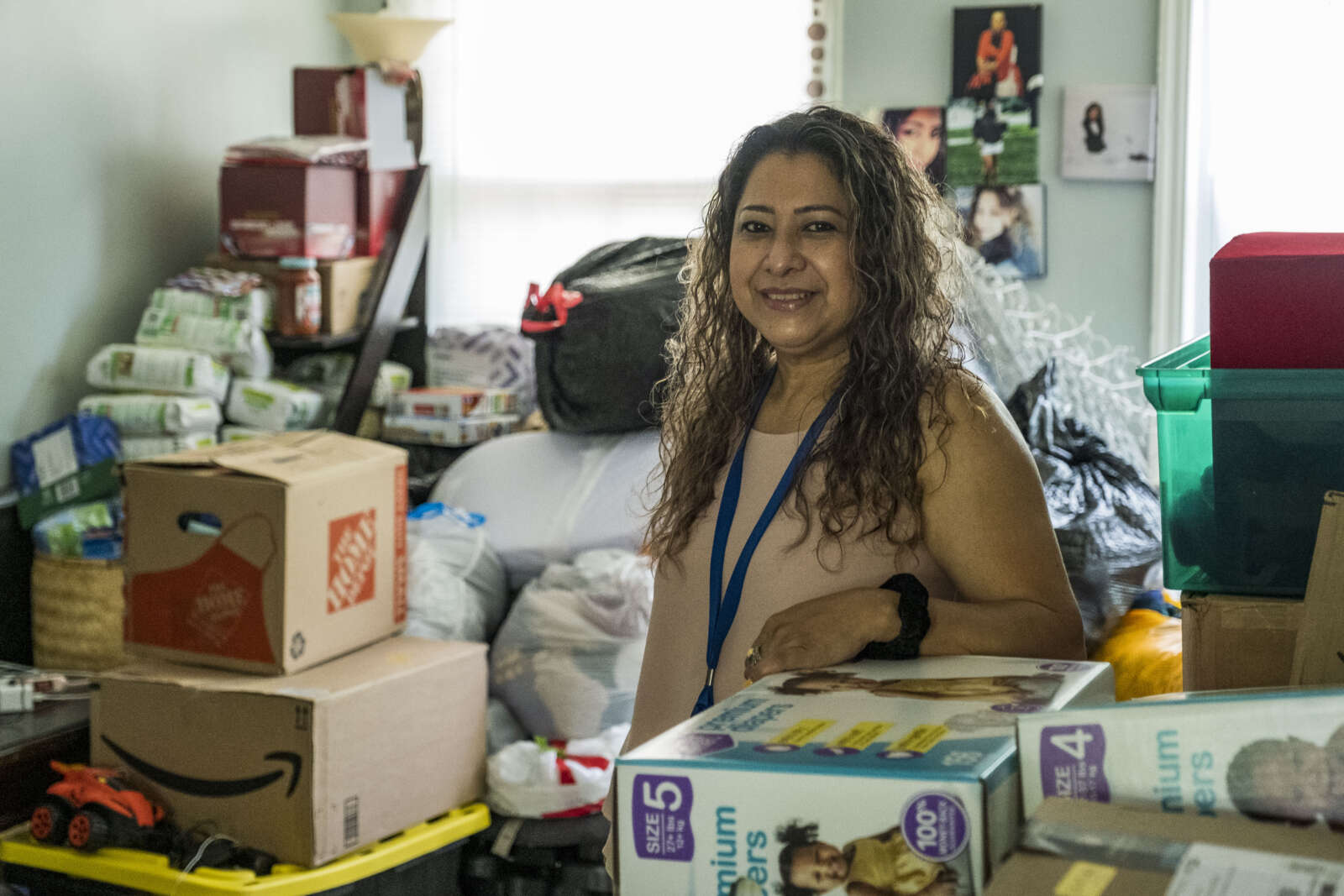
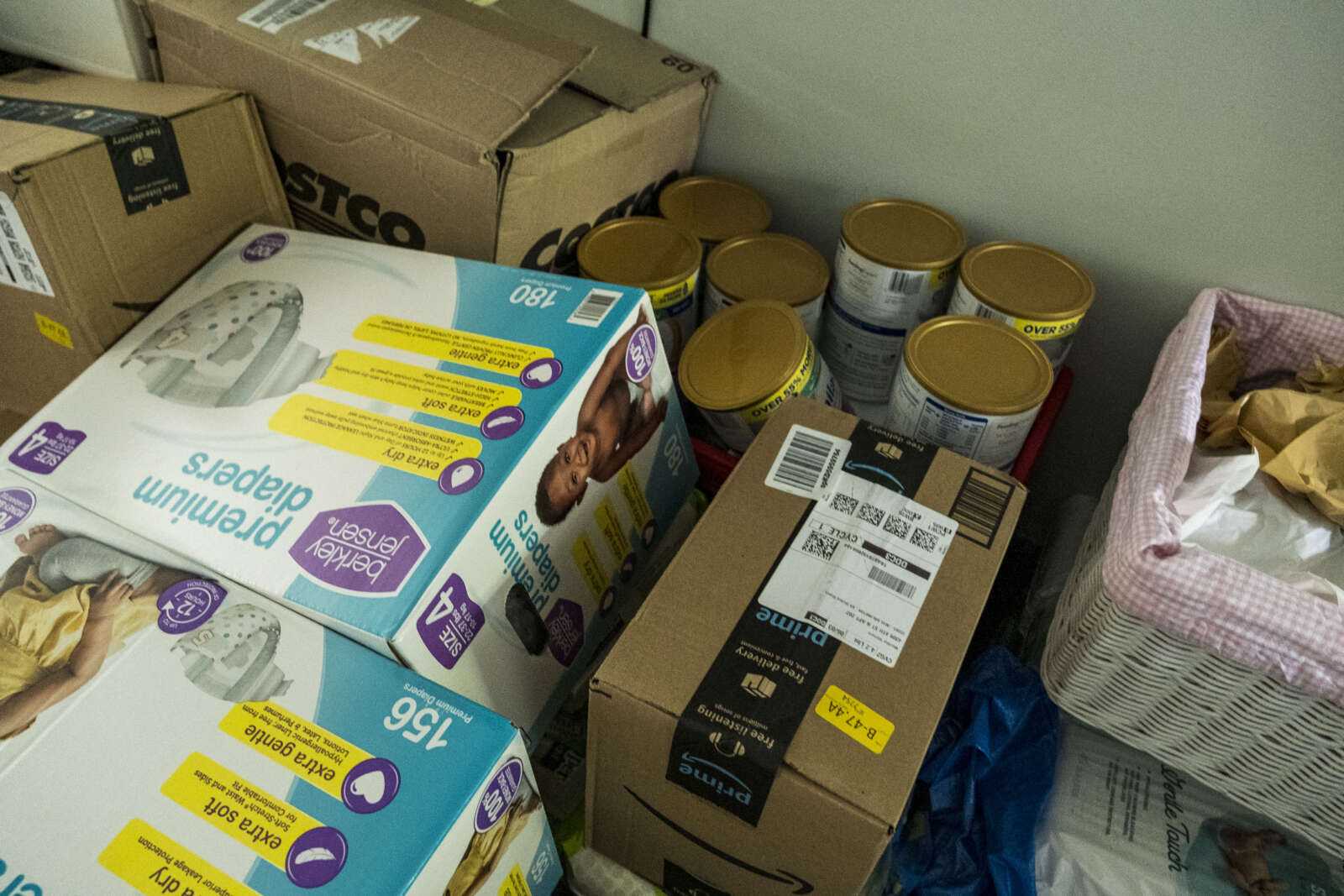
Mariflor Ventura in her home, overflowing with donated necessities (staff photo by Jay Westcott)
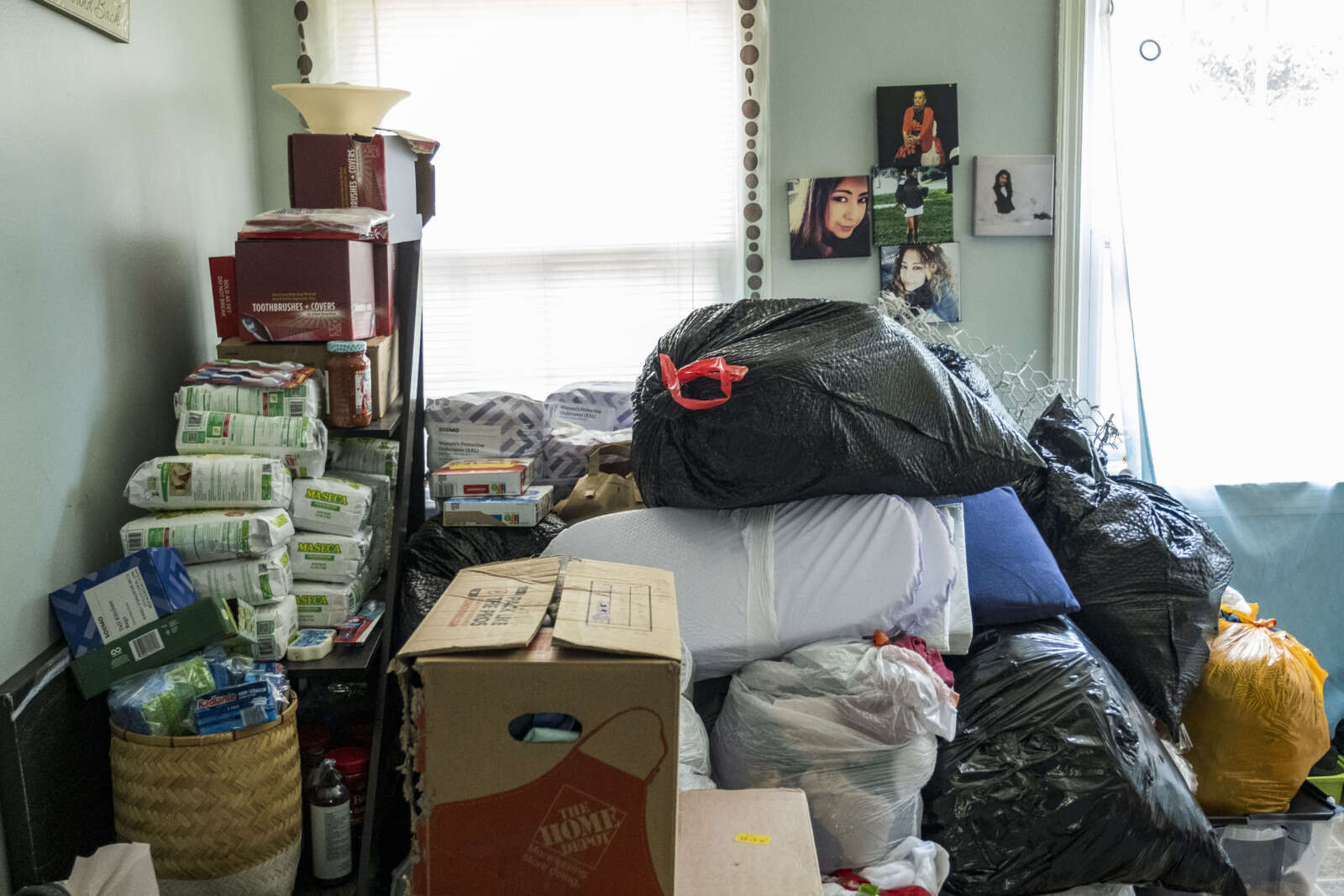
Donations pile up in the home of Mariflor Ventura (staff photo by Jay Westcott)
Donations pile up in the home of Mariflor Ventura (staff photo by Jay Westcott)
Mariflor Ventura made headlines earlier this year for helping her Buckingham neighbors during the pandemic.
Dubbed an “Arlington superwoman” by ABC 7, Ventura has been finding and distributing donations and handing out food and basic supplies for a year — an experience that has changed her life.
But now, she is drowning in donations and buckling under the weight of unyielding need. Still, Ventura is determined to give a leg up to people who have fallen on hard times and is looking for ways to structure and sustain her work.
“I love Arlington,” she said. “Whatever I can do, I’m here.”
Ventura, who is a bus attendant with Arlington Public Schools, began helping her neighbors last year during the lockdowns when school was virtual. Through a local Facebook group, she found items for free and distributed them to her neighbors.
The network expanded quickly, especially after giving an interview in Spanish, which reached immigrant communities as far as Woodbridge.
“This year has been busier than when I started,” she said. “I’m going to have to take a vacation from the donations to spend time with my kids.”
“I stopped fundraising because I don’t want to manage money,” which could open her up to criticisms about how it is spent, she said.
The Amazon wishlist goes beyond the basics. There are decorations so families could have proper graduation parties for their older kids and bubble wands, water guns and coloring books to occupy kids this summer.
All these ideas have come from Facebook group members, she said.
“They have good ideas and they like to help,” she said.
But Ventura has a wishlist of her own: A separate space for the donations, a nonprofit designation, and a regular assistant to keep track of appointments and help distribute items.
She has been considering the now-vacant apartment downstairs from her. Even the nearest storage facility is far away and the move might confuse people who are used to coming to her house. There was talk about finding a church basement, but that fell through, she said.
As it stand right now, her home is filled with donated items waiting to be given away.
“There’s no space to clean — there’s a tiny little space where we watch TV in the dining room area,” she said. “Some days, I give up and say, ‘I’m not going to do anything. I’ll just try to relax.'”
She laughs. “Normally, I’m a very organized lady. My mom taught me to have my clothes picked out for the next day.”
Ventura said some connections are working on turning the organization into a nonprofit, but that will take some time. In the interim, she imagines creating some kind of free thrift store.
The Arlingtonian knows what it’s like to have nothing. At one point, Ventura lost her job, her apartment and her car. But someone opened a door for her to start working at the county, and she worked her way up.
“From my experience, I can help more people,” she said.
She said it is hard for many immigrants to adjust to life in the U.S. — to find jobs, seek out assistance or just feel comfortable visiting a park.
“I hear from them that it’s their dream to come here, but when they come, they [realize] it’s not easy to live here,” she said. “It’s hard to find a job and if you don’t have family here, it’s harder. It’s just like they are stuck. Somebody has to help them up.”
Ventura said her neighbors are also returning the favor.
“It’s not like I’m the hero,” she said. “They see how I help and they’re helping in return.”
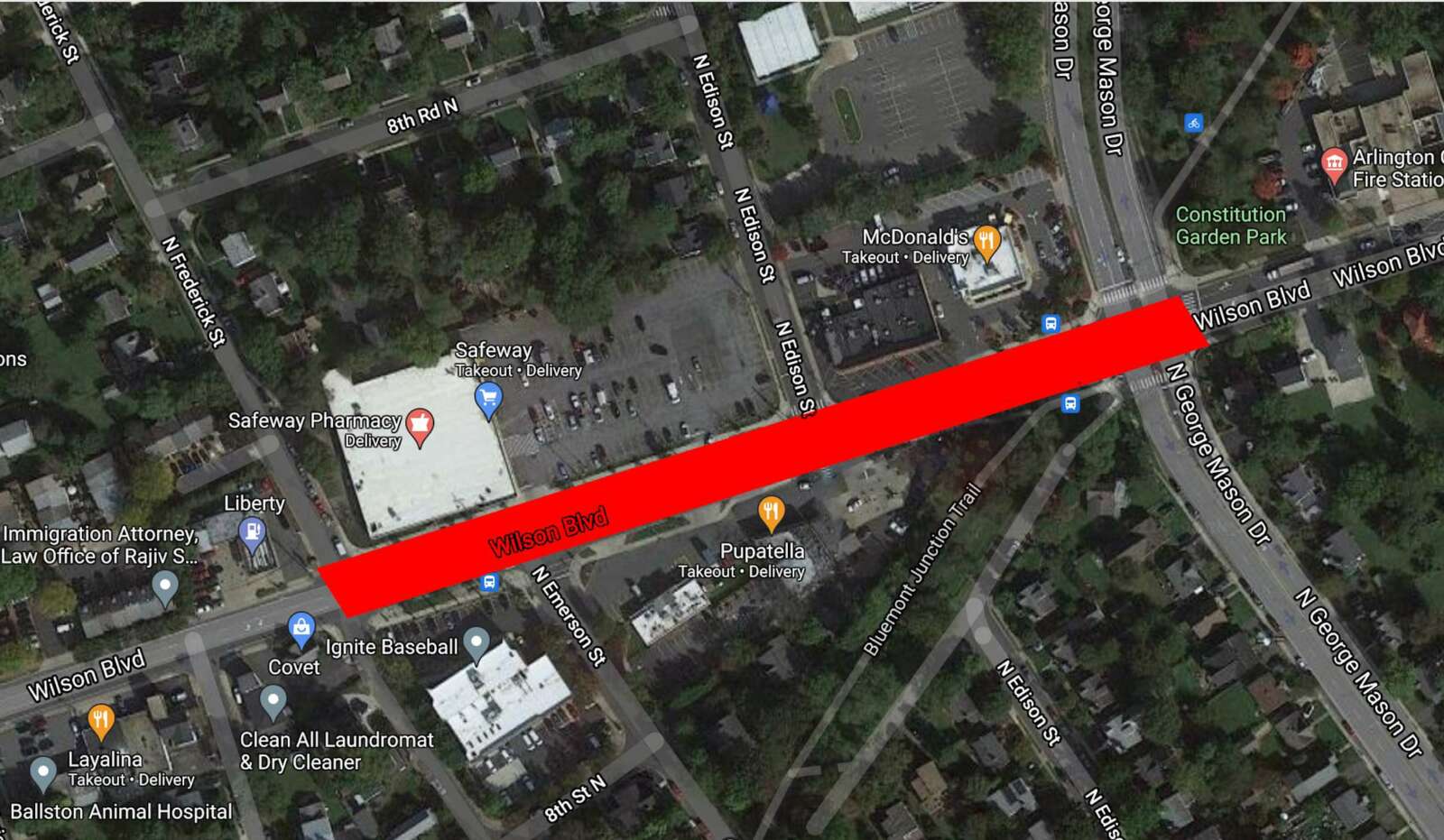
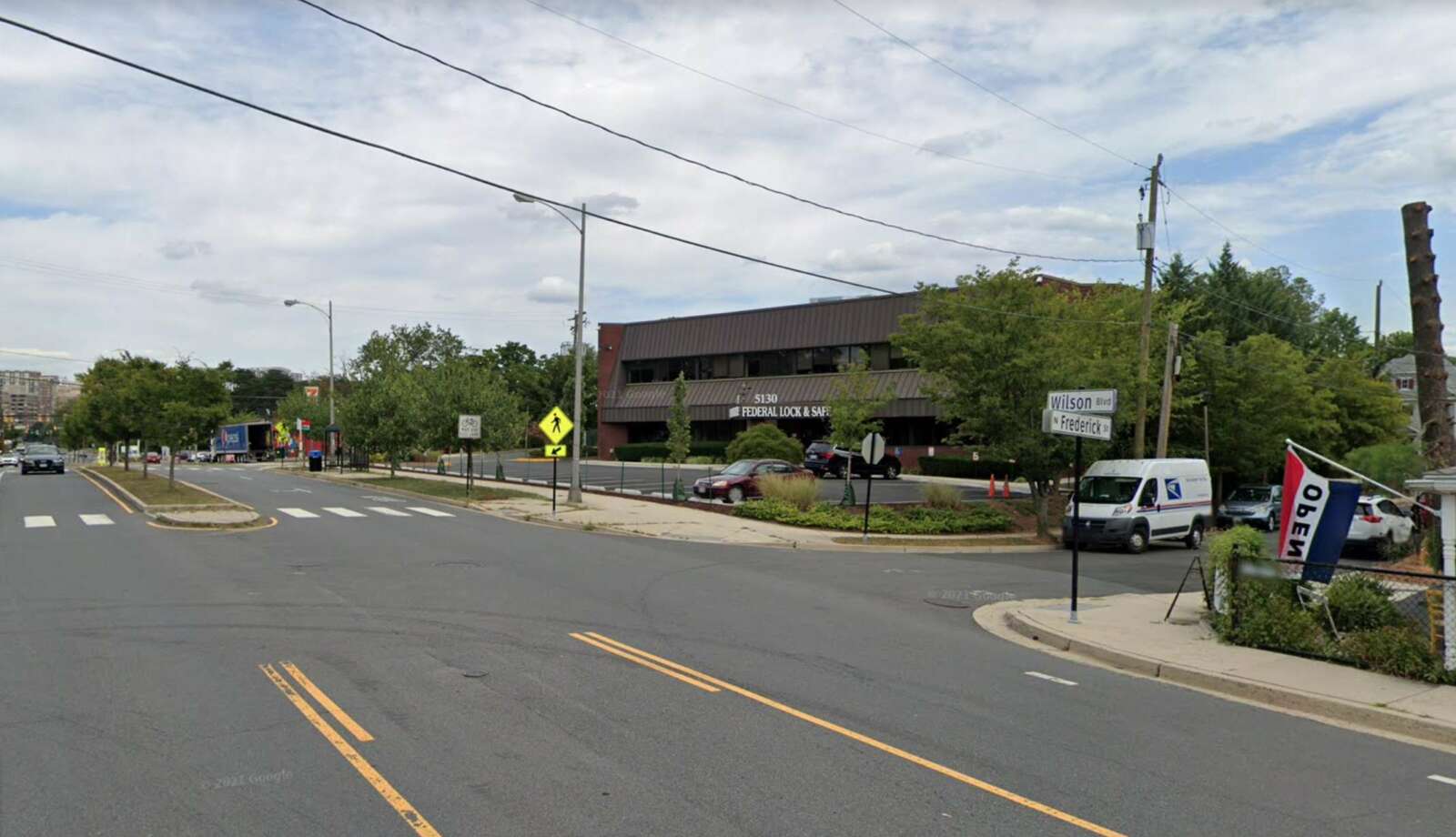
Arlington County will be resurfacing this stretch of Wilson Blvd (via Google Maps)
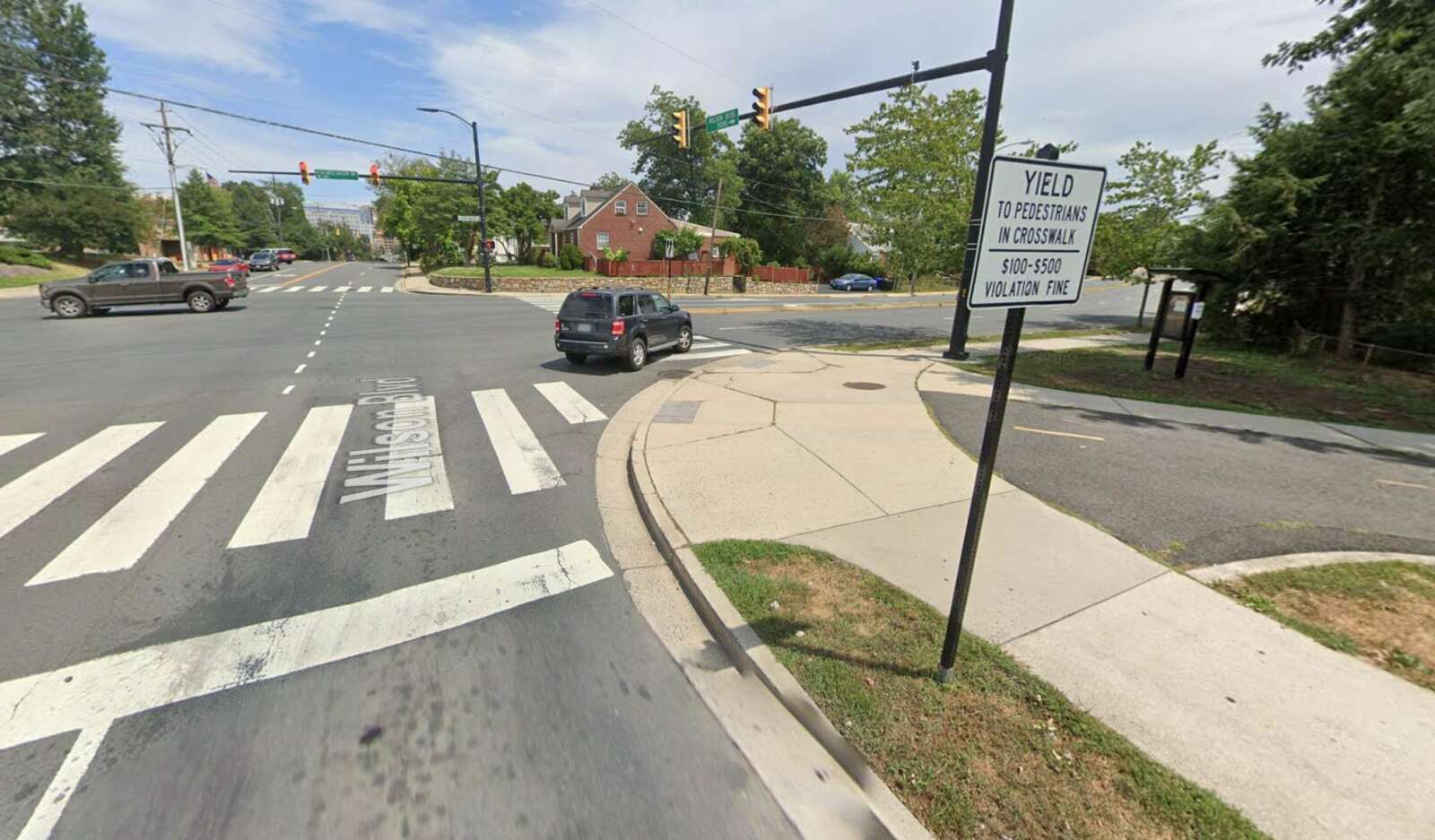
Resurfacing is planned for the Wilson Blvd and N. George Mason Drive intersection (via Google Maps)
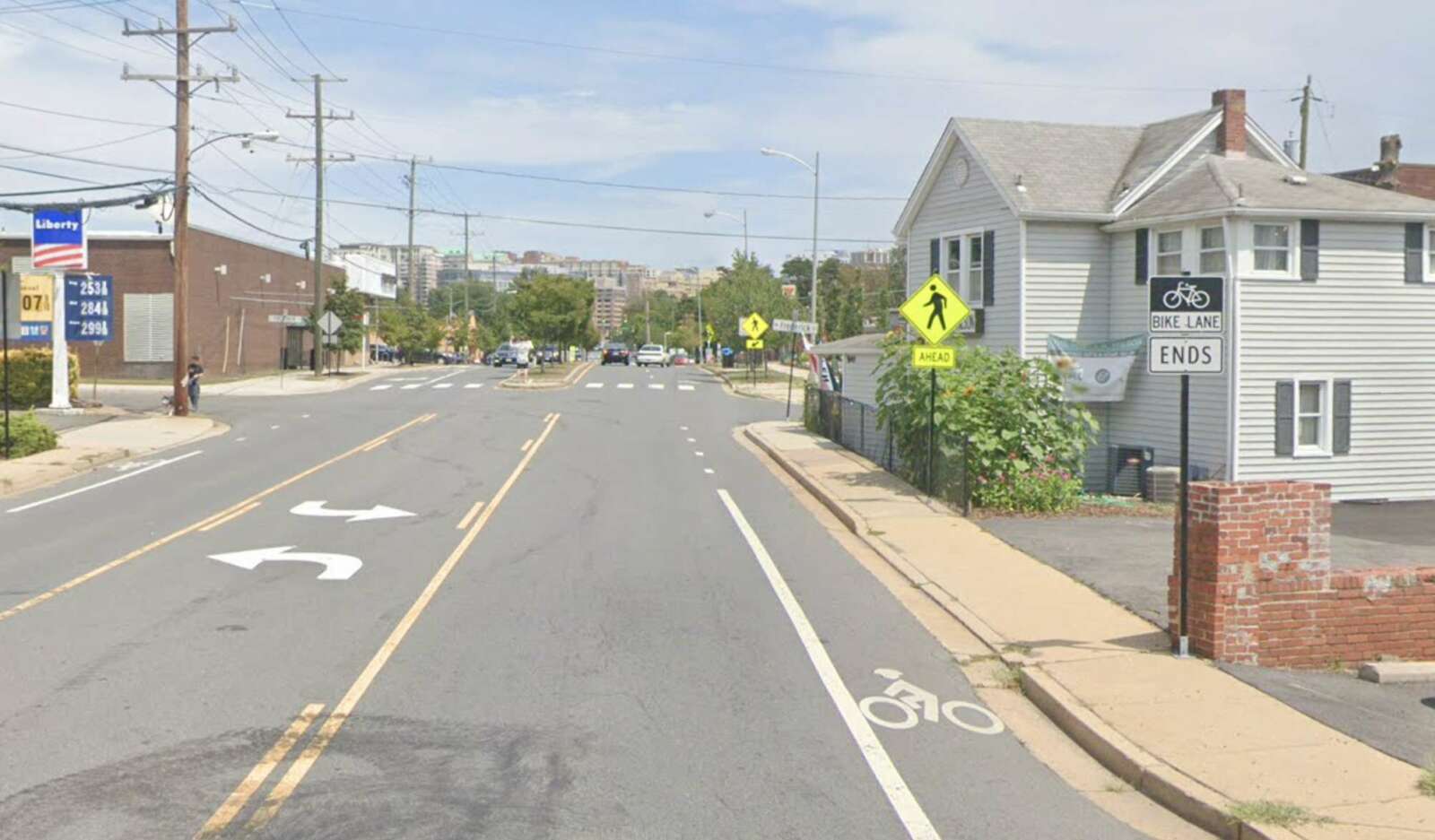
Wilson Blvd near N. Frederick Street, where it transitions widens from one lane to two (via Google Maps)
Wilson Blvd near N. Frederick Street, where it transitions widens from one lane to two (via Google Maps)
The county plans to resurface a stretch of Wilson Blvd in Bluemont to improve the driving, cycling and walking experience.
The project is part of Arlington County’s annual effort to resurface about 100 lane miles of roadway annually, prioritizing those in the most need of upgrades and those adjacent to development or other capital projects.
County staff propose reducing — in most places — the number of vehicle travel lanes along Wilson Blvd from four to two between N. Frederick Street and N. George Mason Drive. During a meeting last night (Monday), they said the reduction will accommodate new turn lanes and buffered and standard bike lanes, and prevent merging conflicts where Wilson Blvd transitions from two lanes to one in each direction west of N. Frederick Street.
Transportation Engineer Dan Nabors said the changes will “improve pedestrian crossings, provide separation between people who are driving, walking and biking, reduce and control vehicle speeds, improve sightlines, and make the street easier to understand for all users.”
Currently, east of N. Frederick Street — near the Safeway — Wilson Blvd has two vehicle travel lanes in each direction, curbside transit stops and shared-lane bicycle markings, also known as “sharrows.” The posted speed limit is 30 mph and most people go 33.8 mph, said fellow transportation engineer Cathie Seebauer.
This spring, road users suggested changes to this segment of Wilson Blvd, which staff said they incorporated into the concept plan shared last night. Community members asked for a continuation of existing bike lanes, a safer Bluemont Trail crossing at the intersection with N. George Mason Drive, and changes to the part of Wilson Blvd where it narrows from two lanes to one west of N. Frederick Street, Seebauer said.
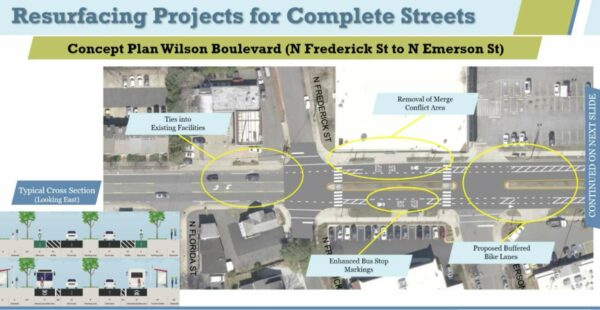
Proposed changes to Wilson Blvd from N. Frederick Street to N. Emerson Street (via Arlington County)
From N. Frederick Street to N. Emerson Street, staff propose eliminating the transition from one to two lanes and adding buffered bike lanes that will be shared with enhanced bus stop markings.
“The road does meet national volume thresholds for a reconfiguration from four lanes to two,” Seebauer said. East of N. Edison Street, however, she said that “two eastbound travel lanes would need to be retained to maintain safety and operations.”
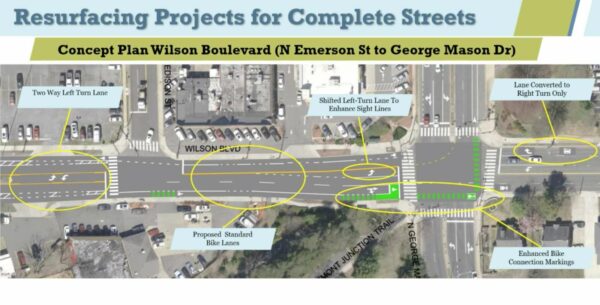
Proposed changes to Wilson Blvd from N. Emerson Street to George Mason Drive (via Arlington County)
From N. Edison Street to N. George Mason Drive, cyclists will have a 6-foot standard bike lane with green paint to warn drivers and cyclists of major conflict points. A two-stage bike box will guide those turning to go north on N. George Mason Drive and help those continuing east on Wilson Blvd to merge with through vehicular traffic when the bike lane disappears.
Wilson Blvd going west will have only one through-lane to make room for dedicated right and left-turn lanes.
An online comment tool will be open until Tuesday, July 7. The resurfacing work will be done this summer and fall.
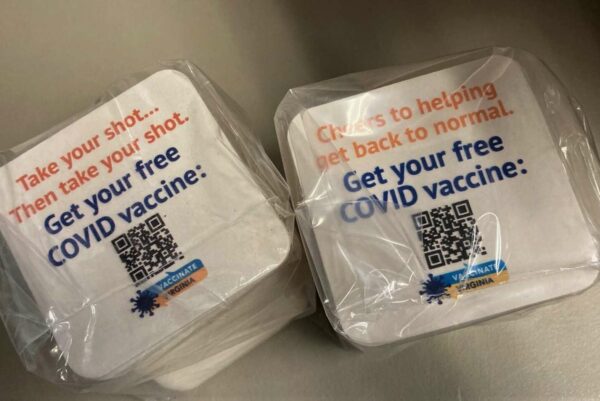
Coasters from Arlington County encouraging people to get vaccinated (courtesy Arlington County)
(Updated at 2:20 p.m.) Patrons at nine restaurants in Arlington may have noticed new cocktail napkins and coasters with QR codes floating around last week.
These coasters and napkins are courtesy of Arlington County as part of its vaccination effort, county communications director Bryna Helfer tells ARLnow.
Scanning the code, patrons of Whitlow’s, TTT Restaurant and Ambar in Clarendon, Wilson Hardware, The Lot, O’Sullivan’s Irish Pub, Rebellion on The Pike, Caspi Restaurant and Lounge and Crystal City Sports Pub can schedule a vaccine appointment while sipping their drinks.
“We want to try and do some creative strategies and get a better understanding… of how we can get the remaining people vaccinated,” Helfer said. “Are incentives what will get the remaining people in Arlington across the finish line?”
Across the country, governments and companies are offering prizes to people who get a shot. These bonuses, from the chance to win the lottery to free state park season passes and absolved parking tickets, have generated a lot of attention. The Biden administration is even encouraging states to offer prizes to draw attention to the vaccine.
In neighboring D.C., Mayor Muriel Bowser is providing cash incentives to people living in parts of Wards 7 and 8 with lower vaccine rates. Residents who go to certain clinics will receive $51 gift cards and can enter a drawing to win cars, groceries and Metrobus passes.
“We haven’t done those things, but we’re exploring and working to try to understand… what would motivate someone to get the shot,” Helfer said. “Sometimes it’s not incentives — it’s fear of shots or it might be something else.”
Coronavirus cases have dropped significantly in Arlington, to around just one per day. Nearly 60% of all Arlingtonians have at least one vaccine dose, while 52% of the population is fully vaccinated, according to Virginia Dept. of Health data. Compared to its neighbors, Arlington’s rates are higher than the city of Alexandria’s but lower than Fairfax and Loudoun counties.
“We have more of a vaccine uptick than a lot of other places, but that said, we have gaps,” she said. “We’re trying to launch outreach to 21 to 29-year-olds to see what’s holding them back and reaching out to people in the 22204 zip code and the neighborhoods along Columbia Pike.”
If Arlington could include doses administered by the federal government, Helfer estimates the rate of unvaccinated individuals would be closer to 30%, as many federal employees and military service members live in Arlington.
In addition to working with 35 pharmacies and offering daily clinics, the county is working with the Complete Vaccination Committee — a volunteer group established to raise vaccine awareness — and trusted partners, including faith groups, to draw attention to the vaccine and get shots in arms, she said.
Now, the county is leaning on those partners as it prepares to launch new outreach efforts.
This week, the county is planning to meet with nonprofits and Business Improvement Districts to see if it can “piggyback” on events such as outdoor movie screenings to administer more shots, she said. With 30% of the community left to vaccinate, Helfer said the county is entering a new stage of vaccine outreach: “field operations.”
Staff members have gone to diaper distributions and food banks with shots and volunteers have stood at busy corners near neighborhood clinics, telling passers-by that a shot is around the corner, she said.
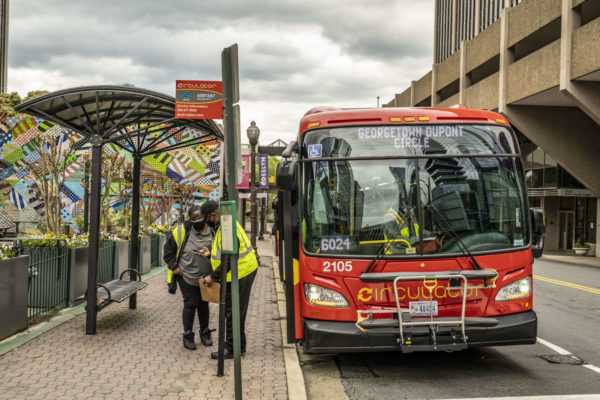
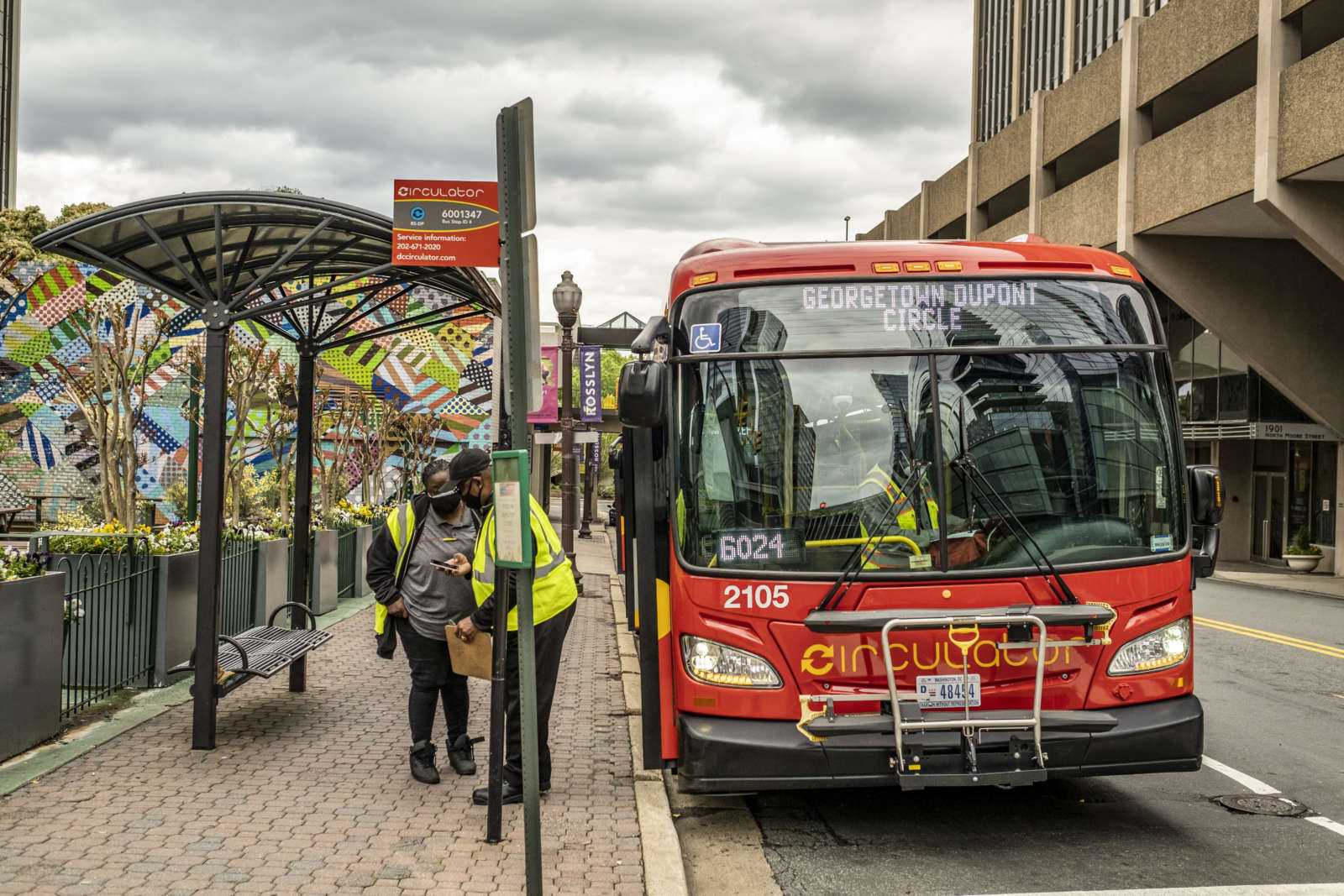
Metrobus drivers at a bus stop in Rosslyn (staff photo by Jay Westcott)
Metrobus drivers at a bus stop in Rosslyn (staff photo by Jay Westcott)
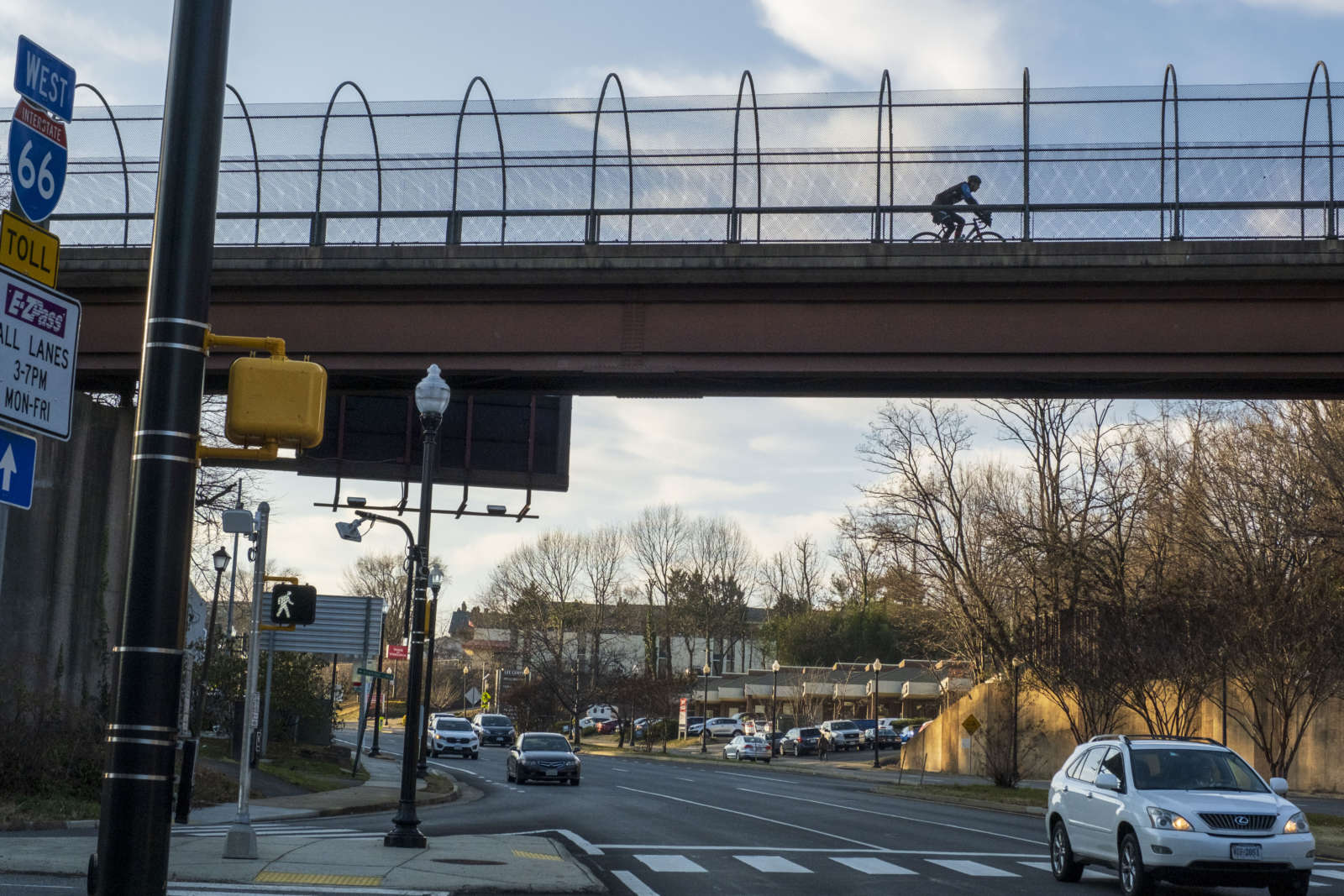
A cyclist crosses over Lee Highway on the Custis Trail (staff photo by Jay Westcott)
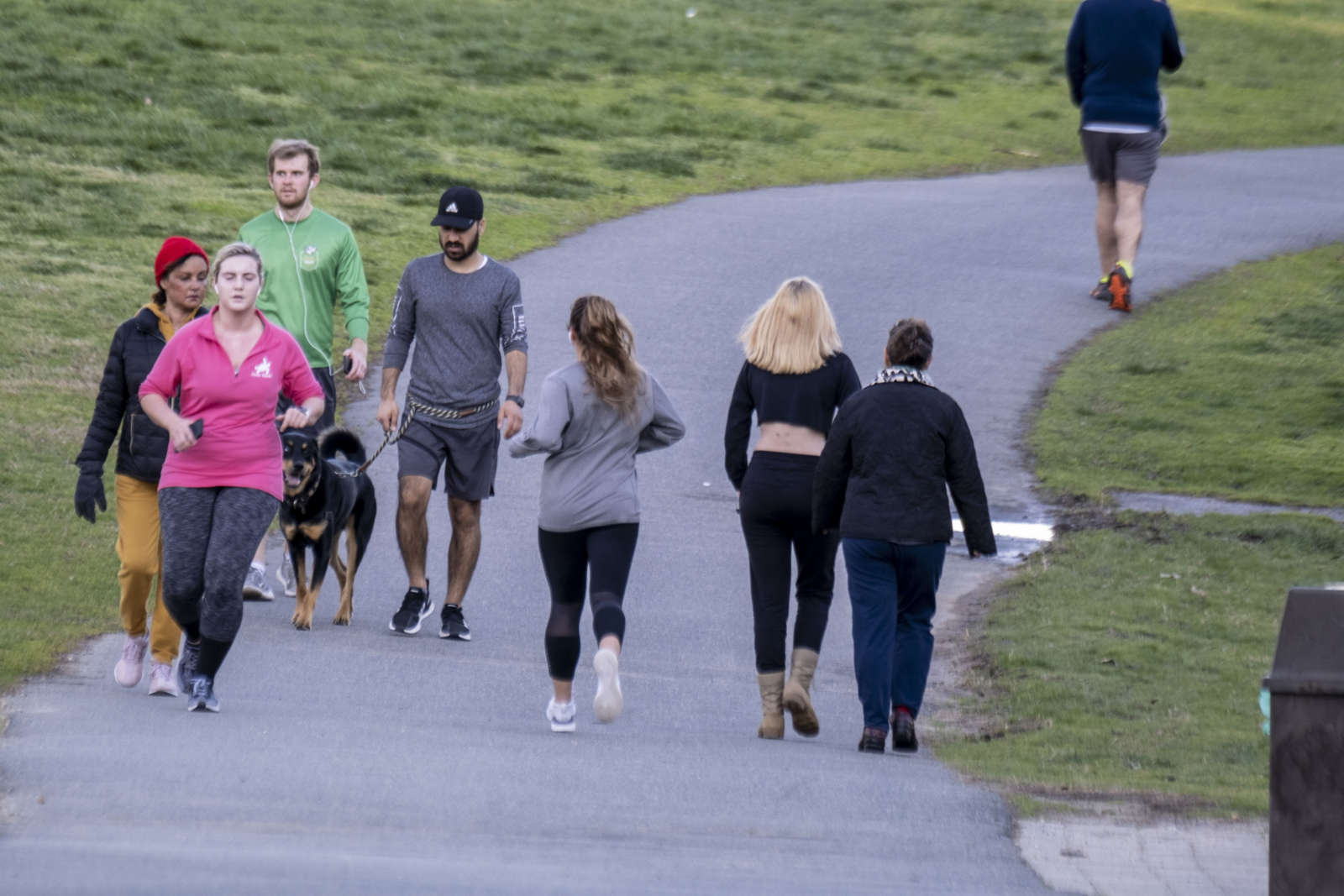
Trail usage in Arlington on March 26, 2020 (staff photo by Jay Westcott)
A mobility advocacy group is asking the county to build a three-year plan for funding projects that make non-car transit faster, more desirable and safer.
And the group, Sustainable Mobility, is trying to capitalize on signs that people are interested in bicycling and walking more coming out of the pandemic.
“We have to seize that opportunity before everybody gets into their cars again,” said Chris Slatt, the group’s president, who is also chair of the Transportation Commission and an opinion columnist on ARLnow. “This is an inflection point. Arlington has let too many opportunities pass during COVID-19 — we never achieved open streets, when people demanded more space to walk, sit and eat — we need them to do better now.”
Its recommendations respond to a draft document outlining the large projects that Arlington County intends to embark on over the next three years. This plan, called the Capital Improvement Plan, is winding its way through review processes and is set to be approved by the County Board in July.
Volunteers from Sustainable Mobility, or SusMo, combed through the transportation projects and identified a handful to nix, postpone or kick to developers for funding and implementation, which they say could free up about $17 million that could fund 20 projects or programs.
Building out the bike network for all ages and abilities
Expanding and connecting the trail network
“None of what’s in our plan is really our idea,” Slatt said. “It is all things that are in sector plans, projects that… the county already has [identified], projects that were identified in the bicycle element of the Master Transportation Plan, or just ways to fund priorities that Arlington says they already have.”
Highlights include:
Changing the signals to reduce the time buses spend at intersections
Conducting a feasibility study of dedicated transit and high-occupancy vehicle lanes on Columbia Pike
All-door bus boarding and off-vehicle fare collection, to speed up buses
A trail on the west side of Carlin Springs road, with a connection to the W&OD Trail, to provide a safer route to Kenmore Middle School
Protected bike lanes on S. George Mason Drive between Route 7 and Route 50, providing a safe connection to Wakefield High School
Additional capital funding for other Safe Routes to School projects
Protected bike lanes on a portion of N. Highland Street in Clarendon
A two-way protected bike lane on Fairfax Drive between Ballston and Clarendon
Other “neighborhood bikeways”
Some projects are already in the County Manager’s draft Capital Improvement Program proposal, including a feasibility study for a trail underpass under Shirlington Road near the Weenie Beenie, and a new trail along the Arlington National Cemetery wall between Columbia Pike and Memorial Avenue.
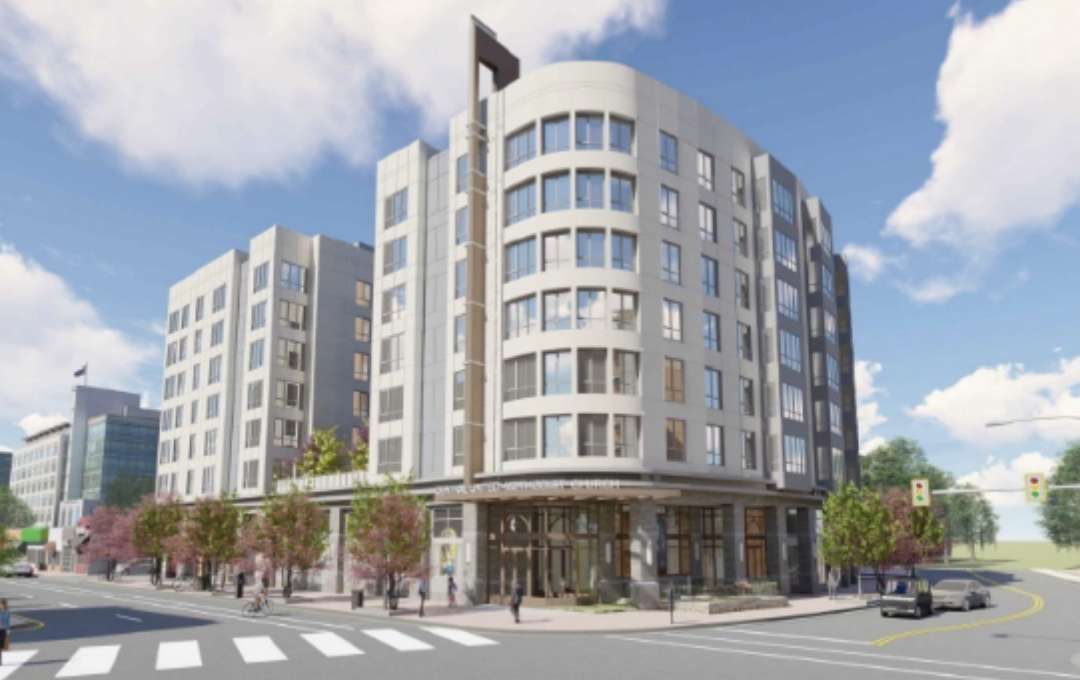
Rendering of the planned Central United Methodist Church redevelopment in Ballston (via Arlington County)
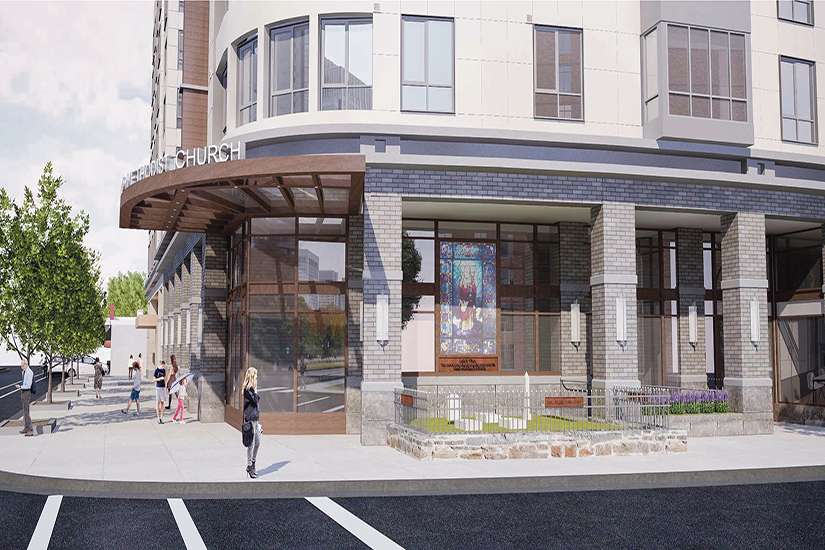
2017 rendering of the Central United Methodist Church in Ballston (via Arlington County)
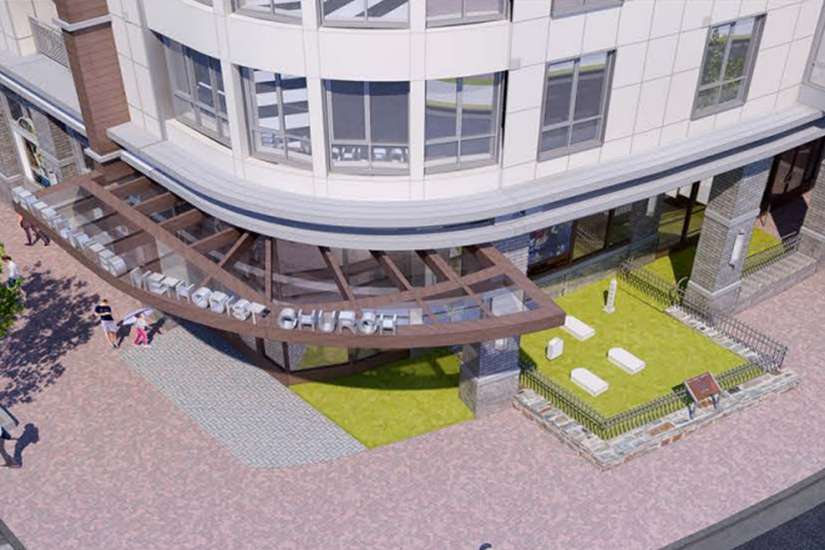
2017 rendering of the Central United Methodist Church in Ballston (via Arlington County)
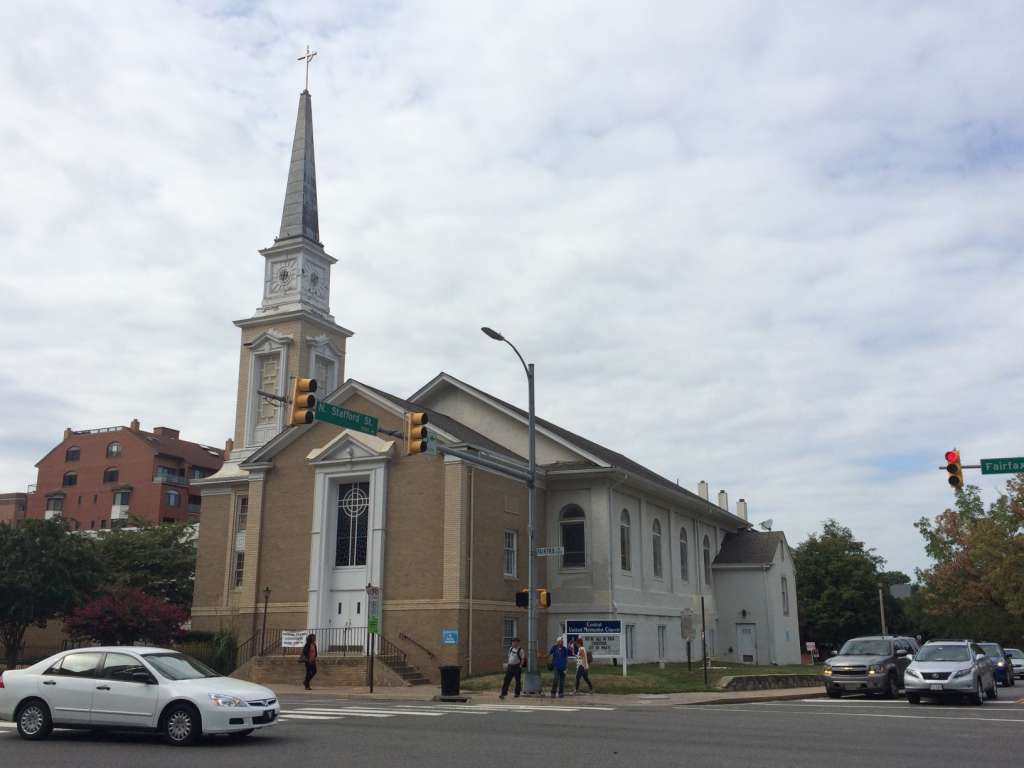
Ballston Central United Methodist Church in 2016
A long-stalled affordable housing development project in Ballston has secured the funding it needs to move forward.
On Saturday, the County Board approved an allocation of nearly $16 million for an 8-story building at the Central United Methodist Church site on Fairfax Drive near the Ballston Metro station.
The project, which will have 144 committed affordable housing units, a childcare facility for up to 100 children and a church space for up to 200 people, is being developed by the Arlington Partnership for Affordable Housing.
“It’s a move that goes a long way — there’s still much more work to do — toward achieving our affordable housing goals here in the county,” Board Chair Matt de Ferranti said.
The funding is in addition to the $3 million allocated to APAH in September 2019.
APAH proposes a mix of units: 15 units are affordable up to 30% of AMI, 60 units affordable up to 50% AMI and 69 units affordable up to 60% AMI.
Twelve units will be accessible to people with disabilities.
Setting aside 75 units for residents earning 50% of the area median income or below “is an elusive income target in affordable housing developments,” said Housing Commission Chair Eric Berkey in a letter to the county.
Twelve of the 69 units will be three-bedroom, something the Housing Commission is also pushing to see more of in the county, generally, Berkey said.
APAH will be providing free in-unit internet access to residents as well.
“Low-income residents often cannot afford internet access or can only afford service that provides very low bandwidth or limited service,” the staff report said.
Although there is momentum now, those involved have had a hard time getting the Ballston Station project off the ground.
The County Board originally approved the development in 2017, when the church was working with Bozzuto Development Company.
The county reapproved the project in 2019, once APAH took it over, to upsize the project from 119 units, including 48 designated as affordable, to 144 units of 100% committed affordable housing.
Last fall, the County Board granted APAH a three-year extension on the site plan amendment, giving the developer until October 2023 to start building.
The project has also faced setbacks, as multiple applications for competitive Low Income Housing Tax Credits were unsuccessful. APAH had to find other ways to make the project financially sustainable.
It changed the mix of apartment units, worked with the county and Virginia Housing to restructure the financing for the project, and applied for and won an $8.75 million Amazon REACH grant from Virginia Housing.
“It is noted that this project was made possible due to APAH and CUMC making changes to the income-level mix of the property and obtaining Virginia Housing Amazon REACH Grant funding,” Berkey said. “That this project required such efforts should be a reminder about the challenges currently faced by our development partners and should inform both our local efforts and advocacy at the state and federal levels.”
Next, the County Board will review the loan documents, likely this fall. Construction is slated to start in October or November and APAH expects work to finish by winter 2023-24.
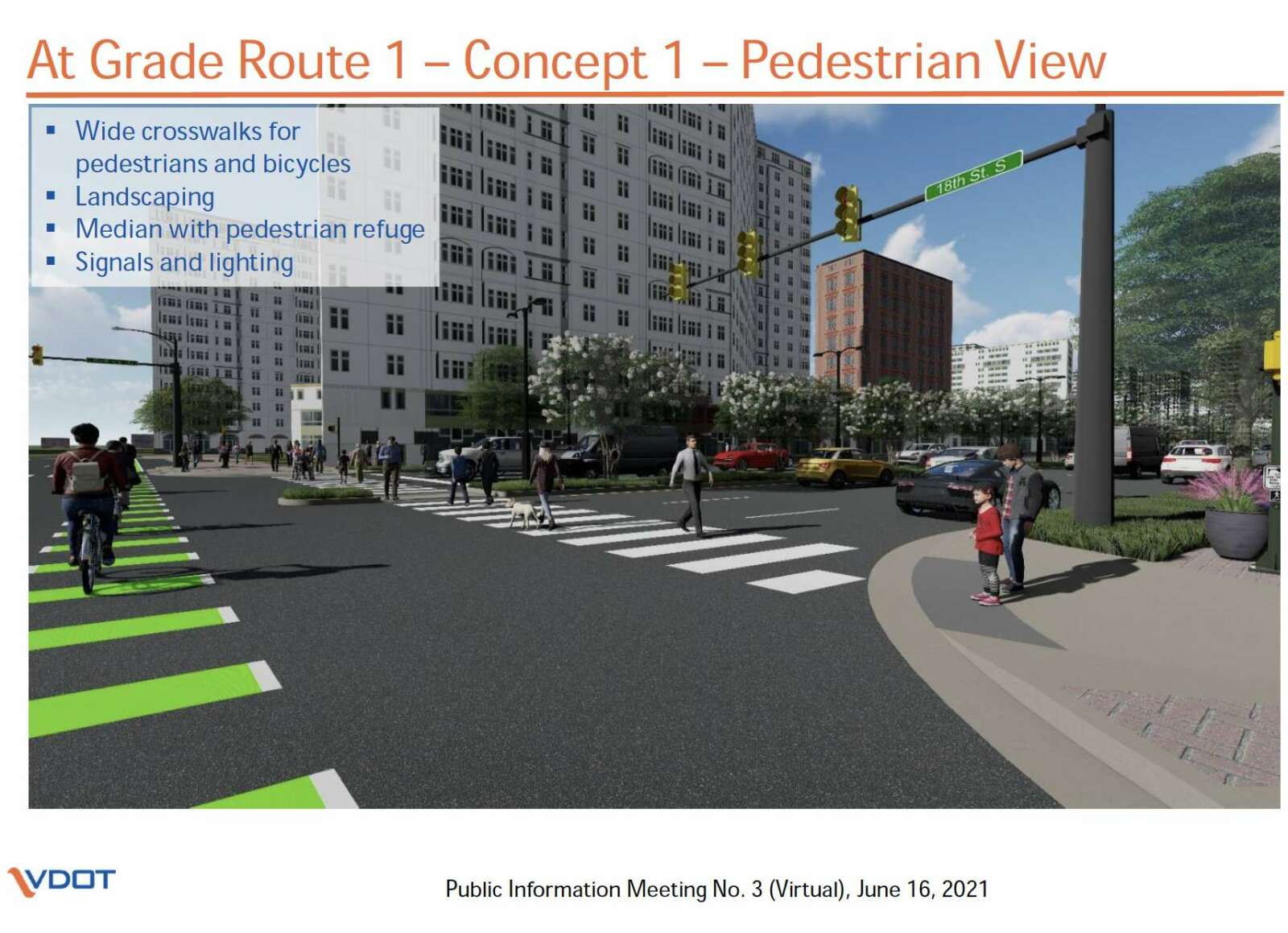
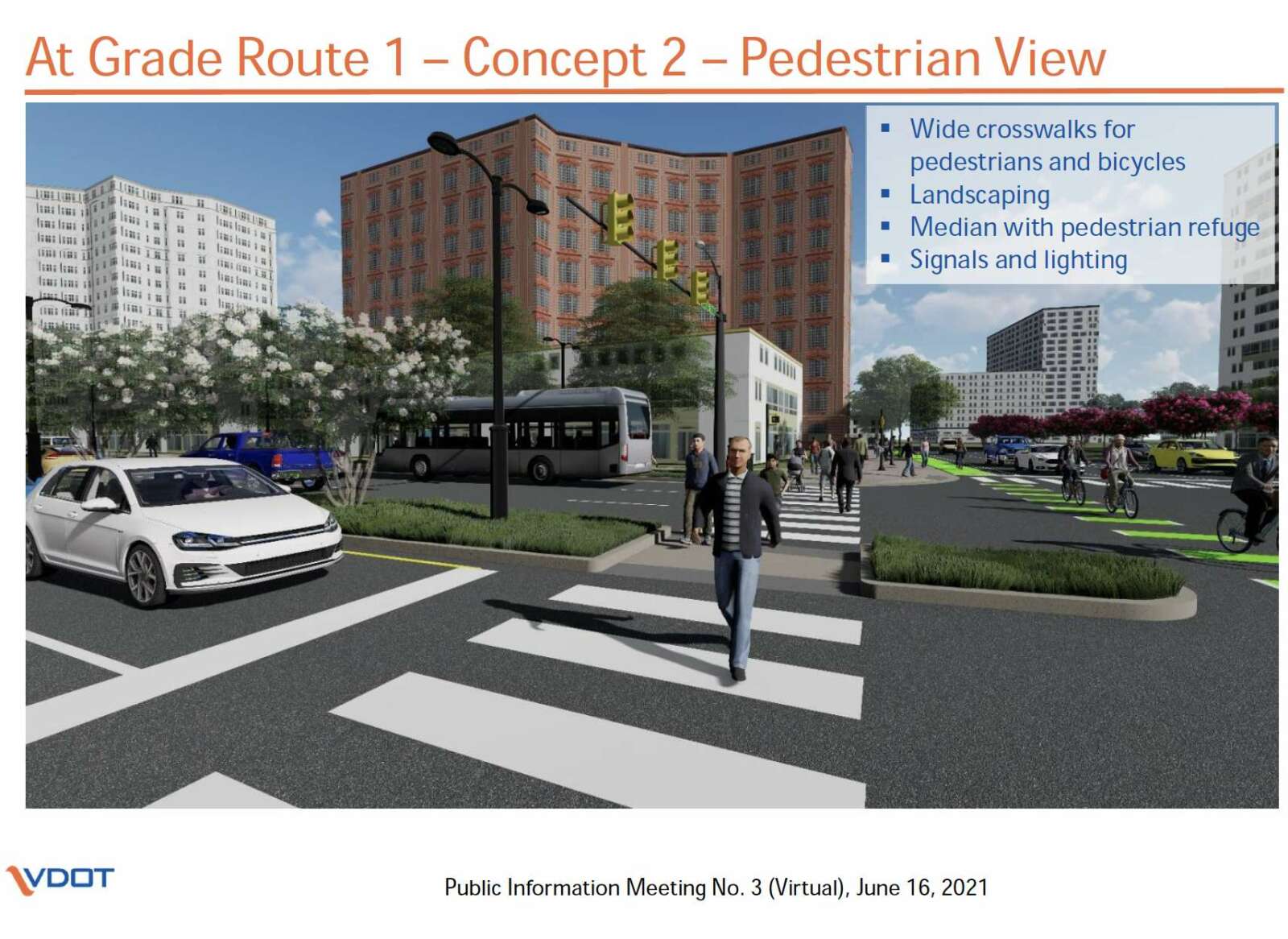
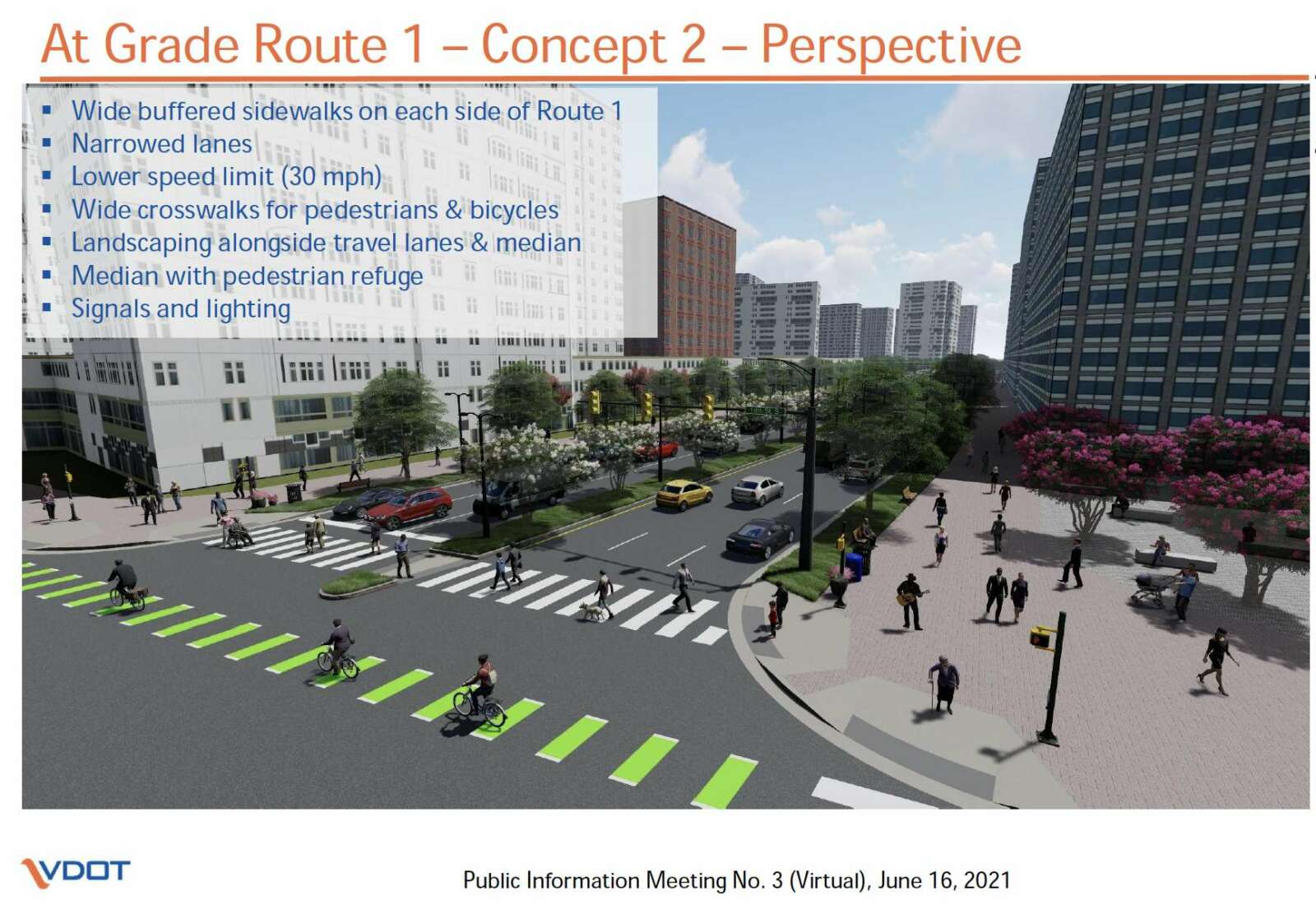
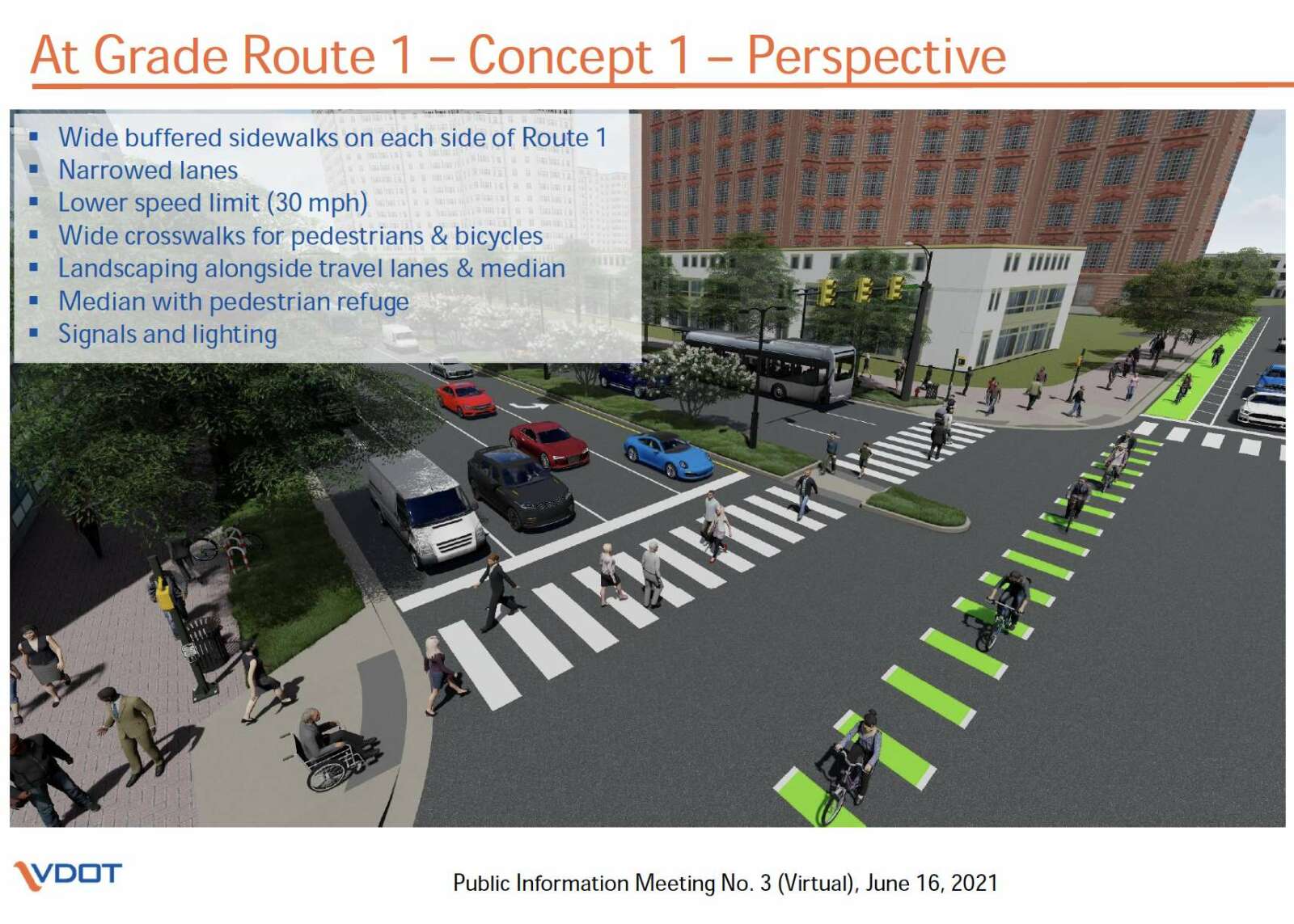
Slide from a VDOT presentation on its recommendations for Route 1 (via VDOT)
Slide from a VDOT presentation on its recommendations for Route 1 (via VDOT)
Slide from a VDOT presentation on its recommendations for Route 1 (via VDOT)
Slide from a VDOT presentation on its recommendations for Route 1 (via VDOT)
It’s official: The Virginia Department of Transportation recommends turning Route 1, which is elevated over 12th, 15th and 18th streets, into an at-grade urban boulevard.
“An at-grade configuration for Route 1 provides most desirable characteristics that meet the multimodal and community vision for National Landing,” according to presentation materials from a virtual VDOT meeting Wednesday.
The news caps off one year of study, but is not much of a surprise, as the at-grade solution seemed to emerge as the likely recommendation over the last few months despite some concerns about it being more dangerous for pedestrians. But the newest version appears to take into account concerns among some over the number of lanes, pedestrian safety, and the possibility of traffic overflow onto local streets.
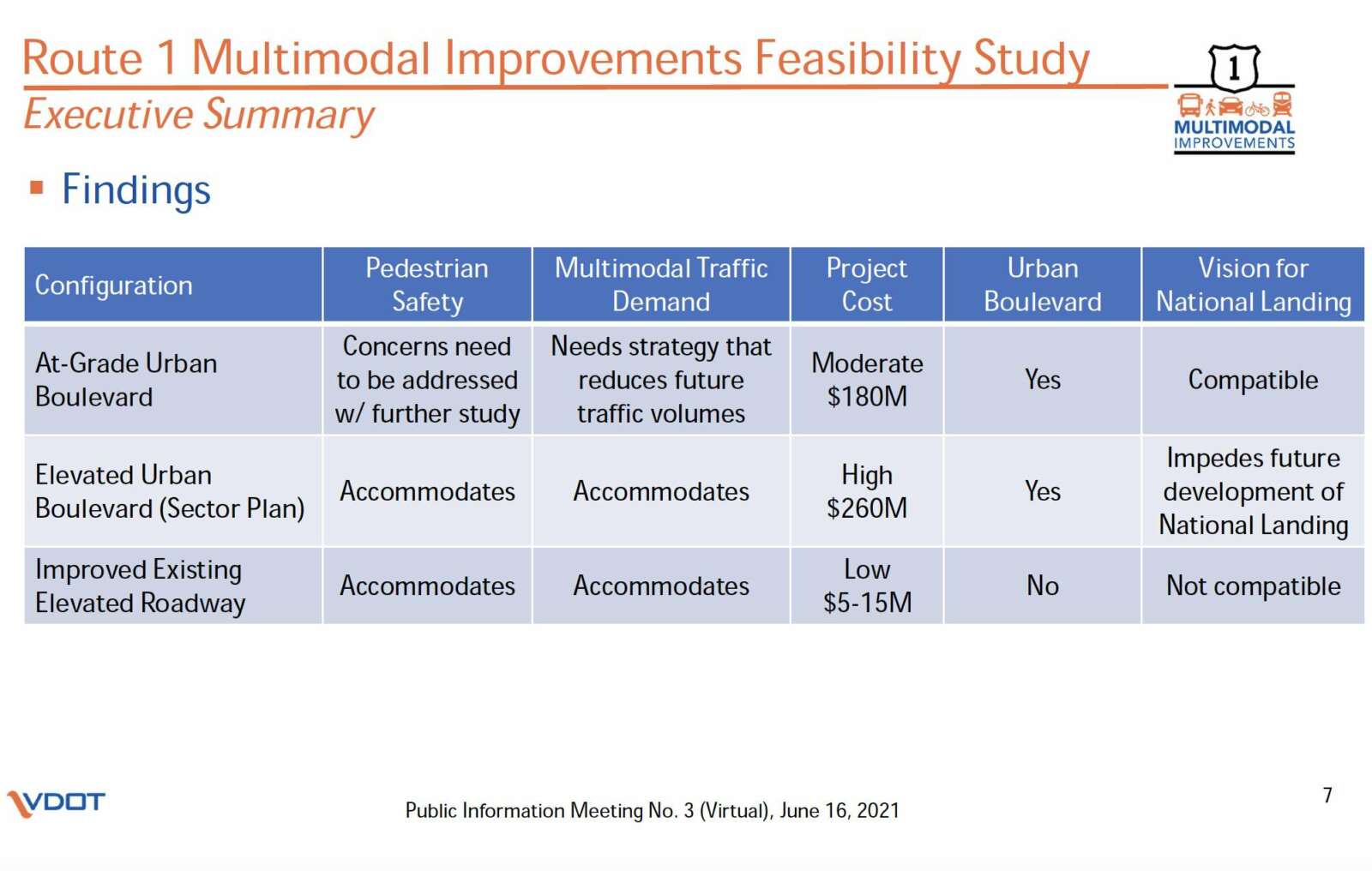
The surface-level Route 1 that VDOT envisions would have wide buffered sidewalks on both sides, six to seven narrowed travel lanes, a 30-mph speed limit, wide crosswalks for pedestrians and bicycles, landscaping and medians with pedestrian refuges.
That is a few lanes fewer than the nine-lane option for the intersection with 15th Street S. that VDOT floated earlier this year. Last night’s presentation said eight- and nine-lane options are “not conducive for pedestrians or the vision for Crystal City.”
According to the presentation, however, even these improvements will not significant reduce crashes and increase pedestrian safety, increase transit effectiveness, or reduce vehicle traffic along an at-grade Route 1.
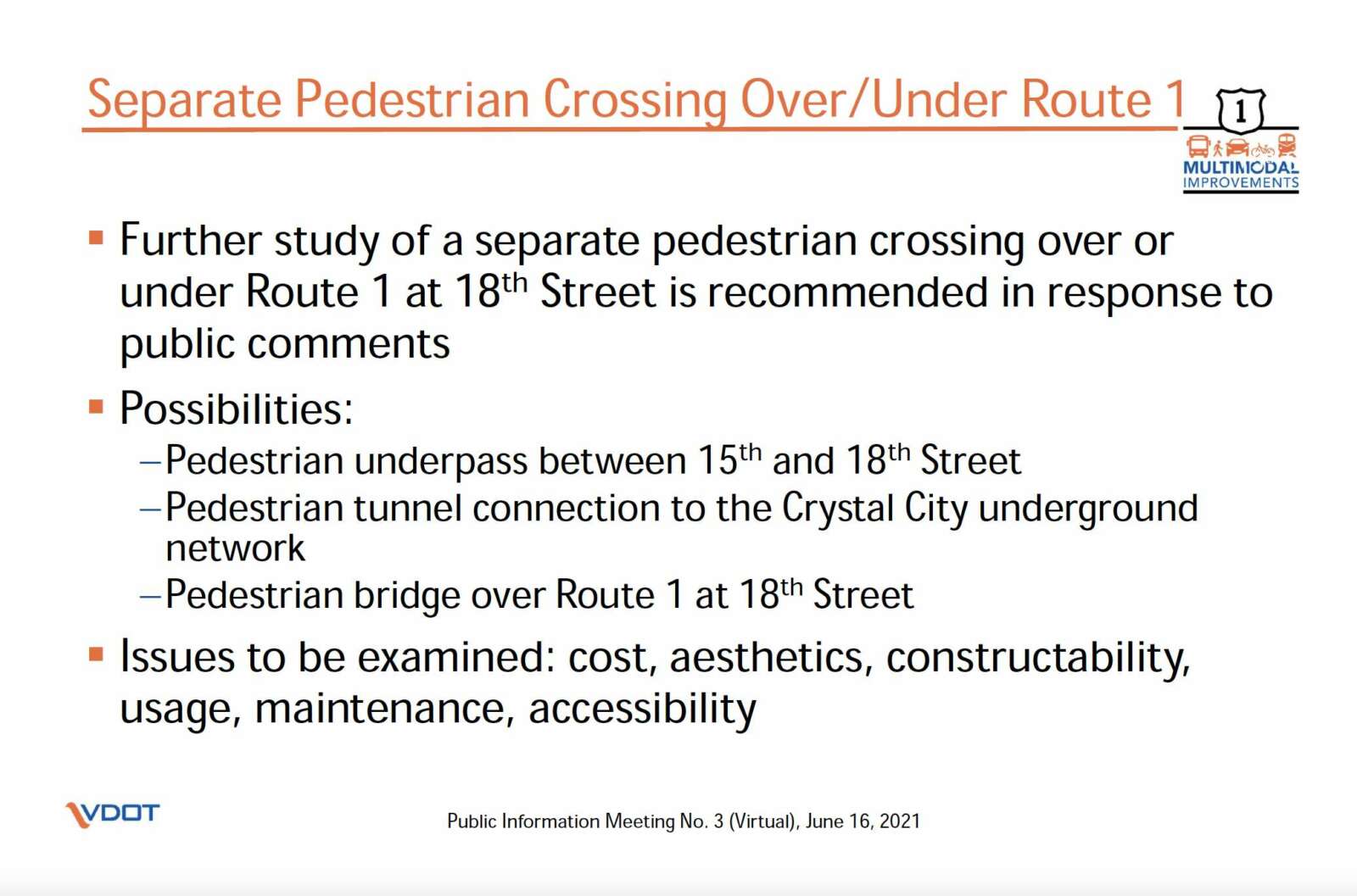
VDOT indicated two things will be needed to make an at-grade Route 1 safer. First is a travel demand management (TDM) strategy to bring down traffic levels. Second, and in response to public comments, the department said it will consider a separated pedestrian crossing over or under Route 1 at 18th Street S.
A “comprehensive and effective TDM strategy that reduces traffic volumes 20% to 30% below existing volumes” will “reduce future congestion and future diversion of traffic to local and regional roads,” according to the presentation materials.
The pedestrian crossing study would look at cost, aesthetics, use, construction feasibility, maintenance and accessibility, the presentation said. Possibilities for grade-separated crossings include a pedestrian underpass, a tunnel connection to the Crystal City underground, or a pedestrian bridge over Route 1.
Both the TDM and pedestrian crossing proposals will be explored in a second phase of the study. The next phase will likely further examine the department’s third recommendation — based on a concept requested by Arlington County staff — to allow all turns at 15th Street S. but no left turns at 18th Street S., near the Crystal City Metro station.
Realizing the urban boulevard vision could cost $180 million, which is less than the $260 million VDOT projects would be needed to create a split-level highway for through-traffic and local traffic, as envisioned in the ten-year-old Crystal City Sector Plan.
The National Landing Business Improvement District has been a champion of turning Route 1 into an urban boulevard. It recently released renderings of a road transformed by protected bike lanes, pedestrian refuges and prominent sidewalks, as part of a new campaign, “People Before Cars,” which has featured outdoor signs and public advocacy.
The state transportation department is accepting public comments on these recommendations through July 12. A draft report will come out in August and a final report in September.
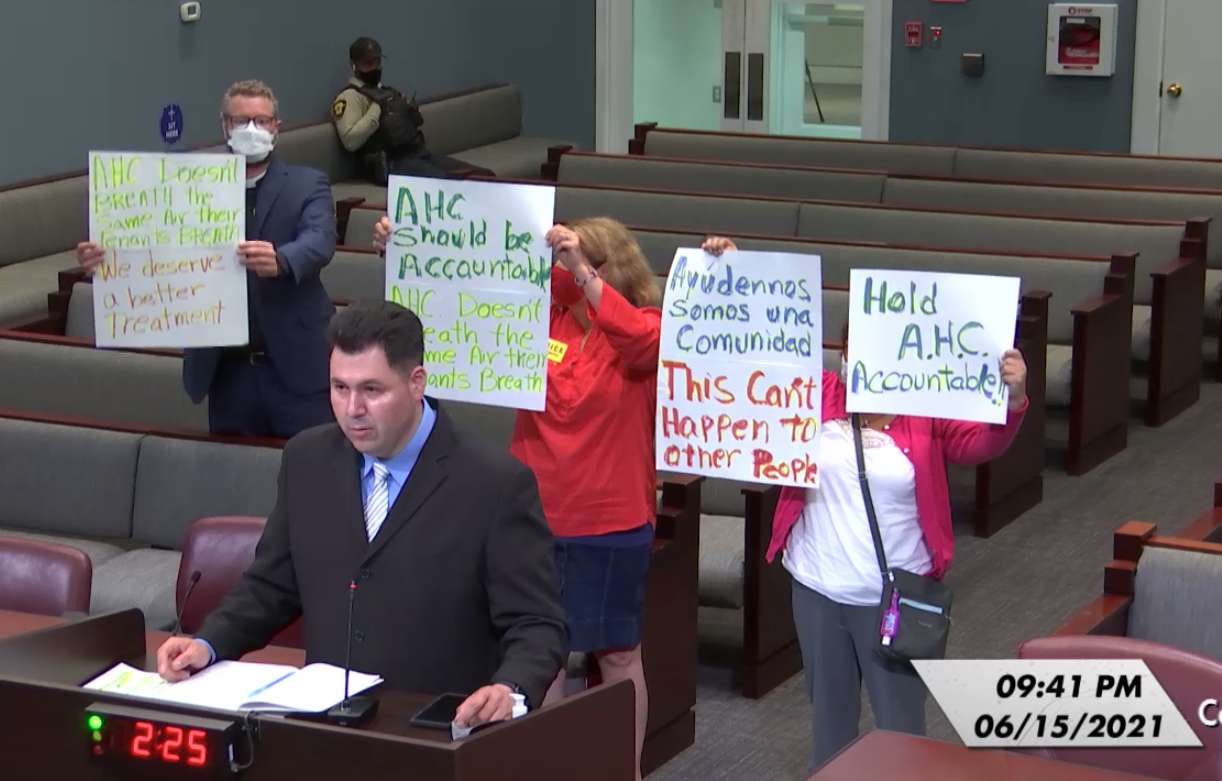
The discussion happened as county staff outlined the flurry of work at the property. Separately, the Board voted 5-0 to enter into an agreement allowing AHC to refinance its loan for the apartments through a new lender before its current loan expires in less than two months.
This loan agreement is urgently needed, according to a staff presentation. If in two months lenders foreclosed on the property, the bank would repossess the Serrano, lifting the affordability restrictions and displacing residents. But some people are worried that preventing AHC from defaulting runs counter to the need to hold the organization accountable.
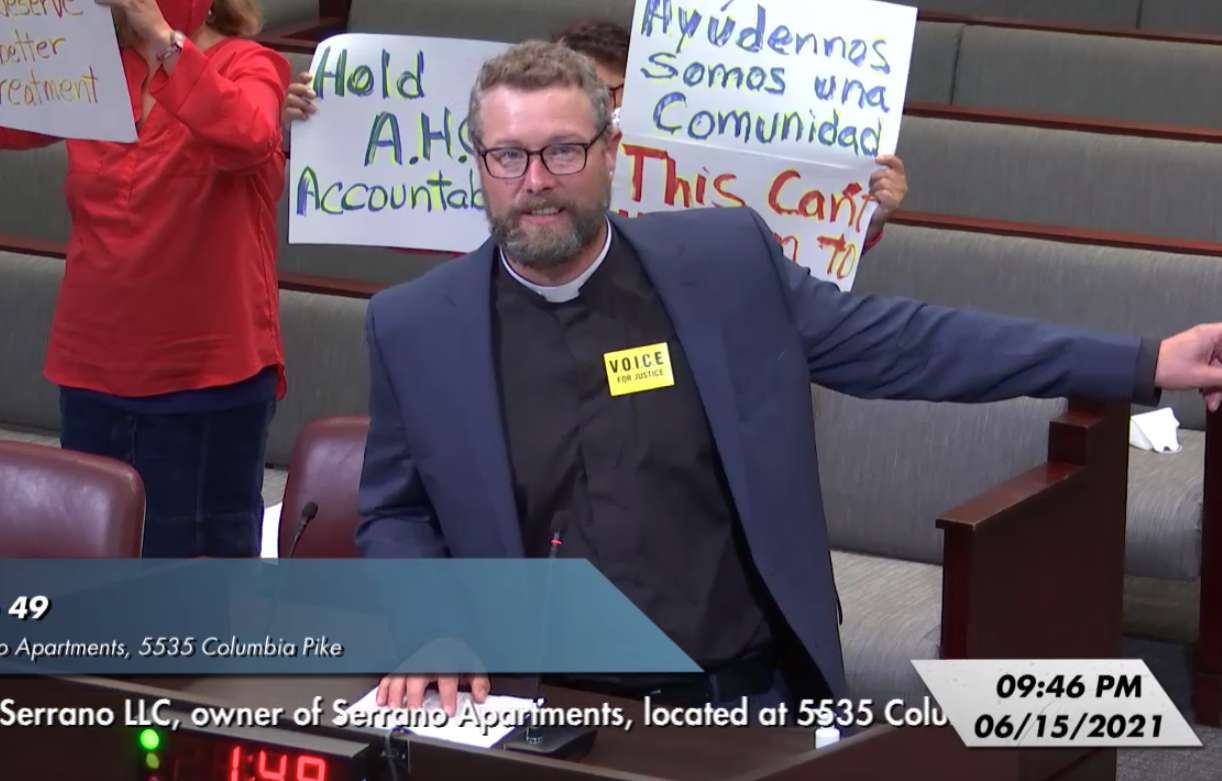
Elder Julio Basurto, a member of the Arlington Schools Hispanic Parents Association, said he has watched the building at 5535 Columbia Pike crumble under AHC. He urged the county “to stop feeding the monster that AHC has become,” a monster that “sucks the life out of the ones they vowed to help.”
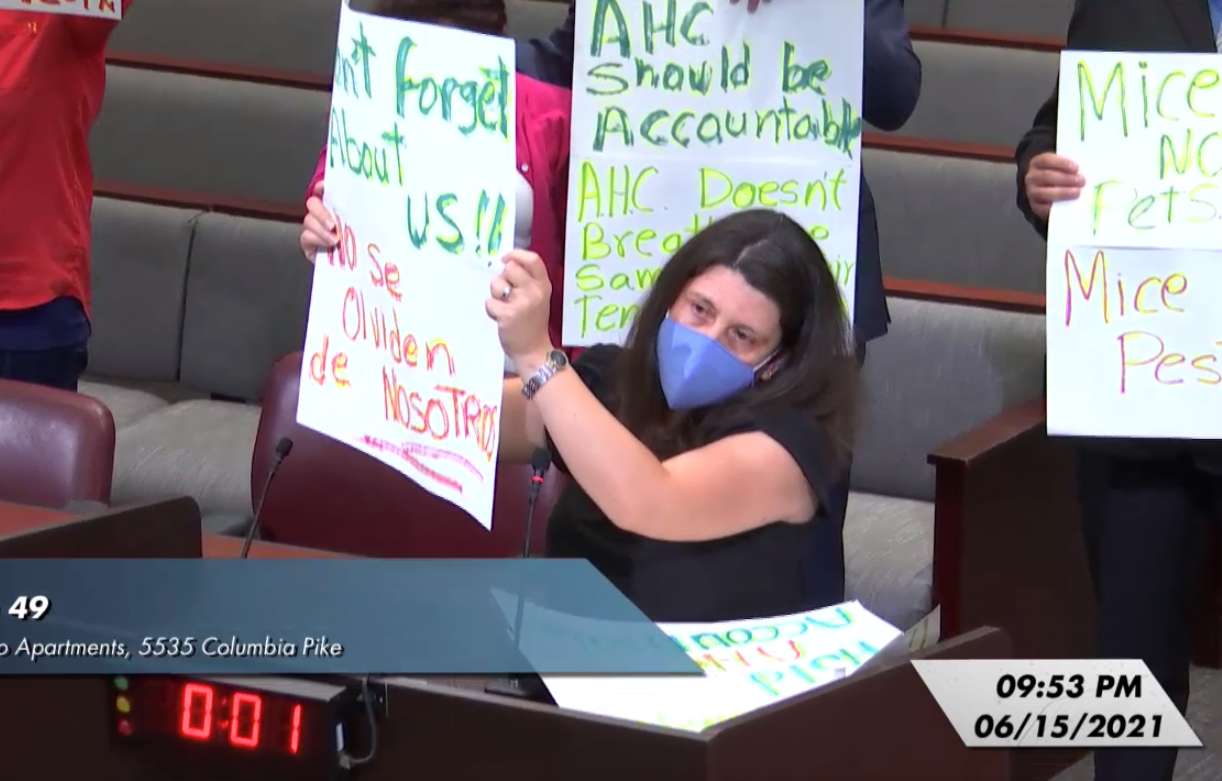
Former school board member Tannia Talento read the signs residents brought — pleas to be heard and protected.
“Don’t forget about us,” she said, saying it again in Spanish. “No se olviden de nosotros.”
Board members explained that allowing AHC to refinance will lock it into a new agreement and force it to make improvements.
“The easy way out for AHC would be to be in a position where they defaulted on a loan and ended up with a foreclosure,” Board member Christian Dorsey said. “They could wipe their hands of it and move on, they could walk away leaving in their wake devastation and despair, leaving people in limbo. Accountability is being engaged with the long-term process to return the Serrano to the level of quality the residents expect.”
AHC has two loans to pay off: a primary loan to a private lender and a subordinate loan to the county through the Affordable Housing Investment Fund. The new lender requires AHC to agree to prioritize repaying the private loan before the county loan, something that required a county vote.
This loan acts like a bridge until 2024, when AHC intends to use Low-Income Housing Tax Credits to finance a full renovation of the property. The county says it will work with AHC to develop a renovation plan.
In recent weeks the county has conducted 150 code violation apartment walkthroughs, put up people in hotels and shared information about various resources they can use, said Housing Director Anne Venezia.
AHC is also keeping busy and finding ways to repay tenants, according to a letter from the Board of Directors.
It is waiving certain fees and returning security deposits for those who relocate and, for those who have been displaced, providing $200 gift cards and waiving utility payments. It reduced July rent by $200 for all tenants.
Board Chair Matt de Ferranti reiterated the responsibility he feels for the conditions of the Serrano and apologized to the residents who were signed up to speak but had to go home due to the late hour — caused in part by an hour-long discussion about a new farmers market’s start time.
De Ferranti called for another update next month and told AHC it, not the county, should bear the brunt of the hotel stays and relocation costs.
“I would submit that we would not be in this situation if care had been taken over the past two years,” he said. “The right thing to do is that the large majority of relocation costs should be covered by AHC and not by the county.”
Some Board members expressed frustration that this conversation mirrors similar discussions over the past two years with AHC. Dorsey said he met with AHC in 2019 about the same problems at the Serrano and, at the time, heard similar remedies.