
Sponsored by Monday Properties and written by ARLnow, Startup Monday is a weekly column that profiles Arlington-based startups, founders, and other local technology news. Monday Properties is proudly featuring 1515 Wilson Blvd in Rosslyn. 

Phone2Action, the Rosslyn-based government affairs technology company, has changed its name to Capitol Canary.

The rebranding comes as the company has expanded beyond what it was founded in 2012 to do — help organizations mobilize citizens via their smartphones — through acquisitions in late 2020.

That’s when Capitol Canary bought KnowWho, which provides an up-to-date directory of policymakers, and GovPredict, which helps users track bills and regulations.

With these two platforms, Capitol Canary says it now offers clients, who currently number 1,200 companies, organizations and advocates, a full-service government affairs solution that can help them push legislation through and energize voters.

A name change has been in the cards for a while now, co-founder Jeb Ory told ARLnow in a statement.

“We’ve kicked around name changes for years — as we grew and did more and more for our clients, we knew that rebranding would be something that would make a lot of sense,” he said. “We kicked the process off in earnest last summer. Once we down-selected to a handful of names, it pretty quickly became clear that Capitol Canary was the winner.”

So why Capitol Canary?

“‘Capitol’ immediately says government. Legislation. Policy. These are at the heart of what we do,” he said.  “‘Canary’ immediately implies relevant information and decisive action. Canaries are smart little birds that have helped people know what to do for centuries.”
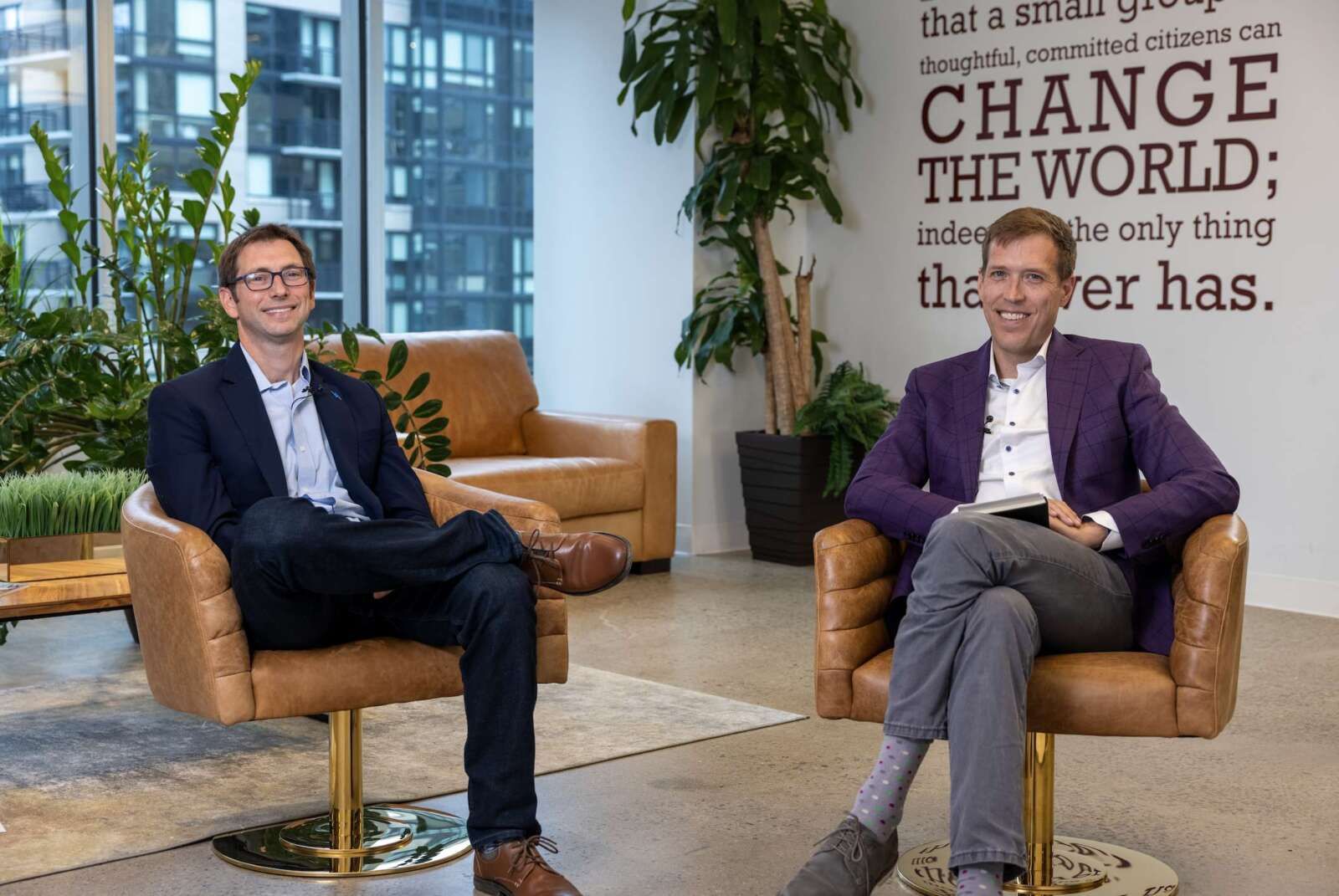
Cofounder Jeb Ory and CEO Steven Schneider (courtesy photo)

The name change also comes ahead of the 2022 midterm elections, and in anticipation of these elections, Capitol Canary is rolling out some new features:

  • an “advocacy dashboard,” which customers can check to see if their campaigns are successful at moving the needle on an issue and engaging key lawmakers.
  • “impact reports,” generated in minutes, which stakeholders can use to run meetings with policymakers. These reports provide everything from bios of lawmakers and their committee assignments to the level of sway an organization has within a lawmaker’s district or state.
  • “get-out-the-vote” tools, which help employees, advocates and supporters check their voter registration status, learn about candidates and find information on how to vote.

And the Phone2Action era ends on a high note, according to Capitol Canary. After riding multiple tidal waves of civic engagement in 2020 — a global pandemic, nationwide social-justice campaigns and a contentious presidential election — the company recorded staggering engagement numbers in 2021.

More than 15.6 million people took roughly 25 million actions — such as signing a petition, calling their lawmaker, sending an email or tweeting at them — on policy issues ranging from COVID-19 relief to infrastructure using the Phone2Action platform. They also used it to access 12.6 million federal, state, local and regulatory policy documents.

Meanwhile, Fortune 100 companies such as Walmart and Uber, associations including the National Restaurant Association and PhRMA, and nonprofits such as the Innocence Project and the Alzheimer’s Impact Movement, used the platform to execute more than 14,500 campaigns.

“Since our founding in 2012, thousands of organizations have trusted our platform to help them shape public policy and elevate stakeholder’s voices. Together, we have transformed how constituents engage with their lawmakers and how public policy is formed, from Capitol Hill to city hall,” said Capitol Canary CEO Steven Schneider in a statement.

While the rebranding reflects this transformation and will kick off a second decade of growth, the company’s goal remains to provide “government affairs and advocacy teams with the tools, intelligence and data they need to do the hard and vital work of shaping policy,” he said.


Sponsored by Monday Properties and written by ARLnow, Startup Monday is a weekly column that profiles Arlington-based startups, founders, and other local technology news. Monday Properties is proudly featuring 1515 Wilson Blvd in Rosslyn. 

Some hackers exploit weaknesses in a company’s security to make money. But other hackers do so to help companies find their weak points.

It’s called “ethical hacking.” Local cybersecurity company SCYTHE has created a platform that emulates cyber attacks, using the work done by ethical hackers, to help companies find their own gaps in security.

“We collect all the information about new attack types, usually written up by the ethical hackers, who are called security researchers… [and] we break down the attacks into the individual steps so that our customers can rearrange the order,” says CEO and founder Bryson Bort. “This lets them make their own attacks so that they can test how effective their security is. The more different ways they can run attack steps, the more they understand how well everything works on their end.”

There’s growing demand for this tool, says Bort, who is hiring folks to meet that demand and add capabilities to that tool — to make it even easier for customers to test out their security — using $10 million it raised in Series A funding last November. This rapid growth, Bort says, has taught him the importance of ensuring team members feel valued and included and have room to grow professionally.

“I think that a lot of founders don’t alway realize when they start a company that while the technology can be unique, it’s really the people who make a company successful,” he said.

Bort — who served as a U.S. Army Officer during Operation Iraqi Freedom and one of 2020’s 50 top cyber leaders according to Business Insider — founded the company in 2017 to develop an idea born from his work at GRIMM, a cybersecurity consultancy he also founded.

And he wanted to make sure the companies were linked — with a sense of humor.

“SCYTHE was a product that came out of work we were doing at GRIMM,” he said. “GRIMM is a services company where it’s about people. SCYTHE is a product, a tool that GRIMM would use. When I created SCYTHE, I wanted to show that the two were connected but also show their differences.”

SCYTHE logo (courtesy photo)

The two companies are also linked through a mythical motif, so to speak. Unicorns.

“We did an annual T-shirt contest for the industry event DEF CON, the largest hacker conference in the world,” Bort said. “I came up with the idea of the grim reaper riding a unicorn because I liked the juxtaposition. The design blew up because other people also saw the humor.”

When he started his second company, he decided to incorporate unicorns into the logo and branded merch, which benefits “chubby unicorns,” or endangered rhinos. And Bort says the majestic, single-horned fantasy creature sums up what SCYTHE does and its goal.

“It just really feels like it’s the best way to describe the company,” he said. “We’re doing things no one else is doing and plan some day to be a literal unicorn startup.”

Unicorn startups are privately held startup companies valued at more than $1 billion, and are so named to underscore their rarity. (Arlington has one unicorn: woman-led financial technology company Interos.)

SCYTHE is hiring lots of positions to continue working toward that goal.

(more…)


Sponsored by Monday Properties and written by ARLnow, Startup Monday is a weekly column that profiles Arlington-based startups, founders, and other local technology news. Monday Properties is proudly featuring 1515 Wilson Blvd in Rosslyn. 

Enabled Intelligence, a startup founded by a longtime Arlington resident and father, is redefining what inclusion of people with disabilities in the workplace looks like.

And it does so while solving a long-standing labor problem for government agencies and contractors trying to automate their operations with artificial intelligence, says CEO and founder Peter Kant.

Enabled Intelligence employs Americans with disabilities and veterans to do data annotation — teaching computers what images or sounds to look for as they are programmed to sift through large data sets — for government and government-adjacent groups.

“It’s technical, repetitive, problem-solving, somewhat compulsive and relatively asocial work,” he said.

This work has to be done by “puzzle solvers who always want an answer” and U.S. citizens to ensure the data stays secure, Kant says. But government groups, which can’t send data annotation overseas like private companies, often struggle to find people to do the work. Kant ran into this problem while leading SRI International, a research institute with a location in Rosslyn.

So he turned to a “highly skilled, underutilized workforce” within the U.S.: people with certain cognitive differences, who have an edge over neurotypical people, and veterans from intelligence and defense agencies, who have helpful subject-matter expertise.

These two groups face barriers to skilled work because of their disabilities, he said.

“Some were bagging groceries but had a computer science degree from Radford University, and because of their neurodiversity, were not working anywhere else,” he said.

Today, 14 of Enabled Intelligence’s 20-person team have disabilities.

“This is not just a company just for people with disabilities, it’s a mix of people neurodiverse and [neurotypical] people,” Kant said.

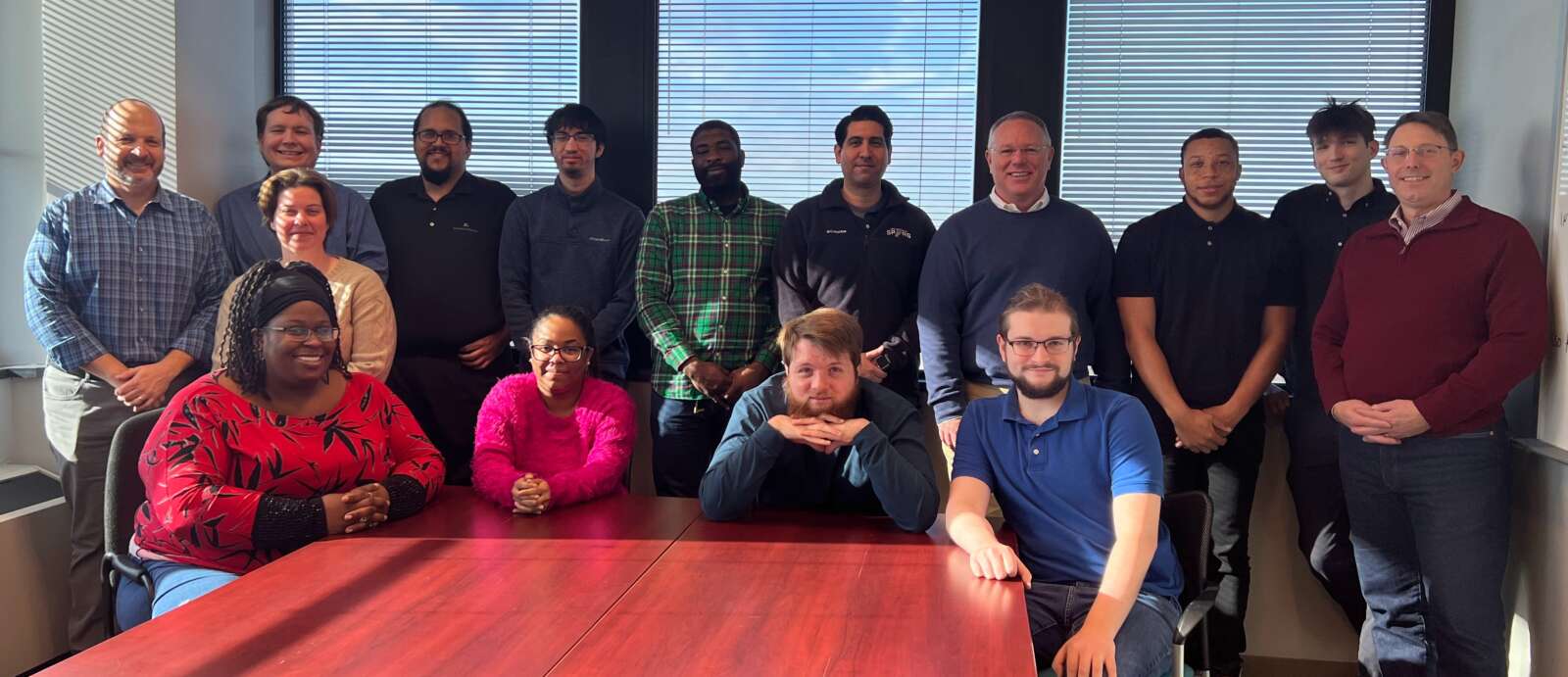
Enabled Intelligence team photo (courtesy photo)

The mix helps people with disabilities integrate while demonstrating to people without disabilities that cognitive differences can be assets, he said.

Case in point: New annotators were identifying photos where at least 20% of a vehicle was in the frame. The trainer, who had 15 years’ experience teaching this work, explained that when it comes to close calls, they should play it safe and include the photos.

“One of the annotators, literally just looking at a Powerpoint slide in the training room, said, ‘No, no, no, it’s 17%,'” Kant said.

The trainer said it was close enough to include, but the team member insisted it shouldn’t be included. After the meeting, the photo was measured and sure enough, 17% of the car was in-frame.

Another employee is a whiz at computers who was working at a grocery store while pursuing her cosmetology license. She couldn’t keep up with these two jobs, however, due to a brain injury that was giving her seizures.

At Enabled Intelligence, she has quickly moved up the ranks. After getting her start identifying photos, she has been promoted to identifying audio files in a different language — which she has already picked up.

“She’s been a very valuable asset to us,” Kant said.

Kant says Arlington organizations have helped him hire employees and find advisors who understand how to work with people with cognitive differences.

He found employees through local nonprofit Melwood, which provides vocational training to people with disabilities. One of his advisors is Arlington therapist Ginny Conroy, who runs Social Grace, a local group that coaches people with disabilities and works with businesses to hire and retain neurodiverse employees.

Enabled Intelligence got its start in March 2020 but has been insulated from the worst of the economic impacts of the pandemic because government work has been relatively stable, he said. So far, Enabled Intelligence has booked $2.5 million in business and closed on a seed fundraising round that netted $1 million, lead by the Disability Opportunity Fund.

After being fully remote for more than a year, the company moved into its first, temporary brick-and-mortar office building just over the border in Falls Church (6400 Arlington Blvd). In the new year, Kant has his sights set on a permanent office so employees can handle more secure data and he can expand the company’s operations.


Sponsored by Monday Properties and written by ARLnow, Startup Monday is a weekly column that profiles Arlington-based startups, founders, and other local technology news. Monday Properties is proudly featuring 1515 Wilson Blvd in Rosslyn.

Courthouse-based data visualization company Lovelytics is on a hiring spree.

The company, founded in 2018, helps clients gather their data in one place and organize, visualize and use the data. Last year, it moved from Rosslyn to Courthouse and doubled in size from 23 to around 50 employees. Founder and CEO Scott Love aims to end 2022 with upward of 100 staff.

“We’re growing quicker than we ever have,” said Love, who’s hired folks in Arlington, across the country and in Canada for Lovelytics’ Toronto outpost, founded in 2019.

In the last two months, a new partnership with data analytics platform Databricks has driven that growth, he says. Lovelytics helps clients who purchase Databricks figure out the best way to use it, which required Love to create and expand his machine learning, artificial intelligence and data engineering departments.

Lovelytics provides a similar service to clients who use the data visualization platform Tableau — and recently won an award for its work helping clients implement the software.

“It’s pretty exciting, since they have tons of partners, around 1,500,” Love said. “For us to win it, especially after only being in business four years at the time, it gives you good publicity, respect from clients you may potentially be working with and credibility.”

That’s not the only accolade the Courthouse startup earned in 2021. The Washington Business Journal recognized it as one of the best places to work in the D.C. area. Love says he tries to keep working for his company fun.

“For me, being a first time entrepreneur, it’s exciting to create a culture,” he said. “It’s been a lot of fun to bring that to life.”

Up until this point, the company has made money without funding rounds, but Love said he’d consider fundraising if he wants to scale up the company faster than it’s growing today, or launch new products.

While Lovelytics is mostly a service-oriented company, last year, it launched its first product called InstantAnalytics, which helps companies centralize and organize the data that multiple sources are collecting.

“That’s really what our job is: being able to translate business problems into technical solutions,” he said.

But many of the companies that needed organizational help with their data when Lovelytics was founded are more mature now, Love says. He’s focused on hiring employees to help those clients obtain insights using their data to solve complex problems through machine learning, artificial intelligence and predictive models.

“When you start to gather that much information, you’re able to get these crazy predictive insights because you know what 10 million customer transactions have done,” he said.

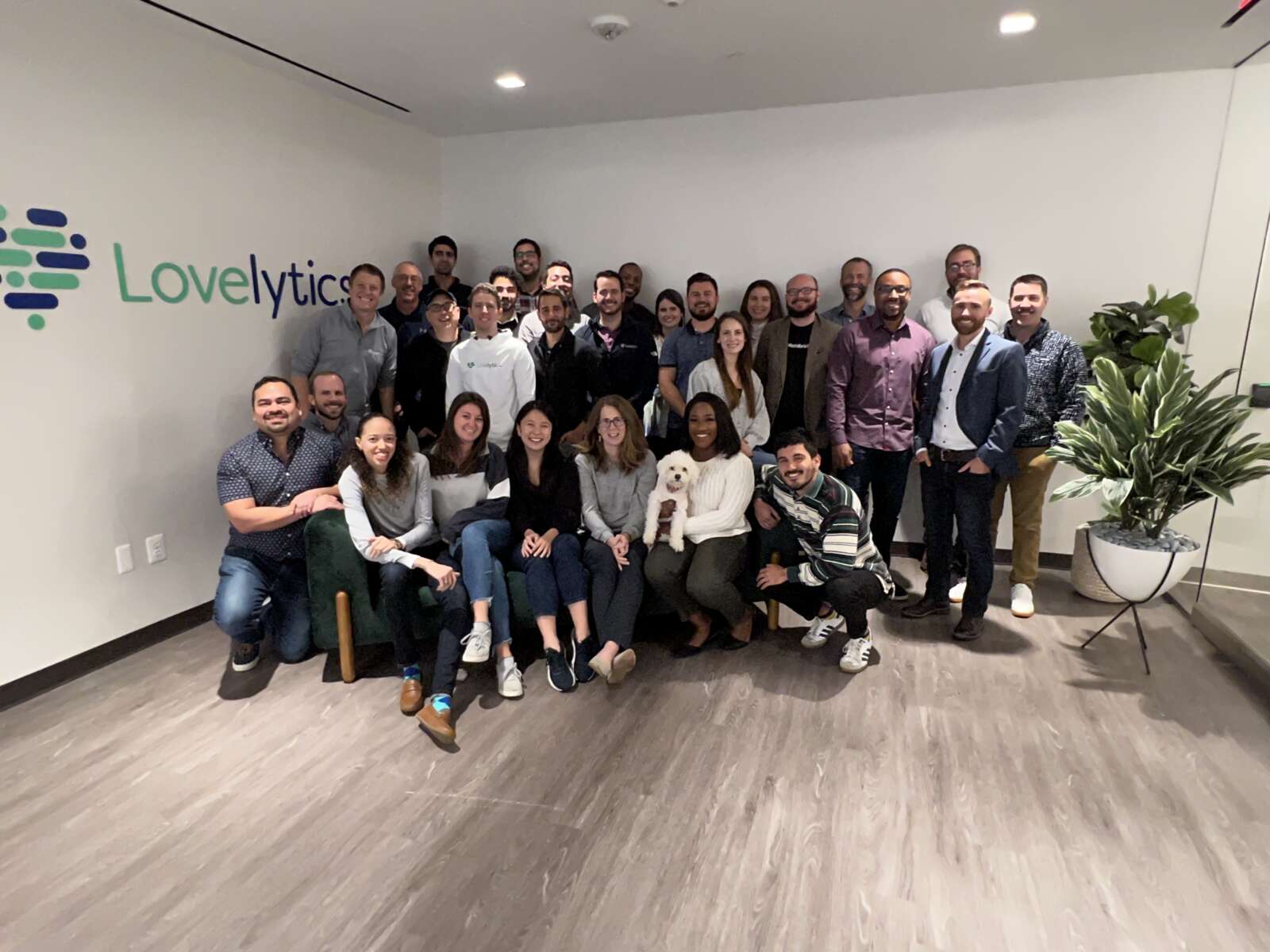
Lovelytics team picture (courtesy photo)

The Courthouse startup has also taken on special projects, building an interactive map of California wildfires for Pacific Gas and Electric’s website and visualizing dense reports by the international non-governmental organization World Economic Forum.

“We can create these concise, consolidated visuals that look good… and you grab that attention of a casual person who may or may not be interested in the topic,” he said.

Ultimately, though, Love aims to give companies the tools their employees need to do their own deep-dives.

“The big thing is self-sufficiency. You have to be able to enable people to do their own analysis,” he said. “Those employees are able to do much better work if they’re not having to wait on the IT department because they’ve been enabled to build their own reports and do their own deep-dive insights.”


Sponsored by Monday Properties and written by ARLnow, Startup Monday is a weekly column that profiles Arlington-based startups, founders, and other local technology news. Monday Properties is proudly featuring 1515 Wilson Blvd in Rosslyn.

A locally owned co-working space is partnering with a nonprofit to help Black girls from the D.C. area reach their fullest potential.

Venture X (2300 Wilson Blvd) in Courthouse is the new headquarters for The Black Girl TRIBE, an organization that educates and uplifts Black girls through mentoring and educational programs and leadership events. The Arlington franchise location’s co-owner Julie Felgar is providing the office space to the nonprofit for free.

It’s her way of giving back to the community via her company and recognizing the work of The Black Girl TRIBE’s founder, Gabrielle Martinez.

“I was inspired by her mission, and support her doing important work she’s doing,” Felgar said. “It’s an equity issue: making sure young ladies from all ethnicities and from all walks of life can value themselves and see what the opportunities are for them out in the world.”

Up until now, The Black Girl TRIBE — which this year received a $100,000 grant from Nike — was based out of Martinez’s house in D.C.

“We used [D.C.] public libraries for everything else, even board meetings and retreats,” Martinez said. “Having this new space is a physical manifestation of the organization’s ‘glow up,’ and it really brings a new level to the way that we program, getting to call the space our own,” she said. “And even though our work has always been valuable and fantastic, having this home base has also leveled up the way that we are seen professionally amongst our community partners.”

Martinez moved in last October and says she hopes to “make the space a safe space for our girls to come learn and thrive” after COVID-19. During the pandemic, the nonprofit has kept in-person events to a minimum.

Felgar says she and her husband, a co-owner, always intended to support one to two businesses locally through Venture X. The Black Girl TRIBE is the first organization she’s partnered with, and she praised the nonprofit’s mission.

“Between 10-14, the foundation of a young lady’s self-esteem is set,” she said. “Being around powerful role models — being with a like group of young ladies and a like group of adults who are empowering them — is really critical to their self-esteem.”

Felgar is still looking for other potential organizations to partner with, in addition to cementing her office’s community presence through events for the Rotary Club of Arlington, the Arlington Chamber of Commerce and political fundraisers.

“One of our initiatives this year will be reaching out into local community,” she said. “The way we designed the space, it’s really easy to host events on weekends and in the evenings. We’re open to allowing people to use space for events — that’s a great way to give back to community and get clients.”

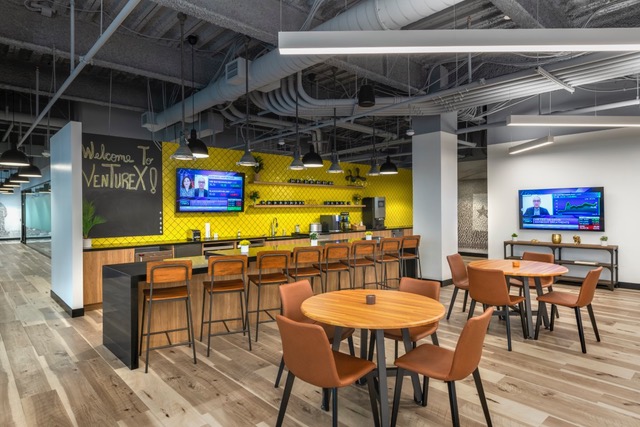
The Venture X co-working space in Courthouse (courtesy of Jeffrey Sauers)

Felgar says she aims to get her office space, which she opened in May, 75% occupied.

“We’ve seen tremendous pickup in last month alone,” she said, although the new Omicron variant may keep leases in the air a while longer. She says in recent months hybrid work arrangements have buoyed her business.

“That’s the great thing about co-working,” she said. “It was a business model that wasn’t designed for hybrid but lends itself perfectly to hybrid model… It’s been tough to open during COVID-19, but in a way, COVID-19 has validated the business model.”

Felgar left her international career with The Boeing Company to establish the Venture X franchise location and firm up her connections to Arlington and Falls Church. Her kids attend Falls Church City Public Schools, where she and her husband — both immigrants — fund scholarships for immigrant and first-generation students.

“We wanted to put our roots firmly implanted in our local community, since that’s a part of our lives that we haven’t gotten to participate in, other than our kids’ schooling and sports,” she said. “This is really great for us to be present.”


Sponsored by Monday Properties and written by ARLnow, Startup Monday is a weekly column that profiles Arlington-based startups, founders, and other local technology news. Monday Properties is proudly featuring 1515 Wilson Blvd in Rosslyn. 

(Updated 4:25 p.m.) Symplicity, a Clarendon-based company that helps college students find jobs and internships, is expanding its international presence.

This month, the company announced its third international acquisition in five years: Canadian company Orbis, a technology platform that connects university students with job and internship opportunities. Symplicity bought Australia-based CareerHub, an online career services platform, in 2017 and Brazil-based Contratanet, the country’s largest network of job portals for students, in 2018.

“It’s a wonderful opportunity,” CEO Matt Small tells ARLnow. “Together, we have most of the universities in Canada.”

Small oversaw all these acquisitions, which add to Symplicity’s growing career services platform — one of its eight solutions for institutions that range from student conduct to academic advising. In the last five years, he says, the company has simplified and improved the quality of these solutions and boosted sales to and renewal rates with universities. Today, the company has more than 2,000 college and university clients in more than 35 countries.

“We’ve been growing by leaps and bounds and have ben wonderfully successful,” he said.

That growth is happening amid a reportedly unsteady job market for college graduates due to the pandemic. Small says more colleges and universities are making employability a top priority, as hiring rates still flag for Gen Z graduates and as student loan debt deepens. He adds that institutions leaned on Symplicity in new ways when universities, and all the services they provide, had to go virtual.

But the chief problem for graduates and universities alike — a skills gap between higher education and industry — predates and has been exacerbated by the pandemic, Small says. When polled, he says, universities would say their students were ready for work, while heads of student recruiting would say students weren’t ready.

“They weren’t talking to each other: employers preferred three years work experience, so they didn’t have to train workers in the actual job,” he said. “Having right major and good grades wasn’t enough to do the job.”

Symplicity CEO Matt Small speaks at a conference (courtesy photo)

He tells students to get to the career center “early and often” to map out what work studies, internships or volunteer programs they can complete and which technology platforms they can master concurrent to their four years of classes. Symplicity placed 450,000 students in internships in the last 12 months.

“It just makes you much more marketable when you graduate,” he said.

Small was tapped in 2016 to work for Symplicity after Miami-based H.I.G. Capital purchased the company. At the time, he was the president of Blackboard International. Symplicity attracted a number of other Blackboard employees and executives, he says.

“I would say we came in and fully professionalized the company and made big product enhancements,” he said.

Two years before Small came on, Symplicity’s founder and then-CEO Ariel Manuel Friedler pleaded guilty to federal computer hacking charges after gaining access to his competitors’ computers in order to steal customer and product design information. Former President Donald Trump pardoned him in February 2020. Symplicity was not charged in the case.

Under the new leadership, Symplicity has also swelled to 300 employees, about a third of whom work from the Clarendon headquarters (3003 Washington Blvd, Suite 900), says Small. The company is actively hiring talent in the software industry.

“I joke that we’re the Ted Lasso of the software industry — everyone here is that level of caring and committed,” he said, referencing the TV show about a college football coach whose charm and optimism win over the English soccer team he is unexpectedly hired to coach.

“We work really hard, but it’s a fun, vibrant culture and a personable place,” he added.


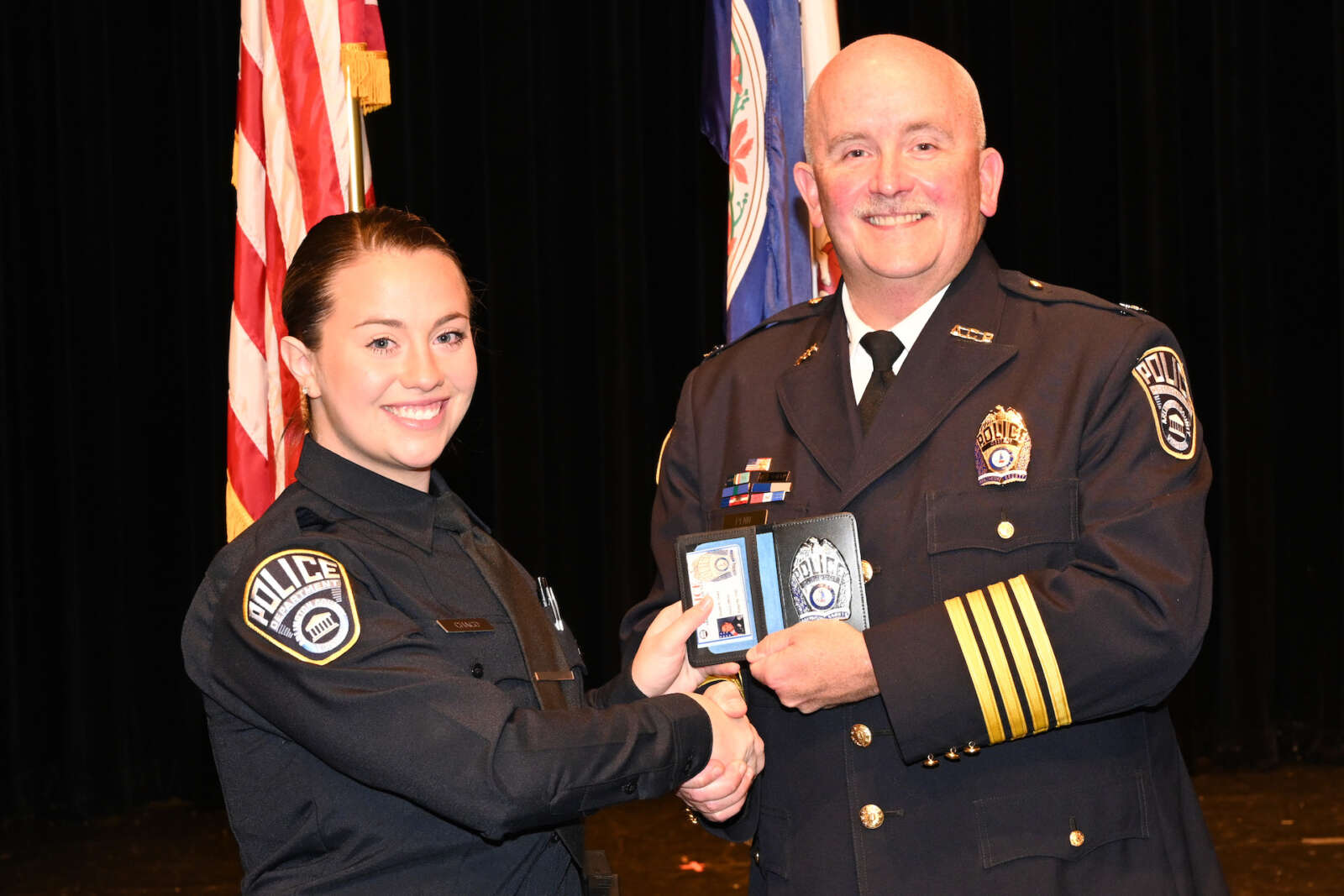
Officer Brooke Chaco with Chief Andy Penn at her police academy graduation on Dec. 10 (courtesy of ACPD)

December 21, 2015 was the day that led Brooke Chaco to becoming an Arlington County police officer.

It was that day six years ago when her stepfather, New York Police Department detective Joseph Lemm, and five others were killed in action while serving in Afghanistan.

“It changed my whole life,” Chaco tells ARLnow. “It made me appreciate what law enforcement does even more.”

Chaco grew up in a family full of police and military veterans, but the profession didn’t much appeal to her until Lemm came into her life as a stepfather when she was about ten years old.

“I was a brat, for a lack of a better word, and didn’t want to give him the time of day,” she admits.

Lemm was a long-time New York police officer, serving for nearly 15 years, mostly in the Bronx. He was also staff sergeant in the Air National Guard and had been deployed multiple times. His stature may have been intimidating, but his demeanor was anything but.

In fact, his nickname among friends was “Superman,” due in part to sorta looking like the superhero’s alter ego Clark Kent and that Lemm could be all things to everyone he loved.

“He was just this big, gentle giant,” Chaco says. “He had a way with his words that gained people’s trust and got them to talk to him.”

In early 2015, Lemm was deployed again to Afghanistan and was looking forward to speaking with his family on Christmas with the hope he’d be home soon.

Four days before Christmas, however, a suicide bomber on a motorbike carried out an attack on his convoy during a patrol. Lemm was only 45 years old when he was killed and left behind his wife, then-16-year-old Chaco, and her four-year-old brother Ryan.

“I had to help raise [Ryan] after my stepfather passed,” she says. “He’s a very big part of my life and a big reason as to why I’m doing what I’m doing.”

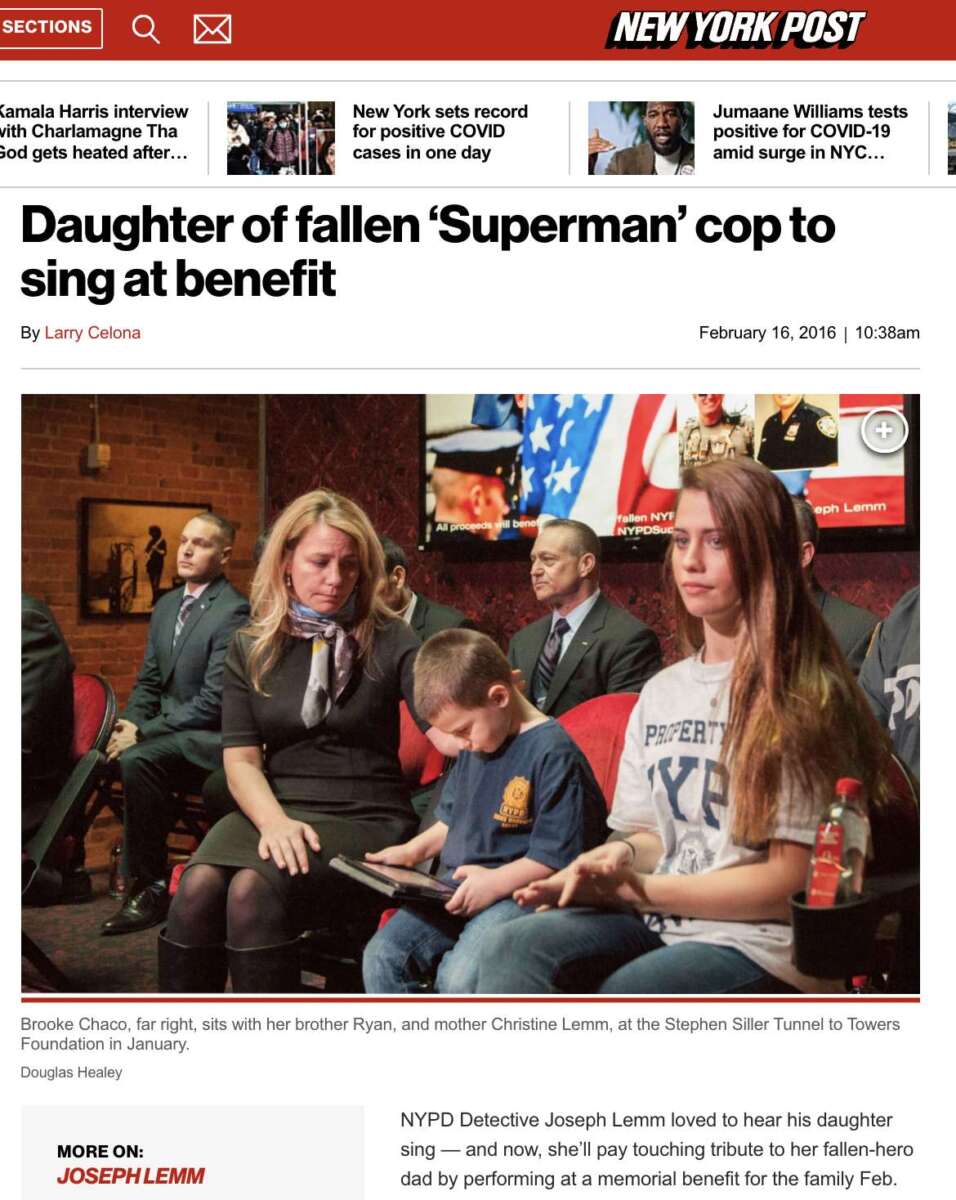
The loss made headlines nationally and especially in the New York City area, where the New York Post wrote about how Brooke, a singer, paid a musical tribute to her fallen-hero dad at a memorial benefit for the family. (Earlier this year, the Post also wrote about a bridge in Westchester County being dedicated to Lemm.)

New York Post article highlighting Brooke Chaco’s tribute to her fallen stepfather

The tragedy helped Chaco find her calling.

She was hired into the ACPD — a force in much need of additional officers — this past April, even prior to graduating from James Madison University. Despite having a family full of officers, she’s the first woman in her family to join the police force. She loves New York and her family, but is looking to forge her own identity in Arlington.

“I didn’t want my peers to look at me any differently or my supervisors to look at me differently because of the sacrifice that my stepfather made,” Chaco says. “I wanted to make my own path.”

Chaco remains an officer in training. She graduated from the academy earlier this year and is now in the midst of field training, where she’s being paired with a more experienced officer. All in all, training to become a full time solo officer can take a little over a year. When that’s completed, and after a few years of patrol work, Chaco hopes to end up in the special victims unit.

(more…)


Sponsored by Monday Properties and written by ARLnow, Startup Monday is a weekly column that profiles Arlington-based startups, founders, and other local technology news. Monday Properties is proudly featuring 1515 Wilson Blvd in Rosslyn. 

When the pandemic hit, Elena Laswick scrambled to keep afloat her five-month-old brand selling artisan-made textiles from Guatemala.

After working for nearly five years with the indigenous Ixil Maya people to increase their textile sales, she launched her own brand to ethically sell their wares.

Elsewhere, Brooke Loving Bagwell was doing the same thing, with her brand amplifying weavers from Cusco, Peru.

Although they worked in the same niche industry, they didn’t connect until the pandemic, when Bagwell sought out Laswick for support. Their conversations evolved into the idea for Amano Marketplace, an online marketplace where Central and South American artists collectives could sell their products for prices that sustain their artisans and communities.

“The idea was born June of 2020, and we got everything online by Oct. 1, 2020,” co-founder Laswick tells ARLnow.

The last year has been spent planting the seeds for a recognizable company and waiting for them to grow.

“I think that marketing takes time. If you want to do it quickly, it takes an insane amount of money, so we’re going the time route,” said Laswick, who is also tapping into her connections in the fair trade world. “It’s just a matter of waiting for it to be recognized and waiting for the things we’ve put in motion to have a result.”

Laswick envisions Amano (which means “by hand”) as somewhere customers know they can get an ethical gift that supports Indigenous and Latin artists. For artisans, Amano would guarantee a certain number of monthly sales.

That’s not happening yet, but the marketplace is helping collectives connect with customers, she said.

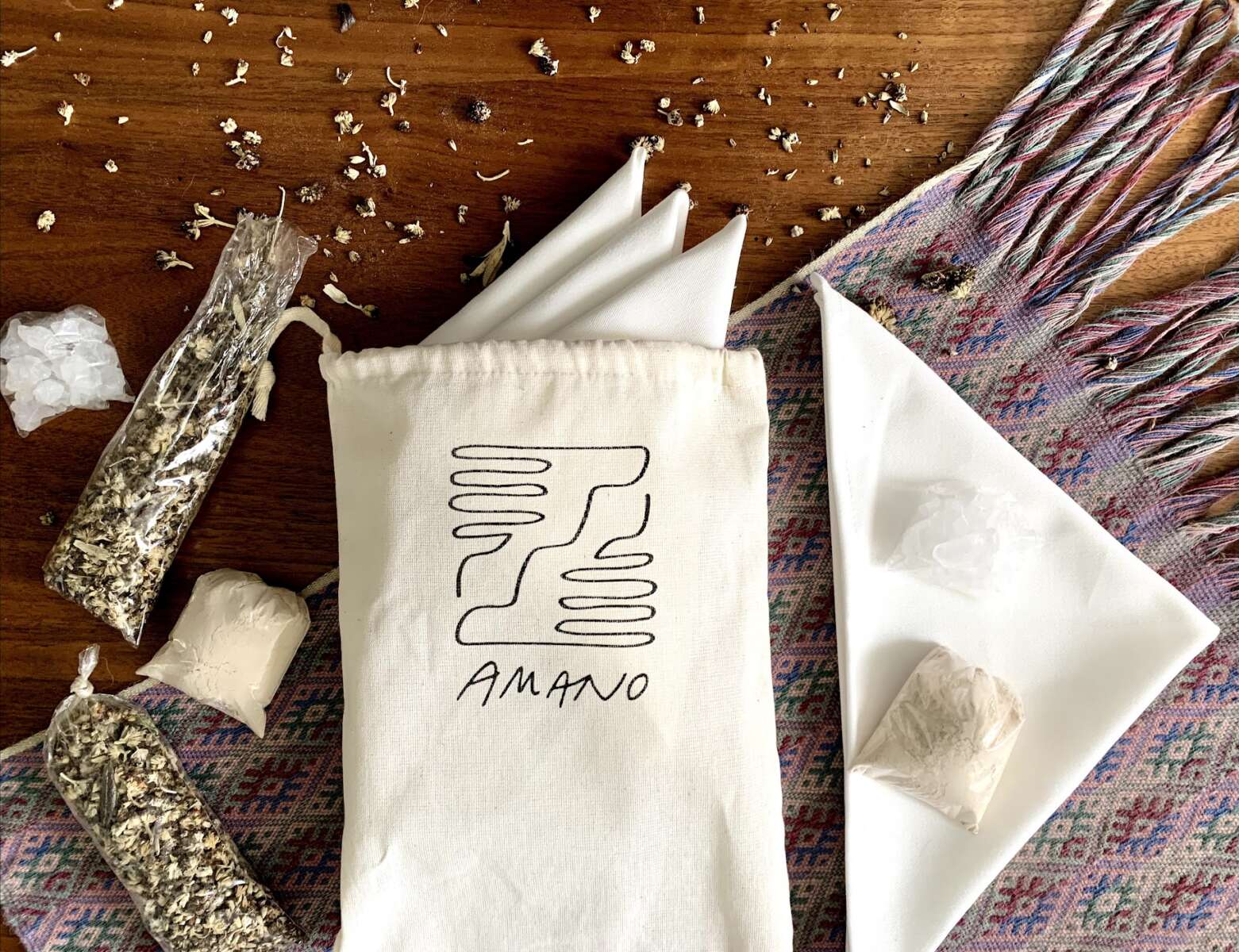
Amano Marketplace merchandise (courtesy photo)

She and Bagwell incorporated Amano Marketplace in Arlington in February 2021. For the past 11 years, Courthouse has been Laswick’s home base when she isn’t in Guatemala. It’s als where orders are fulfilled.

Laswick got into Guatemalan textiles after working with a non-governmental organization called Mayan Hands. Meeting with Ixil artisans, she fell in love with their work and resolved to partner with them.

“The weavings of Guatemala draw everyone in. It’s impossible not to be drawn in, in my opinion,” she said.

Laswick’s stint with Mayan Hands taught her that Ixil weavers make fewer sales because they’re cut off from the international textile community, living in a region isolated from tourists, and market demand isn’t that high.

That’s why Amano is tapping into a consumer base that seeks out ethical products hand-made by women and underrepresented peoples.

A woman artisan who makes goods for the Amano Marketplace (courtesy photo)

The artists with which Amano works have to fight for living wages and appropriate uses for their weavings — adding insult to the injuries of colonization and a 1980s-era genocide that targeted them, Laswick says.

(more…)


Sponsored by Monday Properties and written by ARLnow, Startup Monday is a weekly column that profiles Arlington-based startups, founders, and other local technology news. Monday Properties is proudly featuring 1812 N. Moore Street in Rosslyn.

A local agriculture-technology company is making it possible for people to buy pre-packaged goods based on how much carbon dioxide they save from entering the atmosphere.

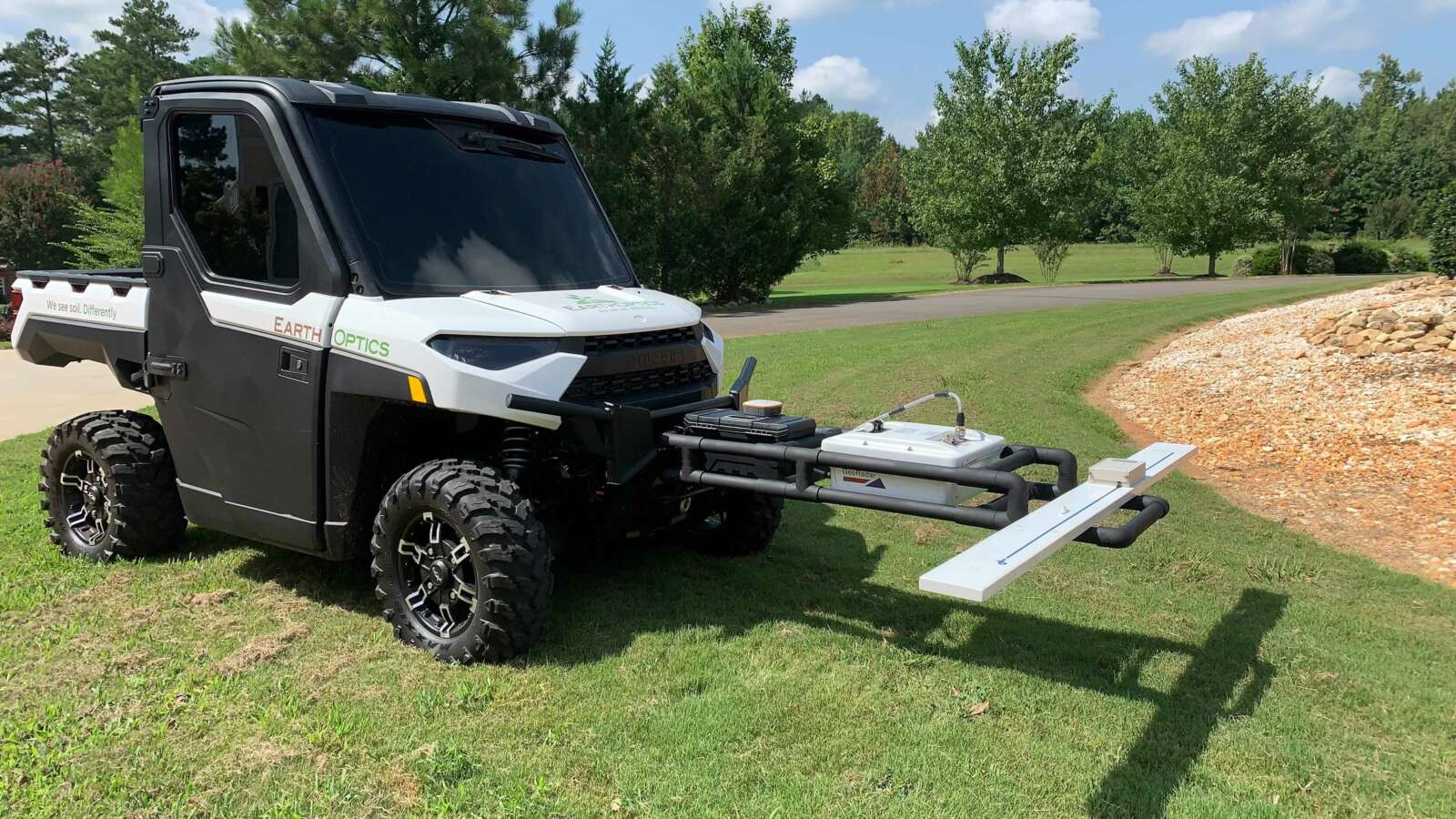
EarthOptics, a startup with a significant Crystal City presence at 2461 S. Clark Street, uses artificial-intelligence to help farmers cheaply and efficiently map, report and verify how much carbon their farm land absorbs through the natural process of sequestration. This way, they can cash in on private- and public-sector incentives related to climate change mitigation.

Now, EarthOptics is using that data to let consumers support these farms more directly. With the labeling initiative, folks will be able to choose to buy products from food and beverage companies that source their ingredients from carbon-sequestering farms.

Consumers can expect to see the new label on certain products, especially from smaller food companies, in their grocery stores in 2023. The timeline will vary some depending on the growing season of particular crops.

“Consumers will be able to look at our Soil Carbon Project label and appreciate that the corn used to make their cornflakes took one pound of carbon dioxide out of the atmosphere and kept it in the soil, or the grain used to produce a six-pack of beer took 20 pounds of carbon dioxide out of the atmosphere,” EarthOptics CEO Lars Dyrud said in a statement.

EarthOptics has already begun the verification process with some interested growers.

The CEO says most soil carbon-mapping methods are time-intensive and expensive, and only yield estimates. That makes it harder for farmers and the packaged goods companies that buy their crops to benefit financially from carbon sequestration.

EarthOptics technology lowers the cost and improves the accuracy of the measurements, making it possible to launch a labeling system, he says.

“For a labeling initiative to be successful, it needs to be accurate and trustworthy,” Dyrud said. “Measuring soil carbon retention for food and other consumer goods historically has been a costly and time-intensive endeavor. What we’ve been able to do at EarthOptics is move the soil carbon needle from estimation to accurate, verifiable measurements.”

Doing so has a host of benefits, Dyrud previously told ARLnow. Farmers are able to contribute to climate-change mitigation through carbon credit marketplaces, where large corporations such as Google or Etsy offset their carbon footprint by supporting businesses that sequester the greenhouse gas.

EarthOptics engineers and researchers are also tinkering with the technology so that it can map more soil properties, such as nutrient and moisture levels, which would combat climate change while making food tastier and more nutritious.

The Earth’s soil naturally sequesters carbon but some human activity — particularly farming — can stymie that natural process. When the soil is too hard or tilled too often, the carbon can’t seep into the ground and instead is released into the atmosphere, where it can remain for thousands of years.

While certain agricultural practices contribute to greenhouse gas emissions, others can reduce them. Scientists estimate that soils, particularly farm soils, could sequester more than a billion tons of additional carbon each year, according to EarthOptics.

EarthOptics’ TillMapper helps farmers decide if, when, where and how deep to till (courtesy photo)

Sponsored by Monday Properties and written by ARLnow, Startup Monday is a weekly column that profiles Arlington-based startups, founders, and other local technology news. Monday Properties is proudly featuring 1812 N. Moore Street in Rosslyn.

VOICE Summit 2021, a conference highlighting the latest in artificial intelligence and voice technology, will kick off this evening in Crystal City.

Thousands of technology specialists, marketers and representatives from leading brands are expected to attend the event, which ends Wednesday evening. It is hosted by Modev, a Ballston-based company exploring the future of voice controls.

The event will highlight innovations in the retail, healthcare, travel and entertainment industries driven by conversational AI. It will focus on how tech companies can enhance customer experience and meet growing consumer demands and heightening expectations for conversational technology, like Amazon Alexa or Google Assistant.

For the first time, the local startup’s conference, now in its fourth year, will be held in Arlington. VOICE 2018 and 2019 were both held in Newark, New Jersey and together attracted some 7,000 attendees. The conference was held virtually in 2020 due to the pandemic.

“We’re excited to bring the event to Arlington, Va. and to gather industry back together,” Modev CEO and founder Pete Erickson said in a statement. “Conversational AI has evolved a lot since the start of the pandemic and is now a core component of an overall general business and marketing strategy for brands and enterprises. Large investments are being made across industries to capitalize on voice driven strategy, and companies are committed to enhancing the customer experience.”

Modev says VOICE Summit is the industry’s flagship event, capable of shaping the future of voice technology, AI and “ambient computing,” or any computer activity so deeply integrated into daily life that humans don’t realize they’re using computers.

VOICE Summit 2021 promotional graphic (courtesy photo)

This is the first major tech event to relocate to National Landing — collectively, the Crystal City, Pentagon City and Potomac Yard neighborhoods  — since Amazon announced it would build its second headquarters in Arlington in 2018, according to Arlington Economic Development.

The two-day event will be virtual and in-person at the Renaissance Arlington Capital View Hotel (2800 S. Potomac Ave). The event will feature keynotes, fireside chats, panels and breakout “conversations” that allow the audience to play an active role in the discussion.

Attendees will hear keynote speeches from Silicon Valley startup founders and tech leaders, including Rich Stern, the CEO of Tune-In; Andi Huels, the head of AI at Lenovo; and Audrey Arbeeny, a two-time Emmy Award winner and creator of sounds for the world’s top brands.

“We look forward to bringing leaders together to discuss this shift and helping them chart a path to success in the new year,” Erickson said.

Smart voice assistants Amazon Alexa and Google Assistant are the event’s top sponsors.

Founded in 2008, today, Modev also produces the VOICE Global event, presented by Google Assistant, and the award-winning VOICE Talks internet talk show.


Sponsored by Monday Properties and written by ARLnow, Startup Monday is a weekly column that profiles Arlington-based startups, founders, and other local technology news. Monday Properties is proudly featuring 1812 N. Moore Street in Rosslyn.

OxiWear, an Arlington-based company developing a wearable oxygen monitoring device, has raised a pre-seed funding round of $1.25 million, exceeding its goal of $750,000.

This funding will allow the medical- and sports-technology startup to finish developing its product and start beta testing it before releasing the device by mid-year 2022.

OxiWear was started by Shavini Fernando, who lives with severe pulmonary hypertension: a condition in which the heart has trouble pumping blood through the lungs. It leaves her vulnerable to sudden and undetected drops in oxygen, known as silent hypoxia.

Rather than let the disease rule her life, she decided to develop an ear-wearable pulse oximeter that offers 24-hour, continuous oxygen monitoring and low-oxygen alerting. She invented the device in Georgetown University’s maker’s hub while a graduate student.

“OxiWear is a product that I developed to help patients like me — those living with pulmonary hypertension,” Fernando said. “Through our research, we learned that there is a larger market for oxygen monitoring including elite athletes, high-altitude travelers and patients with diseases such as [chronic obstructive pulmonary disease], sleep apnea and COVID-19.”

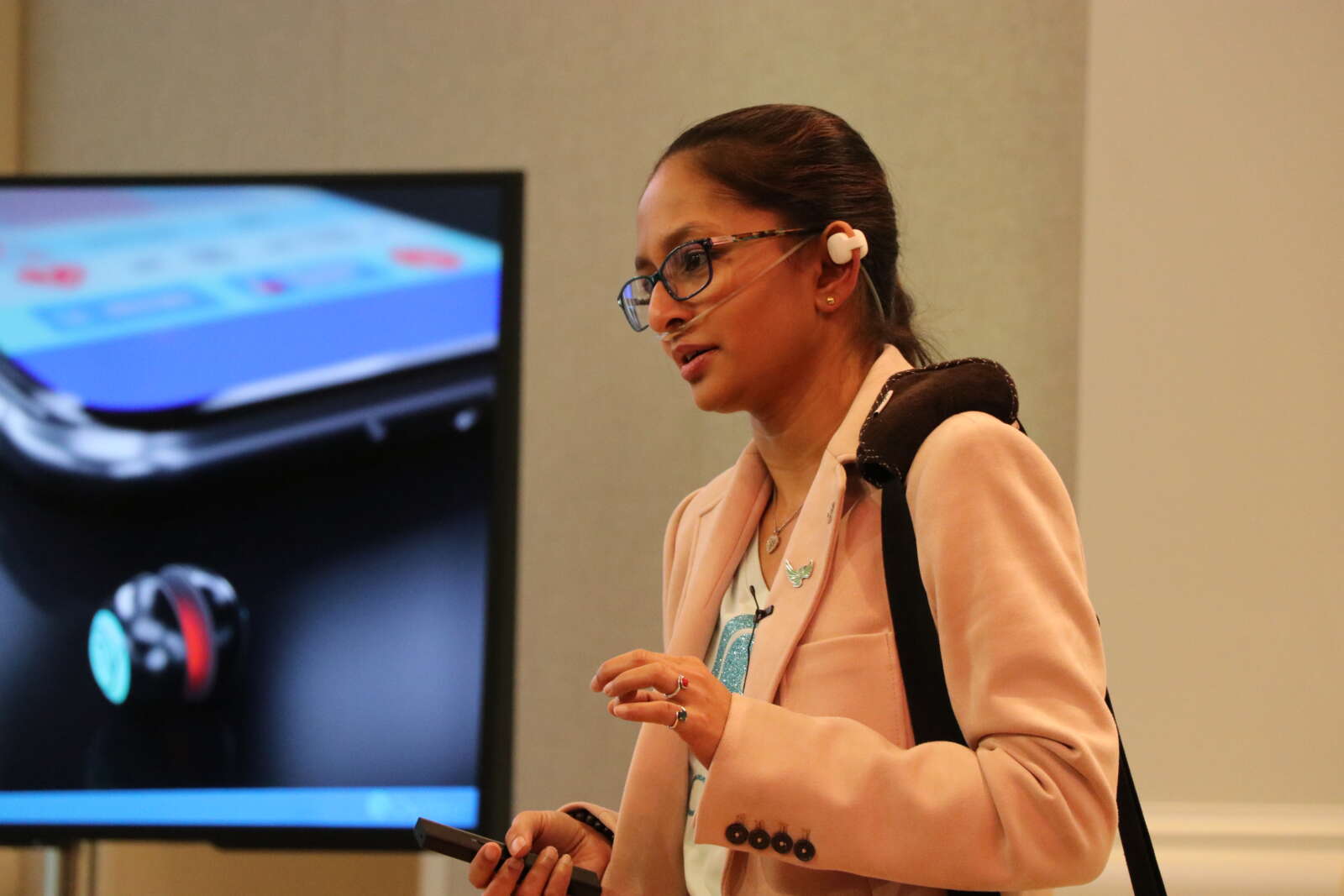
OxiWear founder Shavini Fernando (courtesy of Shavini Fernando)

The ear is one of the most accurate body parts for measuring oxygen saturation levels and detecting when they begin to drop, according to the company.

But the device is not just suitable for those prone to silent hypoxia. Performance athletes and high-altitude travelers can use it to receive non-intrusive and accurate oxygen monitoring 24 hours a day, according to the company.

In anticipation of launching the product next year, OxiWear is meeting with the Food and Drug Administration to earn its medical device designation and is participating in the leAD Sports & Health Tech accelerator program.

Leading the pre-seed round was GAP Funds, an investment program of the Virginia Innovation Partnership Corporation — formerly CIT — that previously invested in the company this summer.

“OxiWear is a game changer for those affected by the complications of pulmonary hypertension, and could be the difference between safety and danger,” said Tom Weithman, VIPC’s Managing Director of GAP Funds.

The startup received re-investments from previous supporters Ted Leonsis and The Paul & Rose Carter Foundation.

“I’ve been a proud, early supporter of Shavini and her life-saving work and I congratulate her on not only meeting her pre-seed funding round target — but decisively beating it,” Leonsis said. “It’s a testament to how in-demand her product is and how smartly she has built her company around it. I expect she will only continue to grow, and I happily stand by her to offer advice whenever she needs it.”

Paul Caicedo, Future Communities Capital, Gaingels, Halcyon Fund, Hourglass Venture Partners, TiE’s D.C. and Boston chapters and Tysons Angel Group funded this round.

Halcyon Fund is tied to a flagship residency fellowship for entrepreneurs at Georgetown, the Washington Business Journal reports. The fund has been building up an investment strategy, including an angel investment network and a microloan fund, with the goal of improving access to capital for women and people of color starting their own companies.


View More Stories