The County Board is poised to pass a controversial incentive package for Amazon this Saturday, which could help bring tens of thousands of jobs and millions in added property taxes to Arlington County, at the cost of tens of millions in tax subsidies for one of the world’s largest companies.

The Board is scheduled to vote on the multi-million dollar incentive package during their regularly-scheduled Saturday meeting, which is Amazon’s last hurdle to clear before beginning development on their new headquarters slated to start construction in 2021.

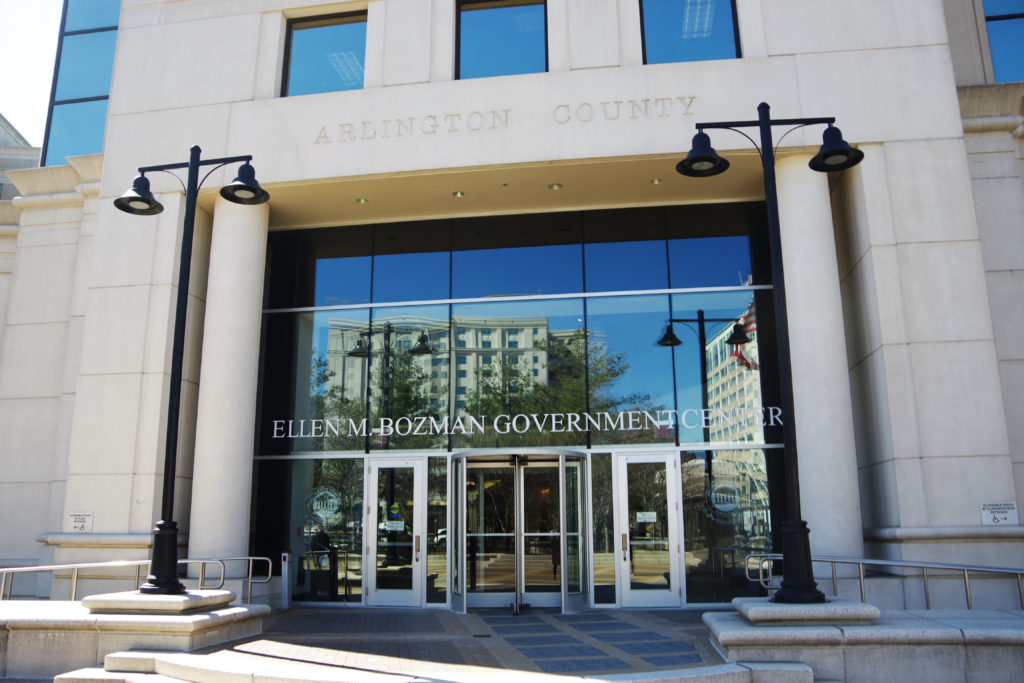
The meeting begins at 8:30 a.m. at the Bozman Government Center in Courthouse, however, the Amazon part of discussion isn’t scheduled to start until after 1 p.m., per an agenda summary and the hearing is expected to be dogged with public protest from critics opposing Amazon.

The county’s incentive package was first publicly released earlier this month and features a 15-year, estimated $23 million incentive given to Amazon if the tech-and-retail giant meets office space occupancy goals over several years. The company would need to fill 60,000 square feet of office space starting in June of 2020 and meet benchmarks towards occupying 6 million square feet by 2035.

The incentive is funded from a portion of the increases in hotel tax revenue that officials predict from Amazon’s “HQ2” moving to the region.

The incentive package up for a vote Saturday also includes plans to spend $28 million over a period of 10 years to update infrastructure around the proposed headquarters, in addition to the state’s multi-million-dollar contribution. That money will be pulled from a portion of the increase in commercial property tax revenue in the Crystal City area that results from Amazon’s arrival.

The county also offered to at least try to fulfill Amazon’s request for an on-site helicopter pad on-site despite residents’ ongoing complaints of existing helicopter noise and the region’s strictly-enforced no-fly zone.

Amazon announced it selected Arlington as the site for its second headquarters in November, promising to bring at least 25,000 jobs and occupy 6,056,000 million square feet of commercial space in the Crystal City and Pentagon City areas, which have experienced high vacancy rates for the last 15 years.

County Board Chair Christian Dorsey said in February the expected number of Amazon jobs is now higher because the company cancelled its other headquarter plans in New York City.

The incentives have drawn persistent criticism from activists who believe the county shouldn’t be giving any incentives to a company run by the world’s richest man — and who fear its relocation to Arlington will exacerbate the county’s affordable hosing shortage. Critics have also raised red flags about a portion of the agreement that gives Amazon advance notice of FOIA requests.

On Friday, local activist coalition “For Us, Not Amazon” announced a noon protest outside the county government steps on Saturday before the vote.

“While the County tries to ignore us, For Us, Not Amazon has been doing the real community engagement, knocking doors, listening to community members’ concerns and it’s time to make sure Arlington County officials listen to every one of us before this sham gets voted on,” the description of the rally reads.

The head of Arlington’s Chamber of Commerce argued the package was a “good deal” for the county in a Thursday op-ed on ARLnow, writing that “focusing on the Transient Occupancy Tax means that taxes on Arlington residents and businesses will not fund these incentives and that Amazon will receive these payments only if our hoteliers grow their businesses too.”

For Us, Not Amazon’s member organizations knocked on doors earlier this week to gather petition signatures opposing the incentive package.

On Monday, 30 advocacy and community organizations — including the Nauck Civic Association and the Arlington NAACP, among statewide and regional groups — signed a letter requesting the County Board “postpone the vote on incentives and hold public hearings to foster transparency and understanding.”

The Board originally planned for a February public hearing and vote on the incentives but rescheduled to March, citing the need for more community discussions.

Saturday’s vote does not include the state’s $750 million-incentive package to Amazon, which the Virginia General Assembly overwhelmingly approved in January.

This weekend’s Board meeting will also not include ideas county officials pitched Amazon but didn’t officially include in the incentive package — such as suggesting Amazon take advantage of a little-used technology incentive program to potentially save millions in taxes, as first reported by ARLnow.

Law enforcement officers from around Northern Virginia will convene in Arlington later this month for a training exercise simulating a terrorist attack or some sort of other “active violence incident.”

County police announced this week that the training will take place on Sunday, March 31. But they declined to release any details about its timing or location, except to say that it would involve “multiple locations throughout the region.”

“The public should not experience any significant impacts to traffic routes or public facilities,” police wrote in a news release. “Members of the public will see an increase in public safety vehicles and law enforcement officers in the area but should not be alarmed or concerned as they will be part of the exercise play.”

Police say the exercise will “provide participants with an opportunity to assess capabilities, plans, policies and procedures outlined in a recently developed Complex Coordinated Attack Traffic Management Plan.”

“It will focus on decision-making, coordination and integration with other organizations during an active violence incident,” police said.

The Northern Virginia Emergency Response System, a joint effort to prepare for emergencies by the area’s law enforcement agency is sponsoring the exercise. Funding will come from the Department of Homeland Security.

The following agencies plan to participate:

  • Arlington County Police Department
  • Fairfax County Police Department
  • Metropolitan Washington Airport Authority
  • Metro Transit Police Department
  • Virginia Department of Transportation
  • Virginia State Police
  • U.S. Park Police

Police say that neither members of the public nor the media will be allowed access to the exercise and its participants.

Arlington has been the site of several other terrorism, or mass violence, exercises in past years as well.

File photo


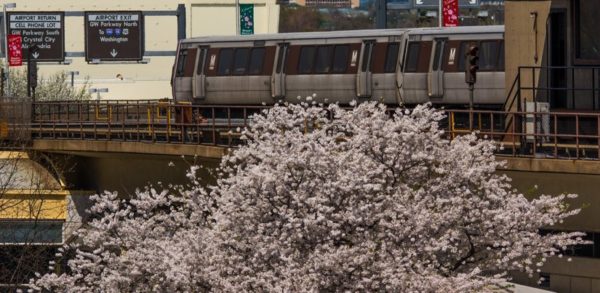
Metro will be suspending all daytime track work during the region’s Cherry Blossom season, however night work is still scheduled to impact Arlington.

Some track work will continue after 10 p.m., as the agency continues scheduled maintenance and capital improvement projects. Crews will be installing radio cables on the Yellow and Blue lines during Cherry Blossom season this year, causing single tracking in Arlington during the following times:

  • March 22-24 on the Yellow Line between Pentagon City and L’Enfant Plaza, and on the Blue Line between Pentagon City and Arlington Cemetery
  • March 25-29 on the Yellow Line between L’Enfant Plaza and Pentagon City
  • April 1-5 on the Yellow Line between L’Enfant Plaza and Pentagon City
  • April 7 on the Yellow Line between L’Enfant and Pentagon City

The transit agency says it will beef up service during the festival. Between Saturday, March 23 to Sunday, April 14, Metro lines will operate on the following schedule according to the announcement:

  • Trains will arrive at downtown D.C. stations every 4-7 minutes
  • Red Line trains could run every 6 minutes until 9:30 p.m.
  • All other Saturday trains running every 12 minutes
  • All other Sunday trains every 15 minutes

The Cherry Blossom Festival attracted 1.5 million visitors to the greater Washington region last year and netted $160 million in local revenue, reported the Washington Business Journal.

Visitors flocking to Cherry Blossom blooms are add trips aiding Metro’s flagging ridership which is now the lowest it’s been in 19 years. Historically, the petal-peepers provide some of Metro’s busiest days with little-used stations like Arlington Cemetery seeing 60-percent trip increases, according to the Metro’s now-defunct planning blog.


Baby Boy for Cristol — Arlington County Board member Katie Cristol gave birth to her first child, a baby boy, this past weekend. She plans to call in to Saturday’s County Board meeting and participate in the crucial Amazon incentive package vote. [Twitter]

Building Plans for Temporary Amazon Office — JBG Smith “submitted plans March 7 to make common area improvements throughout the 12-story, 221,000-square-foot [office building at] 1800 S. Bell St., to be leased in full by Amazon.” [Washington Business Journal]

County May Change Building Plan Practices — “Arlington officials are considering ending same-day viewing at the Department of Community Planning, Housing & Development after a Washington Business Journal reporter asked to view a permit for a building Amazon.com Inc. is expected to lease, said Ben Aiken, director of constituent services in the county manager’s office.” [Washington Business Journal]

VRE Plans Moving Forward — “Virginia Railway Express is moving forward with plans to build an expanded Crystal City Station, a key step needed to expand and improve service. The VRE Operations Board is due to vote Friday to allow contracting to move forward for engineering work based on the already approved concept design.” [WTOP]

New Leases in Rosslyn — Earlier this week Monday Properties announced the signing of three lease deals at 1100 Wilson Boulevard, one half of its Rosslyn twin towers. The firms leasing new space are The Health Management Academy and Trilogy Federal LLC, while WJLA owner Sinclair Broadcasting is expanding its existing space. [Monday Properties]

Extensive Road Closures Saturday — Expect a number of road closures in Courthouse, Rosslyn and near the Pentagon Saturday morning for the annual Four Courts Four Miler. [Arlington County]

Nearby: Gentrification Fears in Arlandria — “Concern of rising rents and gentrification have always been present in the Arlandria neighborhood, which sits between South Glebe and West Glebe roads and ends at Potomac Yard. Amazon.com Inc.’s plan to move to nearby Arlington has only intensified those worries.” [Washington Business Journal]


Metro is moving forward with its new budget, proposing sweeping service increases to bolster ridership with the need for a modest budget increase from Arlington.

The WMATA Board of Directors gave initial approval for the transit agency’s draft $3.5 billion, FY2020 budget during a meeting today (Thursday). The budget paves the way to start running Yellow Line trains to Greenbelt and Red Line trains all the way to Glenmont, eliminating the Silver Spring turn-back.

The budget asks Arlington to contribute $77.6 million to the agency’s operating budget, a $2.6 million increase from last year.

“Yellow and Red extensions help any Arlingtonians heading to those end points and expand the commute/travel shed into Arlington to accommodate growth in Pentagon City and Crystal City,” Metro Board member and Arlington County Board Chair Christian Dorsey told ARLnow after Thursday’s meeting.

“Better service helps us all,” said Dorsey.

Arlington County Manager Mark Schwartz proposed $45.6 million in the county’s next budget to be allocated to Metro’s operating budget, a $5 million increase from budget adopted last fiscal year. The remainder of the county’s $77.6 million in funding is from a small increase in the portion of the county’s capital improvement program (CIP) funds set aside for Metro.

Arlington County Board members advertised a 2.75-cent bump to the real estate tax in Arlington’s next fiscal budget, in part, to cover rising expenses at Metro.

The idea was Dorsey’s, who said the increased funds to Metro allowed the transit agency’s budget “to do more service, reduce the price of some fare pass products including on bus where ridership is cratering while having no fare increases and staying within legislatively mandated caps.”

The budget also included a small, $1 million proposal provide $3 subsidies for late-night rideshare trips that area workers take, now that Metrorail’s own late-night service is no more.

One uncertainty the transit agency’s budget continues to face is its ridership rates, which have now plummeted to a 20-year low. The budget banks on that number stabilizing this year, a result WMATA General Manager Paul Wiedefeld hopes to achieve with the increased service.

Wiedefeld initially proposed even more sweeping service increases, including an expansion of rush-hour service, but the expense prompted consternation from county officials. Those proposals were ultimately stripped from the budget.

The budget proposal Board members approved Thursday did not include service cuts or fare increases. 

Metro Board member Corbett Price, representing D.C., thanked Dorsey at the end of the meeting for his “political leadership” in assembling the budget, reported WTOP.

“My only hope is people say such things about me when I’m dead,” joked Dorsey.

Metro Board members will convene again this month for a final vote on the budget, which goes into effect in June.


(Updated at 10:45 p.m.) About a year ago at this time, Arlington looked to be in serious trouble down in Richmond.

In mid-March 2018, county officials faced the decidedly unpleasant prospect that they’d come out on the losing end of a bruising legislative battle with two local golf and country clubs.

One of the county’s foremost foes in the General Assembly had engineered the passage of legislation to slash the clubs’ tax bills, potentially pulling more than a million dollars in annual tax revenue out of the county’s coffers.

Arlington had spent years tangling with the clubs, which count among their members local luminaries ranging from retired generals to former presidents, arguing over how to tax those properties. Yet the legislation from Del. Tim Hugo (R-40th District) would’ve bypassed the local dispute entirely, and it was headed to Gov. Ralph Northam’s desk.

That meant that Arlington’s only hope of stopping the bill was convincing the governor to strike it down with his veto pen.

In those days, long before evidence of Northam’s racist medical school yearbook photos had surfaced, the Democrat was well-liked in the county. He’d raised plenty of cash from Arlingtonians in his successful campaign just a year before, and had won endorsements in his primary contest from many of the county’s elected officials.

Yet the situation still looked dire enough that the County Board felt compelled to take more drastic steps to win Northam to their side. The county shelled out $22,500 to hire a well-connected lobbying firm for just a few weeks, embarking on a frenetic campaign to pressure the governor and state lawmakers and launch a media blitz to broadcast the county’s position in both local and national outlets.

“It became apparent to all of us that every Arlingtonian had something at stake here,” then-County Board Chair Katie Cristol told ARLnow. “At a time when we were making excruciating decisions about our own budget, the idea that you would take more than million dollars and put it toward something that wasn’t a priority for anyone here was so frustrating.”

That push was ultimately successful — Northam vetoed the bill last April, and the county struck a deal with the clubs to end this fight a few weeks later.

An ARLnow investigation of the events of those crucial weeks in spring 2018 sheds a bit more light on how the county won that veto, and how business is conducted down in the state capitol. This account is based both on interviews with many people close to the debate and a trove of emails and documents released via a public records request (and published now in the spirit of “National Sunshine Week,” a nationwide initiative designed to highlight the value of freedom of information laws).

Crucially, ARLnow’s research shows that the process was anything but smooth sailing for the county, as it pit Arlington directly against the club’s members. Many of them exercise plenty of political influence across the region and the state, and documents show they were able to lean heavily on Northam himself.

“One would expect a Democratic governor to be highly responsive to one of most Democratic jurisdictions in the state,” said Stephen Farnsworth, a professor of political science at the University of Mary Washington in Fredericksburg. “But this was a matter of great concern to a bunch of very important people in Virginia, and that may well be the reason why additional efforts were necessary.”

And, looking forward, the bitter fight over the issue could well have big implications should similar legislation ever resurface in Richmond.

“Structurally, this bill could absolutely come back someday,” Cristol said. “And the idea that a bill that has such deleterious consequences for land use and taxation in jurisdictions across Virginia could come back and garner support because of an effective lobbying interest is very much a real threat.”

(more…)


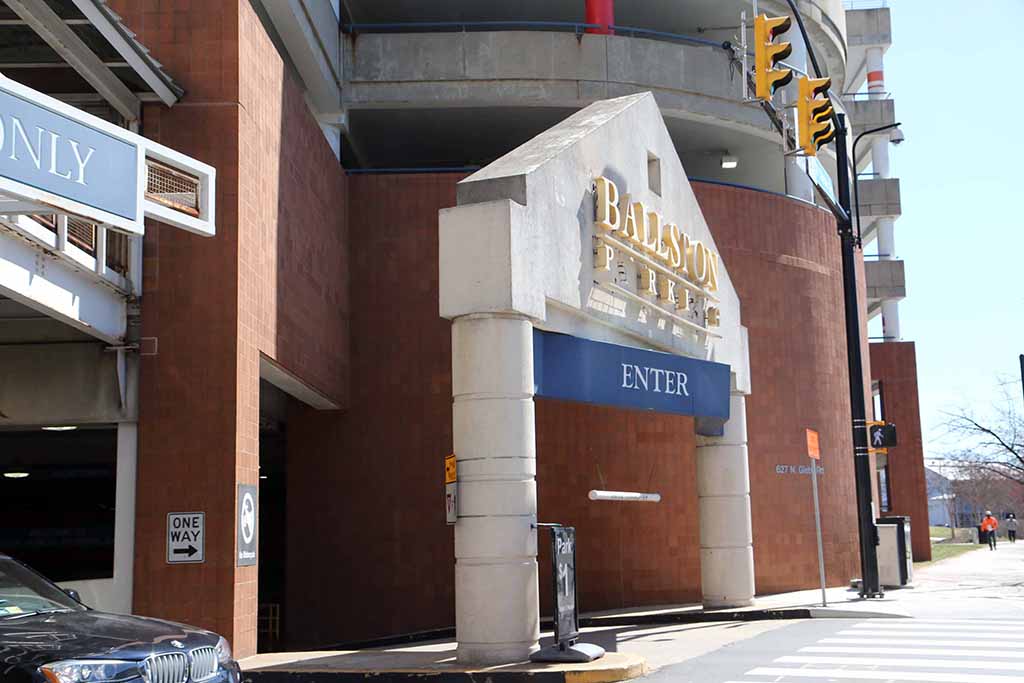
Arlington officials could soon approve additional rollbacks to the number of parking spaces required for new apartment developments along the Rosslyn-Ballston corridor.

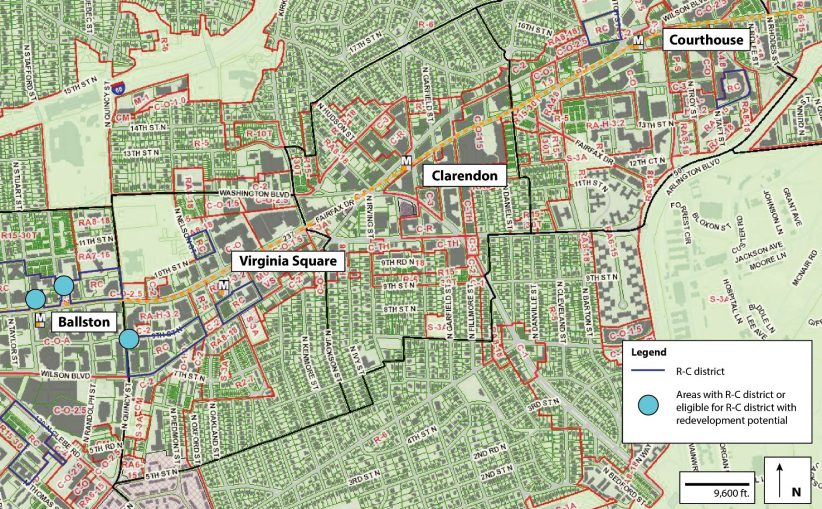
Right now, the County Board is barred from allowing new developments along certain sections of the corridor if they don’t have at least one parking space for every unit planned for the new building. The Board is now considering removing that restriction, which would specifically impact properties zoned as “R-C” districts.

About 105 properties are currently zoned “R-C,” according to a staff report prepared for the County Board, and they’re generally located around the Ballston, Virginia Square and Courthouse Metro stations.

The Board approved similar reductions to parking minimums for apartment developments along the R-B corridor and in Crystal City and Pentagon City in fall 2017, in a bid to increase walkable and transit-accessible development, and staff suggested that this change would be a logical next step for the county.

“In general, the proposed amendment could potentially facilitate multifamily residential projects in the future and that the amendment would provide the County Board the same flexibility it has when considering modifications to minimum parking ratios in other Commercial/Mixed Use Districts on a case-by-case basis,” staff wrote in the report.

Those 2017 changes generally targeted properties in the immediate vicinity of Metro stations, and the newly targeted “R-C” districts are slightly different.

Staff describes the zones as a “transitional mixed-use zone between higher-density mixed-use areas and lower-density residential areas,” and the county’s zoning map shows that the affected properties tend to sit a block or two away from major arterial roads like Wilson Blvd or Fairfax Drive.

Allowing the Board to approve similarly reduced parking minimums on those areas as well would provide “consistency” with those previous changes, staff argue.

Officials have already relied on the tweaked parking requirements to allow smaller parking garages at developments around popular Metro stations on the R-B corridor. Other cities have even taken the more drastic step of banning parking minimums entirely.

The Board will consider this proposal for the first time at its meeting Saturday (March 16). Members are scheduled to set a Planning Commission hearing on the matter for April 8, then hold a public hearing and vote on April 23.


This Saturday, the County Board is set to vote on long-awaited zoning changes “to eliminate perceived and actual barriers to child care” in Arlington.

The bundle of zoning ordinance amendments the Board is poised to approve aim to add more childcare centers to the county and ultimately make the service more affordable. It’s the latest component of a discussion that’s lasted years on how the county can help parents struggling to afford rising childcare costs.

One of the zoning amendments up for a vote Saturday would end the requirement that small family daycare homes need to apply for extensive county approval if they cared for up to nine children. Family day care centers with nine or fewer children could thus be approved “by right,” whereas now the cap is five kids.

The maximum number of children these smaller facilities could care for would also be lifted to 12 from nine, but the new “by right” exception would only apply to facilities caring for nine or fewer kids.

Another amendment would reduce parking requirements in light of findings that indicated current lot requirements were too costly for new businesses and that many staff and parents travelled by public transportation. The amendment would change the requirement from one parking space per daycare employee to one space per eight children cared for by the center.

A proposed amendment also noted that, “based on community input and feedback, Arlington’s child care providers perceive the existing development review process as a significant barrier.” Now officials are proposing to reduce the permit reviews from three to two reviews in order to “streamline” the process and “provide more certainty to child care providers.”

The vote has been delayed several times: Board members originally aimed to pass the changes before the end of 2018. In the summer, members approved a “Childcare Action Plan” to grant parents daycare subsidies.

The zoning changes have been in the works for months, and were approved by the Planning Commission’s Zoning Committee in January. If the Board passes the bills, the zoning changes will go into effect July 1.

“We’ve come a far way, but we’ve got a long way to go,” said Board member Libby Garvey at the time.

Childcare services in Arlington are among the country’s most expensive, costing an average of $21,000 a year per child, according to estimates from the Economic Policy Institute.

But Board Chair Christian Dorsey noted in July that multiple kids means Arlington’s families pay an average of $42,705 per year for daycare $2,000 higher than D.C. and a number that left Dorsey “gobsmacked.”

“I can’t imagine our rents are higher than they are in D.C.,” he said. “The District has just as much supply-demand pressure, yet we’re more expensive… I’m not interested in Arlington exceptionalism when it comes to this.”

In addition to voting on the childcare zoning bills, the Board is also scheduled to discuss a proposal to increase legal aid funding for the county’s undocumented residents and a controversial subsidy package for Amazon.


Bicyclists in Potomac Yard and Crystal City might’ve noticed some funky new protected bike lanes around town — but some of them won’t be sticking around for long.

The lanes popped up this week to coincide with the “National Bike Summit,” a gathering of cycling activists held at the Hyatt Regency Crystal City.

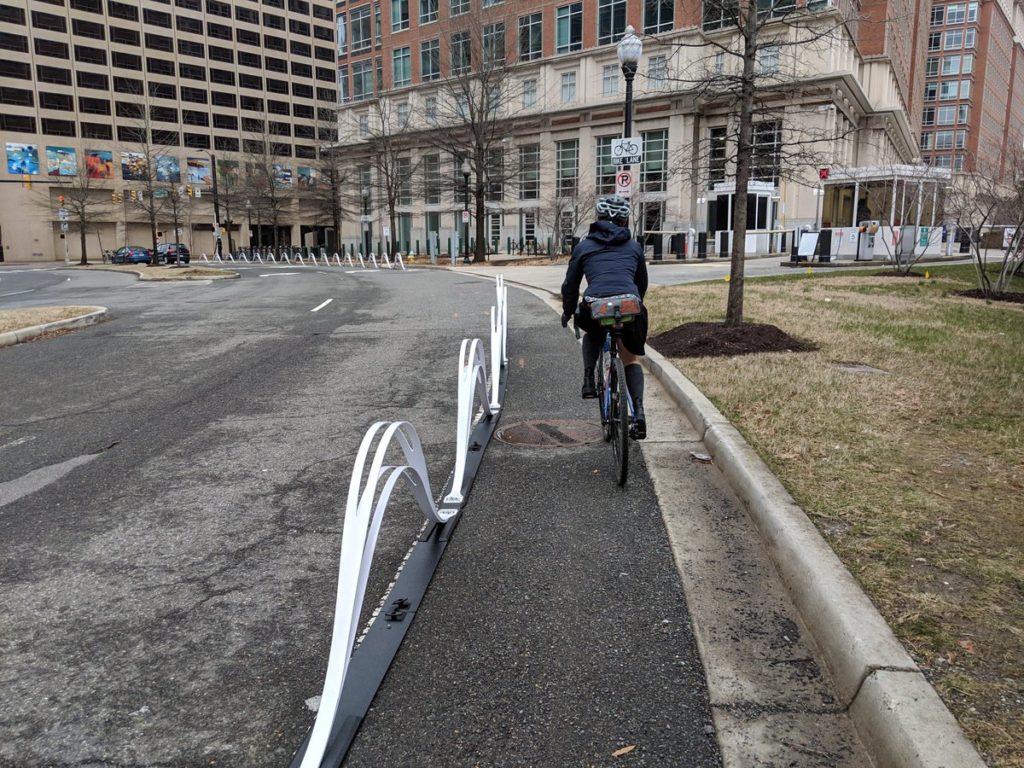
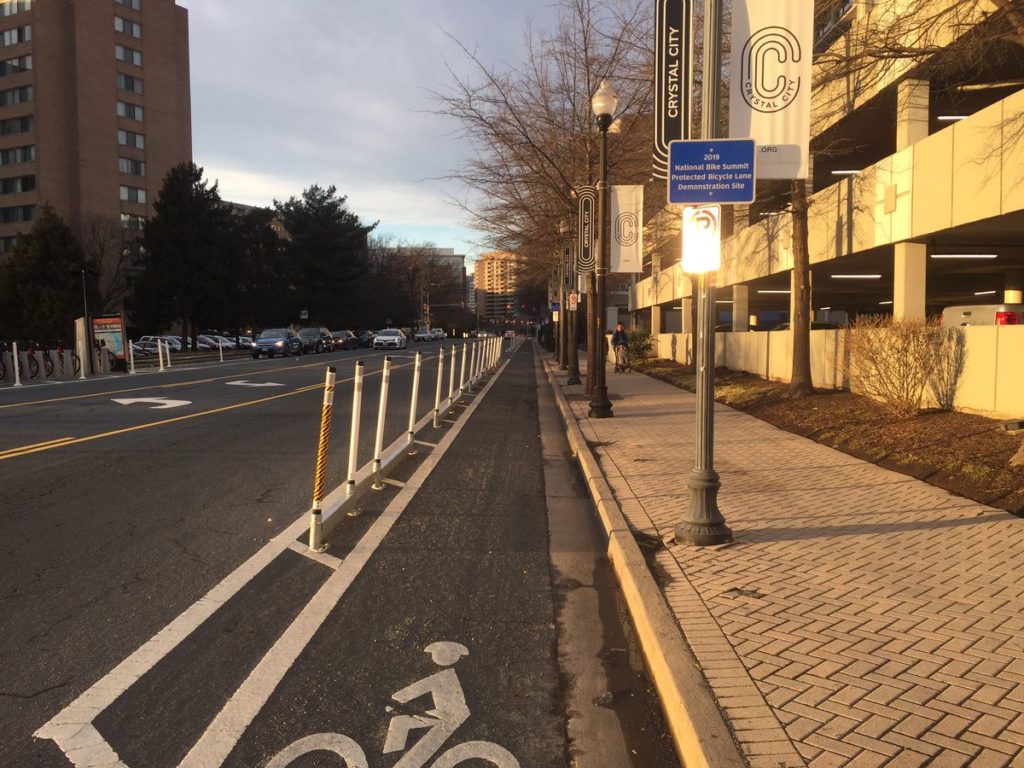
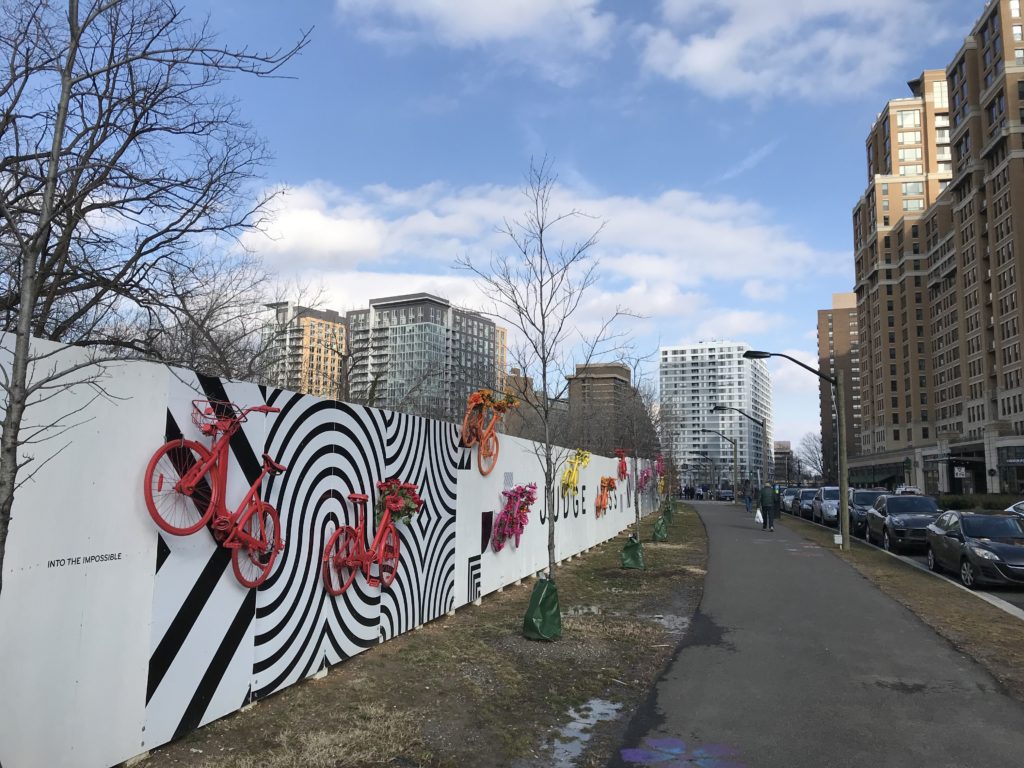
Some of the protected lanes are located along S. Eads Street in Crystal City, near the road’s intersection with 22nd Street S. They’re part of the “BikeRail” product backed by Minneapolis-based firm Dero, and are a bit sturdier than the plastic poles the county has installed along other protected bike lanes.

The Crystal City Business Improvement District says Dero donated the BikeRails for pilot program purposes, and county staff installed them this week. They may not stay in their current locations, but the county plans to keep them a little longer, at least.

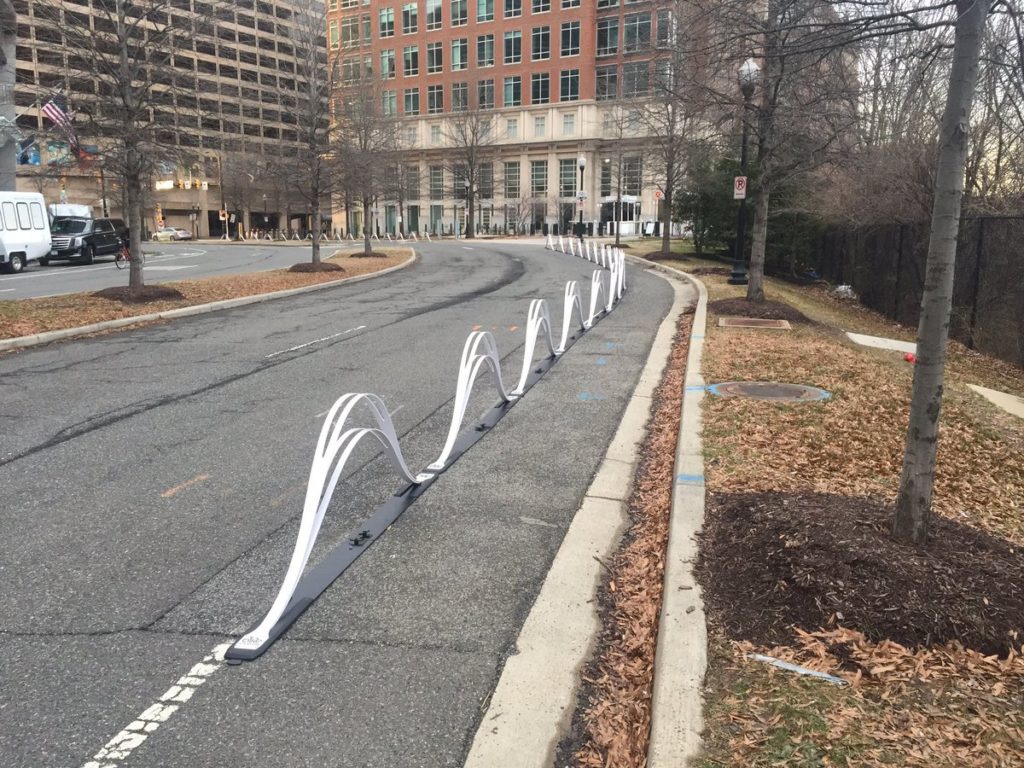
Another bike company sponsoring the conference, Bike Fixation, donated some even more unusual looking lanes for cyclists to try out.

https://twitter.com/JuddLumberjack/status/1104882364407341056

The county set up the wave-shaped barriers along a stretch of S. Potomac Avenue in Potomac Yard, leading up to where the bike conference was held.

Those, however, are merely temporary, according to the League of American Bicyclists (which sponsored the conference). They could be gone as soon as sometime this week.

Photo 1 via @mttrgrs, photos 2 and 3 via @juddlumberjack


Drivers along a busy stretch of road in Pentagon City could soon need to slow down a bit.

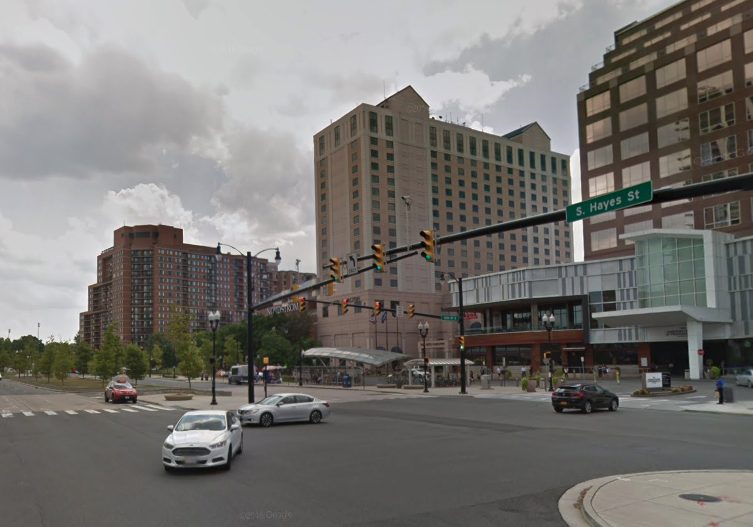
County officials are proposing changing the speed limit along S. Hayes Street as the road runs between Army Navy Drive and 15th Street S. It currently has posted speed limits of 35 and 30 miles per hour along different stretches of the road, but the county could bump that down to 25 miles per hour.

The Crystal City Business Improvement District requested a study of the speed limit along that section of the street, which runs past major developments, including the Fashion Centre at Pentagon City and Pentagon Centre, as well as the neighborhood’s Metro station.

Staff wrote in a report for the County Board that the “high volumes of pedestrian crossings and higher density land development” in the area justify bumping down the speed a bit.

Similarly, staff noted that an examination of the last four years worth of crash data for the area suggest that a lower speed might be beneficial for the area.

If the Board approves the change, the county will spend $1,500 to install signs advertising the newly revised speed limit along the road.

The Board is set to consider the issue for the first time at its meeting Saturday (March 16), where members are scheduled to set a public hearing on the matter for April 23. The Board could then approve the change immediately afterward.

Photo via Google Maps


Free Amazon Mugs at Northside Social — Amazon is partnering with Northside Social to give out free branded to-go tumblers this morning. [Instagram]

Kojo Explores the Amazon Effect — “We’ll look back on Seattle’s history with Amazon and discuss how our local governments can navigate their relationship with the company. Plus, we’ll hear from a policy researcher on how the DMV’s housing market will shift over the next two decades as Amazon gets settled in the region.” [Kojo Nnamdi Show]

Amazon’s Tech Effect — “Within the [D.C.] area’s tech industry – the sector likely to be most affected by the [Amazon] news – leaders are either keeping mum about their reaction or publicly expressing excitement. But behind the scenes, experts say, there is a fair amount of apprehension.” [U.S. News]

Metro to Subsidize Late Night Uber Rides? — “With Metro hours due to remain limited for the foreseeable future, Metro plans to pay cabs or a company like Uber or Lyft $1 million to slightly discount trips for certain people rather than provide alternative bus or other service.” [WTOP, WMATA]

737 Max Grounded at DCA — “For people flying in and out of the Reagan National Airport, Wednesday’s grounding of all 737 MAX 8 and MAX 9 jets brought mixed reactions. Some flights were cancelled. Others were already in the air when the emergency order came down, and were grounded the moment they touched down.” [WJLA, NBC 4]

‘Poo’ at Wakefield High School — Arlington Public Schools has been slow to fix a direction sign at Wakefield High School that is missing the “L” in “pool.” [Sun Gazette]

Photo courtesy Dennis Dimick


View More Stories