Progressive Voice is a weekly opinion column. The views and opinions expressed in the column are those of the individual authors and do not necessarily reflect the views of their organizations or ARLnow.com.

 The 2020 Census is probably not anybody’s idea of a sexy topic. But ensuring an accurate 2020 Census count is vital to both getting the number of congressional seats a state deserves and to the day to day effective functioning of government.

As we currently sit, the upcoming 2020 Census is going to be a disaster.

The 2020 Census brings with is a technological redesign that relies on “many new and modified IT systems.” These changes include encouraging respondents to use the Internet and telephone instead of a paper survey, relying more heavily on local data, and using field technology to minimize data and increase productivity.

While these technological advances should make the census more cost efficient and accurate in the long run, the proprietary designs of the technology have been costly with well documented difficulties in implementation. This is in addition to the leadership vacuum created when former Census Director John H. Thompson resigned in the summer of 2017. The Trump administration has not yet appointed anyone to fill the position.

Beyond the institutional challenges are the societal concerns that could depress responses to a census questionnaire: cybersecurity threats, the climate of fear among immigrant communities regardless of their documented status and the growing digital divide between urban and rural areas and between wealthy and poor communities.

Why does this all matter?

First the Constitution requires a census every 10 years and declares it the official number for state populations in determining congressional representation. If the census undercounts individuals, a state could get less representation than it is entitled to.

The census has historically undercounted low-income households and households where English is not the first language. While Arlington is a largely affluent jurisdiction, an estimated 9 percent of Arlingtonians live in poverty. Moreover, a language other than English is spoken in nearly 30 percent of Arlington households.

Second, the federal government often relies on census data in allocating funding to state and local governments. More than 130 federal programs rely on census data to distribute funding to the states, including Medical Assistance, Supplemental Nutrition Assistance Programs (SNAP or food stamps), Highway Planning and Construction, Special Education grants and Head Start. In 2015, the Commonwealth of Virginia received more than $10.2 billion from census-guided federal grant programs, which was approximately 20 percent of the state budget that year.

With the rapid population growth in Arlington and Northern Virginia over the past decade, an inaccurate census could lead to lower revenue to the Commonwealth to implement crucial programs.

What can we do?

First, we need to urge Congress to fully fund the 2020 Census. Last fall, Secretary of Commerce Wilbur Ross requested the Census Bureau’s budget be increased by $187 million in FY 2018 to address some of the technological needs; however, that request did not include additional funding for the Integrated Partnership and Communications program that is crucial in addressing factors that may depress the census response rate.

(more…)


Peter’s Take is a weekly opinion column. The views and opinions expressed in this column are those of the author and do not necessarily reflect the views of ARLnow.com.

On February 22, Arlington County Manager Mark Schwartz presented his proposed FY 2019 Annual Operating Budget. It’s balanced at the current real estate tax rate.

Some aspects of the manager’s budget are commendable, particularly the short-term focus on core services, coupled with many sensible cuts, to close a $20.5 million budget gap.

Other aspects are troubling, exposing a lack of long-term financial planning relating to many of the same core services.

Commendable

The manager’s budget appropriately focuses on several core service areas, including:

  • increasing public safety personnel salaries and benefits to remain competitive in recruitment and retention
  • Metro
  • Arlington Public Schools (APS)

The manager notes his proposed budget “includes the first installment of a multi-year plan to gradually reduce the workweek for firefighters.”

The manager observes that his budget meets the Metro request “for a 3 percent increase in operating funding, while relying on a comprehensive solution (among Virginia, Maryland, and the District) to meet our capital obligations.”

His budget “meets the commitment to Arlington Public Schools articulated as part of the Revenue Sharing Principles (local taxes split with 53.4 percent to the County and 46.6 percent to APS) and provides an additional $13.4 million in ongoing funding compared to FY 2018.”

Troubling

Both the manager and the APS superintendent dance around the operating budget implications of APS’ projected enrollment growth. That’s troubling. This is an example–but only one example–of both the manager and the superintendent failing appropriately to engage the community regarding many important long-term financial issues at stake.

The manager states: “increasing taxes each year to meet school enrollment needs is not sustainable.” He’s right, but he fails to provide the community with a quantitative explanation why increasing taxes each year to meet school enrollment needs is not fiscally sustainable.

Moreover, he has not provided the community with a manageable number of alternative options that are fiscally sustainable. Finally, the manager should explain why continuously increasing APS’ current 46.6 percent share of local tax revenues is not sustainable.

Meanwhile, the superintendent says that because APS is on pace to grow to 30,000 students by 2021, “we’ve got to begin to think about a sustainable future.” He also fails to provide the community with a manageable number of alternative quantitative options that achieve a fiscally sustainable future.

The time merely “to begin to think” about these financial issues is over. The time to think about these financial issues extensively, involving the community at every stage of the process, is now!

An over-simplified example is illustrative. The superintendent’s proposed operating budget assumes per-pupil expenditures of $19,235. APS’ latest enrollment projections show enrollment growing from 28,020 in 2017 to 32,666 by 2027. If that projected enrollment growth of 4,646 students is multiplied by the assumed per-pupil expenditures, that would add $89,365,810 of expenditures into the operating budget by 2027 solely to support the increase in enrollment.

Conclusion

It is highly unlikely that County tax revenues will rise sufficiently by 2027 to cover an $89,365,810 increase in spending solely to support an increase in current APS enrollment. What are the major alternative options available to address such a projected budget gap, and which ones command the greatest community support?

The County Board and School Board should collaborate quickly to present the major alternative financial options to the community, inviting the community to say which options the community prefers.


It’s a question that some have been asking themselves as Arlington has advanced to be among the most likely destinations for Amazon’s second headquarters.

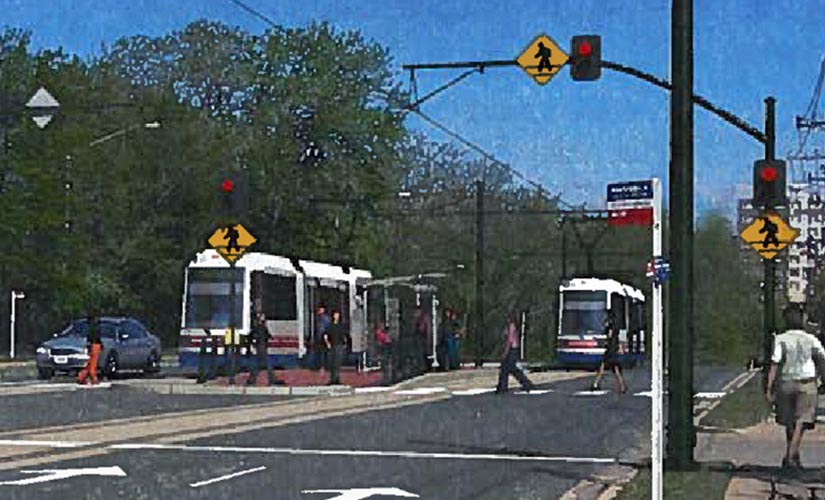
Would the proposed Columbia Pike and Crystal City streetcar system have helped Arlington’s chances had it been built?

The Arlington County Board voted to cancel the project in 2014 after rising cost estimates and questions about its advantages over buses led to widespread opposition and voter discontent.

Had it been built, the streetcar would have run from Crystal City — which is seen as a strong contender among D.C. area locales — to Columbia Pike and the Skyline area of Fairfax County.

ARLnow.com talked to several insiders to get their take on the hypothetical question.

Several we spoke to, who work in economic development and on transportation issues, said that the streetcar would have been an attractive amenity in the eyes of Amazon. It would have provided a vital, high-frequency link from offices in Crystal City to workforce housing along Columbia Pike, they said.

Also cited as evidence: Amazon’s own support of streetcar system in Seattle.

However, another insider, who works in the works in the commercial real estate industry, doubts that the streetcar would have made much of a difference.

For one, the would-be streetcar is being replaced with enhanced bus service on the Pike and along the Potomac Yard-Crystal City corridor. Also, Crystal City already has one of the highest scores for transportation accessibility among HQ2 contenders, thanks to the frequent bus service, Metro’s Yellow and Blue lines, VRE, commuter buses, the Mt. Vernon Trail and walkability to Reagan National Airport.

In other words, said the insider, the streetcar might have been icing on the cake, but it is unlikely to have moved the needle much on Amazon’s decision. Plus, it is possible that Arlington would have had to contend with some of the streetcar problems currently being experienced by D.C.

Amazon is expected to make its decision later this year. Arlington and Northern Virginia, one insider speculated, is likely to at least be among the top five contenders, and at least one betting market agrees, giving the region the highest odds among the company’s top 20.


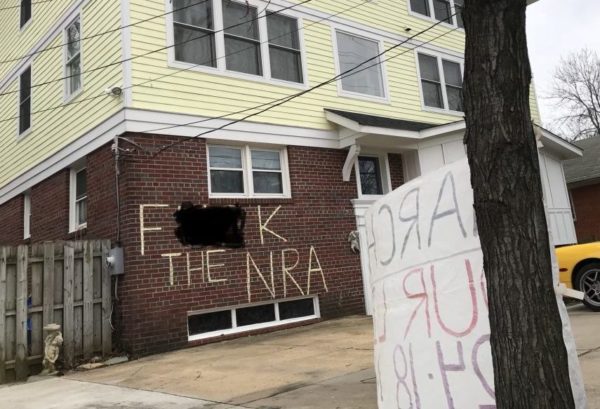
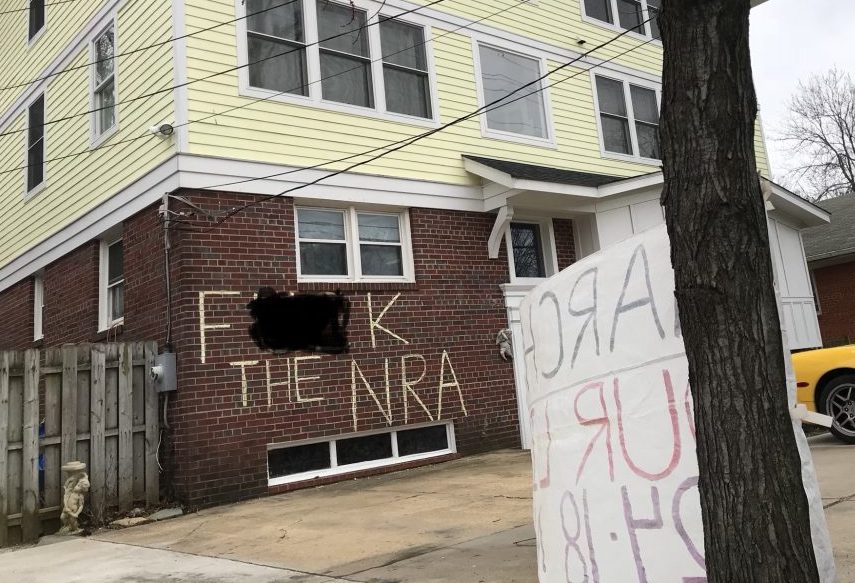
Opinions seem to be divided about the house in Arlington’s Highland Park neighborhood with the chalk message declaring “F–k the NRA.”

On one hand, many people — even those who are not fans of the National Rifle Association and pro-gun policies — object to writing a large profanity on the front of a house along a busy road. There are children in the neighborhood who walk by this house, those who object to it say.

On the other hand, the resident who wrote the message is exercising his or her right to free speech and addressing an important topic. When guns are being used to kill children in schools, supporters say, the “F-word” should be the least of people’s concerns.

What do you think?


With Saturday’s County Board meeting over, let’s take a look back at the biggest stories on ARLnow over the past week.

  1. Exclusive: Amazon Employees Are Very Interested in a Particular Article About Arlington
  2. Hospitalized Yorktown High School Student Has Died
  3. Arlington County Police Searching for Missing Teen
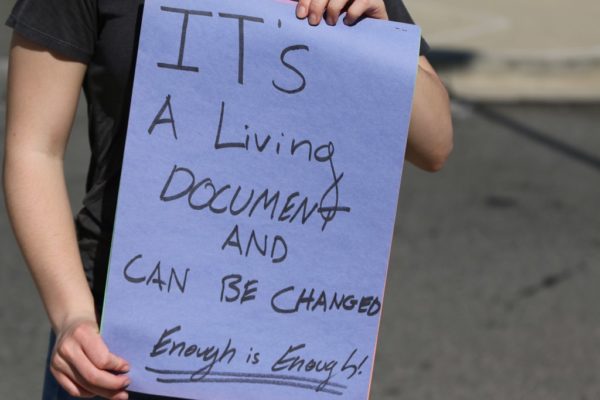
  4. Students Stage Walkouts At Arlington High Schools
  5. County Wins Top Environmental Award from U.S. Green Building Council (published Dec. 2017)

Feel free to discuss these topics, your weekend plans or anything else that’s happening locally in the comments below. Have a great rest of your weekend!


The Right Note is a weekly opinion column. The views and opinions expressed in the column are those of the author and do not necessarily reflect the views of ARLnow.com.

Larry Roberts recently gave up his duties as “editor” of the Progressive Voice to take on the role of Chief of Staff for Lieutenant Governor Justin Fairfax.

In his farewell column, he made the case for why the column he headed up was needed.

Based on his words in the column, the authors who have participated, and the opinions expressed therein, it was to give a voice to those who generally embrace the direction taken by the Arlington County Board.

Since all but one of our elected officials in Arlington are Democrats, it is fair to say that those who share Mr. Roberts views are already well publicized throughout the community. Democrats not only control the outcome of all the votes, they control all of the information flow as well.

With near universal control by the Democrats, it is good for the public discourse for someone on the right to continue talking about the issues from this perspective. The 300-500 words written through the prism of fiscal conservatism in this forum each week may be the only time some in Arlington ever read that type of perspective.

While the voters have generally continued to provide big margins for Democrats at the polls since I started writing this column, they have elected an entirely new County Board. Included in that new roster is the first non-Democrat to be elected to a full term in nearly three decades. The County did withdraw from what many residents felt was a boondoggle streetcar project.

Instead of pushing for even more funding for a pool project, the County scaled it back. The County hired a new auditor, albeit one who needs some additional support to truly be effective.

These were “wins” for the taxpayer, but there are still many ways the County could improve the way it serves Arlingtonians.

Roberts’ column also caused me to look back over the past five years and scroll through roughly 250 columns or 100,000 words. Looking all the way back to my first column, I wanted to end with a reminder about how the right views local government:

What cannot stand is the notion that all, or even most, fiscal conservatives are anti-government.

In fact, we believe there is an appropriate role for each level of government. The most important of which, outside of self-government, is local government. It is where our tax dollars meet the asphalt. It is where our children attend school, our homes are kept safe, our water is dispensed, and our trash is collected. It is where we can most easily and directly petition our elected officials for assistance. And, at least theoretically, it should be the most responsive to changing community needs with the smallest amount of bureaucracy and red tape.

We just want to do it in a way that makes the most fiscal sense, is accountable, and serves people efficiently. That is why I continue to write.


Progressive Voice is a weekly opinion column. The views and opinions expressed in the column are those of the individual authors and do not necessarily reflect the views of their organizations or ARLnow.com.

By Alfonso Lopez

Last week the Virginia House of Delegates passed a bill, HB 1257, to prohibit any locality in Virginia from adopting an ordinance, procedure or policy that restricts the enforcement of federal immigration laws to less than the full extent permitted by federal law.

While that may sound reasonable to some Virginians, it ignores the complicated relationship between federal, state and local law enforcement with regard to immigration and contradicts Arlington policy. It also ignores the urgent need for immigrants to feel comfortable and confident in talking to law enforcement after a crime has occurred.

When immigrant victims and witnesses fear law enforcement, crimes go unsolved and perpetrators go free. Across Virginia, service-providers working with immigrant victims — and law enforcement investigating crimes involving immigrant victims and witnesses — report the significant obstacles this fear poses to the criminal justice system’s ability to transform crimes into convictions.

Domestic violence, sexual assault and street robberies are just a few of the types of violent crimes that routinely go unreported and unsolved. This public safety crisis needs to be addressed to keep criminals from taking advantage of the fear that is running rampant in Virginia’s immigrant communities.

Current policy in Arlington prevents victims and witnesses of crimes from being asked about their immigration status when speaking with the police, unless that information is directly relevant to the crime being investigated. This policy was put into place to keep Arlington law enforcement from having to shoulder the burden of federal immigration laws.

Arlington’s policy is also particularly designed to strengthen community policing — a style of policing that establishes a familiar, on-the-ground presence for law enforcement among residents — by ensuring that residents who are concerned about their immigration status are not afraid to report criminals and assist prosecutors in investigating criminal activity.

Furthermore, consistent with an advisory opinion released in January 2015 by Virginia Attorney General Mark Herring, the Arlington County Sheriff’s Office is not required to hold an individual in custody past his release date based solely on a request to detain him by U.S. Immigration and Customs Enforcement (ICE).

These non-mandatory requests neither impose a legal obligation nor provide the necessary legal authority to detain individuals past their release date, and must be accompanied by a court-issued warrant to be honored and avoid raising constitutional concerns.

Above all, each of these policies make our community safer by encouraging a free flow of communication between undocumented immigrants and law enforcement, and neither policy runs contrary to federal law.

HB 1257, however, could prohibit common-sense public safety policies like ours and replace them with a requirement that Arlington participate in ICE’s 287(g) program, which would effectively deputize our local police to act as enforcement for federal immigration law.

(more…)


Peter’s Take is a weekly opinion column. The views and opinions expressed in this column are those of the author and do not necessarily reflect the views of ARLnow.com.

Virginia Medicaid expansion is the top 2018 legislative priority for Virginia Democrats. Since Democrats lack a majority in both legislative branches, they must make a deal with Virginia Republicans to expand Medicaid.

Discussion

Prospects for such a deal have improved significantly in the House of Delegates (HOD). But, the Senate budget bill is disappointing.

Last Thursday, Delegate Terry Kilgore (R-Scott), chairman of the HOD Commerce and Labor Committee:

“said his struggling coal-country district would get the ‘hand up’ it desperately needs if more uninsured Virginians were made eligible for the federal-state health-care program.”

Kilgore also suggested other HOD Republicans are ready to join him:

“‘I’m not that far out on a limb. We have to step up, we can’t be the party of ‘no,”said Kilgore. He said at least 15 Republican House delegates will likely vote with him on the issue.”

Virginia Democratic Governor Ralph Northam welcomed Kilgore’s announcement:

Governor Northam thanks Delegate Kilgore for sharing his ideas about how to expand health coverage for Virginians who need it… He is encouraged by discussions with members of both parties on this important issue and believes we can reach an agreement that works for everyone.”

This past Sunday, the firewall against Medicaid expansion fell further in the HOD under a budget plan

“that would accept $3.2 billion in federal money to pay for 90 percent of the cost of expanding the program on Jan. 1, 2019 [to 300,000 Virginians], while relying on a new ‘provider assessment’ on hospital revenues to cover the state’s share of the cost of health coverage for currently uninsured Virginians whose care is uncompensated.”

It’s useful to review the conditions and limitations which some HOD Republicans now are advancing as the price of their support for Medicaid expansion:

“Kilgore said work requirements like those the Trump administration has allowed Kentucky to impose, coupled with a mandate that recipients contribute a ‘small co-pay,’ would make for ‘a conservative approach’ to expansion.”

Would most Democrats prefer no work requirements–even for “able-bodied adults”? Absolutely. But, if Democrats rigidly insist on what I agree is a much more humane approach, the most likely outcome is no Medicaid expansion at all.

Democrats will have to choose between an unattainable (in this legislature, this year) ideal, or a significant increase in the numbers of low income Virginians who get health insurance. We should put people’s needs first.

The HOD budget proposal on Medicaid expansion sets up a potential showdown with the Virginia Senate. It’s Finance Committee has said “it will not include full Medicaid expansion in the budget.”

This Finance Committee proposal would extend coverage to an additional 20,000 low-income people with mental illness, addiction or chronic disease–compared to the 300,000 who would be covered under the HOD budget plan. But, the Senate proposal lacks any financing mechanism.

Conclusion

Democrats’ long-term goal must continue to be full Medicaid expansion. But overriding that goal, we must help people who are dying, or who are much sicker than they need to be because of untreated illnesses.

Even with its significant flaws, the HOD budget bill represents the high-water mark for Medicaid expansion in this legislative session. Democrats should now focus on a legislative strategy to convince key Republican state senators to adopt the approach of HOD Republicans who support Medicaid expansion.


The following Letter to the Editor was submitted by Mac McCreery, David Peete, Tom Prewitt, Robin Stombler and Jeff Zeeman. McCreery, Peete, Prewitt and Zeeman are all members of the Arts District Committee. Stombler serves as Chair of the Committee.

We didn’t always agree at first. As representatives of business, arts, industry, and community interests, we were bound to have divergent ideas, but we came together as members of the Arts District Committee, a component of the Four Mile Run Valley Initiative Working Group. Let us share with you what we found.

Arlington already has a burgeoning arts district. Along South Four Mile Run Drive, between South Nelson Street and Walter Reed Drive, there is an 85-seat black box theater, studios for dance classes and recitals, gallery space, a costume and property shop for a Tony-award winning regional theater, and a private recording studio where the country’s most widely recognized and acclaimed bands lay down tracks. Over 30 arts-related organizations already call this area home, including multi-ethnic heritage arts groups.

In this neighborhood, we also have the last vestiges of light industrial space in Arlington. It is a relatively affordable place for small businesses to operate, such as a new distribution brewery and multiple family owned mechanic shops that have operated through generations. We quickly determined that an arts district must embrace both the cultural arts and the industrial nature of the area. This melding of uses is important for sustainability and long-term economic viability.

For a revitalized arts and industry quarter, we define arts broadly. Imagine theaters, rehearsal halls, visual art galleries and craft spaces. But also fuse the arts with light industry to include culinary arts, metalworking, furniture making shops, and technological innovation/maker spaces. These examples are meant not to limit, but rather to highlight some of the uses envisioned. Using one scenario, the Arlington Food Assistance Center could be combined with culinary arts classes and catering and a rooftop garden could support those endeavors. The quarter should espouse innovation, creativity, skill and talent.

A sound infrastructure is necessary for this quarter to thrive. We researched and expounded on five elements: Mission, Physical, Financial, Development, and Arts Specific. Within these elements is a call to embrace the industrial roots of the area with a thriving mix of arts, culture, business and industry. We have the opportunity to expand on a unique area of Arlington, leverage existing institutions and buildings, and stop the cookie cutter development from settling in. While this area already provides value with its arts and industrial uses, our report outlines how it can offer so much more as a branded, place-making center for Arlington.

Unanimous in our support for the recommendations in our Committee report on an arts and industry quarter, we find that working in collaboration – business, arts and community – we have a strong opportunity ahead of us.

ARLnow.com occasionally publishes thoughtful letters to the editor about issues of local interest. To submit a letter to the editor for consideration, please email it to [email protected]. Letters may be edited for content and brevity.


Before we head off into President’s Day — or, as we call it here in Virginia, George Washington Day — weekend, let’s take a look back at the biggest stories on ARLnow in recent days.

  1. Arlington County Firefighter Arrested on Drug Charges at Fire Station
  2. Developing: Police Investigating Fall from Clarendon Building
  3. County Wins Top Environmental Award from U.S. Green Building Council (published 12/20/17)
  4. Arlington’s Sunniva Goes to ‘Shark Tank,’ Walks Away Without a Deal
  5. Taylor Elementary School Pleads Guilty to Marijuana Possession

Feel free to discuss these topics, your weekend plans or anything else that’s happening locally in the comments below.

We’ll resume our regular publication schedule on Tuesday, barring any breaking news. Have a great weekend!


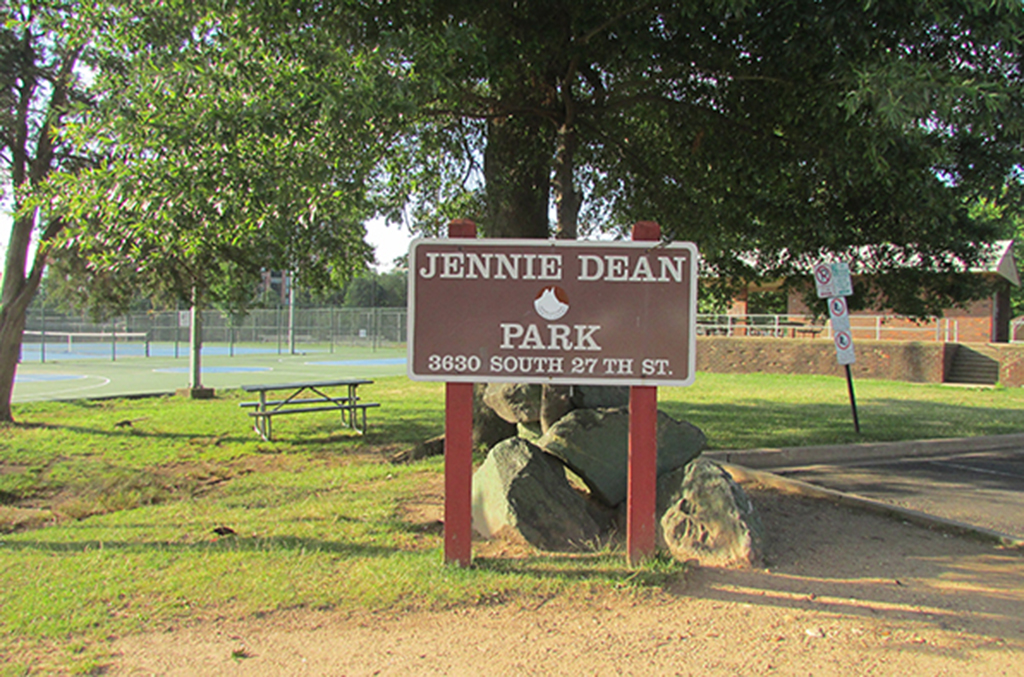
The following Letter to the Editor was submitted by Edith Wilson, president of the Shirlington Civic Association and a member of the Four Mile Run Valley Working Group, regarding plans for Jennie Dean Park.

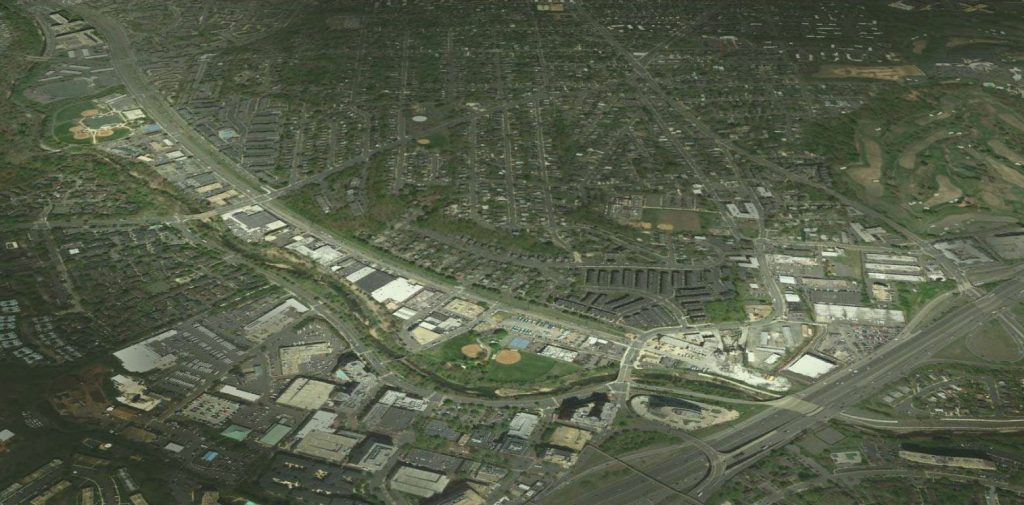
On February 6, the Parks & Recreation Department provided the Four Mile Run Valley (4MRV) Working Group with the staff policy framework for Jennie Dean Park over the next 20 years. Here’s a different view of the situation faced by decision-makers.

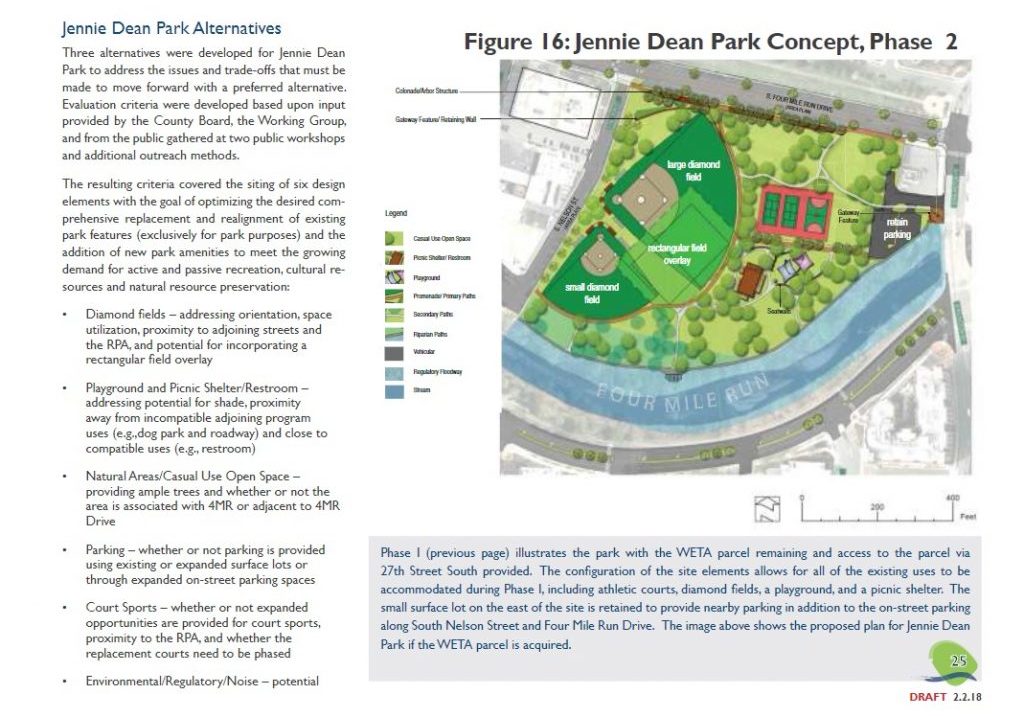
This park concept is vastly improved over initial proposals, reflecting many compromises where there is no perfect solution, Markedly responsive to a wide range of sharply competing interests and community input, it does right by the environment by respecting the flood plain and resource conservation area (RPA) and planting many more trees. It increases total recreation facilities by creating a new rectangular field where soccer and other casual sports can be played. A brand new playground would be located in the center of the park amid greenery and away from noisy trucks and buses from County facilities and the cement plant. It leaves the majority of new parkland along S. Four Mile Run Drive for landscaping and open space.

There is a lot of history to our valley, but part of that history is the new elements too. Take us for example. Over the last 40 years, residential multi-unit housing was built along the south side of the stream from the Village westward to S. Walter Reed Drive. Twenty years ago Arlington County worked hard to create the Village of Shirlington, a landmark mixed-use urban village with a population that celebrates its diversity. The Shirlington neighborhood now has over 2,200 households with tens of thousands of regular visitors to its business areas. How can this work, though, since there is no park, playground, not even a school or church with open space, in this area? What was the County thinking?

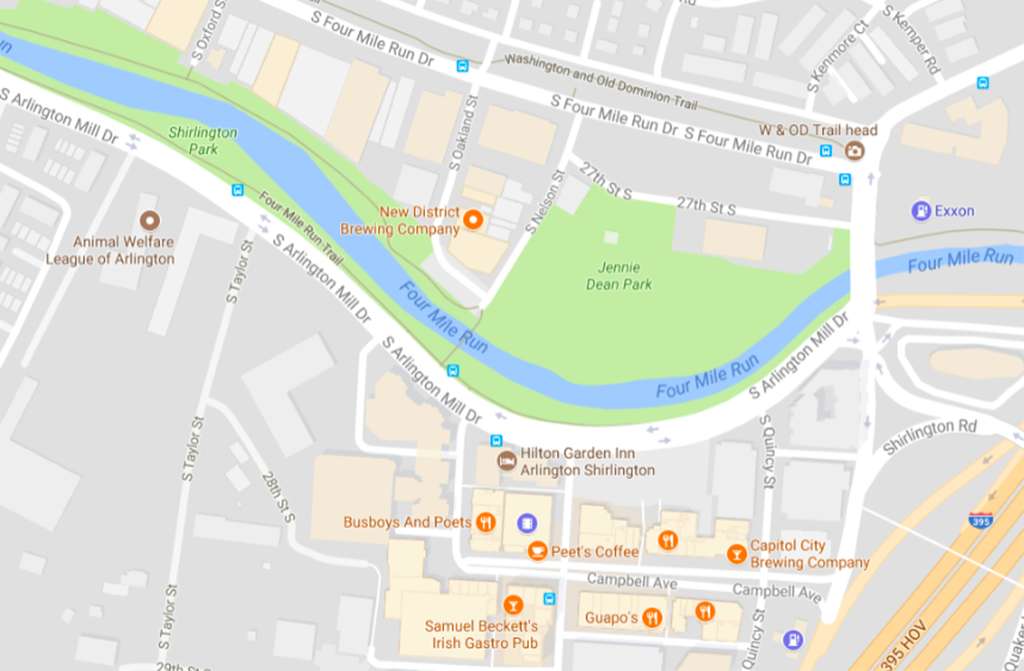
The answer is that literally across the street, though not within the boundaries of the Shirlington neighborhood, are the parks our community depends on: the long landscaped strip along S. Arlington Mill Drive, the dog park, and Jennie Dean Park. Arlington residents from all over come here with their families and pets. Shirlington residents are out there every single day, often several times.

What makes the valley between Shirlington and Nauck special is our beautiful section of Four Mile Run stream. This is presided over by Marvin, the elegant Great Blue heron who lives on a small rocky island in the lower stream, a stretch few visit because it is blocked by a large softball field fence. The Great Blue heron is the largest of all the North America herons, If you are lucky, you can see Marvin gliding down the center of the stream at dusk, dipping like a trick pilot under the pedestrian bridge. There are raccoons, turtles, ducks, geese, snakes, fish and lots of other birds too. Providing public access to the stream and wildlife such as this was the guiding principle of the enormously successful 20-year-old stream restoration project from Shirlington Road eastward to the Potomac River. Now it’s time to extend that principle westward.

This area has a high risk of flooding. – why do you think WETA needs to leave its old production center in the middle of the park? Environmental rules and common sense mandate addressing these conditions but the current softball field location stands in the way. The proposal shifts this field away from the stream, leaving a large open space for many more water-absorbing trees, traditional picnic areas, a nature overlook and a riparian pathway. Moving this field, in turn, also creates space for a new rectangular playing field lying across the back of two slightly repositioned diamond fields. Again, two-thirds of the frontage along Four Mile Run Drive would still be turned into casual space with landscaping and room for an impressive park entrance.

As Arlington’s population and density increases, demand for park and recreation space is shooting up. No one neighborhood owns any of these parks, not even those of us close by. Let’s absolutely respect and honor the important history of this particular neighborhood – including the baseball and softball leagues that have been played here for decades — but let’s focus on the future we need to build together. Let’s share.

ARLnow.com occasionally publishes thoughtful letters to the editor about issues of local interest. To submit a letter to the editor for consideration, please email it to [email protected]. Letters may be edited for content and brevity.


View More Stories