With leaves falling along with autumn temperatures, Master Gardeners of Northern Virginia is pleading with local property owners not to rake and remove all their leaves from yards.

“There are many ways you can use them rather than sending them to the landfill,” said Claudia Gerwin, who on Oct. 3 led an online program for Virginia Cooperative Extension’s Arlington-Alexandria office.

Gerwin trained as Master Gardener in 2012 and currently serves as cochair of the organization’s public-education committee.

Leaves release valuable nutrients as they decompose, improving soil quality, Gerwin said, offering a number of opportunities:

  • Spreading a layer of leaves about 3 to 4 inches deep around trees — though not immediately adjacent to the trunk — will offer winter shelter for insects and animals while providing moisture for the trees themselves
  • At-home composting provides a carbon- and nitrogen-rich result that can be used to dress gardens and lawns

Gerwin said those who take the outlined steps are not just benefiting themselves. “Your yard plays an important role in the ecosystem,” she noted.

There were some concerns raised during the program about composting and leaf-leaving resulting in a proliferation of snakes and rodents, but generally that was not a problem, several said.

“They have their own [shelter] system already in place,” said Ginny McNair, one of the participants.

Virginia Cooperative Extension is a joint effort of Virginia Tech and Virginia State University. The Arlington office is located at the Fairlington Community Center, and speakers on a wide array of topics are available for presentations to community organizations.

The local Master Gardeners Help Desk is open weekdays from 9 a.m. to noon at the Fairlington Community Center, 3308 S. Stafford Street. In-person, phone and email inquiries are answered.

In addition, local residents can get answers to questions at the second annual Master Gardeners of Northern Virginia Fall Fest, slated for Saturday, Oct. 11 from 10 a.m. to 3 p.m. at Duncan Library in Alexandria.

Elaine Mills of Master Gardeners said the online Oct. 3 program was the last for the year, but 2026 will provide many more.

“Look for our class list for new programs in December,” she said.

Presentations from Master Gardener speakers are archived online. The recent “Leave the Leaves” program will be added in coming weeks, Mills said.

For those who do put some or all of their leaves out for collection, the Arlington government makes several sweeps through neighborhoods in November and December each year.

About 50,000 cubic yards of leaves are collected each year, being turned into mulch that is available to local residents without charge if picked up or with a fee if delivered.

Tree seedlings available from Dept. of Forestry

The Virginia Department of Forestry this month is offering a wide variety of trees and shrubs for purchase through its online seedling store.

Bred specifically for Virginia’s soils and climate, seedlings are grown and sold directly from the agency’s nurseries in Augusta and Sussex counties. The nurseries are financially self-supporting, and have been providing seedlings for more than a century.

Nearly 60 tree and shrub species are available this year. Additions include northern spicebush (Lindera benzoin), hackberry (Celtis occidentalis) and black gum (Nyssa sylvatica), as well as returning best sellers like eastern redbud (Cercis canadensis), pawpaw (Asimina triloba) and American hazelnut (Corylus americana).

Orders are accepted until April, but supplies are limited, and some species sell out quickly. Deliveries and pickups are scheduled for mid-February through late April.

In celebration of the 250th anniversary of the signing of the Declaration of Independence, the Department of Forestry also is offering seedlings from some of the oldest white oaks in Virginia — many being as old as the country’s founding.

A brief description and photo of the parent white oak will be shipped along with the seedlings.

The Virginia Department of Forestry has offices throughout the commonwealth. Inquiries from Arlington residents are handled from the Fairfax office.
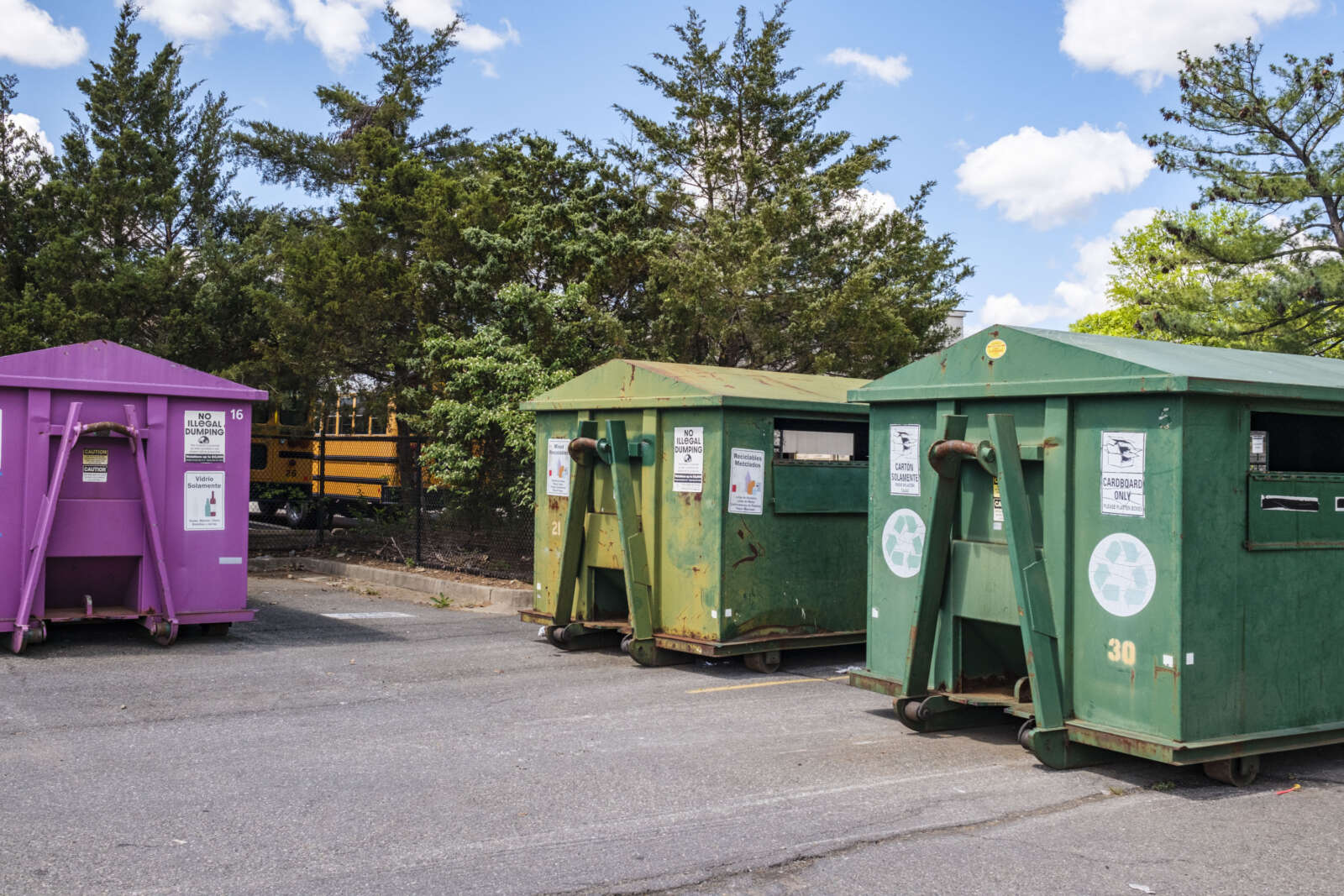
Recycling bins in Arlington County (staff photo by Jay Westcott)

Arlington’s recycling rate is trending up — but there is still a ways to go to reach the county’s goal of diverting nearly all trash from incinerators and landfills by 2038.

In 2021, the recycling rate, which now includes the county’s new food scrap collection program, was 52.4%, according to Solid Waste Bureau Chief Erik Grabowsky. Last year’s rate is projected to be 54%.

The county’s recycling rate has risen incrementally in the last six years, from 44.5% in 2015. But residents and the government will have to double down on food scrap collection and recycling, while reducing overall waste, over the next 15 years if the county is supposed to reach its goal of diverting 90% of trash from incineration and landfills by 2038.

Grabowsky says greater participation in the county’s food scraps collection program and improved recycling habits would get the county halfway there.

“If we do a much better job of recycling and a much better job of food scrap collection, we get into the mid-to-high 70th percentile,” he said in a February meeting. “Beyond 75%, it’s a real challenge.”

To close that 15% gap, county staff, a Solid Waste Committee and local environmentalists have several ideas, including promoting reusable dishware in Arlington Public Schools and starting collections for hard-to-recycle items.

These and other ideas could be incorporated into a forthcoming Solid Waste Management Plan to replace the current one approved in 2004. This road map, which could be ready for public engagement this summer, will guide the county’s approach to waste management and could include interim milestones to make a 90% diversion rate seem manageable: a 60% diversion rate by 2028 and 75% rate by 2033.

Solid Waste Committee Chair Carrie Thompson says she likes to think of this plan as a “Zero Waste Plan,” the most important objective of which is getting all Arlingtonians on board with producing less trash.

“We’re all in this together,” Thompson tells ARLnow. “We have to be conscientious because the county can only do so much… If we all do better about what hits the bins, then what they do is more effective.”

For instance, food scraps and compostable paper comprised 26-32% of what went into the trash last year, while recyclable paper products and glass comprised about 14-16% of trash, according to data provided to ARLnow. Since 2019, residents have been asked to recycle glass separately to improve recycling quality and save the county money.

Conversely, trash and glass make up about 14% of the recycling stream and have no value, according to an updated pamphlet from Arlington County about what should and should not be recycled.

(more…)


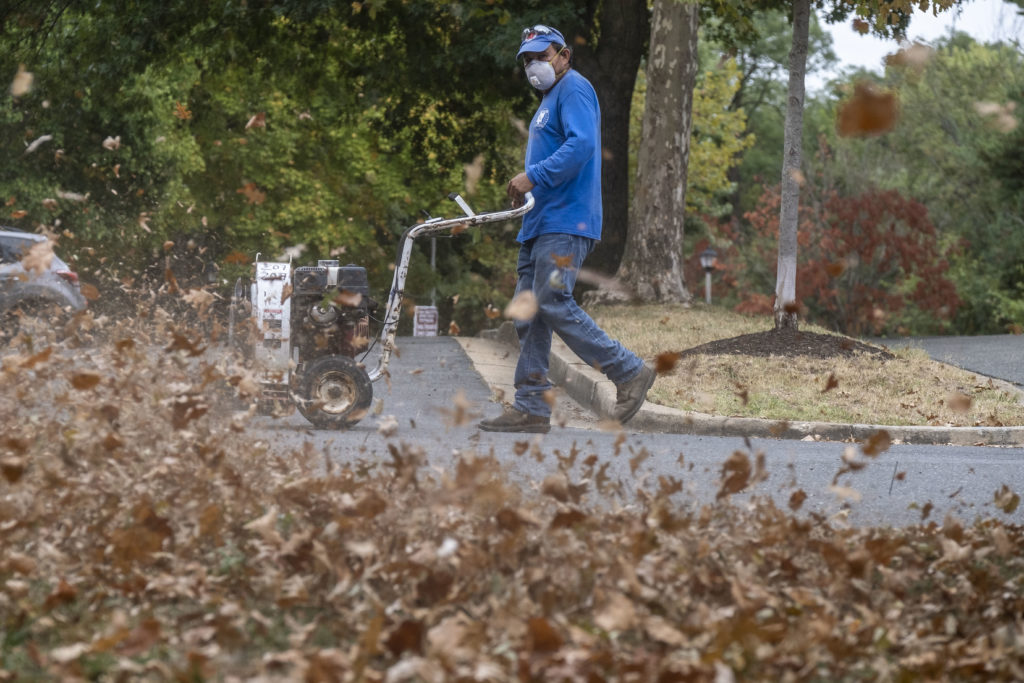
Leaf cleanup in Arlington (staff photo by Jay Westcott)

Cool fall mornings mean leaf collection season is near.

And Arlington’s Department of Environmental Services is reminding homeowners collecting their leaves and cleaning out their gardens to use only paper yard waste bags.

“Plastic ones can’t be composted and won’t be collected. If you have a landscaper, make sure they know,” spokesman Peter Golkin said. “The issue with yard waste in plastic bags is the most glaring problem for organics.”

Leaves bagged in paper can be composted along with other yard waste and food scraps, and turned into compost residents can use in their gardens.

Since September 2021, Arlington County has collected residents’ food scraps mixed in with their yard waste. Participation hovers around 40-45% of homes, and the county says participating residents diverted 27% of their food waste from the incinerator in April 2022, up from 21% in January 2022 and 15% in October 2021.

“As with any new program, there is a learning curve. Arlington is one of the first localities to collect food scraps at the curb,” Golkin said. “Food scraps collection is just over a year old but we hear from new users and even won a 2022 Achievement Award from the Virginia Association of Counties.”

He reported that there is demand for learning more about the organics collection process.

“We had a big turnout for the Rock-n-Recycle Solid Waste Bureau open house this month and got to share loads of information and compostable bags for food scraps, particularly with young families,” he said. “Same for the County Fair. More educational opportunities to come.”

The department will soon distribute a cart hanger with a rundown of what can, and can’t, be put in the cart.

Golkin has two rules of thumb: “If it grows, it goes” and “When in doubt, leave it out.”

So go ahead and put hairs from the hairbrush or fingernail clippings in the food scrap collection bin. Other bathroom trash, like used tissues, however, cannot be composted.

While a variety of products are advertised as “compostable,” residents should take care when disposing them, Golkin says.

“Products that are 100% bamboo are compostable but if you can’t tell, best to put an item in the trash,” he said. “Read disposal instructions carefully. If there are no disposal instructions, that’s probably a sign to use the garbage can.”

For example, the handles of bamboo toothbrushes are compostable but the nylon bristles are not. Meanwhile, plastic-looking compostable cups or flatware must be Biodegradable Products Institute or Compost Manufacturing Alliance certified compostable.

“Apple cores, banana peels, chicken bones and even greasy pizza boxes are easier,” Golkin said. “Toss them in the green cart.”

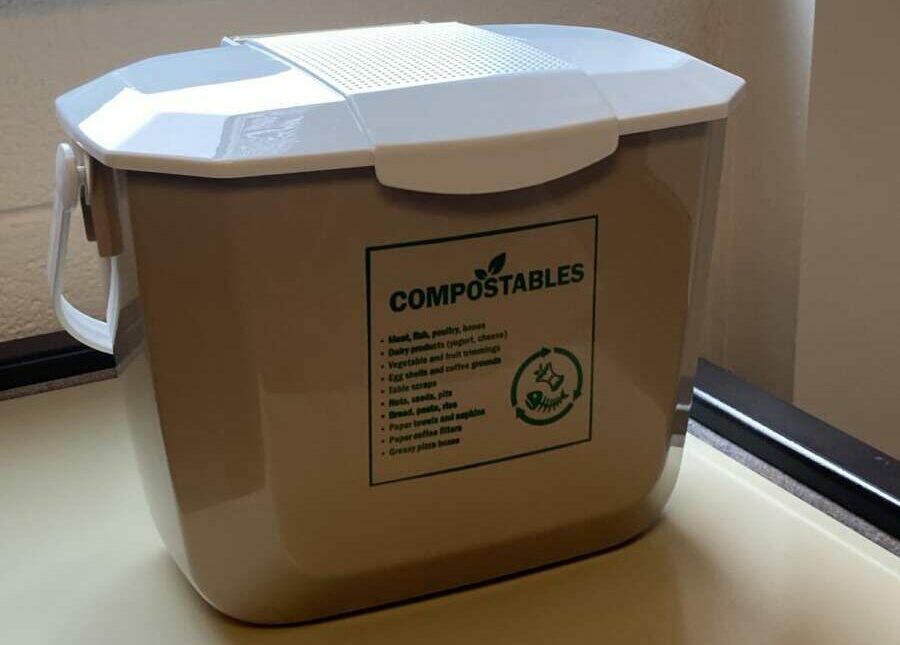
The free food scrap bin Arlington County provided to residents starting September 2021 (file photo)

Since the initiative launched, he said, more than 100 cubic yards of finished compost has returned to Arlington for residents to pick up — similar to the county’s free mulch program. More will be available “in the next few weeks,” with details forthcoming on DES’s social media account.

The county’s curbside pickup is not an option for apartment dwellers, but officials encourage residents to discuss food scrap collection with their apartment or condo management.

For now, they can drop off their food scraps at the Trades Center in Shirlington, at local farmers markets and at the MOM’s Organic Market near Courthouse.

Based on current waste stream data, staff and a public advisory committee are working on a new, state-mandated Solid Waste Management Plan for the county, to be released in 2024, he said.


APS Appoints New DEI Chief — “The School Board appointed Dr. Jason Ottley as the new Chief Diversity, Equity and Inclusion Officer at its Oct. 28 School Board meeting. Dr. Ottley has been serving as Interim Chief Diversity, Equity, and Inclusion Officer since Sept. 1.” [Arlington Public Schools]

Ed Center Project Taking Longer — “The firm that has been overseeing construction at the former Arlington Education Center will get another funding bump, as the project lingers longer than expected and requires more oversight. School Board members on Oct. 28 were slated to be briefed on the plan to provide another $277,083 to McDonough Bolyard Peck, which is serving as construction manager adviser on the project. Final approval of the funding is slated for November.” [Sun Gazette]

Time to Compost Your Pumpkins — From Arlington’s Dept. of Environmental Services: “Reincarnation is real. Toss rotting pumpkins in the green curbside cart and they’ll come back to life as nutritious compost.” [Twitter]

Fewer Day Laborers at Shirlington Site — “The users, who live mostly on Columbia Pike and Alexandria, have shrunk to 10-20. ‘The outdoor site is no longer there, and it’s only a matter of time before jobs disappear from there,’ Tobar said.” [Falls Church News-Press]

ANC to Recreate 1921 Procession — “Arlington National Cemetery said Wednesday that it will host a public memorial procession and military flyover on Nov. 11 in honor of the 100th anniversary of the Tomb of Unknowns. The procession, which visitors can observe, will begin at the main entrance to the cemetery on Memorial Avenue near the welcome center.” [Washington Post]

Honor for Wakefield Driving Teacher — “The Virginia Association for Driver Education and Traffic Safety has named Wakefield High School’s Tony Bentley the Behind the Wheel Teacher of the Year. The announcement was made at the state meeting, held online on Oct. 1, which featured 140 driver-education teachers and representatives from the Virginia Department of Education.” [Sun Gazette]

Staff of Rosslyn-Based Politico Unionizes — “The news staffs of Politico and E&E News went public Friday with the news that that they have formed a union. Around 80 percent of the newsrooms’ combined staffs are on board… Politico is based in Virginia, a right-to-work state, so employees will likely have the choice of whether or not to join if the union drive is successful.” [Washingtonian]

It’s Monday, Nov. 1 — The first day of November will be sunny, with a high near 60. Northwest wind 7 to 11 mph. Sunrise at 7:35 a.m. and sunset at 6:07 p.m. Tomorrow there will be a chance of showers. Mostly cloudy, with a high near 53.


Major Metro Delays — “Following an investigation into the derailment of a Blue Line train, the Washington Metrorail Safety Commission has ordered Metro to put roughly 60% of its rail fleet ‘out of service’ starting Monday. This will bring the total amount of Metro cars available to 40 and shift train service to departures every 30 minutes on all lines.” The delays may stretch beyond today as the 7000 series railcars are inspected. [WTOP, Twitter, Twitter]

County Board Roundup — “The Arlington County Board took action at its October meeting to ensure the safety of its youngest residents and secure quality housing. It also took steps to plan for Arlington’s priorities of housing and land use, transportation, sustainability efforts and more in the 2022 General Assembly legislative session.” [Arlington County]

Composting Program Profiled — “Erik Grabowsky is painfully aware that each time he chucks an overripe avocado, he’s not only lost a dollar; he’s also adding to the roughly 3,000 to 6,000 tons of food waste that residents in Arlington County, Virginia, generate every year. Most of it ends up in a nearby landfill. But Grabowsky, chief of the county’s solid waste bureau, is betting on a new residential composting program to change that.” [Bloomberg]

ACPD Latino Liaison — “ACPD is announcing the appointment of Cpl. Montoya as our first Latino Liaison Officer. He will work proactively with the Spanish-speaking community to build trust and confidence, share information, and conduct proactive engagement.” [ACPD, YouTube, Twitter]

Beyer Seeking Interns — From Rep. Don Beyer: “My office is now accepting applications for paid congressional internships.” [Twitter, Rep. Don Beyer]

Alexandria Police: Don’t Run Us Over — “Public Service Announcement: We recently have had two officers struck by inattentive motorists, so we are asking all who visit, work, and live in Alexandria to take a moment to understand Virginia’s ‘Move Over’ law and ensure you are following it.” [Twitter]

Outlook: Sunny, with a high near 66 today (Monday). Northwest wind 8 to 14 mph, with gusts as high as 26 mph. Sunset at 6:25 p.m. Tomorrow it will be sunny, with a high near 71 and sunrise at 7:22 a.m.


We’re now in week two of food scrap collection in Arlington.

If you receive Arlington County’s residential trash collection service, then you can now place compostable items in your green organics cart instead of the trash. Earlier this summer the county distributed a countertop caddy and compostable bags to residential collection customers as a way to collect food scraps in the home.

(Apartment and condo residents who receive private collection service can drop off food scraps at designated locations.)

Examples of items that can be composted include:

  • Vegetables and fruits
  • Meats, including bones, and old meat grease (sopped up with a paper towel)
  • Dairy products and eggshells
  • Breads
  • Coffee grounds, paper coffee liners and tea leaves (but not tea bags)

Food and beverage containers that are marked as compostable, some of which actually contain a plastic lining, should be kept out and placed in the trash instead, officials previously said.

For those who still have questions about how to best go about collecting and disposing of food scraps, a dedicated county web page has answers and a new county-produced video, below, also offers tips. Among them: place a paper towel at the bottom of the bag to soak up liquids, and be sure to wash the caddy with soap and water regularly.