

A record number of fifth graders from Germany have come to Arlington this year through the county’s sister city program.

Students, parents and civic leaders from the city of Aachen arrived in the United States on Oct. 8 and will stay through Oct. 16. They are being hosted by Arlington families representing 16 public and four private schools, in a quarter-century collaboration sponsored by the Arlington Sister City Association.

“There have been so many people who have rallied for this program,” said Emily Lyons, who is coordinating the visit.

She spoke during a welcome breakfast held on Saturday at Alice West Fleet Elementary School. It was part of a lengthy list of activities planned for the German families during their week-long stay.

They, in turn, will welcome their Arlington families to their city next spring.

“I’m happy to receive you all in Aachen,” said the city’s mayor-elect, Michael Ziemons, who was part of the contingent.

Speaking with County Board members Susan Cunningham and JD Spain, Sr., at the breakfast, Ziemons noted that he had met County Board Chair Takis Karantonis just the past week. Karantonis was in Aachen as part of a separate Sister Cities exchange.

“He explained to me all the systems you have here,” said the incoming mayor, who will preside over a city council of 58 members compared to Arlington’s five County Board members.

Ziemons said that Aachen’s location at the crossroads of Europe makes it a multicultural community.

“This is what makes our town special,” he said, promoting student exchanges as one way to further “warm, warm friendships.”

The exchange program has an upper limit of 50 students per year. Lyons said organizers believe this is the first time that number has been reached.

Many of the German families are fluent in English. To aid in communication and as a courtesy to their guests, some Arlington youth received rudimentary German-language instruction prior to the start of the exchange.

Aachen’s history stretches back more than 1,200 years. In 800, the German ruler who is remembered in history as Charlemagne — “Charles the Great” — was crowned in Aachen Cathedral on his way to creating one of Europe’s earliest superpowers.

At its peak, what came to be known as the Holy Roman Empire included all of present-day France, Germany and Italy plus parts of modern-day Belgium, the Netherlands, Austria, Spain and Switzerland. It would last, in various forms, for more than 1,000 years, with Aachen remaining its historical center.

The cathedral has survived and is a UNESCO World Heritage Site today. Its 1.3 million annual visitors have the opportunity to view the throne where Charlemagne’s coronation took place.

Cunningham noted that her family participated in the exchange in 2018. Plans for doing it a second time with her younger daughter were not possible due to the impact of Covid, which derailed in-person exchanges for several years.

“I’m glad to see you all back at full capacity,” she said. “Have a great time.”

Spain said that he and his family had lived in Stuttgart, Germany, during military service in the 1990s.

“I have a really fond affinity for all things German,” he told the crowd. “Let’s keep this going.”

Lyons noted that bonds created with student exchanges can last a lifetime. She participated in a similar event in high school, and “I’m still friends with people I met,” she said.

The Aachen students joined host families at the Yorktown High School homecoming football game and were slated to tour Nats Stadium. They also will spend tomorrow (Wednesday) at their host schools.

While the fifth-graders are visiting, a group of Aachen high-school students is spending two weeks in the county as part of another Sister Cities exchange.

With about 260,000 residents, Aachen is Germany’s westernmost and 27th largest city, and is slightly more populous than Arlington. Located on its country’s western border, the city is adjacent to both Belgium and the Netherlands.

Aachen is one of Arlington’s five Sister City relationships, along with Reims, France; Ivano-Frankivsk, Ukraine; San Miguel, El Salvador; and Coyoacán, Mexico. The Coyoacán relationship currently is in emeritus status, but efforts are being made to bring it back to life.

Arlington Public Schools leaders hope that a new “adopt-a-school” partnership model will increase schools’ formal partnerships with business and civic groups.

Noting that 30% of Arlington’s public schools have no such partnerships, APS staff outlined plans to increase opportunities for volunteerism at a School Board meeting yesterday (Thursday). They focused primarily on relationships with the business community.

Partnerships “benefit above and beyond the work we can do within our four walls,” Superintendent Francisco Durán told School Board members.

“We need support, and we’re getting that support,” he said.

There is always room for improvement, school officials acknowledged.

“The majority of schools … reported they would benefit from dedicated partners to support school facilities needs, beautification and mentoring or after-school programming, particularly for low-income students and families,” school officials learned in a survey of principals presented to School Board members.

About 60% of respondents reported being “very interested” in the adopt-a-school initiative.

Currently, businesses, nonprofits, civic groups, faith-based organizations and institutions of higher learning work with individual schools, sometimes on an ad hoc basis. The new effort aims to formalize the partnership process.

At the School Board meeting, Board member Miranda Turner said she hopes new partnerships and volunteers will also spur creative thinking to “help us take ideas and see if they are worth running with, and then running with them more quickly.”

“We certainly have lots of highly educated people who want to contribute,” she said of the local community.

The adopt-a-school effort is among several proposals coming out of a working group set up by APS in October 2024, addressing concerns that not enough is being done to connect schools with those wanting to offer support.

According to school leadership, some of the concerns raised by members of the working group were:

  • Unclear definitions on how to engage and who to contact
  • Inconsistent screening requirements for volunteers and partners
  • A lack of clarity on how to donate money or supplies
  • The need for a standardized process and agreement forms
  • Needing improvement on school and system-wide needs to guide potential donors/partners
  • The lack of a clear measurement process and rubric for gauging partnerships’ success

Nearly all APS schools — 95% — have successfully recruited volunteers that support students and teachers, according to county data.

A survey of 38 schools found that 89% use volunteers to support events; 68% for beautification and facilities upgrades; 49% for classroom support; and 32% for mentoring and tutoring.

Currently, the school system has more than 11,700 active volunteers in its database, with more than 4,000 volunteer applications approved during the 2024-25 school year. Of those in the database, only about 15% volunteer on a recurring basis, based on sign-ins to the APS volunteer-management software.

“That’s the big gap we are working toward” closing, said Catherine Ashby, the school system’s director of school and community relations.

Ashby said restructuring the school system’s administration of volunteer programs will assist efforts.

“Our team is really excited about this work,” she said.

Volunteers seem eager to help when called upon for specific initiatives. More than 190 signed up in two weeks after the school system announced a new pilot program — called Readers Rise — being launched at Barrett, Long Branch and Hoffman-Boston elementary schools.

At the meeting, School Board Chair Bethany Zecher Sutton praised all volunteer efforts as benefiting the overall learning environment.

“We’re grateful for all of the volunteers and all of the partners and all that goes into enriching student learning,” she said.


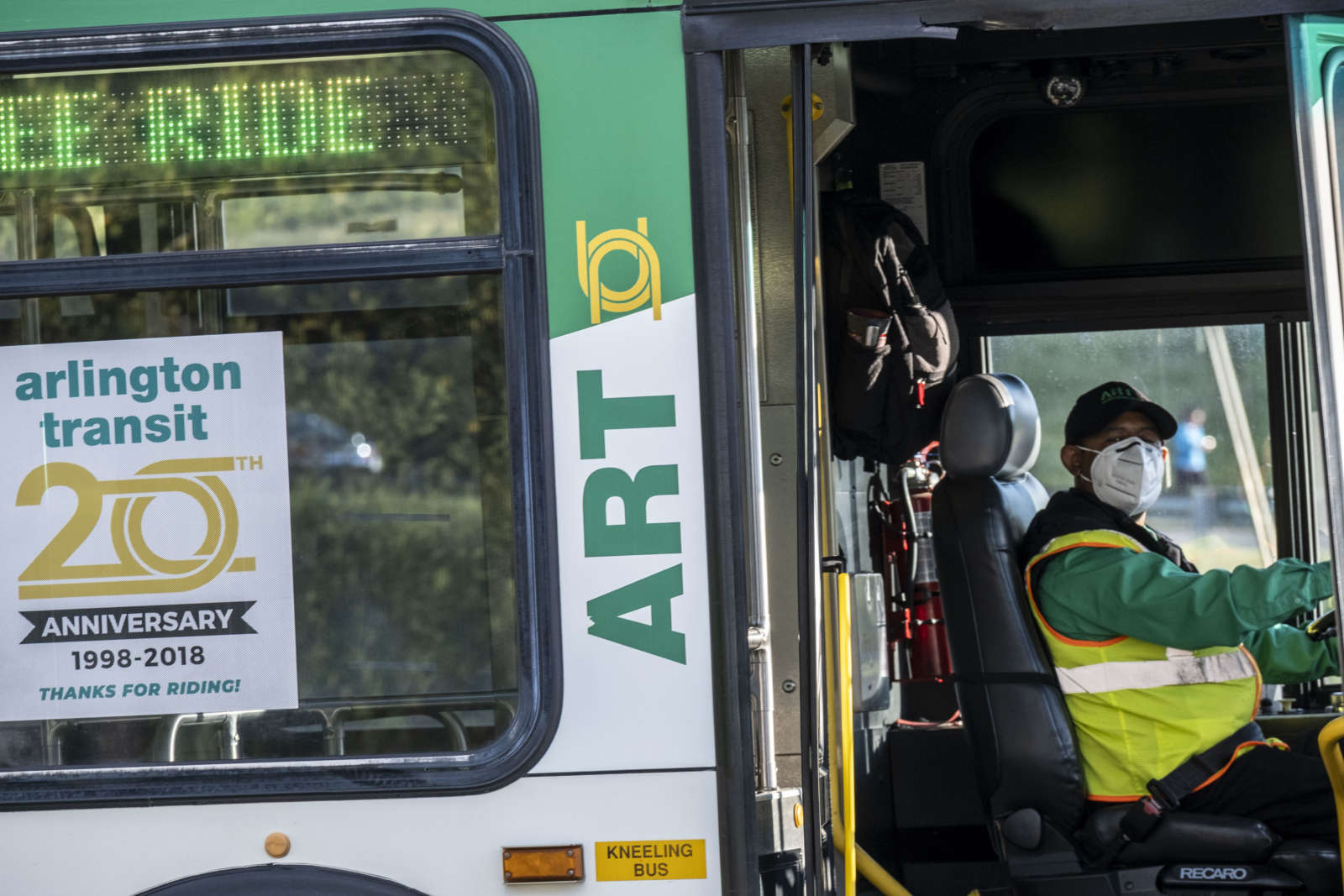
An ART bus and driver (staff photo by Jay Westcott)

(Updated at 3:20 p.m.) Starting this month, Arlington students can now get free Metrobus rides throughout Arlington.

This builds on a program in place since 2022 allowing students with iRide SmarTrip card to ride Arlington Transit (ART) buses for free. Students who live in Arlington and are enrolled in kindergarten through 12th grade can obtain these cards from Commuter Stores in Arlington or, if they are APS students, through their schools.

Now, students with these cards will have free access to Metrobus’ greater range of service and hours, per a county press release. They will be able to travel to destinations that ART routes do not reach, including some schools, such as Swanson Middle School.

“APS is excited about the expansion of the Student iRide Fare Free Program to include Metrobus service within Arlington,” APS Director of Facilities and Operations Cathy Lin said in a statement. “This opportunity expands access for our students to travel in Arlington on public transit buses.”

The new program also responds to an increase in student ridership that the county ties to free ART travel for students. Arlington County reported that student ridership increased from 61,060 riders between January and September 2022 to 108,365 during the same period in 2023.

“We are encouraged to see that student ridership on ART bus has increased since the rollout of the student fare free program in 2022,” Dept. of Environmental Services spokeswoman Claudia Pors told ARLnow. “Our hope is that by expanding iRide to Metrobus, more young people will become comfortable and familiar using public transportation to get around Arlington safely and sustainably.”

Pors says there are currently no plans to expand the program to include Metrorail. Students can still access the Metro with an iRide SmarTrip card but they will have to pay the full fare amount.

The Arlington County Board approved the agreement with WMATA and the county in July 2023, the county press release says. The county allocated $360,000 in the 2024 fiscal year budget to reimburse Metrobus for the student rides.

Arlington County has taken other steps to make bus rides fare-free, including its free rush hour service on ART buses. Initially set to expire in December, the program was extended through this month.